How to Write a Product Requirements Document That Generates Release Notes


If you walked into a product organization and told them they were going to play a high-stakes game of telephone with their customers every two weeks, they would ask you to leave.
But that is exactly what happens during a software release. The product manager writes a PRD to tell engineering what to build. Engineering builds it. Then, right before launch, someone (often a technical writer or product marketer) has to look at the Jira tickets, the pull requests, and the original PRD, and try to translate all of that back into something a customer can understand.
Information gets lost. Marketing rewrites it wrong. Support doesn't know what changed. The release note, which should be the clearest communication of value the company produces, becomes an archaeological dig through technical debt and forgotten context.
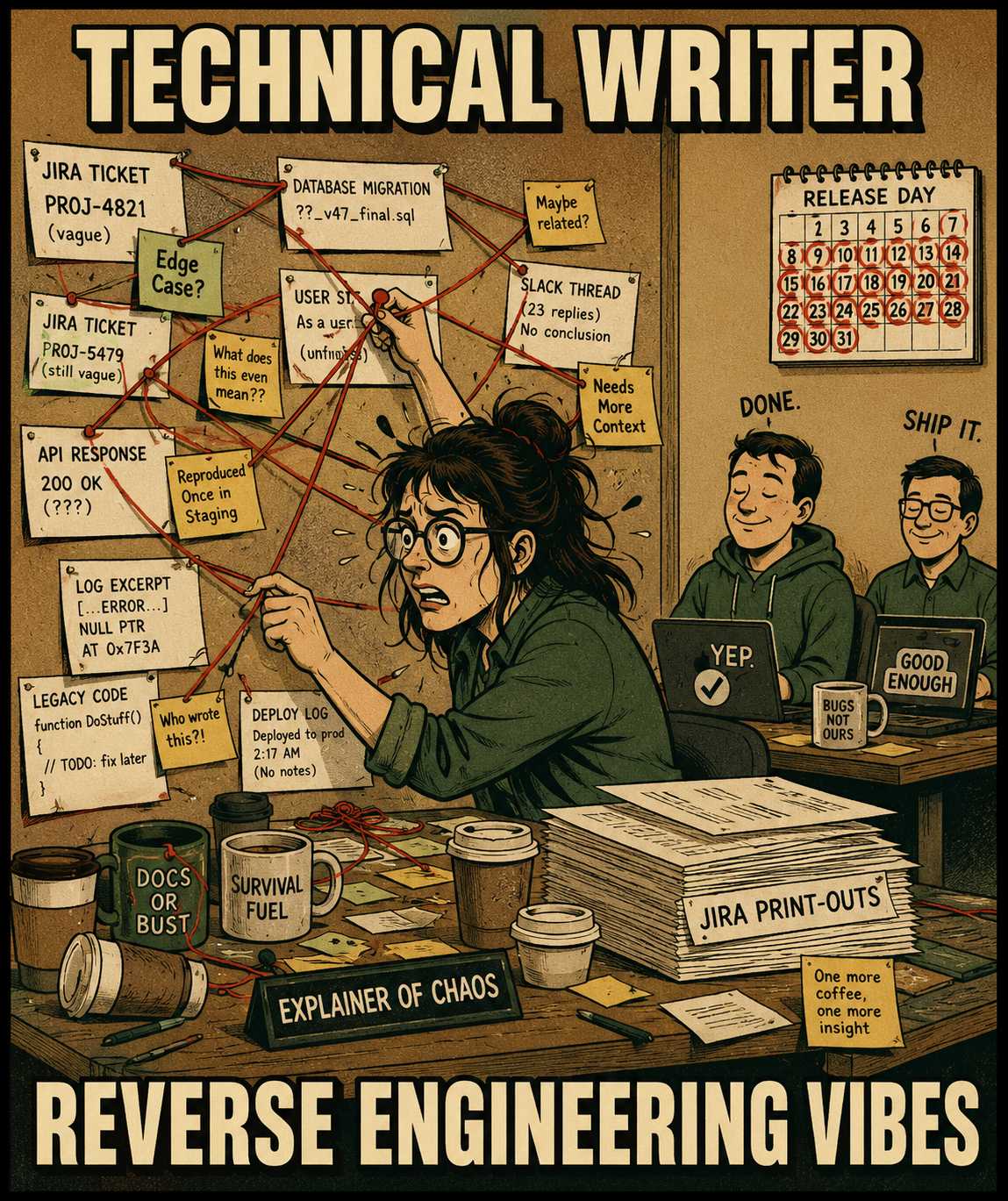
The source material is the problem. PRDs are almost exclusively written as internal instruction manuals, designed to tell engineers what to do rather than to tell customers why it matters. If you want release notes that don't require a separate translation step, you have to write PRDs with external communication in mind from the start.
Anyway. The structural changes required to make a PRD "release-ready" are not complicated, but they are a shift in how product managers think about their audience.
Why Most PRDs Can't Generate Release Notes
Most PRDs fail as source material for release notes because they are entirely implementation-focused. They outline the "what" and the "how" but completely abandon the "why" in terms that a customer would recognize.
A standard PRD might include a requirement like: "Refactor the authentication middleware to support OAuth 2.0 with PKCE extension." That is a perfectly valid instruction for an engineer. But when a technical writer tries to turn that into a release note, they have to reverse-engineer the customer benefit. Is this for security? Is it to allow single sign-on? The PRD doesn't say.
This disconnect is well-documented in the software engineering literature. When design documents serve only as implementation guides, the resulting documentation inevitably falls out of sync with what users actually experience. The design intent gets captured; the user impact doesn't.
A large-scale empirical study of over 32,000 release notes across 1,000 GitHub projects found significant discrepancies between what release note producers include and what users actually want to know. Producers tend to document implementation-level changes. Users want to know about new features and what those features do for them. The gap between those two things is exactly where the game of telephone begins.
Traditional PRDs also rarely distinguish between what changed under the hood and what the user will actually experience. They lack explicit before/after comparisons, making it nearly impossible for someone outside the immediate development team to understand the practical impact of the release. A 2022 mapping study on documentation in continuous software development found that informal, implicit documentation is one of the primary causes of knowledge loss in agile teams, and that knowledge rarely makes it downstream to the people who need it most.
The result compounds with every release cycle. Customers miss features. Sales pitches outdated capabilities. Support triages problems that were already fixed months ago. The engineering effort is real; the customer value is invisible.
What a Release-Ready PRD Actually Looks Like
To extract release notes directly from the source document, you have to bake the customer-benefit framing into the original spec: separating what the engineer needs to build it from what the customer needs to understand it.
The Nielsen Norman Group's research on user-centric language makes the principle concrete: users want to know what a product or feature will do for them, not what it does in technical terms. "Refactored authentication middleware to support OAuth 2.0 with PKCE" is a feature description. "You can now sign in with your Google or Microsoft account" is a user benefit. Both describe the same change. Only one belongs in a release note.
A release-ready PRD includes three things that most PRDs omit.
First, a user-facing impact statement for every feature: one to three sentences describing what the feature does and why the user should care, written in plain language, in the present tense, as if addressing the customer directly. This is what the release note pulls from.
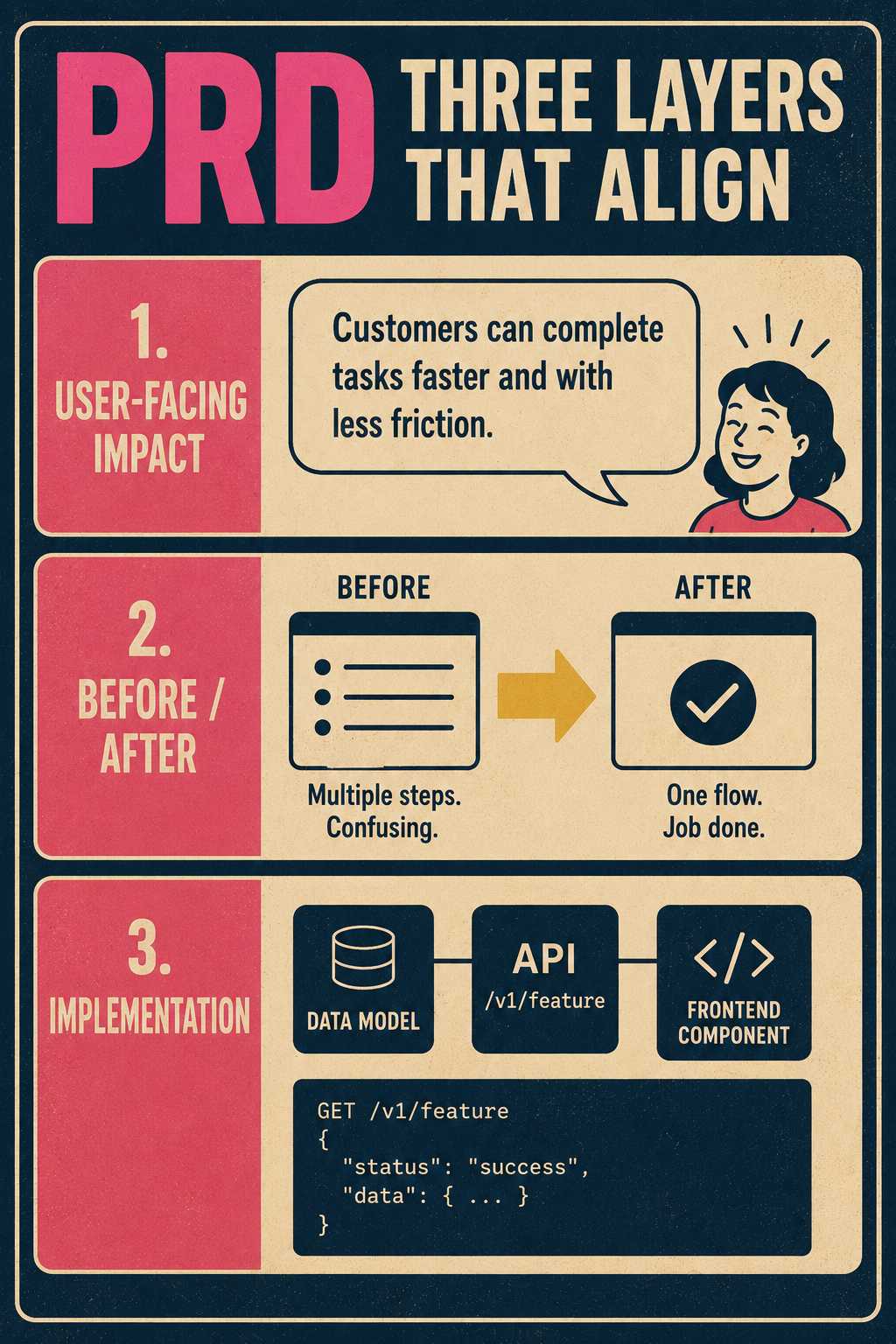
Second, an explicit before/after comparison. "Previously, users had to manually export data to a CSV. Now, they can sync directly to their CRM." This gives the release note writer exactly what they need without having to reverse-engineer it from a technical spec.
Third, a clean separation between the user-facing layer and the implementation layer. The database schema changes, the API endpoints, the architectural decisions: those stay internal. The customer-facing summary sits at the top of each feature section, clearly labeled, clearly scoped.
Structured authoring frameworks like DITA (Darwin Information Typing Architecture) have long advocated for exactly this: modular, audience-aware content that can be filtered and reused across output formats. Write the content once, in a structure that supports multiple audiences, and let the structure do the routing.
The Part Everyone Gets Wrong
I'm sympathetic to the argument that this adds overhead for product managers. They are used to writing for engineering, and adding a customer-facing layer takes more time up front.
But the overhead is front-loaded, and the savings are distributed across every downstream team that touches the release. The Reforge analysis of how PRDs actually function in modern product teams makes this point clearly: a PRD that only serves engineering fails to unlock the cross-functional alignment that makes shipping faster and less chaotic.
The validation test is simple. If someone outside your product team (a sales rep, a customer support agent, a new hire in marketing) can read the user-facing sections of your PRD and understand exactly what shipped without asking follow-up questions, it is structured correctly. If they can't, the translation step hasn't been eliminated; it's just been deferred.
Research on release note production and usage confirms that the most common structural problems in release notes (duplication, inconsistency, vague descriptions) trace back to the source artifacts. The release note is only as good as the documentation it was built from.
There is also a knowledge preservation argument. Engineering teams that rely on implicit, informal documentation consistently lose context when features ship. The rationale behind a decision, the user problem it was solving, the before/after state: these things exist in someone's head during the sprint and nowhere else by launch day. A PRD that captures user impact explicitly also preserves institutional knowledge.
Anyway. The ACM research on structured authoring in docs-as-code environments describes this as the core challenge of modern documentation: getting the right content into the right structure at the moment it is created, rather than trying to retrofit structure onto content that was never designed for reuse.
Where This Approach Breaks Down
I don't know if this works for every single product update. There are limits.
Highly technical products with no user-facing UI, deeply internal tooling, or changes that only matter to engineers (a database migration that improves query speed but doesn't change functionality) will always be difficult to frame in customer-centric terms. In those cases, the PRD may still need a separate translation step. But even then, starting with a clear statement of impact ("Queries now run 40% faster on datasets larger than 10GB") makes that translation much shorter.
Recent work on LLM-powered release note generation, including SmartNote, presented at FSE 2025, shows that automated systems can generate structured, audience-aware release notes from code commits and pull request data. But those systems perform best when the source material already contains clear, categorized descriptions of what changed and why. The AI formats and aggregates well; it cannot invent customer-benefit framing that was never written down.
Tom Johnson's work on using file diffs for release notes makes a related point from the technical writer's perspective: the information is often in the code, but extracting it still requires someone who understands what the user cares about. Structure in the source document dramatically reduces that extraction cost.
The Workflow Shift
This is a workflow shift. Product managers are used to writing for engineering. Adding a customer-facing layer takes more time up front. But it eliminates the game of telephone at launch, and it makes release notes accurate by default because they're coming from the same source of truth as the build.
When your PRD is structured to describe user impact clearly, the downstream documentation process changes. With Doc Holiday, a writer pulls directly from the structured PRD and the underlying code to draft release notes, changelogs, and API documentation. AI accelerates that drafting step; the writer decides what ships. Because the source material already contains explicit user-impact language, the writer is making editorial decisions rather than doing archaeology. The PRD becomes the foundation. The writer stays in control. No translation loss, no last-minute scrambles.