Why Your Documentation Always Falls Behind Releases


Every quarter, the same conversation happens. Someone notices the docs are three releases behind. There's a brief flurry of concern, a vague commitment to "do better," and then the next sprint starts and nothing changes. The documentation gap widens again.
This keeps happening because the documentation process most companies still use was designed for a different era. It assumes that releases are infrequent enough that a writer can finish one set of docs before the next feature ships. That assumption stopped being true for most software teams a decade ago, and the gap between how fast engineering moves and how documentation is managed has been widening ever since.
The problem is structural. Here is what the structure actually looks like.
The Pipeline Was Never Built for This
DORA's research classifies deployment frequency as one of the core throughput metrics for software delivery. Elite-performing teams, according to the 2023 Accelerate State of DevOps Report, deploy on demand, often multiple times per day. The same report found that high-quality documentation leads to 25% higher team performance, which makes the irony particularly sharp: the teams moving fastest are the ones whose documentation processes are most likely to fall apart.
The documentation model most companies still use is a manual write-review-publish cycle. A technical writer gets a feature brief, interviews an engineer, drafts the content, sends it for review, and publishes it. That cycle takes days at minimum, often weeks. When a team is shipping code daily, the cycle is already behind before it starts.
A 2022 mapping study on documentation in Continuous Software Development, published in Information and Software Technology, identified this as the defining challenge: documentation is out-of-sync with the software, and the short-term focus of fast-moving teams means it stays that way. The study found that in Agile, Lean, and DevOps environments, documentation is routinely deprioritized, resulting in artifacts that are incomplete, outdated, or entirely neglected after their initial creation.
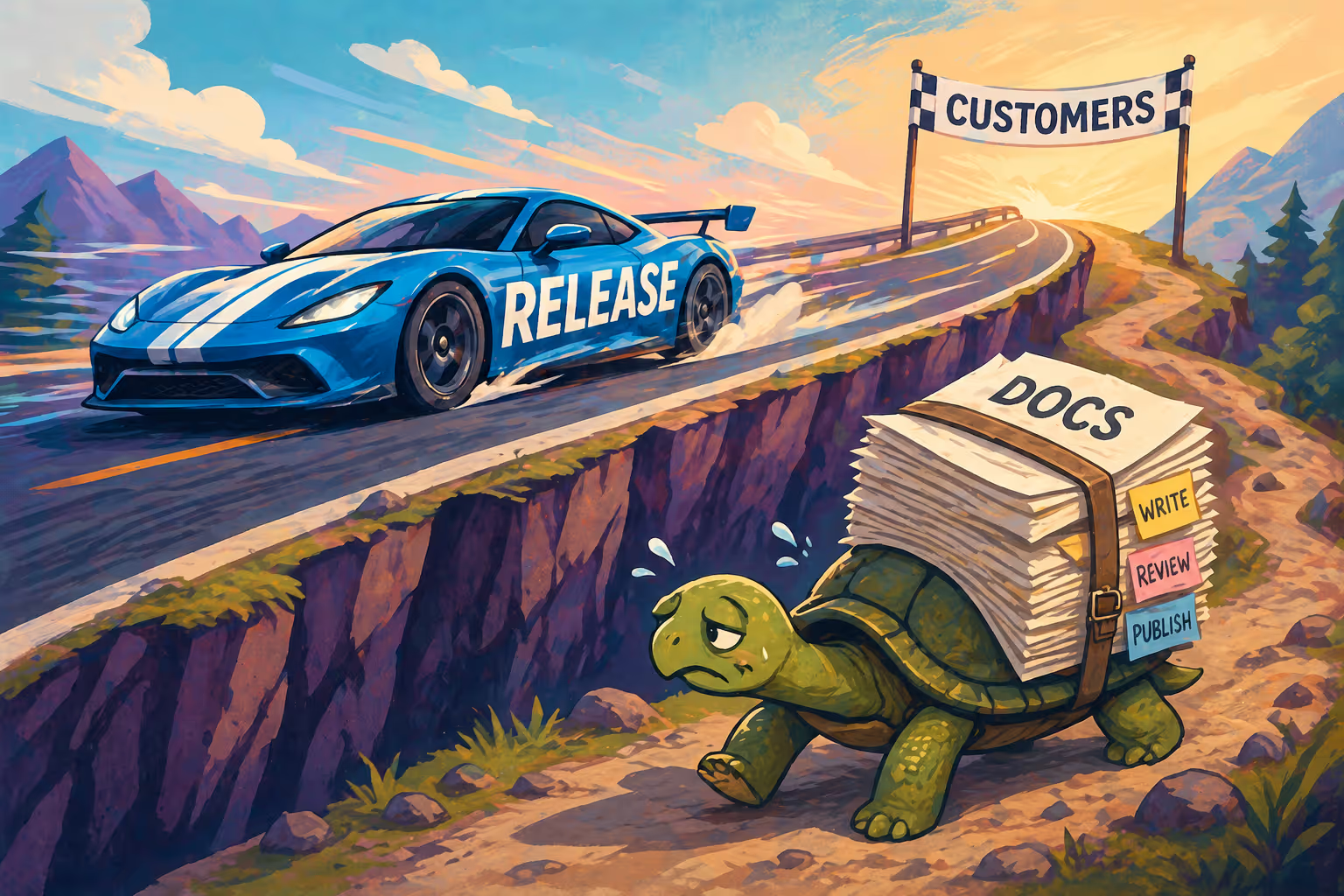
The speed problem is real, but it is not the only problem.
Writers Are Not in the Room Where It Happens
Technical writers are typically brought in after the engineering work is finished. By that point, the engineers who built the feature have moved on to the next sprint. The Slack threads where the design decisions were debated have scrolled into history. The pull request comments that explained why a particular API behaves the way it does are buried under hundreds of subsequent commits.
Tom Johnson, a technical writer with over a decade of experience in large software organizations, documented this dynamic in detail: documentation tasks are rarely assigned story points or grouped into sprint planning alongside code changes, and most project managers will not hold up a release for missing documentation. The result is that writers are perpetually reconstructing the story after the fact, working from stale context and hoping an engineer has time to answer their questions.
This is not a people problem. Engineers are not being uncooperative. Writers are not being slow. The process gives writers no access to the systems where release decisions are actually made, so they are always working from incomplete information.
A large-scale empirical study of software documentation issues, published at ICSE 2019 and drawing on 878 documentation-related artifacts from mailing lists, Stack Overflow, issue repositories, and pull requests, found that the most common documentation problems are failures of up-to-dateness and correctness. Those are not failures of effort. They are failures of access and timing.
The knowledge transfer problem gets worse when people leave. Research on turnover-induced knowledge loss by Martin Robillard at McGill University found that when contributors leave a software project, remaining team members are forced to reverse-engineer systems and search for context that was never formally recorded. The knowledge that should have been in the documentation was never written down, and now it is gone.
The Debt Compounds Every Quarter
For teams that eliminated or never hired technical writers, the situation tends to be worse in a different way. Engineers write documentation sporadically, with no structured review process, and existing content rarely gets updated when features change. The documentation that exists is a snapshot of the product at some earlier point in time, and no one is sure exactly which point.
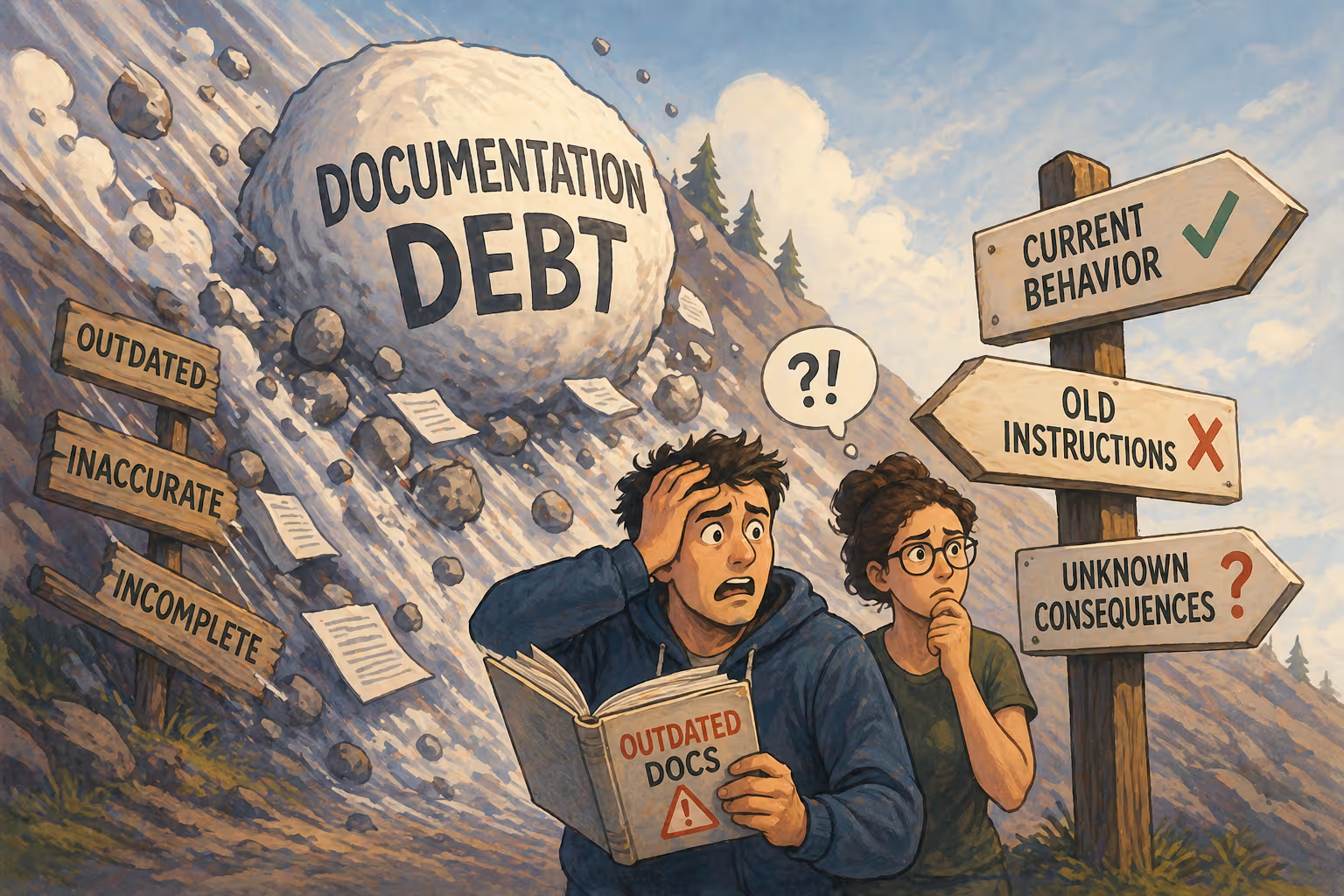
This is documentation debt, and it behaves like financial debt: the longer you carry it, the more it costs. As the codebase evolves, outdated documentation actively misleads developers and users. The Stack Overflow 2024 Developer Survey analysis found that developers spend more than 30 minutes a day searching for solutions to technical problems, a significant portion of which is caused by documentation that is incomplete or wrong. Stripe's Developer Coefficient report put the broader maintenance burden at over 17 hours per developer per week.
Legacy documentation piles up and no one has time to reconcile it with new features. The gap widens every quarter. The 2023 DORA report's finding that documentation quality predicts team performance is not a surprise to anyone who has watched a new engineer spend two days trying to understand a system because the docs describe a version that no longer exists.
The Two Options
There are really only two ways to close the gap between documentation and releases.
The first is to slow down the release cadence until the documentation process can catch up. No competitive software team will do this. The competitive dynamics of software markets make velocity too important to sacrifice.
The second is to automate the parts of the documentation pipeline that do not require human judgment. This means generating documentation directly from the engineering systems where decisions are already being recorded, rather than asking humans to reconstruct those decisions after the fact.
The New Stack noted in 2019 that continuous documentation should be treated the same way teams treat continuous integration: automated, triggered by code changes, and part of the delivery pipeline rather than an afterthought. The observation was correct then and is more urgent now.
This is the operational model that Doc Holiday is built around. It connects to the engineering systems where work is already happening (GitHub pull requests, Jira tickets, product specs, Slack) and generates release notes, API references, and changelogs from those sources automatically, which your team then reviews and refines. A writer checks the output for accuracy, handles edge cases, and ensures the voice is right. The generation happens in lockstep with the release. The writer is not starting from scratch; they are validating and managing a first draft that already has the right context.
That shift, from writing to validating, is what keeps documentation current without rebuilding a large team or asking engineers to slow down.