What is a Release Communication Strategy?


If you run a software team, you know the feeling. You spend three months building a feature that customers have been begging for. The roadmap was tight, the sprints were clean, the QA was thorough. You deploy to production on a Tuesday afternoon, and nothing breaks. It is a perfect launch.
Two weeks later, your sales team loses a deal because they told a prospect the platform couldn't do the exact thing you just built. Your support queue is full of tickets asking for workarounds to bugs you fixed in the release. A major account churns, citing a lack of innovation.
The code shipped. The product improved. But the reality of the product didn't change for anyone who actually uses it or sells it.
That gap — the space between shipping a change and the relevant people knowing about it — is what a release communication strategy is designed to close. It is the set of structural decisions a team makes about how product changes are announced, documented, and explained to users, stakeholders, and internal teams. Not a single document. Not a template. A set of decisions, made in advance, that govern how information moves when software changes.
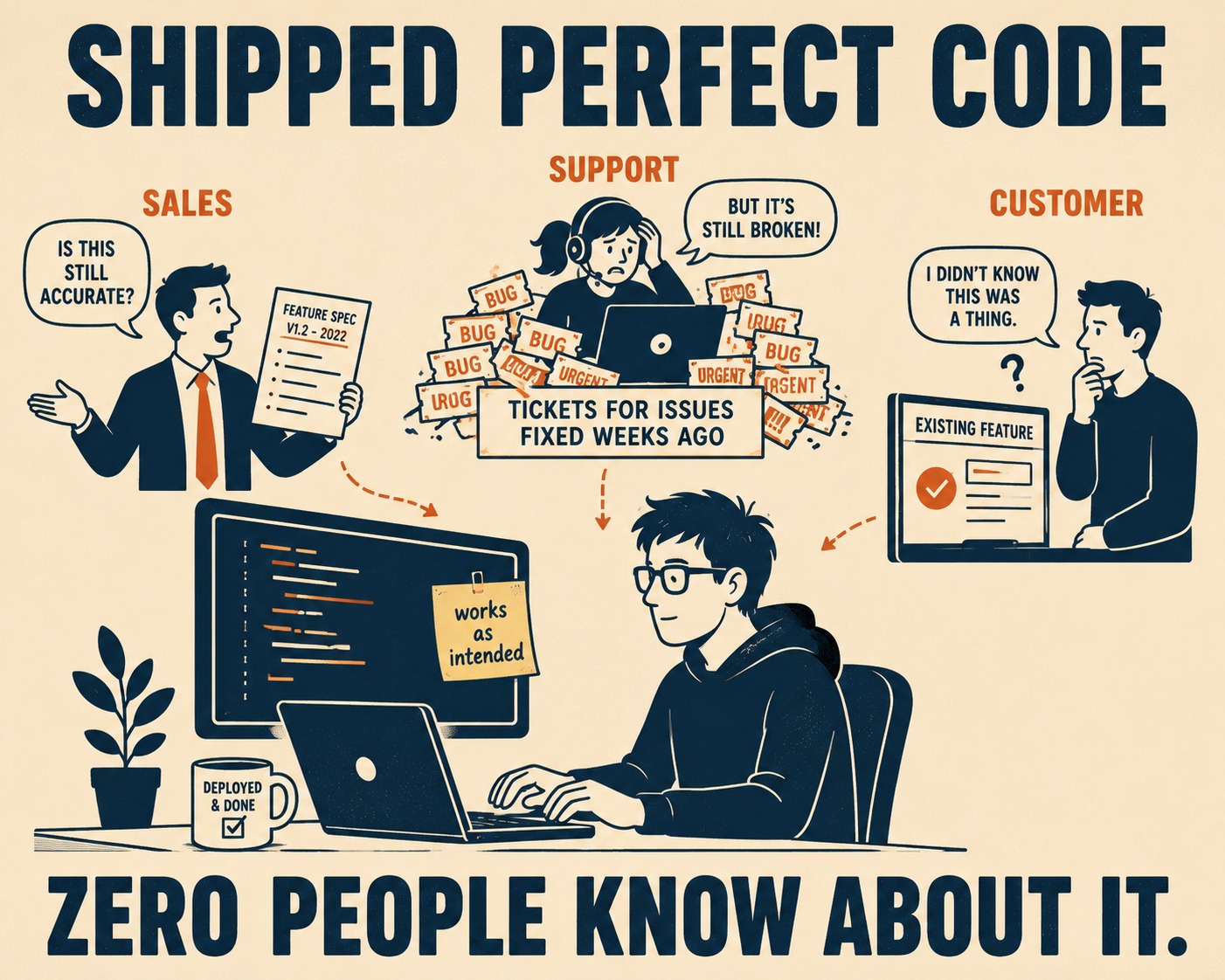
Anyway. We are very good at building deployment pipelines for code, and very bad at building deployment pipelines for context.
What Breaks Without One
When a release communication strategy doesn't exist, the failure modes are predictable.
Customers don't know what you built, so they don't use it. This is the most expensive failure. Engineering effort that doesn't result in adoption is wasted capital. A 2020 study published in IEEE Transactions on Software Engineering analyzed 32,425 release notes across 1,000 GitHub projects and found that release notes are one of the most important artifacts for communicating change — and that there are significant perception gaps between the people who produce them and the people who use them. The producers think they're communicating clearly. The users think they're getting noise.
Internal teams operate on stale information. Sales reps pitch yesterday's product. Support agents triage problems that were solved three days ago. Product managers assume a feature failed because the metrics are flat, when in reality, the feature just lacked distribution. LaunchNotes put it plainly: when the release process doesn't include a path to internal stakeholders, those stakeholders will always be working from stale information — and stale information in a sales conversation is indistinguishable from a product that isn't improving.
The root cause is structural. Product development has dedicated tooling, dedicated headcount, and rigorous processes. Communication is treated as a handoff step at the end of the sprint: a quick changelog entry, a Slack message thrown over the wall. Microsoft's Engineering Fundamentals Playbook lists "afterthought" as one of the canonical documentation failure modes — key documents created last minute, just before the end of a project, forgetting that they also help the team while working on the project.
A strategy means treating the communication of the release as a first-class output of the release itself.
The Decisions a Strategy Actually Requires
A release communication strategy isn't a checklist. It is a set of decisions about audience, timing, and channels — and the decisions compound on each other.
The first decision is audience segmentation. Not everyone needs to know everything, and the same information framed the same way for all four audiences serves none of them. A 2024 practitioner survey found that project managers, developers, and support teams want fundamentally different things from the same release document: project managers wanted new features, developers wanted breaking changes and migration paths, support teams wanted known issues and workarounds. Keep a Changelog has been making this point since 2014: changelogs are for humans, not machines — and "humans" is not a monolithic category.
The second decision is timing and sequencing. When does the internal team find out? When do beta users find out? When does the public find out? ITIL 4's Release Management practice explicitly includes a communication plan as a required component of the release schedule — not because enterprise frameworks are always worth emulating, but because the sequencing problem is real at every scale. Support and sales need to be equipped to handle questions before users know to ask them.
The third decision is ownership. Who writes the external announcement? Who writes the internal briefing? Who validates that the technical content is accurate? The 2020 IEEE study found that most release notes are produced by a single main contributor who aggregates inputs from multiple team members — which means the quality of the output depends heavily on whether that coordination is designed or improvised. Most teams improvise it.
The fourth decision is the feedback loop. Communication is not a broadcast; it is a circuit. When a customer requests a feature and you build it six months later, closing that loop is one of the highest-leverage trust-building exercises available. But it requires a system that connects the original request to the eventual release — something most teams haven't built.
These four decisions are not independent. You can't make good timing decisions without knowing your audience. You can't assign ownership without knowing what content each audience needs. The strategy is the set of answers to all four, made in advance, so the team isn't reinventing them under pressure the day before launch.
How the Strategy Changes as the Team Grows

Early-stage startups can run lean. When the company is ten people, the release communication strategy is the founder yelling across the room that the new dashboard is live. That's not a failure of process; it's appropriate to the scale.
As the company grows, that informal system breaks. Growth-stage companies need repeatable systems. They need to ensure that the sales team in a different city knows about the feature the engineering team just shipped. First Round Review's documentation guide describes this transition well: early hires become the heroes of the company, building and shipping, and then as the company grows, they get bombarded with questions because nothing is written down. The fastest way to get answers becomes asking the old guard — which is a vicious cycle that kills velocity.
At the enterprise level, the complexity compounds further. You have compliance requirements, governance, and coordinated rollouts across dozens of teams. The Conventional Commits specification emerged partly to address this: by structuring commit messages with typed prefixes (feat, fix, BREAKING CHANGE), teams create machine-readable metadata that can be used to populate audience-specific documentation automatically. The structure has to exist somewhere upstream of the document for the document to be segmented correctly.
What Good Execution Actually Looks Like
Good execution looks like communication integrated into the development cycle, not bolted onto the end of it.
It means the content is generated from the same source of truth that engineering uses. It means there is clear ownership and validation before anything goes out. It means the structure is consistent enough that users know exactly where to look for breaking changes or new features — and that support teams are briefed before the announcement goes public, not after.
The docs-as-code movement has pushed this direction for years: when documentation lives alongside the codebase, it's more likely to be updated in sync with product changes. The same principle applies to release communication. When the communication workflow is separate from the engineering workflow, it drifts. When it's integrated, it stays current.
The infrastructure problem is real. When teams try to solve it with manual effort — forcing writers to maintain separate versions of a changelog for different audiences — the maintenance burden becomes overwhelming and the quality degrades. The 2020 IEEE study found that developers view the process of writing release notes as tedious and time-consuming, which is one reason automated generation has attracted significant research attention. The friction is not a character flaw; it's a signal that the system is wrong.
The alternative is to treat release communication as a system to be managed, not a document to be typed. If you build the infrastructure to pull context directly from engineering workflows — from commits, pull requests, and issue trackers — you can generate the baseline documentation automatically. A skilled operator then validates, refines, and segments that output for the right audiences. Doc Holiday provides this infrastructure, generating release notes, changelogs, and API references directly from your engineering systems. It gives lean teams the structure to manage release communications at scale, so the gap between shipping code and delivering context finally closes.