How to Maintain a Changelog When AI Writes Half Your Code


It is Friday afternoon and you are looking at the commit history for the week's release. Your team merged forty pull requests. The human engineers wrote thoughtful, if terse, descriptions of what they changed. The autonomous coding agents, however, were prolific. One agent pushed thirty commits to resolve a single issue, ranging from "fix typo" to "refactor auth module." Another agent bundled a database migration with a CSS tweak. A third simply wrote "update files" five times in a row.
You need to tell your users what actually changed in the product. But the commit history is no longer a linear narrative of human intent. It is a fragmented, high-velocity ledger of machine actions.
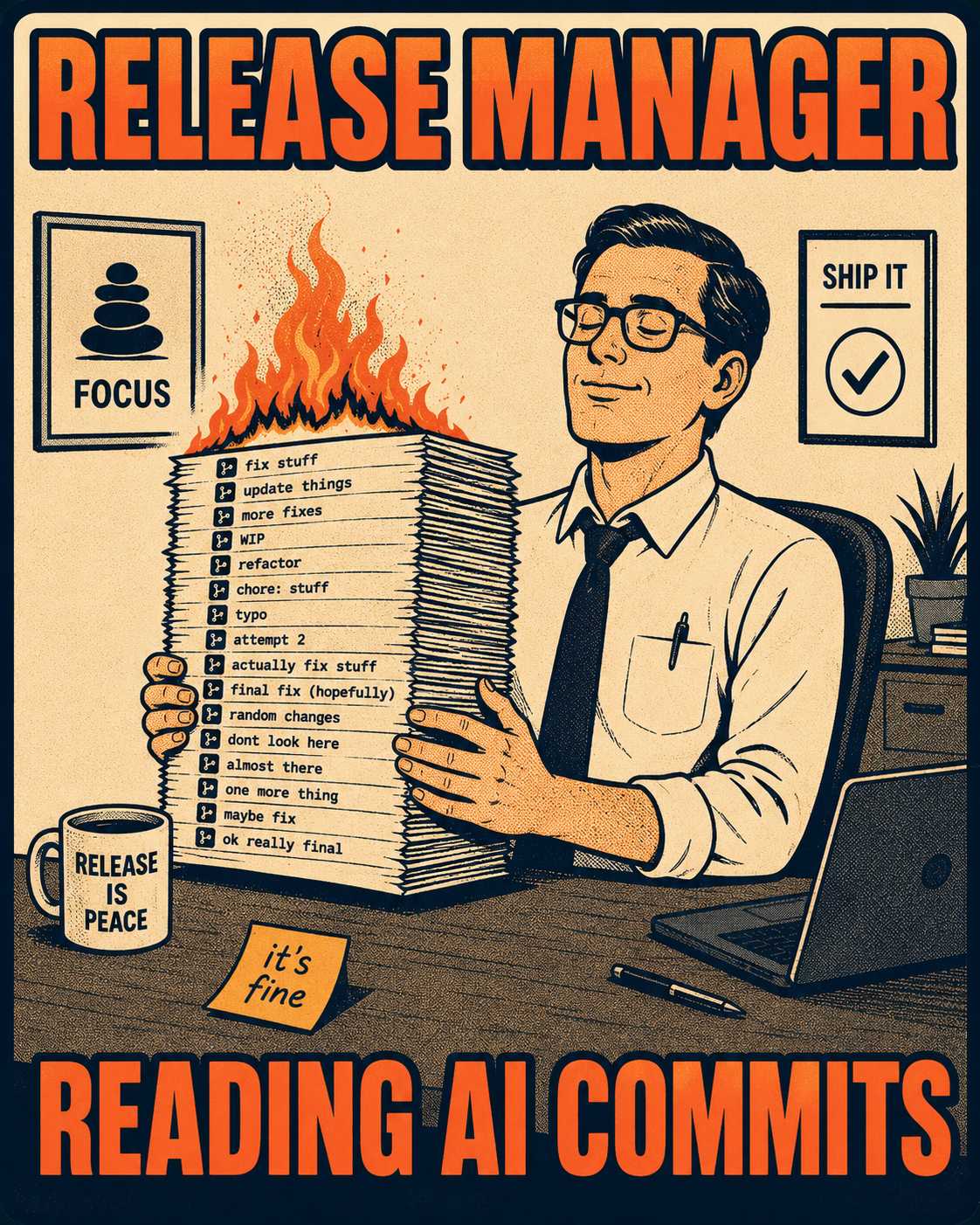
This is the reality of modern software development. When AI agents write a significant portion of your codebase, the traditional changelog workflow breaks down. You can no longer assume that a human will sit down at release time, read through the commit log, and reconstruct a coherent story for your users. The volume is too high and the signal-to-noise ratio is too low.
To maintain a useful changelog in an AI-heavy environment, engineering teams are abandoning manual transcription in favor of structured generation and human governance.
The Narrative Coherence Problem
The traditional approach to release notes assumes that commits tell a story. A developer fixes a bug, writes a commit message explaining the fix, and later, a release manager summarizes that message for the changelog.
AI agents do not write stories. They execute tasks. They generate commits that are often highly granular or confusingly broad. Multiple agents working in parallel produce overlapping, poorly coordinated changes that do not surface cleanly in a linear commit log. Agents are also particularly prone to introducing breaking changes during maintenance tasks — refactoring and chore commits introduce breaking changes at rates of 6.72% and 9.35% respectively — which makes accurate documentation more critical, not less.
When you rely on AI to write code, the commit log stops being a narrative and becomes a raw data stream. Trying to manually summarize this stream is an exercise in frustration. The problem is not just that AI writes bad commit messages, though it often does. The problem is that the unit of work has changed. A single logical feature might now be spread across dozens of micro-commits generated by multiple agents working in parallel.
Structuring the Raw Material
To solve this, teams are moving away from freeform text and toward structured data. If you cannot rely on the narrative quality of the commits, you must rely on their metadata.
The most common approach is enforcing a strict commit convention, such as Conventional Commits. By requiring every commit (whether human or AI-authored) to start with a specific type — like feat, fix, or chore — teams create a machine-readable history. Tools like commitlint can enforce these rules in CI pipelines, rejecting any commit that does not follow the format.
Once the commits are structured, automation takes over. Tools like semantic-release parse the commit history, group changes by type, and automatically generate draft release notes. The version bump is determined by the commit types themselves: a feat triggers a minor release, a BREAKING CHANGE footer triggers a major one.
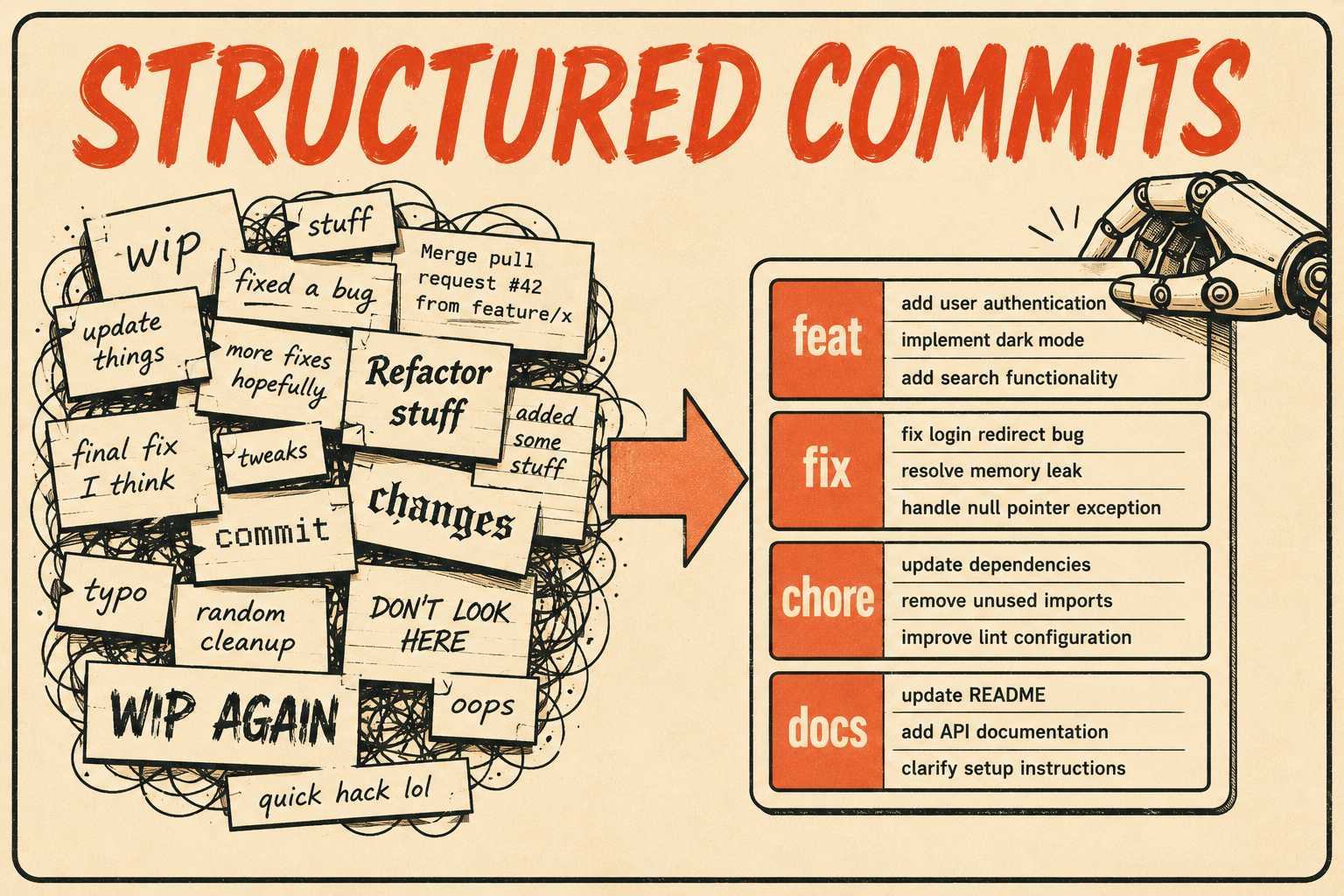
However, relying solely on commit-level automation often produces verbose, overly technical changelogs that are useless to end users. To counter this, many teams are shifting the focus from the commit to the pull request. Instead of tracking every individual change, they require every PR to include a user-facing summary. GitHub's automatically generated release notes, for instance, are built entirely from PR metadata and labels rather than raw commit messages. This PR-level approach filters out the noise of the underlying commits and gives the changelog a more coherent, user-readable shape.
The Role of Human Governance
Automation can assemble the pieces, but it cannot decide what matters. This is where skilled human oversight becomes essential.
In an AI-assisted workflow, the changelog manager is no longer a scribe. They are an editor and a governor. Their job is not to write the release notes from scratch, but to validate the auto-generated draft, triage ambiguous entries, and ensure the final document reflects the actual impact on the user.
This governance role is critical because AI agents lack context. An agent might correctly tag a commit as a fix, but it does not know if that fix resolves a minor visual glitch or a critical security vulnerability. It might bundle a breaking API change with a routine dependency update. A human editor must catch these edge cases, elevating the important changes and discarding the trivial ones.
As the volume of AI-generated code increases, this oversight becomes a mandatory quality control layer. Governance frameworks for agentic code generation are increasingly explicit about this: human accountability cannot be delegated to the agent that produced the artifact. The human provides the final validation that the documentation reflects what users actually need to know, not just what the codebase did.
A Managed Artifact
Maintaining a changelog when AI writes half your code requires a shift in perspective. The changelog is no longer a manually reconstructed narrative. It is a managed artifact, generated from structured data and refined by human judgment.
This is the operational reality that Doc Holiday is built to handle. When your development pipeline produces a high volume of fragmented, AI-generated commits, you need a system that can automatically parse that history, extract the relevant metadata, and organize it into structured changelog material ready for human review. Doc Holiday provides that scaffolding — commit parsing, version tagging, automated draft generation — so that a skilled human can focus on validation and user-facing polish rather than reconstruction from scratch.