The Bus Factor: Why Knowledge Concentration is a Liability and How to Fix it


If you run a mid-sized engineering organization and a critical system goes down at 2:00 AM on a Saturday, the difference between a minor hiccup and a multi-day outage often comes down to who happens to be awake. When the only person who understands the deployment pipeline or the legacy authentication service is unavailable, the team is paralyzed. This is the reality of the bus factor.
The bus factor is the number of people on a project who would have to be hit by a bus—or simply quit—before the project collapses. The phrase sounds morbid because the risk is real. It is a measurement of knowledge concentration, and teams with a bus factor of one are living on borrowed time.

When tribal knowledge gets locked in people's heads instead of systems, it creates a fragile environment. The longer someone works on a codebase, the more undocumented context they carry. They know the edge cases, the architectural decisions that were never formalized, and the gotchas that never made it into a ticket. When they leave, all of that context goes with them. A study on turnover-induced knowledge loss found that maintaining abandoned code is exceptionally difficult because the remaining team lacks the tacit knowledge of why things were built a certain way.
Where Knowledge Concentration Bites
The bus factor manifests in several common scenarios that quietly drain engineering velocity and increase operational risk:
- A senior engineer quits, and nobody knows how the deployment pipeline works. The pipeline is a complex web of bash scripts and custom CI/CD configurations that only one person ever touched. When it breaks, the entire release cycle halts while the remaining engineers reverse-engineer the process.
- A lead developer goes on parental leave, and a critical bug surfaces in their domain. The bug is deep in a legacy service that hasn't been touched in years. Without the original author's context, a simple fix takes days of tracing execution paths and guessing at intent.
- A contractor wraps up their engagement, and the permanent team cannot maintain what they built. The contractor delivered working software, but the knowledge transfer was rushed or non-existent. The code works, but nobody understands its architecture or how to extend it safely.
- An architect gets promoted and stops writing code, but nobody else understands the system design. The architect holds the mental model of how all the microservices interact. When new features require architectural changes, the team is blocked waiting for the architect's input, creating a severe bottleneck.
These scenarios are not just hypothetical frustrations; they are expensive organizational failures. Research from SHRM indicates that replacing an employee can cost anywhere from 50% to 200% of their annual salary. But the true cost of a low bus factor isn't just recruitment—it's the lost productivity, the delayed releases, and the increased risk of customer-facing defects when undocumented systems fail.
How Documentation Actually Helps
The generic advice to "write stuff down" does not work. It treats documentation as an afterthought, a chore to be completed when there is spare time. To effectively reduce the bus factor, documentation must be specific, structured, and integrated into the engineering workflow.
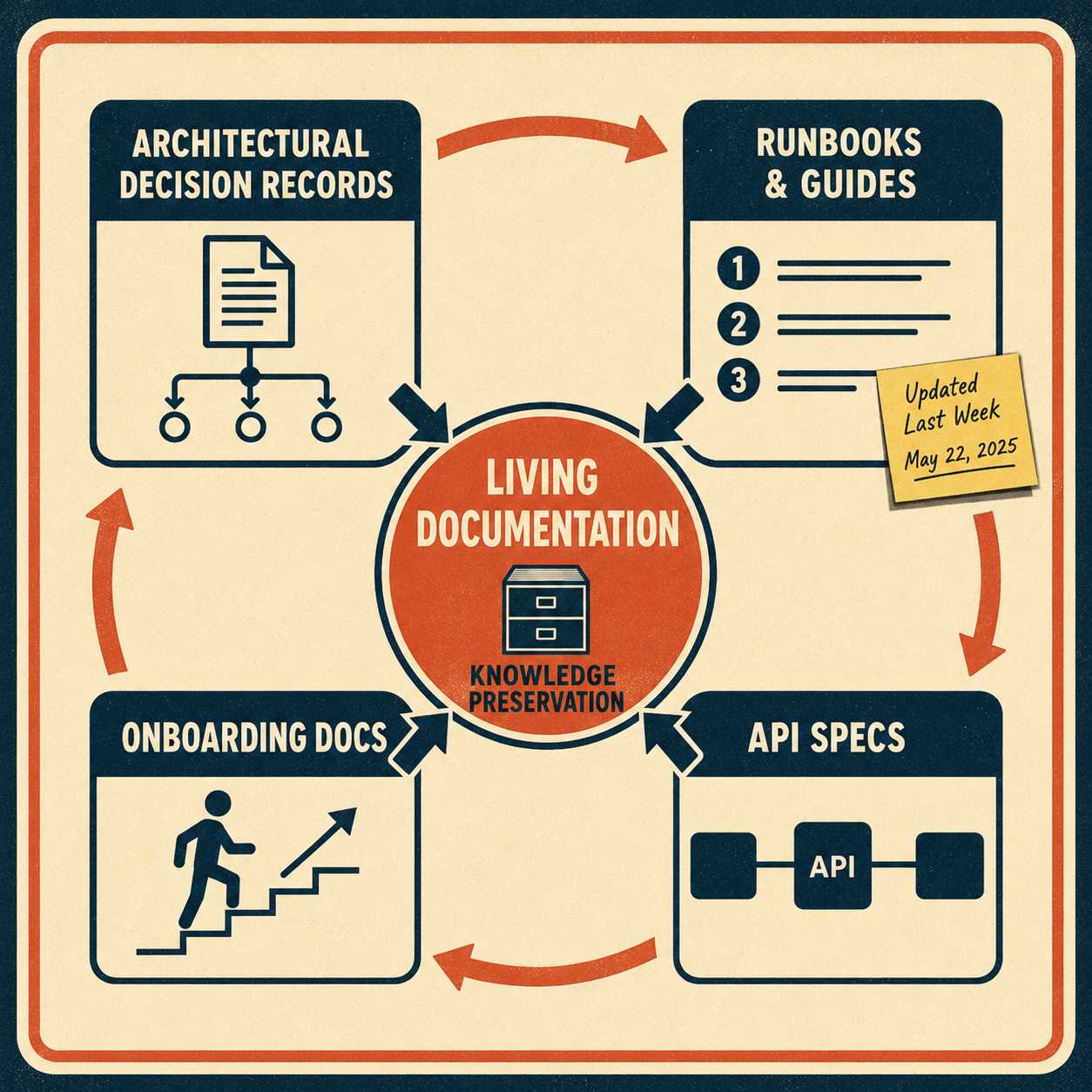
Architectural decision records (ADRs) capture why choices were made, not just what was built. As Martin Fowler describes, an ADR is a short document that explains a single decision, the context for making it, and its significant ramifications. By recording the rationale and the alternatives considered, ADRs preserve the "why" behind the code, preventing future engineers from repeating past mistakes or questioning the architecture without understanding the original constraints.
Runbooks and operational guides provide step-by-step instructions for deployments, rollbacks, and incident response. When an incident occurs, responders shouldn't have to guess or wait for a specific expert to wake up. Runbooks externalize operational knowledge, allowing any qualified engineer to safely execute critical procedures.
API documentation and integration specs ensure that downstream teams aren't dependent on one person's Slack availability. When APIs are well-documented, teams can integrate independently, reducing bottlenecks and freeing up the original developers from constant support requests.
Onboarding docs that assume zero prior context force the team to externalize what they assume is obvious. The onboarding process is a stress test for knowledge distribution. If a new engineer cannot ramp up without constant guidance from a senior developer, the bus factor is too low. Comprehensive onboarding materials ensure that foundational knowledge is accessible to everyone.
The Reality of Velocity Pressure
The practical barrier to reducing the bus factor is that manual documentation almost always loses to velocity pressure. Engineering teams are incentivized to ship features, not write docs. As a result, documentation falls behind the code, people stop maintaining it, and eventually, the team stops trusting it.
This is where automation matters. If documentation is generated directly from the engineering workflow instead of being a separate chore, it stays current and doesn't slow teams down. When documentation is a byproduct of engineering activity—extracted from code commits, API specs, and deployment events—it reflects the actual state of the system, not what someone remembered to write down last month.
A low bus factor is a financial liability. It makes hiring harder, slows down new engineers, and creates single points of failure that executives should care about. The fix isn't just "hire more people"—it's building systems that preserve knowledge even when people leave. Doc Holiday assists in reducing bus factor by capturing knowledge at the source—pulling release notes, API references, and changelogs directly from the work engineers are already doing—but humans remain responsible for validation, review, and ownership of that documentation. The platform gives teams the structure to scale their documentation output without depending on one person's memory; the judgment about what is accurate, complete, and worth preserving still belongs to the people on the team.