How to Write Release Notes For a Feature No One Asked For


It is Thursday afternoon. You are staring at a blank release notes document.
Your team just spent six months shipping a massive infrastructure migration. Or maybe it was a compliance overhaul. Or a strategic partner integration that the CEO promised on a golf course.
Whatever it was, you now have to write the release notes for it.
The standard playbook doesn't work here. The standard playbook says you should celebrate the win. It says you should thank users for their feedback. It says you should frame the update as a triumph of customer-centricity.
But no one asked for this.
If you try to force this update into the "you asked, we listened" template, it will sound fake. Users can tell when you are faking enthusiasm for a feature they didn't want. They know when you are trying to spin an internal technical debt reduction as a thrilling new capability.
So how do you write about the things you had to build, rather than the things they wanted you to build?

The Trap of the Feedback Loop
We have been taught that good product development is entirely reactive. We are supposed to listen to users, gather their requests, and build what they ask for.
This is a trap.
Sometimes, building what users ask for is exactly the wrong move. As product researchers have noted, users often express needs based only on what they currently understand, leaving their "latent needs" — the things they actually require but cannot articulate — unaddressed. A study from the University of Washington and Colorado State University found that proactive market orientation, anticipating what users will need rather than just responding to what they say they want, is substantially more strongly related to new product success than responsive market orientation.
If you only build what is requested, you end up with a faster horse.
Sometimes you have to ship things for reasons that have nothing to do with immediate user demand. You ship for compliance, because regulators demand it. You ship to pay down technical debt, because if you don't, the system will eventually collapse under its own weight. You ship to turn a feature into a platform, enabling future capabilities that users will ask for once they exist. You ship a security hardening update because a penetration test found something uncomfortable.
These are all valid reasons to build software. But they are terrible reasons to put in a release note.
Why the Standard Template Fails
The standard release note template assumes a shared victory. It assumes the user wanted something, and you gave it to them.
When that shared context doesn't exist, the template breaks down.
If you write, "We are thrilled to announce our new SOC2 compliance architecture!" you sound out of touch. The user is not thrilled. The user does not care about your compliance architecture.
If you write, "You asked for better data handling, so we migrated our entire backend to a new database," you are lying. They didn't ask for that. They asked why the app was slow on Tuesdays.
Faking it damages your credibility. Research on brand transparency shows that perceived honesty is a key mechanism in reducing negative reactions, particularly when communicating less-than-ideal news. When you pretend a purely operational update is a highly requested feature, you tell the user that you don't actually know what they want.
The irony is that honesty usually lands better. Most users don't need to be excited about a release. They need to know what changed and whether it affects them.
How to Frame the Unrequested Feature
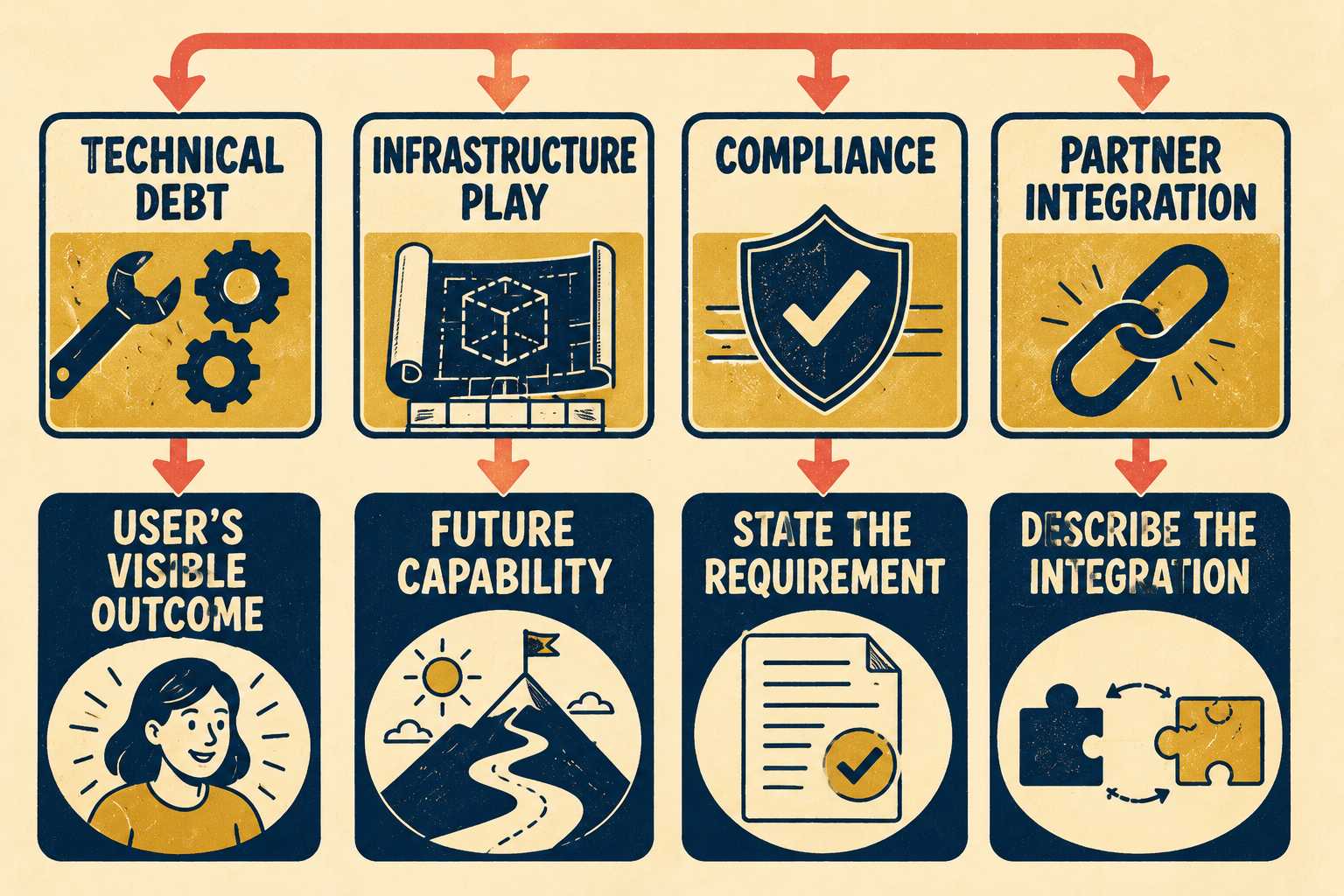
You cannot rely on enthusiasm. You have to rely on clarity.
The framing strategy depends on why the feature was built. The categories are different enough that they need different approaches.
If you built it to pay down technical debt, lead with the problem it solves, even if the user didn't name the problem.
Before: "We refactored the data ingestion pipeline for better throughput."
After: "Large data imports will no longer time out."
The user didn't ask for a refactored pipeline. But they did experience the timeouts. Connect the invisible work to the visible outcome. The work is still worth explaining, but the explanation should start from the user's experience, not from the engineer's.
If you built it as an infrastructure play to enable future features, own that framing. Tell them this is the foundation.
Before: "We've introduced a new unified entity model across the platform."
After: "We've rebuilt how the system handles user data. You won't see many changes today, but this sets us up to launch custom reporting next quarter."
This works because it is honest. It acknowledges that the current update is unglamorous, but it gives them a reason to care about the future. Mind the Product's analysis of platform thinking makes this point well: the most important product decisions are often not about what users see today, but about what the system must support tomorrow. You can say that plainly.
For compliance and security updates, the framing is even simpler. Just state the operational reality.
"To comply with new data retention standards, reports older than 90 days will now be automatically archived."
Do not apologize. Do not try to make it sound exciting. Users respect straightforward communication when it concerns security or compliance, and they tend to distrust the version that tries to dress it up.
For sunsetting legacy workflows, the same principle applies. Rally's guide on feature removal makes a useful point: a trap people fall into when communicating feature removals is believing it is bad news. State the decision clearly, explain why it makes sense now, and focus on the path forward. "We've decided to retire the legacy export tool" is a complete sentence. You don't need to mourn it.
For partner integrations driven by business strategy rather than user demand, just state what the integration does. Don't pretend it was the most requested feature of the year. The users who need it will find it.
The Extraction Problem
Writing these notes is hard enough. But usually, the writing is not even the hardest part.
The hardest part is figuring out what actually changed.
When a team ships a massive infrastructure update, the commit log is a mess. It is full of internal refactors, dependency bumps, and cryptic messages. Research from a multi-method study of nearly 1,600 commit messages across five highly active open source projects found that an average of around 44% of messages could be improved, with developers often lacking the time and motivation to write messages that clearly explain what changed and why.
You have to sift through that noise, find the actual user-facing changes, and then translate them into something readable. You have to figure out if fix(export): resolve timeout on large datasets is a minor bug fix or the culmination of a six-month infrastructure project. (It's the six-month project. It's always the six-month project.)
This extraction work takes hours. And it drains the energy you need for the actual writing — the framing, the positioning, the careful explanation of why this unrequested feature actually matters.
Doc Holiday generates structured release notes directly from engineering workflows. It processes the commit history, groups the changes by impact, and produces a first draft based on the actual code shipped. That draft handles the extraction and the initial translation, so the writer can spend their time on the part that actually requires judgment: figuring out how to explain the new compliance architecture to someone who just wants to know if anything broke.
It doesn't replace the writer. It just means the writer isn't spending Thursday afternoon reconstructing what shipped from Jira tickets.