How to Document a Feature Deprecation Effectively


If you run a software platform long enough, eventually you have to turn something off. Maybe it is an API endpoint that costs too much to maintain, or a UI feature that only three customers use, or a legacy authentication method that is no longer secure. You have to tell your users that something they rely on is going away.
This is not a technical problem. It is an operational communication problem. You are forcing your users to do work they did not plan to do, on a timeline they did not choose, to maintain functionality they already had. If you document this poorly, you will drown your support team in tickets and permanently damage customer trust. If you document it well, the transition happens quietly.
The difference between a chaotic deprecation and a quiet one comes down to how you structure the communication lifecycle.
The Announcement Has to Be a Contract, Not a Warning
The worst way to announce a deprecation is to say it will happen "soon."
Vague timelines cause panic. When users do not know exactly when something will break, they assume it will break tomorrow. They open support tickets. They escalate to their account managers. They demand extensions. The support load from ambiguity is often worse than the support load from the actual cutoff.
A deprecation announcement must include exactly what is being removed, why it is being removed, the specific date it will stop working, what replaces it, and how to migrate. Every one of those elements is load-bearing. Remove the "why" and users assume you are cutting corners. Remove the replacement path and they have nowhere to go. Remove the specific date and you have not actually told them anything useful.
The length of the timeline should map to the complexity of the migration. When GitHub deprecates a REST API version, they commit to at least 24 months of continued support after the new version ships. When AWS sunsets a service, they typically provide a 12-month runway with a staged lifecycle: maintenance mode first, then sunset, then full shutdown. A UI change might need 90 days. A core API endpoint with deep integrations might need 18 months.
Stripe's approach to this is worth studying. Their entire API versioning strategy is built around the principle that an API represents a contract, and breaking that contract should require extraordinary justification. Their internal policy, as documented by Will Larson, is that they "never deprecate APIs without an unavoidable requirement to do so." The TLS 1.2 deprecation is one of the rare exceptions they cite, and it was driven by PCI compliance, not internal preference. That is a high bar, and it is the right bar for anything that touches production integrations.
The Mechanics of Getting Users to Actually Notice
You cannot rely on users reading your changelog. Research on API deprecation in software ecosystems shows that many developers only discover a deprecation when something breaks. In a study of the Squeak/Pharo ecosystem covering seven years of evolution and more than 3,000 contributors, the researchers found that ripple effects from deprecations spread slowly and unevenly across the ecosystem, with many projects adapting only after the deprecated feature had already been removed.
This is the core problem. You can write the best deprecation notice in the world and still have users calling your deprecated endpoint on the day it goes dark.
To fix this, you have to signal deprecation programmatically. The IETF defines standard HTTP headers for exactly this purpose. The Deprecation header tells a client that an endpoint is deprecated and includes the timestamp when that status took effect. The Sunset header tells them exactly when the endpoint will become unresponsive. RFC 9745, published in March 2025, formalized the Deprecation header as a standards-track specification. Zalando's public REST API guidelines, which are widely referenced in the industry, require teams to add both headers to every response from a deprecated endpoint.
Headers alone are not enough. You also need to monitor who is still using the deprecated feature. If you track usage by account, you can send targeted emails to the specific users who are still calling the old endpoint in the weeks before the cutoff, rather than blasting your entire customer base with warnings they might ignore. This is the difference between proactive communication and noise.
Some teams use a "brownout" strategy. They intentionally disable the deprecated feature for short, scheduled windows to force users to notice the upcoming change before the final cutoff. It is aggressive, but it surfaces the users who missed every other signal.
Deprecation notices also need to appear in more places than most teams expect. The API reference, the changelog, in-app banners, email to affected accounts, and the release notes all need to carry the same message on the same timeline. Sequencing matters: internal teams and high-value customers should hear about it before it goes public, and the technical documentation should be updated before the announcement goes out, not after.
What Goes in the Migration Guide
Telling users a feature is going away is only half the job. You have to show them exactly how to move to the new one.
A good migration guide does not just link to the new documentation. It provides side-by-side code examples showing the old way and the new way. It maps specific parameters from the deprecated endpoint to the new endpoint. It explicitly calls out any behavioral differences users need to know about.
A large-scale empirical study of Java and C# systems found that on the median, only 66.7% of deprecated API elements in Java and 77.8% in C# include a replacement message at all. That means roughly a third of deprecations leave users with no guidance on what to do next. The researchers found no major effort to improve this over time, even as systems matured. The implication is that providing a clear replacement path is the exception, not the norm, and it is one of the highest-leverage things you can do to reduce support load.
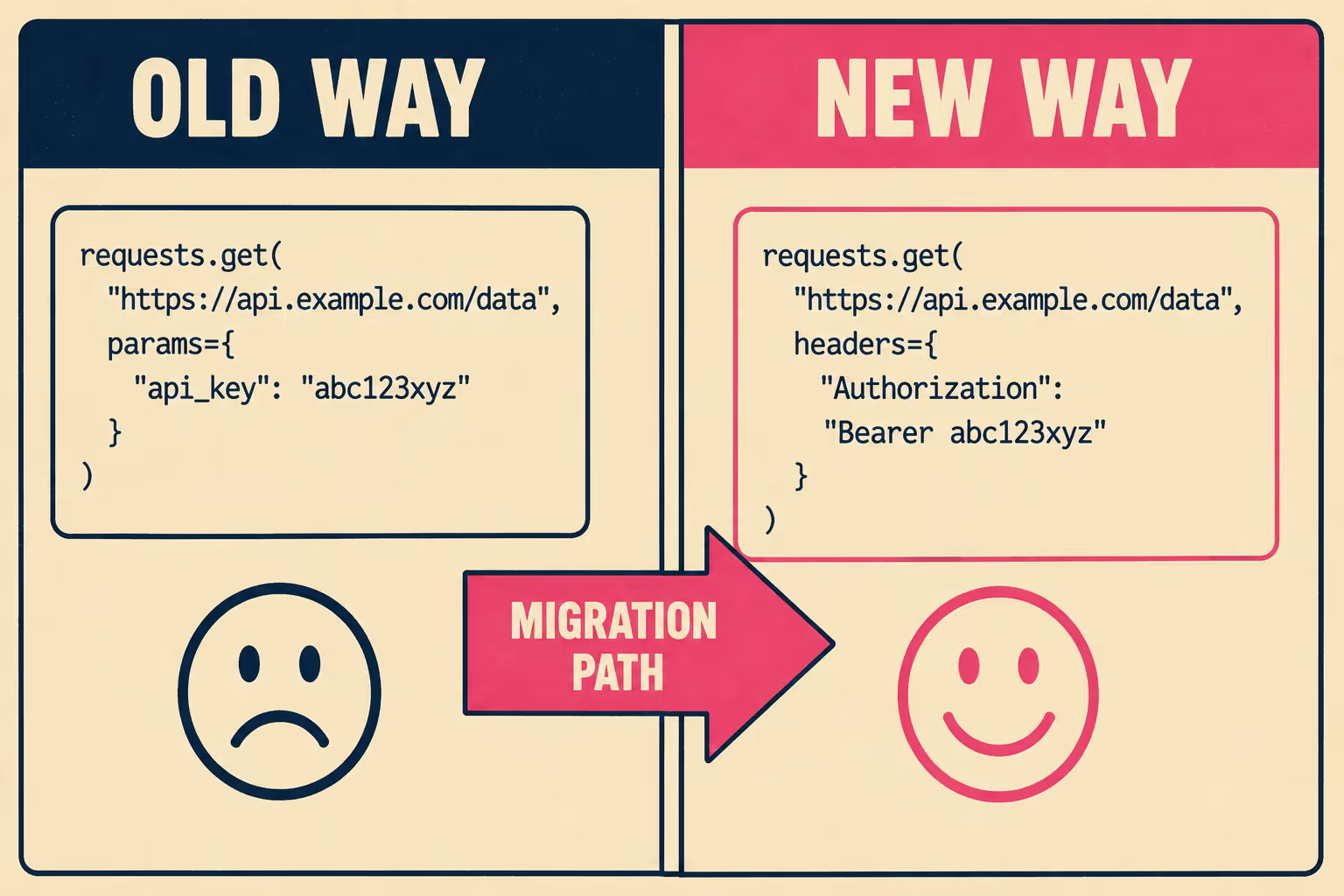
If there is no direct replacement, you have to explain how to achieve the same outcome through alternative means. You cannot just say "this feature is removed." You have to say "if you were using this feature to do X, here is how you do X now."
Partial deprecations are the hardest case. When you are sunsetting one parameter or configuration option but keeping the endpoint alive, users have to parse what still works and what does not. The documentation has to be ruthlessly precise. A table mapping old parameters to new ones, with explicit notes on behavioral differences, is often the clearest format for this.
The table is not a substitute for prose explanation, but it gives users a fast reference they can scan before reading the full migration guide.
The Tone Problem
The tone of a deprecation notice is almost always wrong.
Companies tend to sound either defensive ("we had to do this because of technical debt") or overly apologetic ("we are so sorry for the inconvenience"). Neither works. The user does not care about your technical debt, and an apology does not write the migration code for them.
The effective frame is operational and forward-looking. "This feature is being removed on [date]. Here is how to move to the supported approach." It is a statement of fact, followed by a set of instructions. There is no hedging, no explanation of internal constraints, and no apology. Users respond to clarity.
The same principle applies to support readiness. Before the announcement goes live, your support team needs an internal FAQ that covers the most common objections: "Can I get an extension?", "What if I can't migrate by the deadline?", "Does this affect my other integrations?" Having scripted, accurate answers to those questions before the tickets arrive is the difference between a support team that handles the volume and one that escalates everything.
After the Cutoff Date
The work does not stop when the feature goes dark.
Deprecated code needs to be removed from the documentation, not just marked as deprecated. Old code examples that reference the removed feature need to be updated or deleted. Deprecated doc pages should redirect to the current equivalents, not return 404 errors. Users who missed every warning and are now hitting errors need a clear path to resolution, which means the error response from the removed endpoint should include a message pointing to the migration guide.
This is also the moment to review your monitoring data. Which accounts were still calling the deprecated endpoint the week before cutoff? Those are the users who need a direct follow-up, either from support or from their account manager.
Keeping the Artifacts in Sync
A deprecation is not a single document. It is a lifecycle that touches release notes, changelogs, API references, in-app banners, and email campaigns. The operational challenge is keeping all of those artifacts consistent as the timeline progresses. If the API reference says a feature is deprecated but the changelog says it is fully supported, your users will be confused. If the sunset date gets pushed back, you have to update it everywhere.
This is a structural problem. When you rely on manual updates across multiple surfaces, things drift. The announcement goes out, the API reference gets updated, and then three months later someone updates the getting-started guide without realizing it still references the deprecated endpoint.
This is exactly the problem Doc Holiday is built to solve. Doc Holiday generates release notes, changelogs, and API references directly from your engineering workflows. When you flag an endpoint as deprecated in your code, the change flows through to the documentation surfaces automatically, and your technical writers review it in a dashboard rather than hunting for it across repositories. One deprecation decision, multiple communication artifacts, all kept in sync as the timeline progresses.