How AI Coding Agents Are Quietly Compounding Your Documentation Debt


If you look at the dashboards in most engineering organizations right now, everything is green. Velocity is up. Pull requests are merging faster than ever. Features are shipping.
And yet, if you ask the developer who just approved a 600-line agent-generated PR how the new rate-limiting logic actually works, they probably can't tell you.
They know it passes the tests. They know the linter is happy. They verified the behavior. But they don't know why the agent chose a token bucket algorithm instead of a leaky bucket. They don't know what constraints it assumed. They don't know whether the approach will hold up when traffic spikes.
Coding agents are making documentation debt worse in most organizations right now. This is a real operational problem, not FUD. When an agent writes the code and a human merges it, the traditional assumption of software documentation breaks down. That assumption was that a human wrote the code, understood the tradeoffs, and could explain them later.
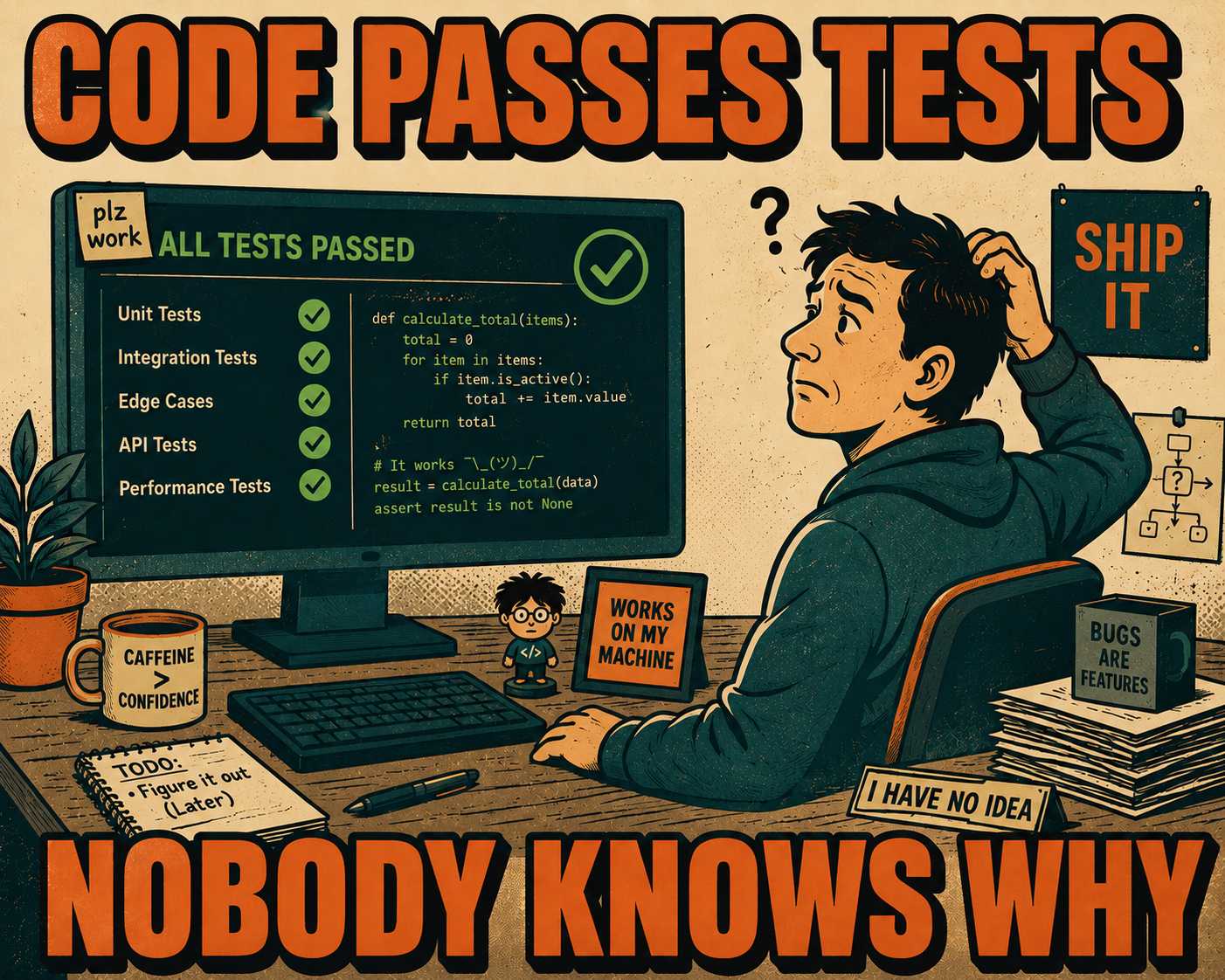
Agents are excellent at producing functional code. They are not good at leaving a trail of intent. The result is a codebase where the "what" is perfectly recorded in Git, but the "why" is nowhere to be found. Researchers at the University of Victoria have a name for this: intent debt, the absence of externalized rationale that developers and future agents need to safely maintain and evolve a system.
The problem is structural. Traditional documentation workflows assume a human wrote the code and can explain it. When an agent writes it and a human merges it, that assumption breaks. And the documentation debt that follows doesn't accumulate slowly, the way a human team's shortcuts do. It accumulates at the speed of agent output, which is considerably faster.
When the Code Outruns the Context
Traditional documentation workflows happen after the merge. You ship the feature, and then someone writes the release notes, updates the API reference, or adds a page to the internal wiki.
This worked when humans wrote the code. The human author carried the context forward in their head. They remembered why they made a particular choice. They could explain it in a PR comment, a Slack thread, or a five-minute conversation.
Agents don't carry context forward. They start cold every session. When an agent writes the code, the human reviewer often doesn't fully understand the implementation details. They are verifying behavior, not internals. They are checking that the tests pass and the diff looks reasonable, not reconstructing the reasoning behind every architectural choice. An empirical study of 567 agent-generated pull requests found that 45.1% required human revision for correctness, documentation, or code style issues after they had already been merged. Nearly half. And those are only the problems that were caught.
By the time someone tries to document the code post-release, the context is already gone. You are left trying to reconstruct intent from behavior, which is expensive and error-prone. A 2024 study in Empirical Software Engineering found that the most common failure mode in automated documentation is omission, not inaccuracy. Teams overlook information rather than include wrong information, particularly for breaking changes.
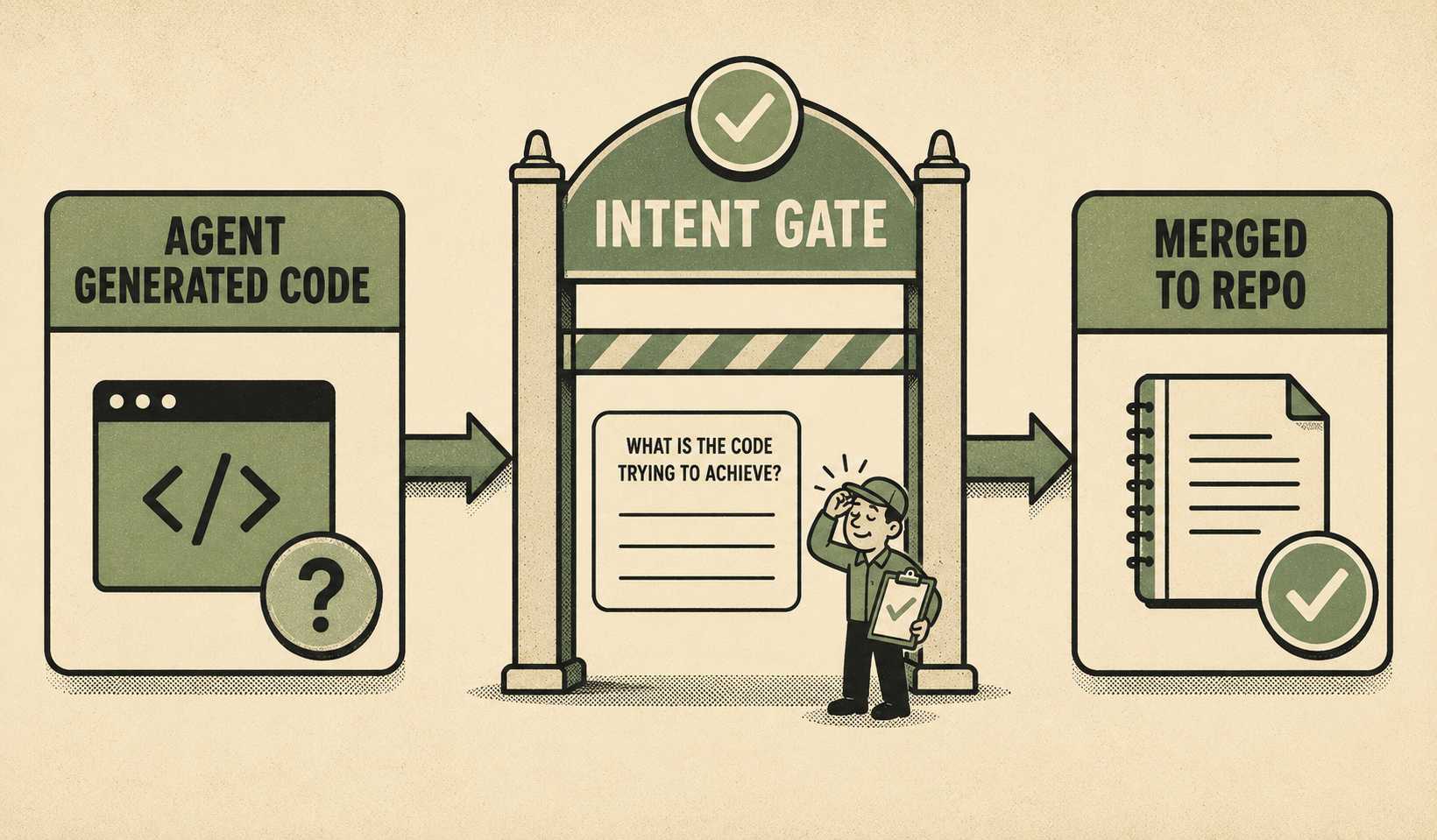
The fix is moving documentation capture upstream. Require the person approving agent output to log a brief intent statement before the merge. One or two sentences. What problem was this solving? What tradeoffs did the reviewer consciously accept? Make it a gate. If you don't capture the intent when the code is generated, you will never capture it.
The Cost of the Black Box Merge
Agents can produce complex, working solutions that satisfy tests but use patterns the team hasn't standardized on.
Six months later, no one knows why that approach was chosen. The documentation says what the function does, but not what tradeoffs it made. This is intent debt, and it compounds faster than technical debt because it is invisible. As Addy Osmani put it: "Code is the answer; the intent was the question it was meant to solve. AI is brilliant at producing answers to questions you forgot to write down."
The mechanism is worth understanding. When a human writes a shortcut, they usually know it's a shortcut. They remember where it is. They can explain why they did it. The debt is visible, at least to the person who created it. When an agent generates code, the shortcuts are invisible. The developer who merged it may not even recognize them as shortcuts. They look like clean, well-structured code. They pass every check. And they accumulate at the speed of agent generation.
There is also a subtler problem. When you ask an agent to solve a problem, you get one approach: the popular one. The model learned it from thousands of repositories. It is battle-tested. It is fine. But what you didn't get is the debate. A senior developer who understands your specific traffic patterns, your specific infrastructure, your specific failure modes, might have written something completely different. Simpler. More tailored. Better for your system. That debate is where engineering judgment lives, and agents skip it entirely.
The operational fix is a decision log, not more API docs. Keep a lightweight record of non-obvious agent outputs that got merged and why the reviewer accepted that approach. Architecture Decision Records (ADRs) have been a standard tool for this for years; AWS teams report spending 20–30% of their time on coordination problems that ADRs directly address. The format doesn't need to be elaborate. A few sentences per decision, stored in the repo, is enough to give the next person a fighting chance.
Documentation Generation Is Happening Too Late
Most teams try to document agent-written code the same way they document human-written code: after it ships.
This is the wrong moment. Agent code lacks the implicit context a human author carries forward. Waiting until post-release to generate docs means reconstructing intent from behavior. That reconstruction is expensive, and it is often wrong.
The fix is treating documentation as a concurrent output stream, not a lagging one. Generate baseline drafts from commit metadata, PR comments, and issue references while that context is fresh. Then have your strongest technical writer validate and refine it, rather than writing from scratch.
This is not a new idea in principle. The Conventional Commits specification enforces structure at commit time so that the type prefix (feat:, fix:, chore:) is already in the message when you go to generate notes. Teams that follow it consistently find that the categorization problem mostly solves itself. The harder problem is translation: even a well-labeled list of PR titles doesn't explain what changed for the user. Recent work on automated release note generation shows that models can bridge this gap by analyzing diffs, commit messages, and PR descriptions together to produce contextually relevant summaries, but the output requires human review to catch omissions.
The key insight is that the context window for documentation is the same as the context window for development. Once the sprint ends and the team moves on, that window closes. The organizations that are solving this problem are generating documentation drafts at merge time, not at release time.
What Not to Do
Slow down agent-assisted development to preserve old documentation workflows. The speed is real, and you want it. The goal is not to make agents work more slowly; it is to capture intent in ways that fit how agents are actually being used.
Try to make agents write better inline comments. They will hallucinate intent. They will confidently explain a rationale that they never actually used. A model can infer a plausible rationale from the code, the same way you can guess why a previous engineer did something. A guess about intent isn't the intent. The model doesn't know whether that 300ms debounce was a deliberate UX decision, a benchmark result, or a number someone typed once and never revisited.
Add documentation bureaucracy that engineering will route around. If you make the process heavy, developers will just approve the PRs faster to get them off their desks. The goal is to capture intent in ways that fit how agents are actually being used, not to force agents into human-shaped workflows.
Building a System That Remembers
The scarce, valuable thing in software used to be a correct implementation. Code was expensive.
AI made code cheap. A DX longitudinal analysis of 400+ companies found that AI adoption rose 65% while median PR throughput rose only 7.76%. The bottleneck isn't code generation; coding represents only about 16% of a developer's day. The other 84% is where the higher-impact opportunities are. Documentation is a significant part of that 84%, and it is the part that agents make worse, not better.
Intent is now the expensive part. The organizations that solve this are integrating documentation generation directly into their release pipeline. Not as an agent feature, but as a system that synthesizes commit history, PR context, and team decisions into structured output while the context still exists.
Doc Holiday connects directly to engineering workflows to generate baseline drafts of release notes, changelogs, and API references at the moment the context is available. Those drafts are not published automatically. A skilled technical writer reviews them for accuracy, fills in gaps, and governs what gets published. That human oversight is the point: the system removes the part where a writer has to go find the data first, and leaves the part where judgment actually matters. That is the operational structure that lets teams maintain documentation velocity while agent-assisted code volume scales.