How to Maintain Release Notes When You Don't Have a Writer


At 4:45 on a Friday, someone asks what shipped this month.
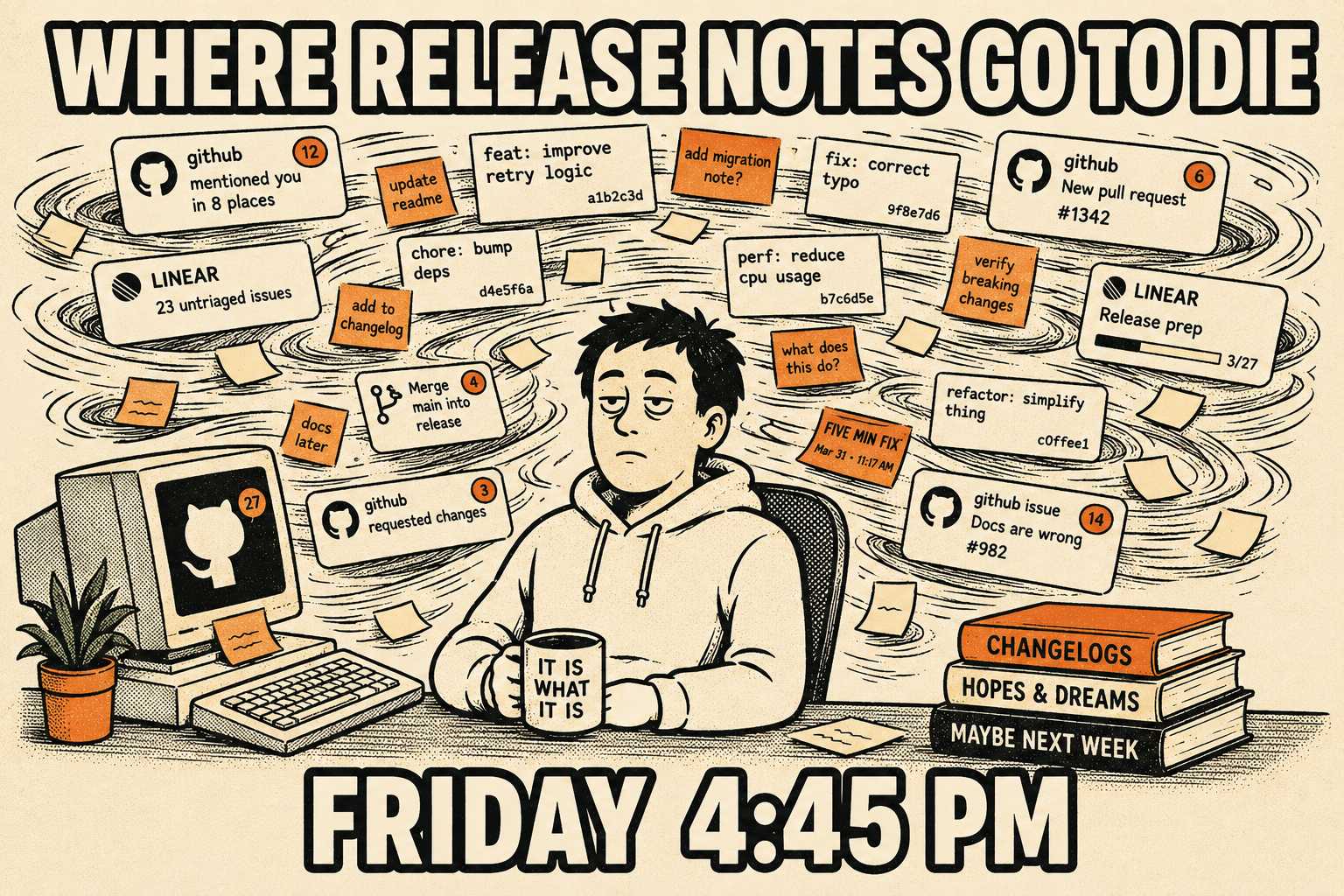
You know the answer exists. It is scattered across forty-seven pull requests, two Linear projects, a few terse commit messages, and the one bug that was “definitely a five-minute fix.” It is not yet a release note.
For a founder with three engineers, or a solo technical lead who also owns product, that gap is a normal operating problem. Release notes matter because customers use them to understand what changed, and a changelog that reads like a Git diff is not doing that job. Customer-facing changelogs work best when they are written for humans, not machines; raw commit-log diffs are full of noise.
The workable answer is smaller than hiring a writer and more disciplined than “we’ll do it after launch.” Use one fixed template. Capture the raw material in the engineering workflow. Let the founder or PM translate it into customer value. Publish on a weekly or themed cadence, not after every deploy. Then put the whole thing on the release path so it has a chance of happening.
That is enough for a team of two to five people. For a while.
The Blank Page Is The Whole Problem
Release notes disappear because the task begins too late. The deploy is over, the team has moved on, and someone must reconstruct a customer story from technical residue.
A blank editor is a strangely effective release-notes deletion machine.
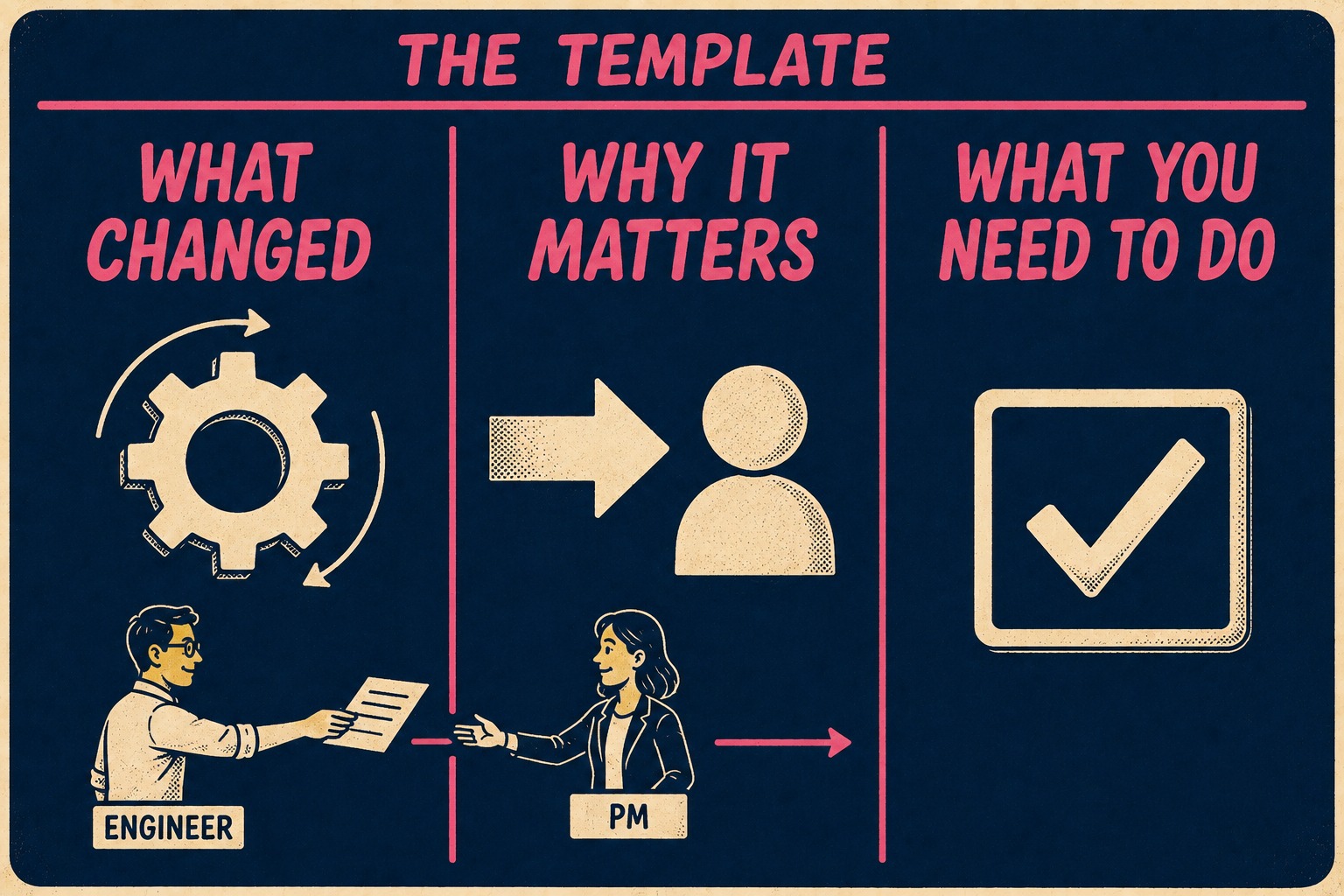
Give the owner a rigid three-part template instead:
The first field stops the note from becoming a technical archaeology project. The second converts implementation into a consequence. The third prevents the worst kind of release note, the one that mentions a breaking change without explaining who has homework.
That last part deserves a little ceremony. Incompatible API changes, backward-compatible additions, and fixes require different signals if users are going to upgrade safely. Your release-note template should do the same, even if you do not publish a library.
The writing itself can stay plain. “We fixed an issue that could duplicate invoice rows in some exports” is useful. “We optimized the serialization layer for enhanced data integrity” is how a customer discovers you have learned to evade the question.
This is also why engineers should not carry the final prose burden alone. Engineers and product-adjacent roles can contribute clearly with some structure; a template does not ask them to become a communications department between code review and incident response.
The Work Is Already In The Workflow
Good release notes do not start with a person remembering what happened. They start with a small amount of issue hygiene before the code is merged.
“Good enough” means every customer-facing ticket has a title that describes the outcome, one sentence about the affected user or workflow, and a category such as feature, improvement, fix, or breaking change. An internal refactor can carry an ignore-for-release label. A change with an upgrade step gets an action-required label.
That is it. This is not a second product-spec process with a ceremonial sign-off and a tragic number of dropdowns.
The point is to create source material that can be sorted. Merged pull requests can provide a first release-note draft, while labels create categories and exclusions before anyone starts writing. The output still needs a review before it is published.
A useful draft can combine source-code changes with version-control and issue-tracker information. Code, commits, and pull-request details can then be categorized and ranked by significance, which gives the reviewer a better starting point than a long merge history.
The useful conclusion is simple: the raw material is already there. It needs transformation, selection, and review. It does not need to be recreated from memory.
The division of labor follows naturally. Engineers own accurate raw material. The founder or PM owns the customer story. An engineer can say, “Added cache invalidation for saved views.” The person closest to the user story can say, “Saved views now reflect permission changes immediately, so admins do not need to ask teammates to refresh.” Both sentences are necessary; only one belongs in a customer-facing update.
On one hand, a founder or PM may be farther from the code. On the other hand, that distance is often what makes the customer translation possible. Keep the handoff lightweight: one good ticket description, one category label, and one checkbox for whether a customer needs to know.
Customers Need The Theme, Not Every Deploy
A daily deployment schedule does not require daily release notes.
Customers need a message when a change affects what they can do, what they see, what they pay for, or what they must do next. They usually do not need an announcement for a renamed variable, a database index, or a bug fix whose effect never escaped the server room.
Group the public changes into a weekly or biweekly note with one theme. “Better control over exports” can contain a new CSV flow, a corrected permission edge case, and a clearer error message. Three tickets become one understandable update.
Grouping similar changes prevents users from receiving an undifferentiated stream of commits. It also gives you room to use the same voice every week: direct, short, and a little boring in the best way.
At much larger scale, a filterable release-notes channel can also support feeds and programmatic access. The scale is different. The operational idea is not. Customers should have one predictable place to learn what changed.
The final trick is to make publication part of delivery. Put the customer-impact field on the pull-request template. Collect the qualifying changes when a release is tagged. Generate a draft. Give the founder or PM a short review window, then publish.
Structured commit trailers and a CI/CD release job can generate the release artifacts from a version tag. Your team does not need that exact implementation. It needs the same property: release notes arise from the deploy process instead of from a separate act of heroism.
Eventually, the manual assembly process becomes the bottleneck. Updates are skipped. A user-facing change lacks context because no one noticed it in the merge history. Documentation that lags behind code changes weakens comprehension and maintenance across the software lifecycle.
That is the point at which the workflow needs a stronger machine around it. Doc Holiday reads commits, pull requests, and ticket data, runs from the engineering pipeline, and produces reviewable documentation and release-note updates. The team still provides clear inputs and a human decision about what should be published; they no longer have to begin every release note with fifty closed pull requests and a blank page.