How Early-Stage Startups Can Win Enterprise Deals With Better Documentation


There is a particular moment in an enterprise sales call when the product becomes almost irrelevant.
The pilot went well. Your internal champion likes the software. The demo was polished, the metrics are good, and somebody has already asked for a pricing sheet.
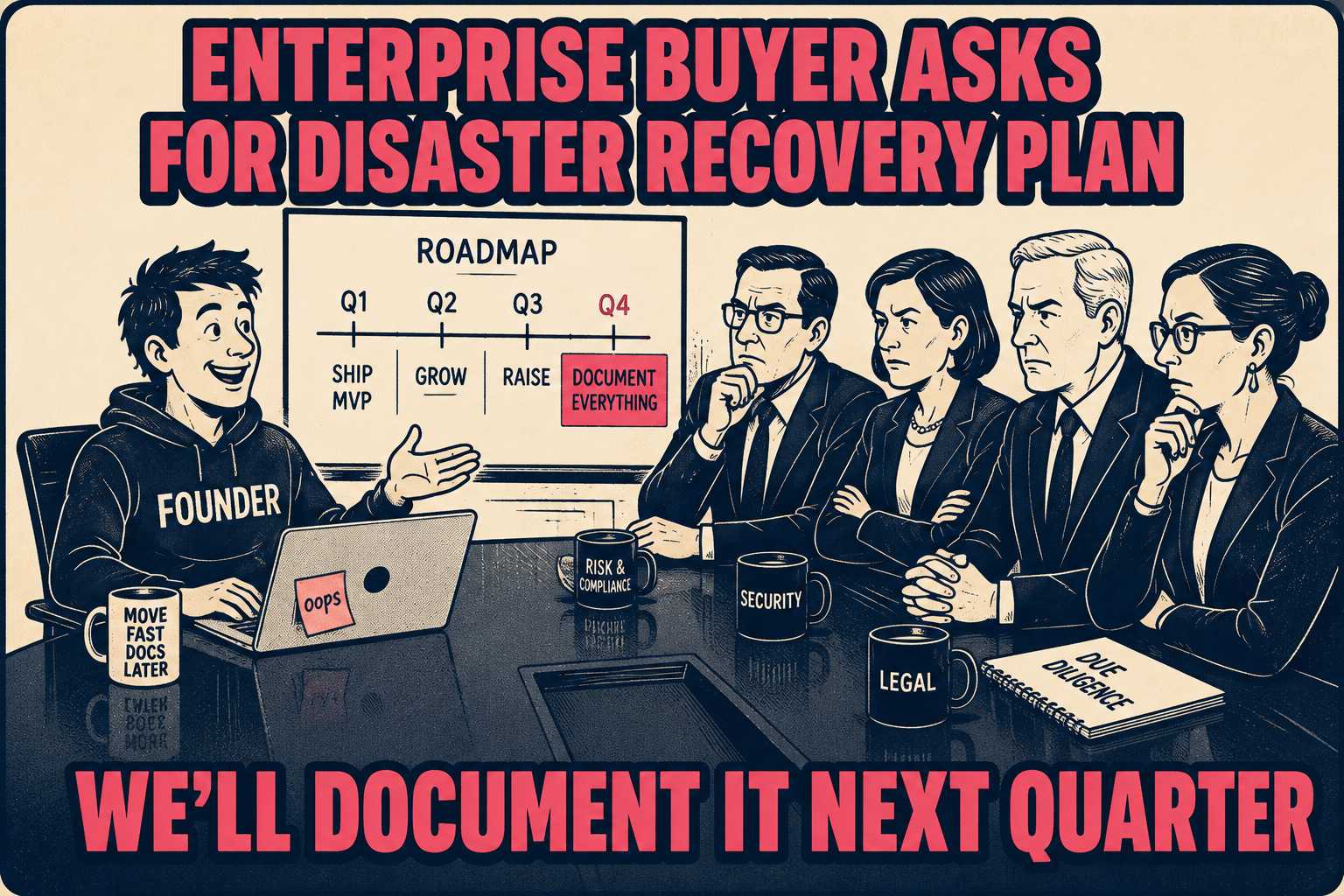
Then a VP of Engineering asks for the disaster-recovery procedure. Security asks how customer data, backups, and support logs are handled in each region. An integration lead wants the API reference, the versioning policy, and an implementation guide that starts before step seven.
A startup can answer those questions with a promise to document them next quarter. The promise usually has the same effect as saying, “we have not thought about this very hard.”
That is why better documentation helps early-stage startups win enterprise deals. It gives buyers evidence that the company can operate reliably after the contract is signed. When you are competing with Salesforce or Atlassian, your product has to work, but the evaluation also asks whether your company looks prepared for the unglamorous parts of being a vendor.
The Part Where the Product Stops Mattering
Enterprise procurement is a risk-assessment process with a sales call attached.
The questions may arrive as a formal RFP, a security questionnaire, or a short spreadsheet passed around by someone in procurement. The shape is surprisingly consistent. The Shared Assessments SIG spans 21 risk-control domains, including application management, cloud services, cyber incident management, operational resilience, privacy, and supply-chain risk management. The CAIQ exists for the same basic reason: buyers want a repeatable way to examine security controls rather than trust a vendor’s homepage.
This is not abstract compliance theater. A public managed-security-services RFP from Howard County Public School System asks vendors for logical topology and connectivity diagrams, testing and validation documents, a technical user guide, documented failover tests, a redundancy diagram, and a description of business continuity and disaster recovery. It also asks where the solution is hosted and how its business continuity works.
That is a useful pattern for every startup selling SaaS. A buyer wants to know where production data sits, where backups sit, what happens to logs and metadata, who can access each of them, and what will happen when an availability zone, a third-party dependency, or your own deployment goes sideways. “We use AWS” is a hosting choice. It is not a data-residency explanation.
SOC 2 belongs in this conversation, but it is often treated as the finish line. The AICPA criteria cover security, availability, processing integrity, confidentiality, and privacy. Buyers still need a plain-English narrative that translates those controls into their questions: system boundary, data flow, recovery objectives, sub-processors, and the specific controls around a customer integration.
Federal authorization material shows what “specific” looks like at the far end of the spectrum. FedRAMP maintains templates for a system security plan, an information-system contingency plan, a cryptographic-modules table, security assessment reports, and requirements traceability matrices. Most startups do not need to build a FedRAMP package. They do need to recognize the underlying buyer instinct: a serious vendor can explain its system in a form someone else can review.
The Integration Gamble
Technical diligence gets sharper when your product has an API.
An enterprise integration team does not want to discover your API’s behavior by trial and error in the middle of an implementation. That team needs authentication and authorization guidance, complete request and response schemas, errors worth reading, realistic examples, rate limits, webhook behavior, idempotency rules, and a clear versioning story. The implementation guide should make sense to an engineer who has never seen your product, not just the developer who built it.
A survey of 104 developers found that providers often fail to communicate API behavior and evolution adequately. More extensive documentation helps developers build on intelligent-software services. A working endpoint does not resolve the adoption problem if an integration team cannot judge the endpoint’s contract.
This is where the trust gap opens. “We’ll document that next quarter” leaves a buyer wondering whether changes will surprise their production environment.
Competitors can show a different operating model. Stripe describes its API as a contract and uses version-change modules that also generate changelog entries and version-specific documentation warnings. GitHub puts breaking changes into a new REST API version, gives advance notice, supports the prior version for at least 24 months, and points integrators to the change log before an upgrade.
Those companies have more resources than most startups. The point is not to copy their machinery. It is to copy the promise: we know what changed, we will tell you before it breaks, and we will leave you a usable migration path.
Release notes matter for the same reason. They show whether a company ships predictably, whether it can distinguish a feature from a breaking change, and whether it communicates operational risk before a customer discovers it in production.
Public incident postmortems do similar work. Atlassian’s detailed postmortem of its April 2022 outage includes the architecture, a recovery timeline, recovery-time and recovery-point discussion, and specific follow-up actions such as DR exercises and an incident-communications playbook. Nobody hopes to need one. Buyers do notice when a vendor can explain what happened and what changed afterward.
Start With a Small but Real Enterprise Pack
A startup does not need a ten-person documentation organization to answer enterprise diligence. It needs a small set of artifacts that stay current enough to be credible.
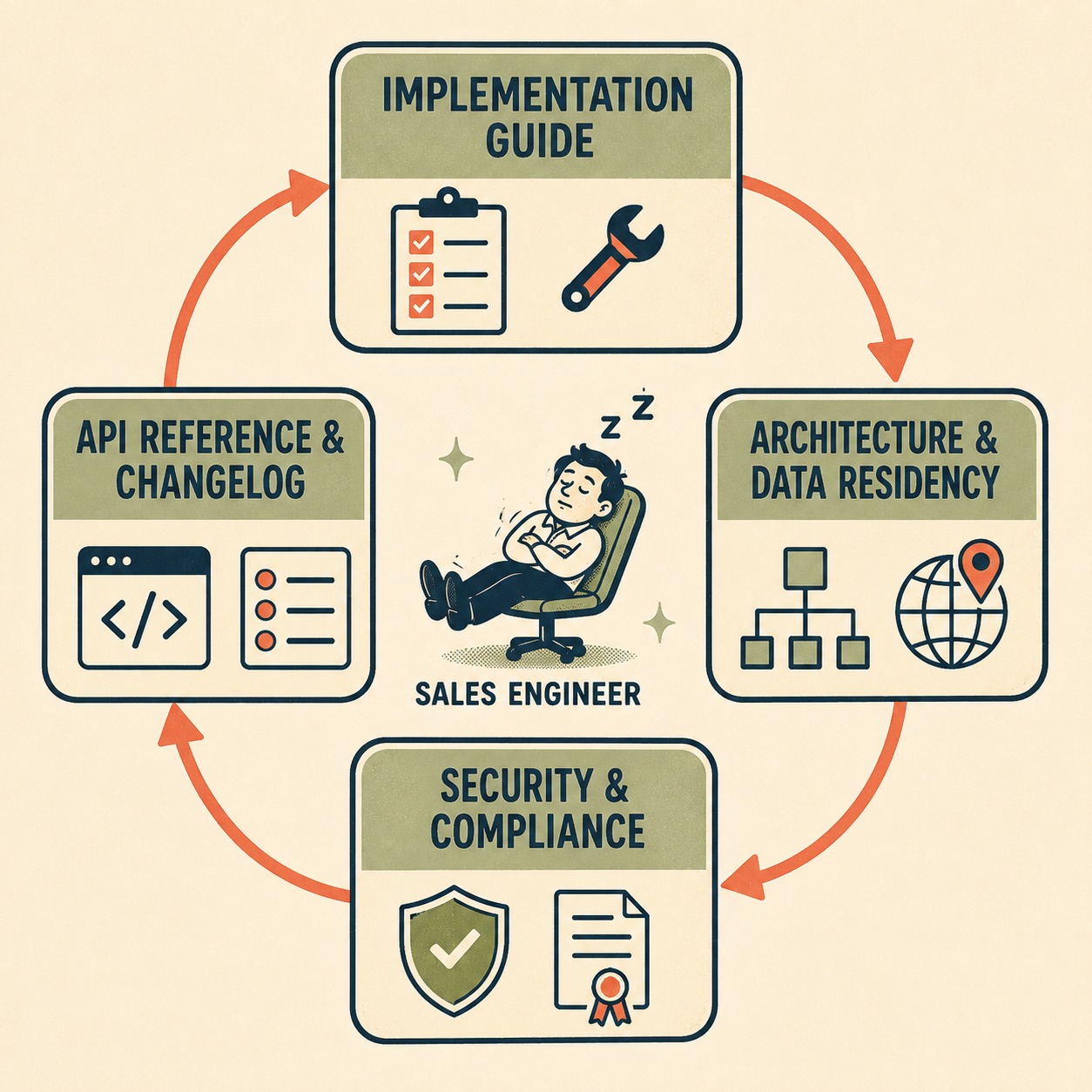
- An implementation guide should cover prerequisites, identity and access setup, configuration, test data, rollout steps, and support escalation. It should assume a capable reader who is new to the product.
- An architecture diagram and data-residency note should show system boundaries, data flows, regions, storage, backup, integrations, sub-processors, and the recovery path. Include RTO and RPO targets where they exist, following established contingency-planning guidance.
- A security white paper and compliance matrix should map your controls to the requirements your buyers recognize, then link to the deeper evidence. NIST’s supply-chain guidance includes an assessment-scoping questionnaire for this kind of structured assessment.
- A versioned API reference, changelog, and release notes should make each change inspectable. Mark breaking changes clearly, identify affected endpoints or workflows, and publish migration guidance before customers feel the blast radius.
This pack speeds up a deal because the buyer can self-serve the first round of answers. It also saves the sales engineer from reconstructing the company’s operating model in a security portal at 11 p.m. on a Friday.
The hard part is maintenance. Architecture diagrams rot. API examples get stale. Release notes become a blank page at precisely the point when the engineering team is busy shipping. Google’s SRE guidance treats release engineering, incident management, postmortems, and launch coordination as related operational disciplines. The documentation should move with the same cadence.
That is the operational opening for Doc Holiday. It reads the commits, PRs, and tickets already moving through an engineering team, then drafts the release notes, API references, changelogs, and documentation updates as reviewable PRs. A product lead or technical writer can validate the output and improve the patterns over time, without rebuilding a documentation team from scratch.
Enterprise buyers will still ask hard questions. Better documentation means your team can answer them with evidence, before the deal becomes another meeting about meetings.