How Startups Can Build a Documentation Strategy Before Hiring a Technical Writer


It is two in the morning and a production server is down.
The on-call engineer at a thirty-person startup searches Slack, Google Docs, and the code repository for a fix. They find no usable runbook. The knowledge is trapped in the head of a senior engineer who happens to be asleep, a pattern common enough in young companies that it has its own grim little playbook: early hires become indispensable, then become the support queue for everyone else when knowledge never leaves their heads.
The engineer waits. The outage drags on.
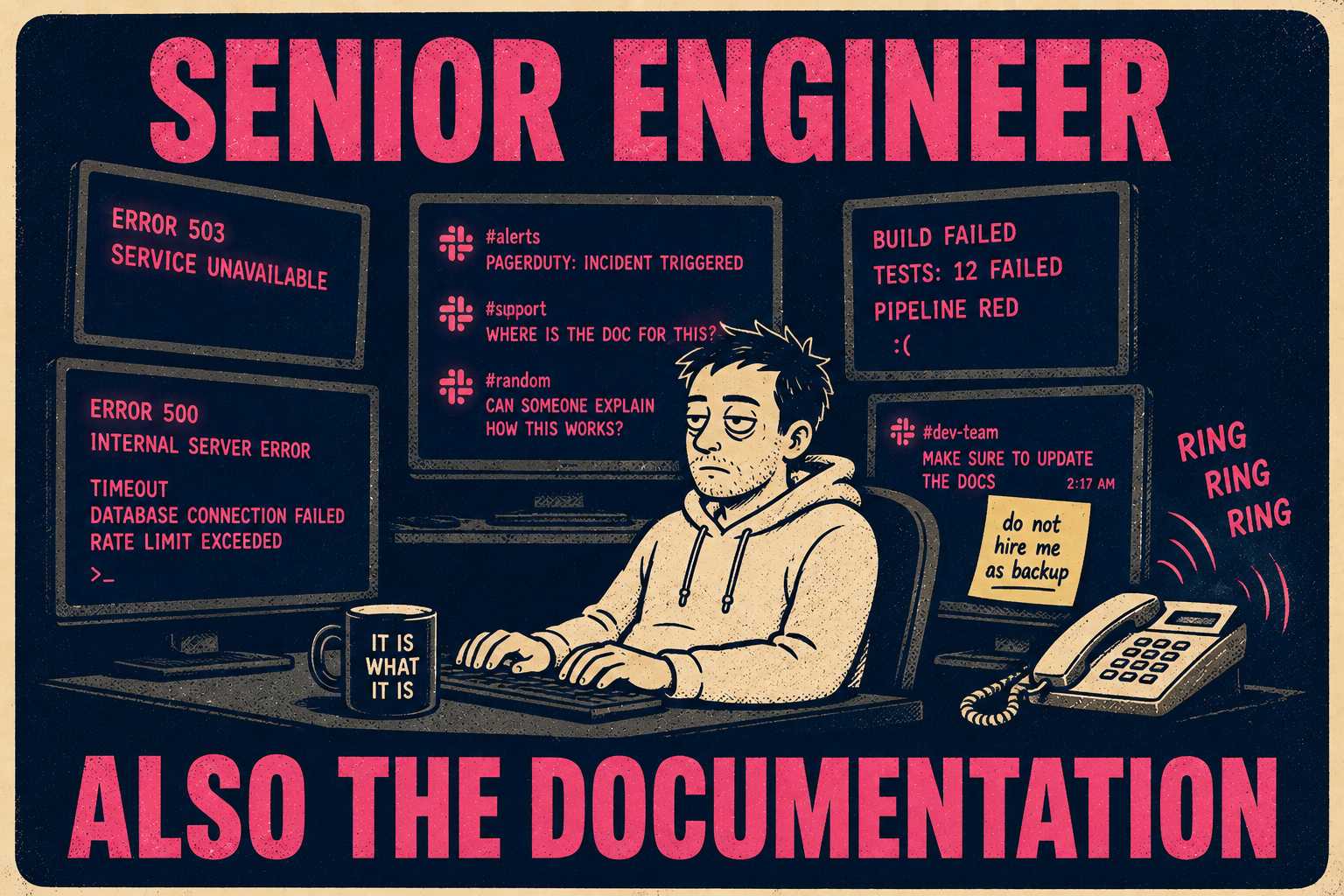
Most startups begin thinking seriously about documentation at this point, when it is already costing them time, support capacity, or a deal that required an answer nobody could produce quickly. They then try to buy their way out with a technical writer.
A technical writer cannot fix a workflow that relies on one engineer remembering to update one page.
The better move is to build the structure before you have the team. Decide what deserves documentation, establish who owns accuracy, and make contribution part of engineering delivery. A future documentation lead should inherit a useful operating system, not a heroic archaeological dig through old Notion pages.
The Trap of the Hero Engineer
Start with four questions before writing anything: What are we documenting, and why? Who needs it? What form will help them use it? How often does it change?
Those questions sound almost too basic, which is usually a sign that teams will skip them and spend three weeks choosing a documentation tool. That is how a startup ends up with seven beautifully formatted pages that answer nobody's question.
Map the surface area by audience. Customers need API references, integration guides, and feature documentation. Engineers need architecture explanations, decision records, and runbooks. Support needs troubleshooting guides and known-issue articles.
The format should follow the reader's job. The Diátaxis framework separates tutorials, how-to guides, technical reference, and explanation, because those formats serve different needs. A new customer trying to get started does not need the same page as an experienced developer looking up an endpoint parameter at 3:00 p.m., or 3:00 a.m.
Then prioritize ruthlessly. Look at the questions that recur in Slack, the integration steps that stall sales, the tickets that support keeps reopening, and the runbooks that on-call engineers cannot find. Pick the five to ten topics causing the most friction and make a few good examples before trying to make a library. The goal is the smallest set of documentation that makes the next important task easier.
This is also the right moment to decide which documents must be current. For an API reference, a machine-readable API description can drive documentation and testing tools. For a release note, version tags and merged changes are the useful source. For a troubleshooting guide, the source is often the incident itself, including the expected behavior, the actual behavior, and reproduction steps.
You Don't Need a Writer Yet
You do need governance. Keep it small enough that people will actually use it.
Create a one-page style guide. Define the voice, required metadata, naming rules, and the one source of truth for each document type. The last part matters. Five scattered versions of a runbook are not redundancy. They are a prank played on the next person on call.
Give every recurring document type a lightweight responsibility map:
One person can play several roles at a twenty-person company. That is fine. The important part is having one accountable person per recurring task, so accuracy does not become a committee meeting with no calendar invite.
The documentation DRI can be a senior engineer or product manager, and it can begin as a ten-percent role. Their job is to validate technical accuracy, spot gaps, and protect the structure. They are not there to turn every pull request into a graduate seminar on commas.
Make the workflow fit engineering's existing habits. Use Markdown or another portable plain-text format, version it alongside the relevant code where appropriate, and ask for documentation updates in the same pull request or release process as the change. Docs as Code combines version control, code review, and automated tests with the rest of product delivery, which gives engineers a familiar way to contribute.
That is not theory. GitLab's own documentation process takes contributors from a source file to a commit, then through a merge request with a documentation template. The exact tools are less important than the shape of the work: capture the explanation while the change is fresh, review it with the people who understand it, and publish from one controlled place.
The Template Is the Manager
Templates are how a lean team gets consistency without an editor standing over everyone's shoulder.
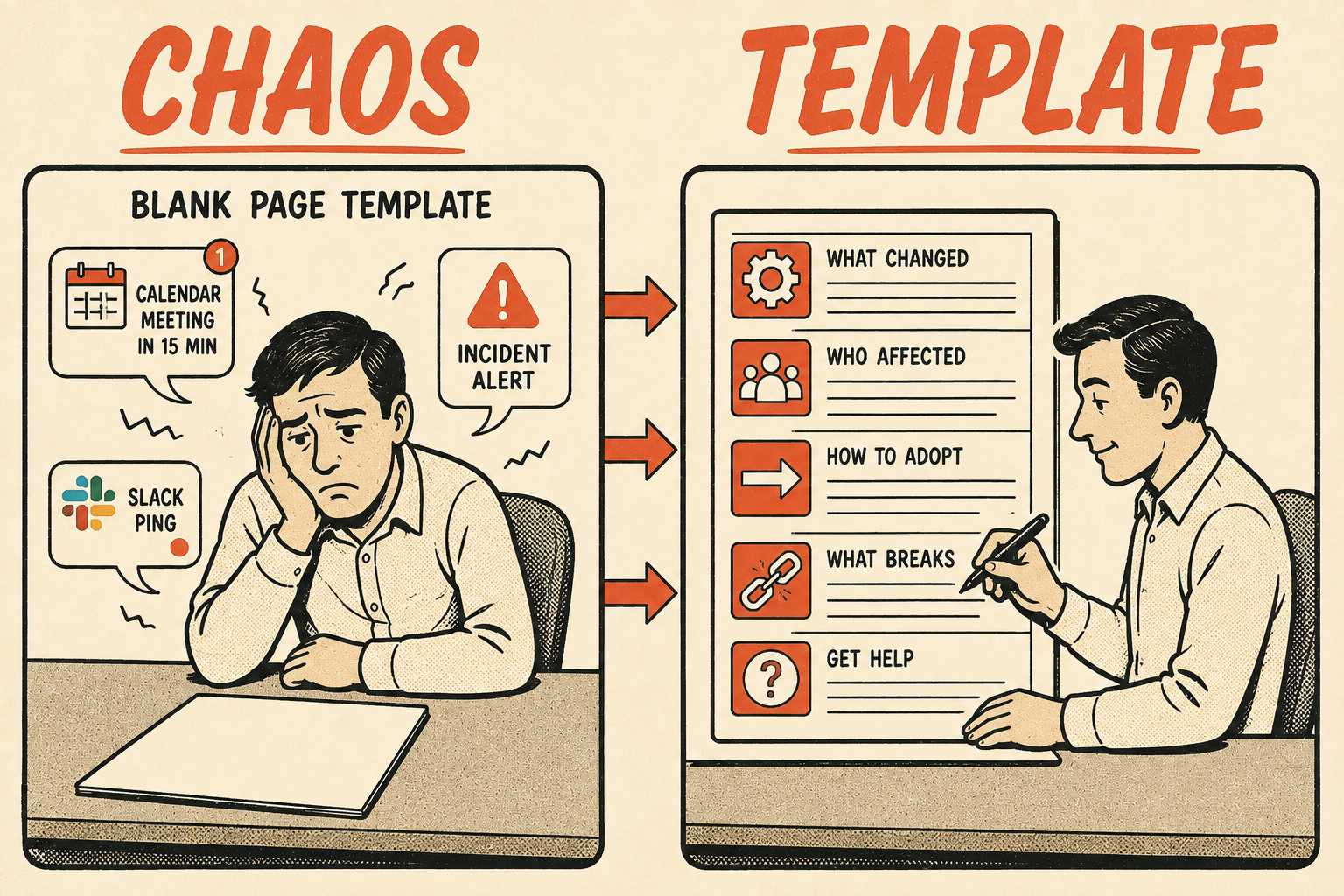
Make a release-note template ask what changed, who is affected, how to adopt it, what could break, and where to get help. Make an API template require purpose, authentication, request and response examples, error behavior, and limits. Make a troubleshooting template require symptoms, likely causes, a safe first action, escalation guidance, and the last validation date.
Engineers will fill in a useful shape. Blank-page prose tends to lose to the next incident, sprint goal, or mysteriously urgent calendar hold.
Architecture needs the same discipline. An Architectural Decision Record captures a decision's rationale, trade-offs, and consequences. A sequence of ADRs gives future engineers an answer to a question code alone cannot settle: why did we choose this? That answer gets more valuable every time the team changes.
Choose tooling that engineers will use and that does not trap your content in an opaque format. Markdown-native systems work well because they can feed a documentation site, a repository, a support tool, or an internal handbook. They also support the kind of maintenance teams actually want: pulling useful context from source code, tests, and changes rather than asking someone to reconstruct a release from memory.
Automation should come before headcount when the work is high-volume and repetitive. Release notes, changelogs, endpoint inventories, and standard feature documentation all benefit from structured inputs and a repeatable template. That matters because continuous-development teams routinely struggle when documentation drifts out of sync with the software.
Hire the writer first when the work becomes bespoke: conceptual architecture, deep integration guides, narrative onboarding, information architecture, and editorial judgment across a complex product. The question is whether you are producing the same kind of information at increasing scale, or discovering new kinds of information that need careful explanation.
A real strategy lets a future documentation lead do the second kind of work. They can improve the information architecture, coach contributors, and expand coverage because the basic system already has owners, templates, inputs, reviews, and a publishing path.
That is where Doc Holiday fits. It helps generate documentation drafts and release-note updates from engineering inputs such as commits, pull requests, tickets, and released changes. The proposed updates land in reviewable pull requests, where the relevant engineer, product owner, or documentation DRI validates technical accuracy, fills in product context, and approves the change before publication. The value is assisted, structured production with a human review step, not unattended publishing.
When you do hire a documentation lead, they manage a system that is already producing and validating useful work. That is a much better first day than asking them to find out which of six runbooks is real.