How Product Teams Can Automate Release Communication Without Losing the Thread


Product teams are shipping faster than their release communication processes can keep up.
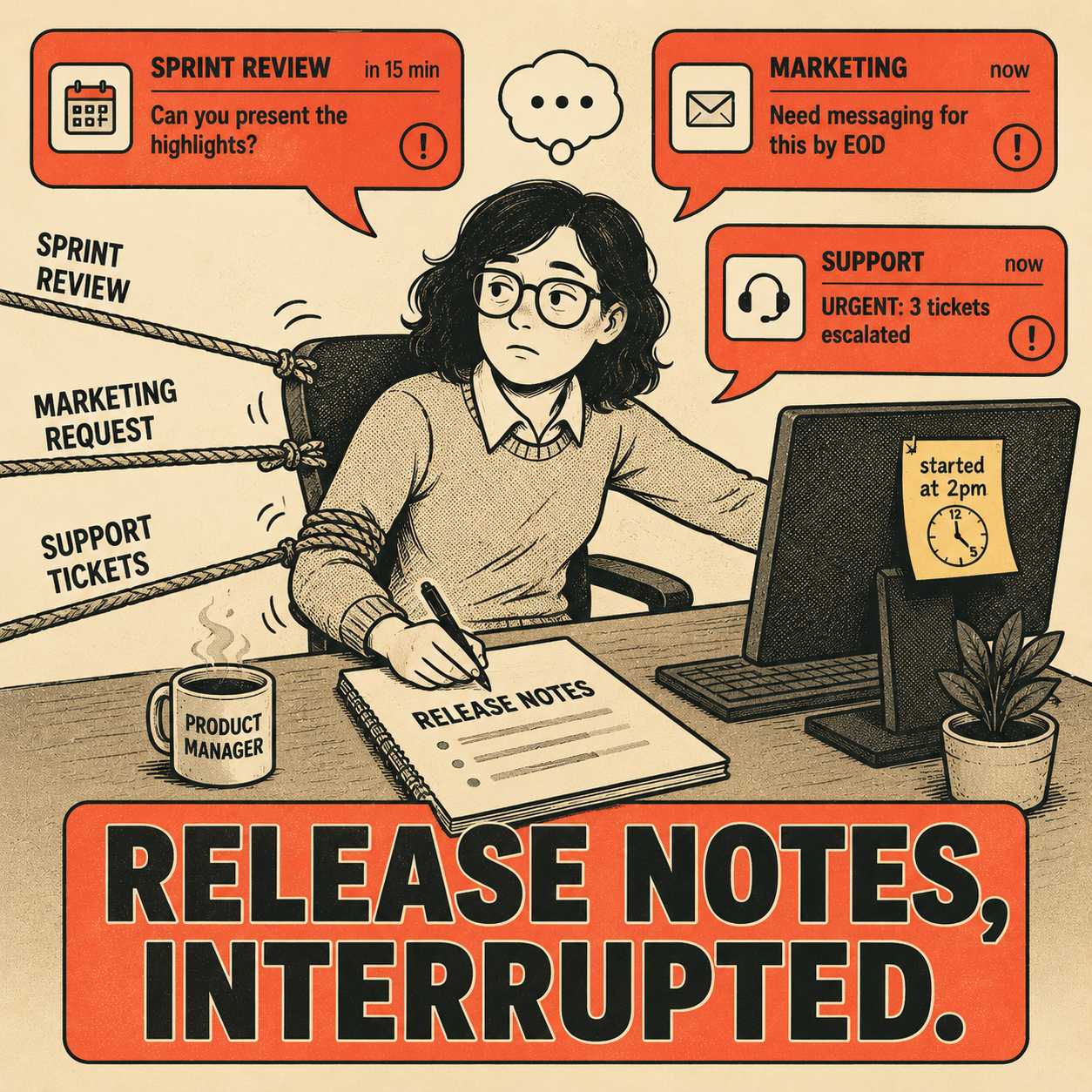
Engineering pushes a commit. The code deploys. The product manager sits down to write the release notes, but gets pulled into a sprint review. Marketing waits for the draft to adapt it for the newsletter. Support starts fielding questions about undocumented changes from users who noticed something shifted but can't find any explanation. The gap between deployment and user awareness grows. That gap is where trust erodes and support tickets multiply.
This is not a failure of effort. It is a structural mismatch. The tooling for shipping code has gotten dramatically faster over the last decade. Elite engineering teams now deploy multiple times per day, while the communication process that follows a deployment still runs on the same manual workflow it always did: product writes, marketing adapts, support absorbs the fallout.
The answer is not to hire more writers. It is to change where the writing starts.
The Scope of the Problem is Larger Than Most Teams Admit
Release communication is not a single artifact. It is a bundle of updates that need to reach different audiences at different times: release notes for end users, changelogs for developers, API documentation updates for integrators, feature announcements for marketing, internal stakeholder briefings for leadership, and support team briefings so the people answering tickets know what actually shipped.
The volume is real. The cadence is increasing. And the cost of getting it wrong is paid in support tickets and churn. Research from Userpilot puts it plainly: if you haven't announced an update in three months, users assume the product is dead. Even a 5% reduction in churn can increase profits by 25% to 95%, which means the ROI on consistent release communication is not trivial.
Most teams underestimate how much of this communication is simply delayed or skipped entirely. The bottleneck is rarely writing skill. It is information gathering. A product manager sitting down to write release notes after a sprint has to reconstruct what shipped from memory, Slack threads, and Jira tickets that were written for engineers, not users. That reconstruction takes time, and it introduces errors.
The insight behind automation is simple: the engineering work itself already contains the information. The commit messages, the pull request descriptions, the Jira tickets, the API schema diffs. If you can extract that information reliably and convert it into customer-facing prose, you eliminate the reconstruction step entirely.
Where Automation Actually Adds Value
The decision tree for automation is more straightforward than most teams expect. If a task requires gathering structured facts from existing systems, automate it. If a task requires strategic framing or empathy, keep a human in the loop.
Right now, successful teams are automating the extraction of changes from engineering workflows. They pull commit messages, pull request descriptions, and ticket updates into a single stream. They automate the conversion of that stream into draft release notes. They automate the distribution of those notes to Slack, email, and changelog pages.
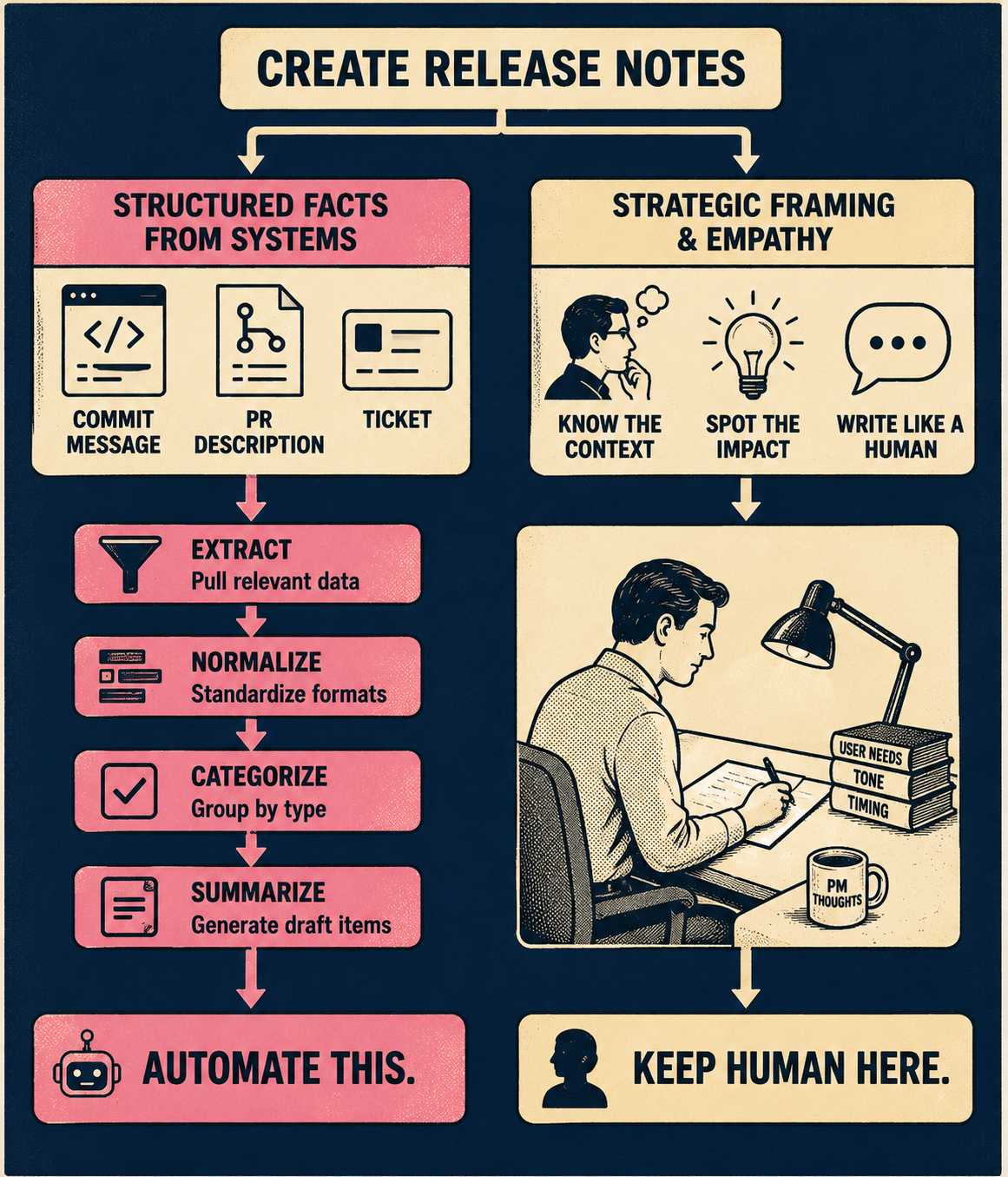
They do not automate the final review.
The teams getting the most value from this approach share one characteristic: their engineering workflow is legible. The Conventional Commits specification provides a lightweight standard for structured commit messages that automation can actually parse. Types like feat, fix, and BREAKING CHANGE give tooling the signal it needs to categorize changes correctly and determine semantic version bumps. If your team is writing commits like fix, update, or wip, the automation will produce useless output. The pipeline is only as good as the input.
Teams that haven't structured their engineering workflow this way face a choice: retrofit the structure now, or accept that automation will require more human correction downstream. Neither option is free. But the teams that invest in commit hygiene and structured PR templates tend to find that the discipline improves their engineering process broadly, not just their documentation.
The Three Layers of the Workflow
The automated release communication workflow breaks down into three distinct layers, and the value of each layer is different.
Data capture is the foundation. The best release communication is generated from engineering artifacts that already exist. Commit messages, pull request descriptions, Jira tickets, Linear updates, API schema changes. This layer is about making the engineering workflow legible enough to serve as source material. Research mapping 97 studies on commit messages and software maintenance found that while commit messages carry crucial information for understanding code changes, they often lack the intent and context needed to convey the full meaning of a change. The practical implication: the more context engineers put into their PR descriptions, the better the generated output.
Generation is where AI tooling converts structured engineering data into customer-facing prose. The output quality depends entirely on the input structure and the oversight model. Unsupervised generation produces generic, occasionally wrong updates. Supervised generation, where a product manager or technical writer validates and edits the AI output, produces faster and more consistent results than manual writing from scratch. This is a quality multiplier, not a replacement for judgment. Ascend.io's engineering team, which built an internal AI-powered release notes pipeline, found that the key to output quality was a low temperature setting for consistency, combined with a PR-based review step before anything published. The automation generates; a human approves.
Distribution is where the generated notes reach users. In-app notifications, email digests, changelog pages, Slack announcements, support documentation updates. Automation here is about routing and formatting, not content creation. Teams that automate distribution without automating generation still save time. Teams that automate both save more. The SmartBear State of API report found that 62% of teams cite limited time as the biggest obstacle to keeping documentation up to date, and 47% flag documentation being out of sync as a key problem. These pipelines address both directly.
What Not to Automate
Not everything should be handed over to a script.
Automation works for incremental updates, regular releases, and API changes. It does not work for communications where tone and empathy matter more than speed. Major product pivots need human explanation. Breaking changes require careful user education and migration paths, not just a changelog entry. When a parameter is removed or a response schema changes, the automated system can detect and flag it, but it cannot decide how to communicate that change to consumers, set a deprecation timeline, or write the migration guide.
Sunsetting a feature is the clearest example. The communication required is not a summary of what changed. It is an explanation of why, an acknowledgment that some users will be frustrated, and a demonstration that the product direction is worth trusting. That requires a human who understands the relationship with the user base. Automation produces a technically accurate summary. It does not produce the empathy that keeps a churning user from canceling.
The practical rule: use automation for the updates users need to know about. Use human writing for the updates users need to feel something about.
The Validation Step That Determines Whether This Works
Automated release communication still needs a human reader before it ships.
Someone needs to know what was actually built, what the edge cases are, and what users will misunderstand. The right person for this is not a dedicated writer on every release. It is a product manager or senior engineer who can scan for accuracy and coherence in under 10 minutes.
The goal is not perfection. It is "good enough to ship without generating confusion or support load."
Product teams often raise three concerns about this workflow. Will the notes sound robotic? Will we lose the brand voice? Will we accidentally ship something misleading? The answer to all three depends on the input quality and the validation step. Teams that treat AI output as a draft to refine get better results than teams that treat it as a finished product. Teams that feed AI well-structured engineering data get better output than teams that feed it messy tickets with no context.
A practical workflow for a team shipping weekly releases looks like this: engineering merges PRs with structured descriptions, automation generates draft release notes from those descriptions, the product manager reviews the draft and edits for clarity and strategic framing, and the notes are published to the changelog, emailed to users, and posted in Slack. Total time: roughly 15 minutes instead of 2 hours. Accuracy: same or better, because the source of truth is the engineering work itself, not a product manager's reconstruction of what shipped.
Who Owns This Process Now
This workflow changes the team structure, and that is worth naming directly.
The old model was "technical writer owns release notes." The new model is "product or engineering owns the source data, automation generates the draft, product validates and ships." The technical writer, if there is one, shifts from drafting to editing and quality control. On teams without a dedicated writer, the product manager absorbs the validation step, which is faster than the drafting step it replaces.
This is a workflow change, not just a tooling change. Teams need to decide who has final authority on release communication and build the validation step into their release process as a non-negotiable gate. The teams that treat validation as optional are the teams whose automated notes eventually ship something confusing.
Audit your current release communication workflow. How long does it take from code merge to user-facing update? How often are updates delayed or skipped entirely? How much of that time is spent gathering information versus writing?
If the bottleneck is information gathering, automation solves it. If the bottleneck is writing, automation accelerates it. If the bottleneck is neither, the problem is organizational, and no tool will fix it.
Doc Holiday generates release notes, API references, and changelogs directly from engineering workflows, then gives your team a dashboard to review, validate, and manage that output before it ships. If your commits are clean and you have someone who can own the validation step, the lag between shipping and documenting gets very short, very fast.