Writing Release Notes for Security Audit Findings


The final report from the third-party penetration test lands in your inbox on a Friday afternoon. It's mostly benign, but there's one critical finding: an authorization bypass in a legacy API endpoint.
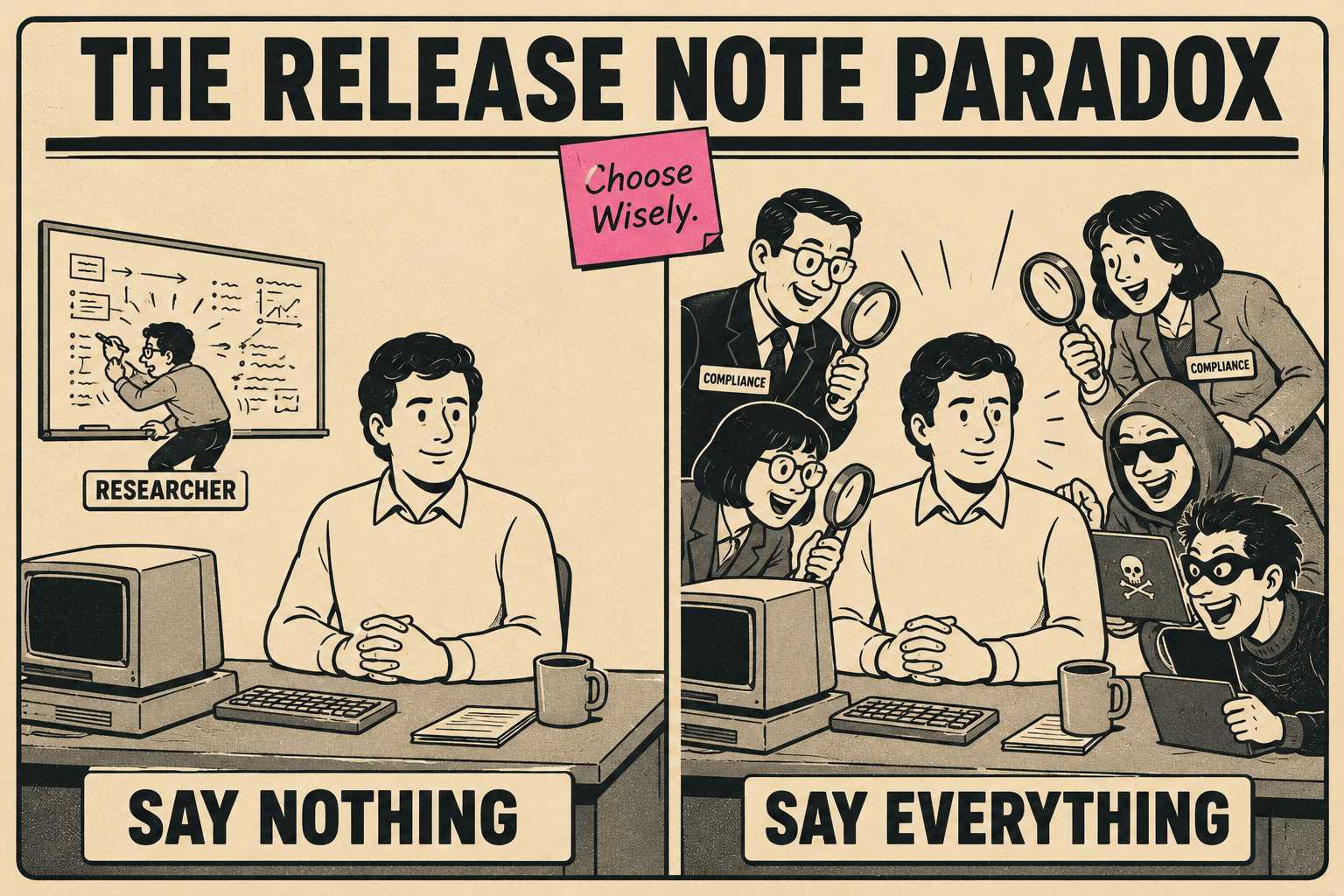
You pull the team together. You write the patch. You deploy the fix. The vulnerability is closed before anyone exploits it.
But now you have a new problem. You have to write the release note.
If you say nothing, you risk losing trust when a customer notices the undocumented change or a researcher publishes a write-up. If you say too much, you risk handing attackers a roadmap to unpatched systems, or triggering a wave of panicked emails from your enterprise customers' compliance teams.
Writing release notes for security audit findings is an exercise in tension. It requires balancing transparency with risk management, and accountability with operational stability. The good news is that the framework for doing it well is not complicated. The execution is.
The Silence vs. Disclosure Decision Tree
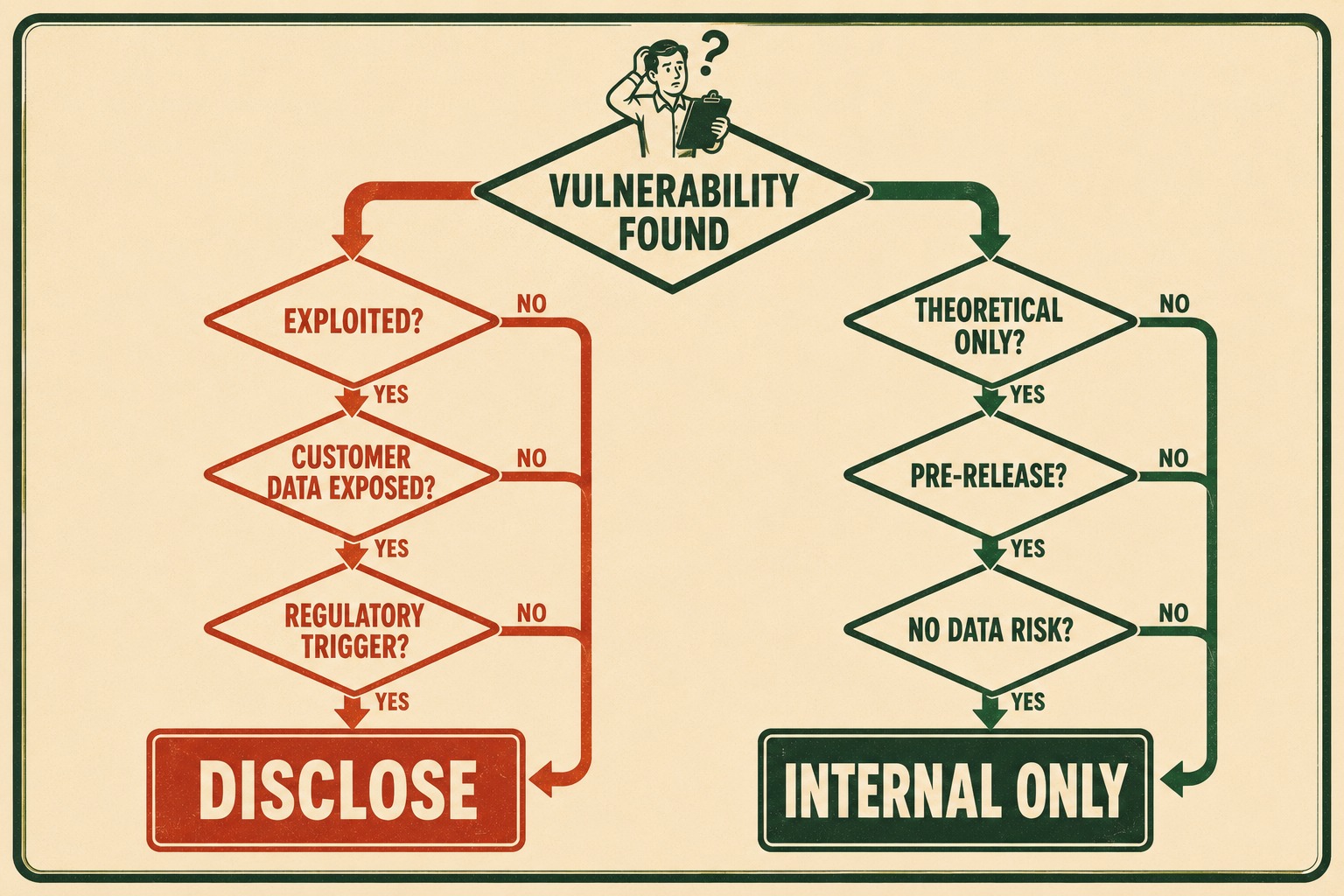
Not every security finding requires a customer-facing release note. Knowing when to disclose and when to stay quiet is the first operational hurdle, and it's one that teams consistently get wrong by defaulting to silence.The conditions that require disclosure are fairly consistent across standards bodies and regulatory frameworks. You disclose when the vulnerability has been exploited in the wild, when customer data was potentially exposed, when there is a regulatory requirement to notify (the 72-hour window under GDPR is the most commonly triggered), or when the finding materially impacts customer trust regardless of technical severity. Public companies now also face a four-business-day disclosure window for material cybersecurity incidents under SEC rules adopted in 2023.You stay quiet — or limit disclosure to internal documentation — when the vulnerability is theoretical and has no exposure, when it was caught in a pre-release environment, or when there is zero risk to customer data. A misconfiguration found and fixed before the feature shipped is not a customer-facing event.
If you are unsure, err on the side of transparency. The FTC has been explicit on this point: failure to disclose can itself constitute an unfair or deceptive practice under Section 5 of the FTC Act, and timely, accurate disclosure is part of a reasonable security program. The legal risk of over-disclosing is almost always lower than the reputational and legal risk of under-disclosing.
The Anatomy of a Note That Builds Trust
A security release note is not a technical deep dive. It is a communication tool designed to manage different dimensions of trust, and each section does a different job.
The opening should state what happened: the vulnerability or misconfiguration, described directly. Do not use euphemisms like "potential security enhancement" or "an issue affecting certain configurations." Customers read through vague language immediately, and it signals that you are more interested in protecting yourself than informing them.
The remediation section explains what you did. This is where you describe the fix, the date it was deployed, and the affected versions. Tenable's guidance on writing security advisories emphasizes that each affected version should have a clear link to the minimum patched version, and that vague remediation language generates significant back-and-forth between support teams and customers.
The customer action section is the most operationally important. If customers need to rotate credentials, upgrade to a specific version, or audit their logs, say so explicitly. If no action is required, state that clearly. Customers who cannot determine whether they need to act will assume the worst.
The final section, often skipped, is the process improvement. How did this happen, and what are you changing to prevent it from happening again? This section is where you demonstrate competence, not just accountability. It is the difference between a note that reads like a confession and one that reads like a postmortem from a team that learns from its failures.
How to Sound Serious Without Sounding Panicked
Tone calibration is difficult. You want to sound like you took the issue seriously and handled it competently. You do not want to sound like you are apologizing for gross negligence, and you do not want to sound like you are burying the lead.
The failure mode on the weak side looks like this: "An issue was identified that could potentially allow unauthorized access in rare edge cases. A patch has been applied." This is vague, passive, and minimizing. It tells customers almost nothing, and the passivity signals that no one is taking ownership.
The failure mode on the strong side looks like this: "A critical vulnerability in our authentication layer has put all customer data at risk. We are deeply sorry for this catastrophic failure." This catastrophizes a finding that may have been caught before any exploitation occurred.
The goal is something like: "We identified an authorization bypass in the v1 API that allowed users to view cross-tenant metadata. We deployed a fix on [Date]. No customer data was accessed. We have added automated regression tests to prevent this class of vulnerability in future releases."
That version names the problem, names the fix, states the customer impact clearly, and closes with a process improvement. It sounds like a team that found something, fixed it, and learned from it. That is exactly what happened.
The Specificity Problem
There is a fundamental tension in vulnerability disclosure: transparency builds trust, but specificity gives attackers a roadmap.
If you provide too much technical detail before customers have time to patch, you increase the risk of exploitation. If you provide too little detail, customers cannot accurately assess their own risk or verify that their mitigations are effective. The CERT/CC Guide to Coordinated Vulnerability Disclosure frames this as the core challenge: notifying the public without giving adversaries an advantage while the remediation gap persists.
The standard approach is coordinated disclosure, as defined by CISA. You provide high-level details when the patch is released, and full technical details only after a reasonable adoption window has passed. Google's Project Zero, which has refined this model over many years, uses a 90-day disclosure window to give vendors time to patch before full details are published.
When the window is closed and the patch is widely adopted, specificity builds trust. It shows you understand the mechanics of the failure. When the vulnerability is still exploitable elsewhere, stay high-level: "We are rolling out a fix for an authentication bypass vulnerability. We will publish a full technical advisory on [Date]."
For severity classification, use CVSS v4.0, the industry-standard scoring framework maintained by FIRST. It produces a score from 0 to 10 based on exploitability, impact, and environmental factors. Publishing the CVSS score alongside your note gives customers a standardized way to assess risk relative to their own environment, and it signals that your severity assessment is not self-serving.
The Internal Review Gauntlet
Security release notes require cross-functional review, and that review process can easily turn a three-sentence note into a six-week project.
Security needs to confirm the technical description is accurate and the severity is characterized correctly. Legal needs to review for liability and regulatory compliance. Customer success needs to prep for inbound questions. Marketing may want to weigh in on tone. Everyone has a reason to slow things down.
The way to prevent this from becoming a bottleneck is to establish the process before you need it. Agree on the template, the severity thresholds, the approval chain, and the target publication timeline in advance. When a finding comes in, the process runs on rails rather than requiring a fresh negotiation each time.
NIST SP 800-216, the federal framework for vulnerability disclosure, recommends formalizing these actions explicitly: accepting, assessing, and managing vulnerability disclosure reports through a defined process rather than ad hoc decision-making. The same principle applies to the internal review workflow for customer-facing communications.
What Happens After You Hit Publish
The work does not end when the note is published.
If customers have questions, your support team needs a triage plan. Prepare a brief internal FAQ before publication so that support can respond consistently without escalating every inbound inquiry to the security team.
If the issue turns out to be worse than initially assessed, update the note quickly and transparently. Acknowledge the update explicitly. Covering up a revision is always worse than the revision itself, and customers who discover a quietly updated note will assume the worst about what else was hidden.
If a third-party researcher found the bug, acknowledge them. Credit is the currency of the security research community, and public acknowledgment encourages future responsible disclosure. The OWASP Vulnerability Disclosure Cheat Sheet lists researcher acknowledgment as a standard organizational obligation, alongside publishing clear security advisories and changelogs.
Where the Human Must Stay in the Loop
AI can draft the initial structure of a security release note. It can generate multiple tone variations. It can check the draft against the required anatomy to ensure nothing is missing from the checklist.
But a human must make the disclosure call. A human must calibrate the severity framing. A human must navigate the legal and security review. A human must own the final messaging.
Security release notes are one of the highest-stakes documentation artifacts a company produces. The cost of getting it wrong is reputational and sometimes legal, as the FTC's actions against companies that delayed or mischaracterized breach disclosures have demonstrated. This is where you want your best writer running the process, not a first draft that no one reviewed carefully.
Release notes for security findings are no longer edge cases. Security audits are continuous, findings are frequent, and the teams that handle disclosure well differentiate themselves operationally. The teams that handle it poorly tend to find out the hard way, usually when a researcher publishes a write-up that is more detailed and more damaging than the note they chose not to write.
If your process for generating structured release notes includes built-in validation and review workflows, you are far more likely to catch gaps before publication. Doc Holiday generates documentation output directly from engineering workflows and gives lean teams the structure to validate, manage, and scale that output consistently. For high-stakes communications like security release notes, the structure matters as much as the content.