When Should a Startup Hire Its First Technical Writer?


At some point, every startup makes the same quiet trade. Instead of one person owning documentation, everyone owns a little of it, whenever they remember.
It feels free for a while.
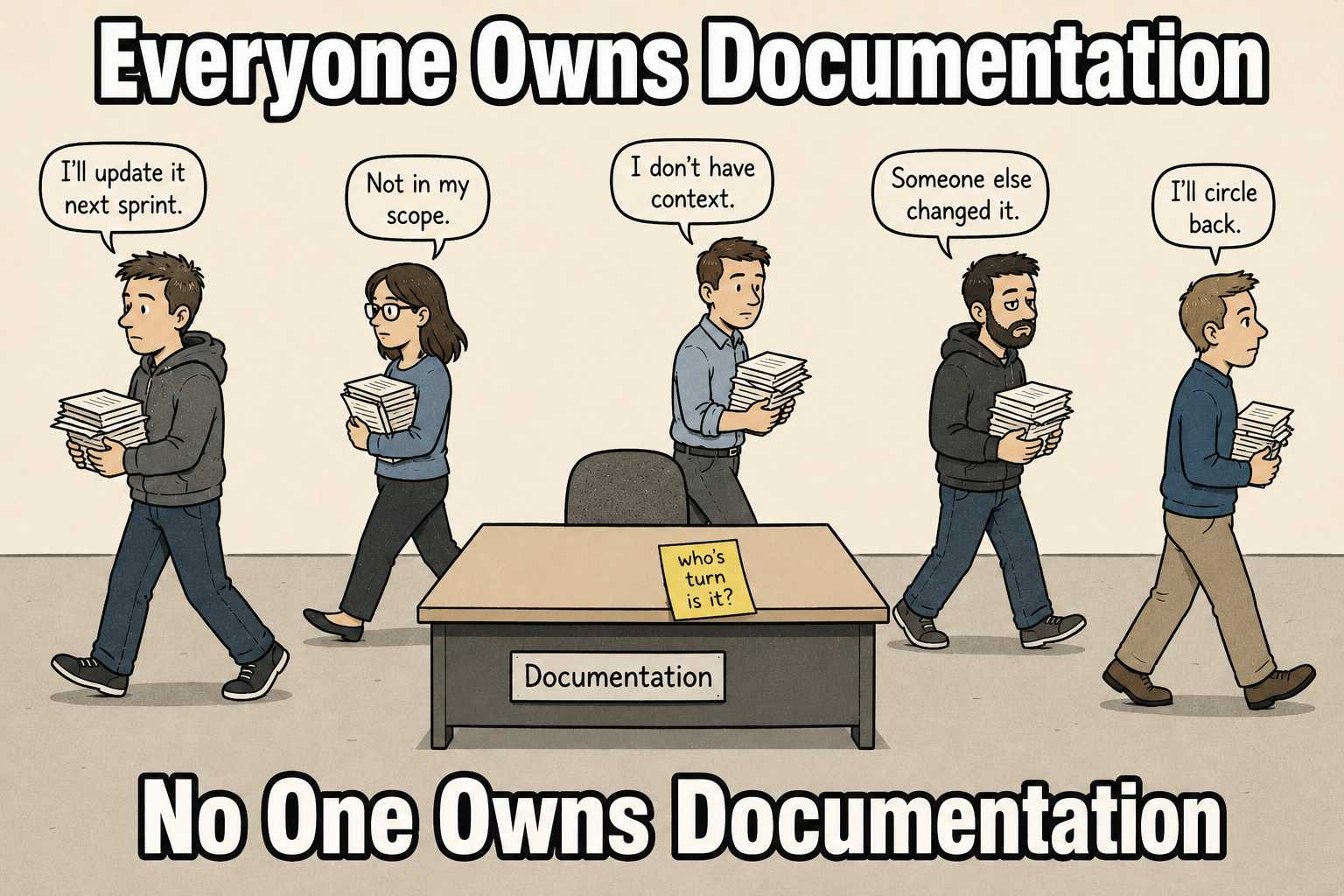
Then release notes take 15 engineer-hours a week to assemble. Support starts answering questions that should have been answered before the ticket existed. A prospect asks for the security architecture, the API docs are one release behind, and suddenly a job description seems like the adult thing to do.
You can keep deferring a technical-writing hire only while the work is mostly mechanical and can be reliably produced from engineering artifacts. Once documentation is constraining enterprise onboarding, developer adoption, support capacity, or retention, delay becomes more expensive than headcount.
The useful distinction is not between companies that “care about docs” and companies that do not. It is between a team that needs a system for producing routine documentation and a team that needs someone to design, govern, and improve that system.
You Can See the Threshold in the Work Already Landing on Your Desk
The first technical writer should not be hired because the documentation folder feels embarrassing. Every documentation folder feels embarrassing to someone. The question is whether the gap is creating a recurring operational cost that the current team cannot clear with a better workflow.
Continuous delivery creates a familiar failure mode: documentation gets treated as waste, drifts from the product, and loses to short-term shipping pressure. Development artifacts are often the best raw material for keeping documentation close to the changes that produced it.
Outdated, missing, and inconsistent documentation makes defect work harder and increases deployment effort.
That gives you a better test than “Do we have enough pages?” Watch the work instead.
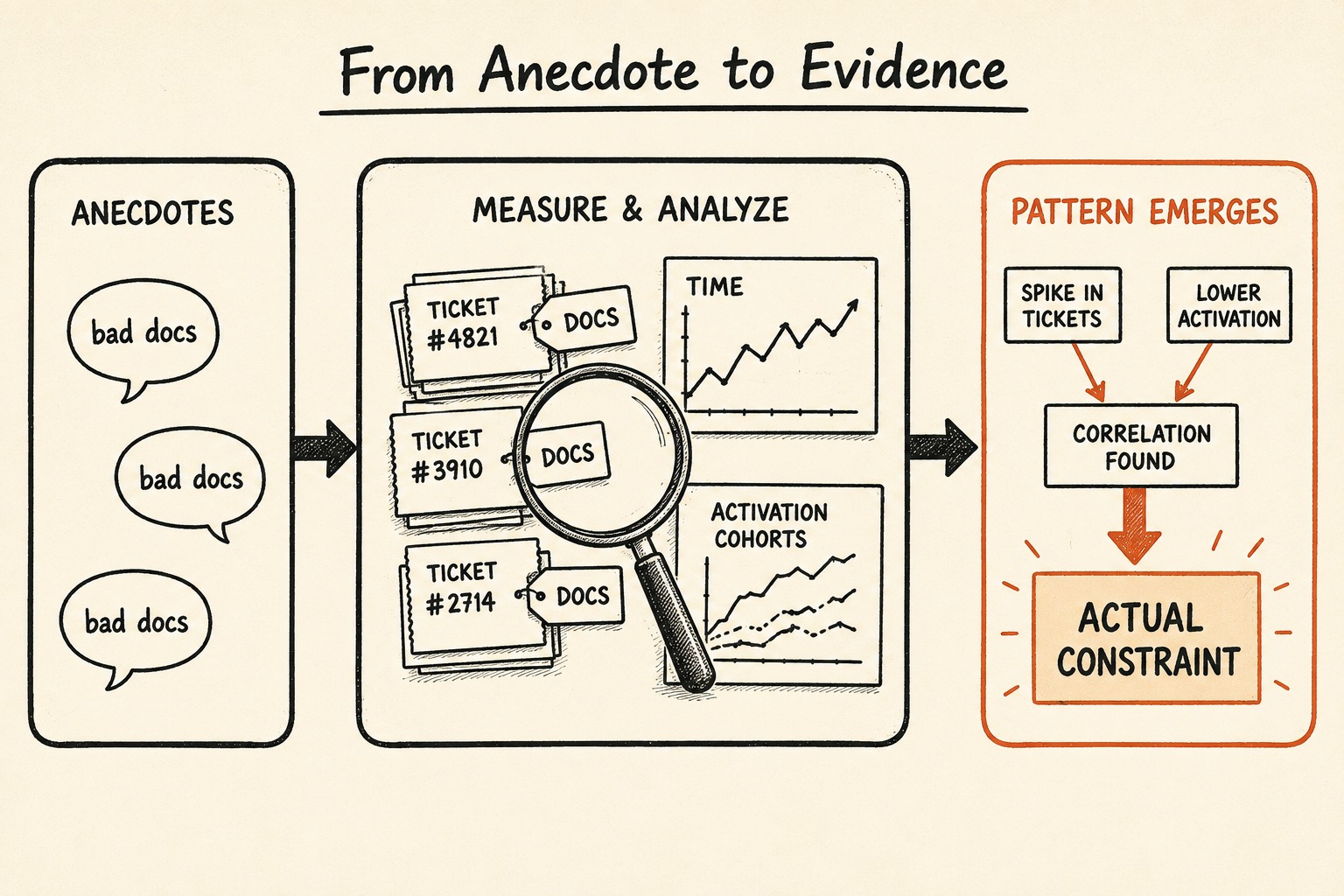
The last row needs a small caution. Do not announce that documentation caused churn because three unhappy customers mentioned it. Measure the pattern: tag tickets, inspect time-to-first-success, compare activation cohorts, and listen for the same friction in renewal calls. The goal is to find an operating constraint, not to win an argument about commas.
Enterprise triggers are especially revealing. A system security plan formally records security requirements and the controls used or planned to satisfy them. When a buyer needs that level of material, the job includes more than translating a merge commit into prose. Someone must collect evidence, set boundaries, coordinate reviewers, and keep the narrative current.
Some of This Work Can Wait, if the Workflow Cannot
There is a real middle path between “engineers write everything by hand” and “hire a technical writer immediately.”
Release notes, changelogs, API references, and change summaries are closely tied to structured evidence: commits, pull requests, issue tickets, tags, and API descriptions. That makes them good candidates for automation. GitHub’s release-note generator already compiles merged pull requests, contributors, and changelog links, with categories defined from labels. The OpenAPI Specification likewise gives documentation tools a standard machine-readable account of an HTTP API’s surface area.
This is why a 15-hour release-note problem is usually a workflow problem before it is a staffing problem. Put release-note categories in the pull-request taxonomy. Keep the API description with the service. Define who reviews customer-facing changes before they ship. Treat the documentation update as part of the release artifact, rather than a mildly optimistic postscript.
There is precedent for the practice. GitLab’s documentation workflow requires documentation for user-facing features, API and UI changes, workflow changes, and deprecations. It describes why separate documentation and code changes can result in surprise features and additional support tickets, then brings documentation into the merge-request review process.
AI makes this workflow considerably more useful for a lean startup. A code-aware system can generate and maintain high-quality repository documentation. Use accuracy, completeness, relevance, understandability, and readability as the quality gates for its output.
Those are management criteria, not reasons to ask a model to moonlight as VP of Customer Success.
Use AI to produce the first pass from the sources that changed. Then use a reviewable process to verify it against the intended audience and release. This buys time to hire deliberately. It also gives the eventual writer a working system to improve instead of an inbox full of “Can you document this?” requests.
The First Writer Should Design the System That Survives Them
There is a point where a better workflow stops being enough.
Hire the first technical writer now if any of these are true: enterprise onboarding requires security or compliance material that cannot be assembled reliably from code changes alone; your API has an external developer ecosystem whose activation depends on coherent guides and examples; support is repeatedly absorbing questions that a maintained documentation program should eliminate; or customer evidence shows that setup guidance is affecting adoption and retention.
At that point, hire a documentation system architect.
That person will still write. They should also set the information architecture, establish templates, define what a release must produce, configure source inputs, direct AI output toward the right audience, and create a review path for engineering, product, support, and security. A useful documentation system starts with scope, audience, and reader goals. Those decisions cannot be replaced by a generated endpoint description, because they are decisions about the business and the user.
This matters most for developer products. People take different paths when learning a new API, so the documentation needs to support more than a reference page. Explicit documentation strengthened the productivity advantages of static typing in a controlled study by Endrikat et al., giving teams one more reason to treat documentation as part of the product experience rather than decorative packaging.
The anti-patterns are predictable. Hiring before the product or release workflow stabilizes creates a moving-target job. Hiring a writer without source-grounded automation turns that person into the slowest part of a growing release process. Treating the writer as a ticket desk gives the company pages, but no system for deciding what belongs on them or how they remain true.
Use a simple decision rule. If the pain is repetitive and source-grounded, build the system first. If the pain crosses functions, blocks revenue, slows onboarding, or requires someone to govern the customer’s understanding of the product, hire now. If automation cannot clear the trigger on its own, that is the trigger.
Doc Holiday fits the first half of that equation. It reads commits, pull requests, and tickets, then generates documentation and release-note updates as reviewable changes. That gives a lean team a way to validate routine output now, and gives its eventual first technical writer a system worth running rather than a documentation department to rebuild from scratch.