How to Avoid Documentation Debt Before Your Series A


An investor has asked for an architecture walkthrough. The CTO opens the system diagram, one of those diagrams that was accurate for a week in February, and gets through the happy path. Then someone asks why the team chose a queue instead of synchronous processing, which endpoints changed in the last two releases, and who owns the deployment rollback.
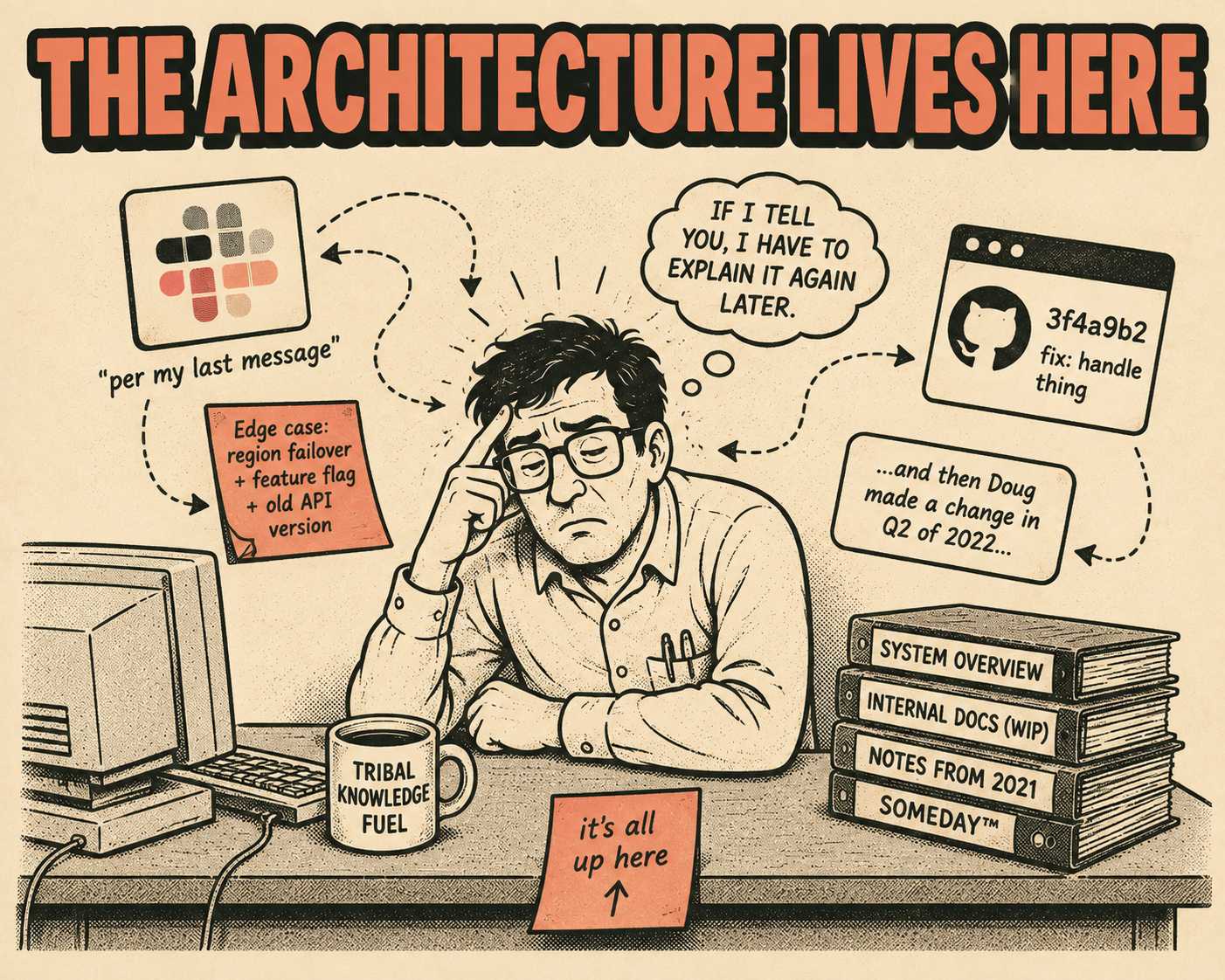
The answers exist. They are spread across pull requests, Slack, commit messages, and the head of the engineer who happened to be in the room.
That is when documentation debt becomes expensive.
The practical way to avoid documentation debt before your Series A is to capture a small, defined set of records at the moments your team already makes decisions and ships software. Treat an architecture decision, an API change, a support escalation, and a release as documentation triggers. Give one senior engineer responsibility for completeness. Use structured formats so the first draft can be generated from the work itself, then reviewed while the context is still fresh.
You do not need a glossy documentation portal. You need enough of a technical record that a competent engineer who joined last week can understand what the system does, why its important choices were made, and how to operate it without beginning with a Slack search.
The Trouble Starts When a Simple Question Needs a Scavenger Hunt
Documentation debt is the accumulation of answers that were available at the time of a decision but were never made durable. The architecture exists, but the rationale is gone. An endpoint exists, but there is no current request example or statement of what breaking change means. A deployment is repeatable, until the person who has done it twelve times is on vacation.
Git history is valuable evidence, but it is a bad handbook. Commit messages tell you that something changed. They rarely explain the rejected alternatives, customer impact, operating assumptions, or follow-up work someone will need later.
This is why the debt hides so well. A small team can carry it for a while. The founders talk constantly. The person who wrote the service answers the support question in three minutes. A new engineer can get the missing context at lunch.
Then the team grows, the product has more surface area, and those three-minute answers happen five times a day. Support escalates issues that engineering should have made self-service. Onboarding turns into archaeology. A fundraise adds a deadline and a new audience that has no reason to know which Slack channel contains the answer.
The organizational risk is real rather than theoretical. Contributor turnover can result in knowledge loss that affects code quality and team productivity. The details vary by team context. A pre-Series A company should not copy a large-company documentation department. It should make its own knowledge easier to recover.
Due diligence does not require investors to read every runbook. It does give them a chance to see whether technical risk and organizational risk have been allowed to merge. An undocumented production path can be fixed. A system whose critical knowledge leaves with one person is harder to explain away.
A Few Records Will Do More Than a Hundred Polished Pages
The first mistake is starting a project called “document the whole company.” That project has no natural end, competes with product work, and usually dies after a heroic week of cleanup.
Start with the records that remove interrupts and preserve decisions. The practical question is how much documentation is enough, because a startup needs artifacts that earn their keep rather than prose for its own sake.
An ADR works well because it captures one significant decision and its rationale, tradeoffs, and consequences. Capturing the decision, context, and considerations in an ADR repository gives future teammates a decision trail instead of another question to reopen. That constraint is a feature.
For APIs, use a contract that machines and people can read. An OpenAPI description gives documentation, code-generation, and testing tools a common description of an HTTP API. Pair the schema with a concise human review of examples and upgrade guidance, and it becomes a stable backbone for current endpoints, versions, and integration questions.
The standard here is modest. Investors do not expect an enterprise help center from a 15-person startup. They do expect evidence that someone can trace the system’s important choices and understand a recent release without assembling a small historical society.
This work also needs an owner. Make one senior engineer or engineering leader accountable for documentation completeness as a measurable operating responsibility. Their job is to define the triggers, inspect exceptions, and keep the team from treating documentation as somebody else’s future problem.
The rest belongs in the existing definition of done. Documentation that travels with the related code gets better timing, visibility, and technical review. A lean startup can use a stripped-down version: when a feature changes the experience, API, or operating procedure, its documentation change travels with it.
Let the Release Do the Remembering
Documentation fails in fast-moving teams because the hard part arrives after the release. The engineer has switched contexts. The details have already blurred. “Write the docs later” means recreating a decision from artifacts that were never designed to explain it.
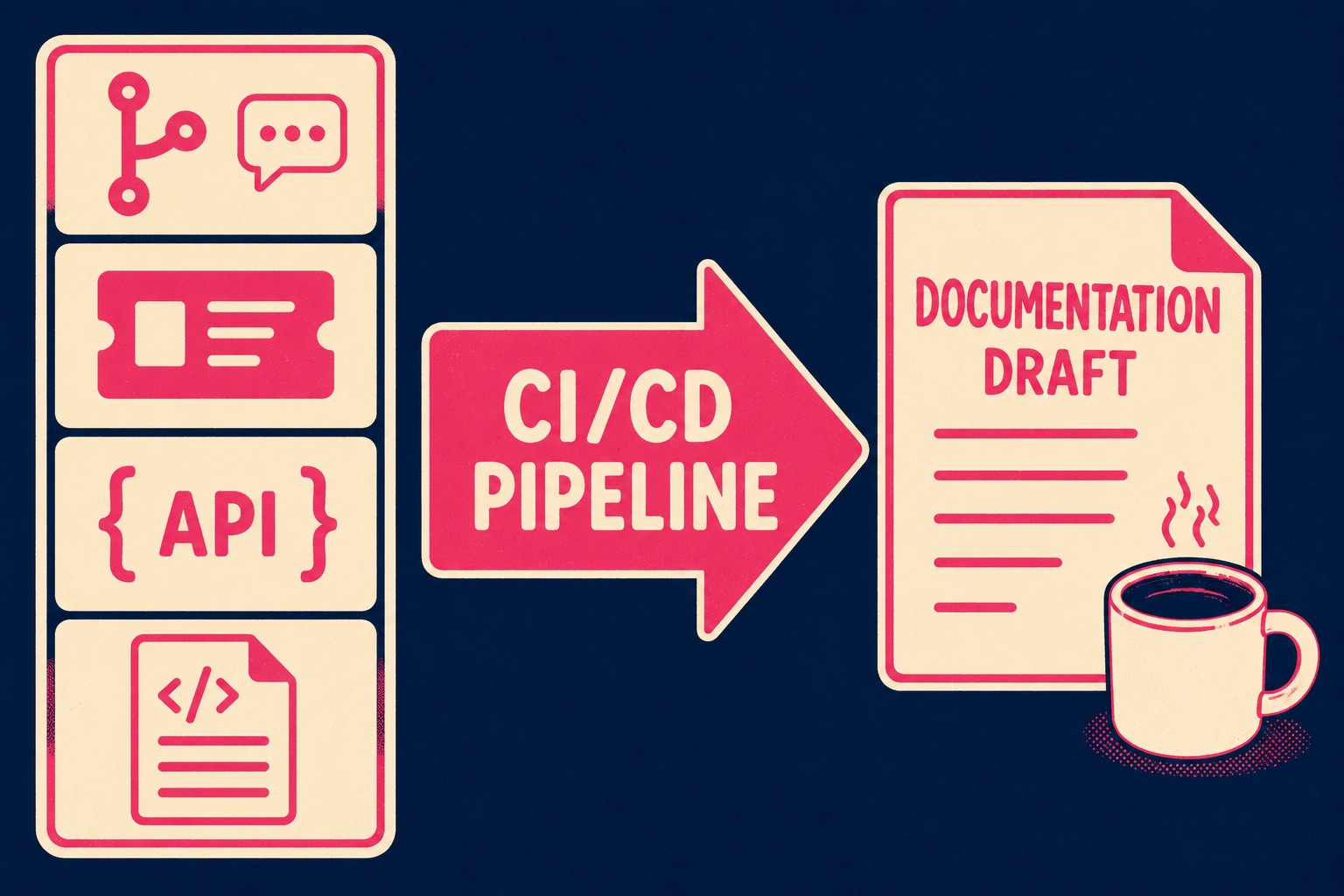
The better operating model runs in the other direction. A pull request, ticket, API specification, deployment config, and release build already contain much of the raw material. Your CI/CD pipeline, the automated system that tests and deploys changes, can use those inputs to flag a required record and produce a baseline draft when a merge or release occurs.
Review remains part of the workflow. The reviewer’s job shifts from transcription to judgment. A senior engineer can check whether an API example is usable, whether a release note describes the customer-relevant change, and whether an ADR explains the consequence that future teammates will care about.
Repeatable releases depend on explicit, automated processes and an archived change report. Your company only needs a scaled-down version of that instinct, where release knowledge survives the release.
For the next month, give the team four small commitments:
- Name the documentation owner and publish the four triggers in the engineering handbook.
- Add ADR, runbook, and release-note templates to the repository, with a required owner and review date on each.
- Require an OpenAPI update or an explicit exception for every externally visible API change.
- Review the last five support escalations and turn the repeated questions into the first runbooks.
After that, measure the pain rather than the page count. Track how often support asks engineering to explain a known behavior, how long a new engineer needs to make a meaningful change, and how many releases ship without an understandable change record. Those are operational measures of whether knowledge is becoming easier to use.
Hiring a dedicated technical writer before Series A may be premature. Arriving at Series A with a blank backlog is much more expensive, because the cleanup steals senior engineering time at exactly the moment leadership needs that time for the product, the team, and the raise.
The choice is when your team does the remembering: while the release context is still on the screen, or later, under a diligence deadline. Doc Holiday reads commits, pull requests, and tickets to generate reviewable documentation and release notes on every release, leaving the senior engineer to validate and refine the record instead of creating it from a blank page.