How to Write a Technical Spec That Doubles as Documentation


A feature ships on Tuesday. On Wednesday, a support question arrives: can a customer change the default retention period, and what happens if they set it too low?
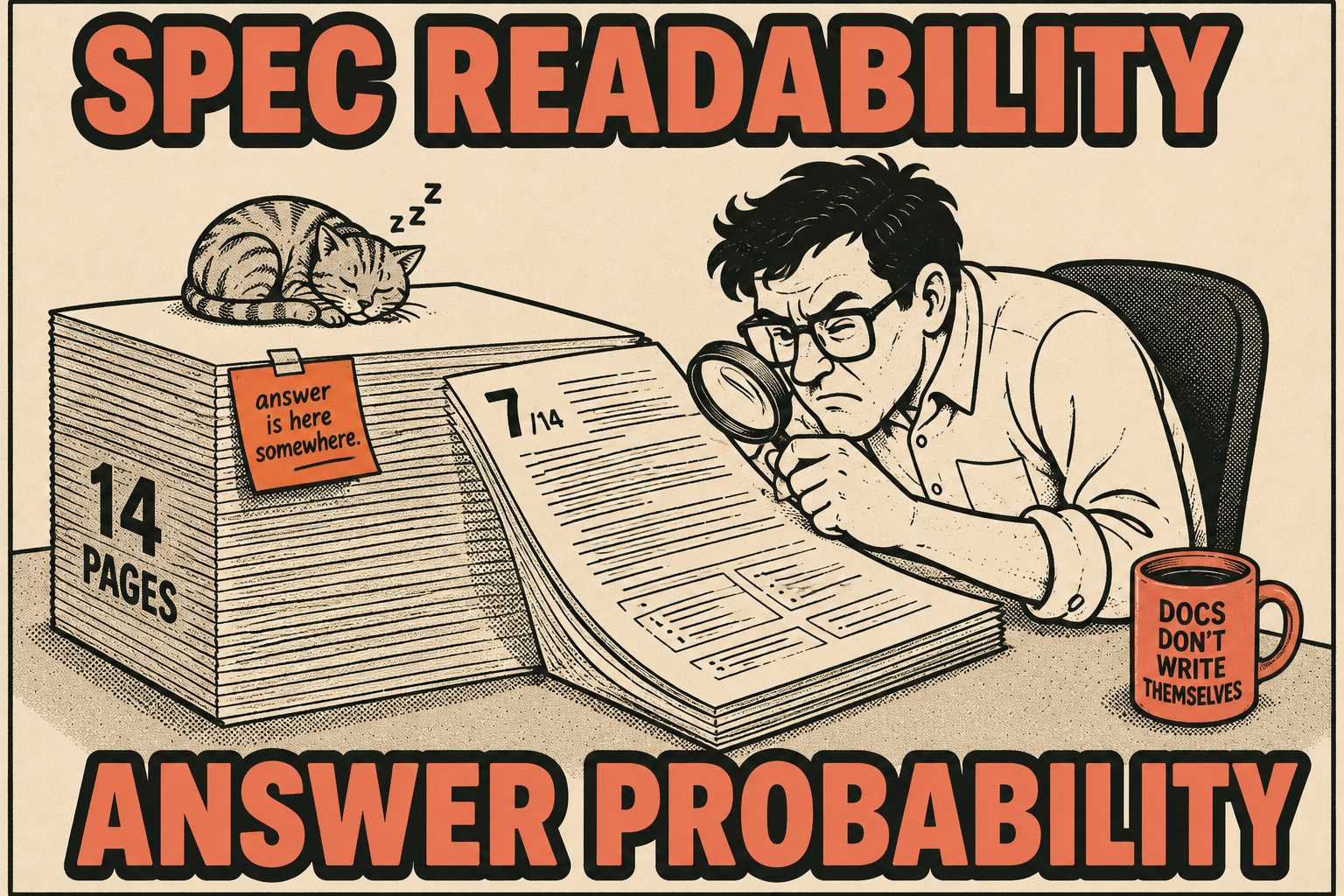
Someone finds the spec. It is 14 pages of careful thought about tables, jobs, retries, migration order, and an internal project with a name that made sense for about three weeks. The answer is probably in there. It is also probably not findable by the person who needs it.
That is the odd thing about many technical specs. Teams write them because a nontrivial change deserves careful reasoning and broad feedback, which is exactly what an RFC is for. Then the feature launches and the team either writes the same information again for customers or decides the spec should count as documentation. One route duplicates effort. The other leaves a beautifully argued record of a meeting standing in for a user guide.
A technical spec can double as documentation when it deliberately contains a user-facing layer: the problem the feature solves, the behavior a person will observe, the inputs and outputs, realistic examples, and the failure cases. Keep the engineering plan too. Just put it somewhere that can be cleanly separated from the part a customer, support engineer, or new teammate needs.
The Useful Part Is Usually Trapped in the Middle
A spec is written for people who already have the room’s context. They know why the change exists, which older system it replaces, and why Project Saffron is an unfortunate but immovable name.
A documentation reader has none of that. Good documentation fills the gap between what the audience must know to complete a task and what it already knows. The gap gets wider once the reader is outside the design meeting, whether that reader is a customer, a support team, or the next engineer to inherit the feature.
That is why first-person plural prose causes so much trouble later. “We decided to add a reconciliation worker after the Saffron migration” records a decision, but it does not explain what a user can do. “You can reconcile invoices after import; the system retries failed checks for 24 hours” gives someone a behavior they can act on.
The distinction is not cosmetic. Product documentation organized around repeatable topic types is easier to scan, easier to find, and less likely to preserve the contributor’s point of view by accident. An implementation-first spec tends to bury the feature’s contract under its construction. A documentation-ready one brings that contract to the surface.
There is a limit here. A design document should still become an archive of implementation decisions after code ships, rather than masquerading as current product documentation. The goal is not to publish an RFC unchanged. It is to give the final docs an accurate, reusable spine instead of forcing somebody to reconstruct the feature from code, tickets, and old messages.
Give the Feature Two Views of the Same Truth
The simplest move is structural. Every significant behavior gets a public explanation, while internal reasoning stays in clearly marked sections. Requirements engineering standards already treat requirements work as producing defined information items with specified contents and formats. Your template can make that discipline useful downstream.
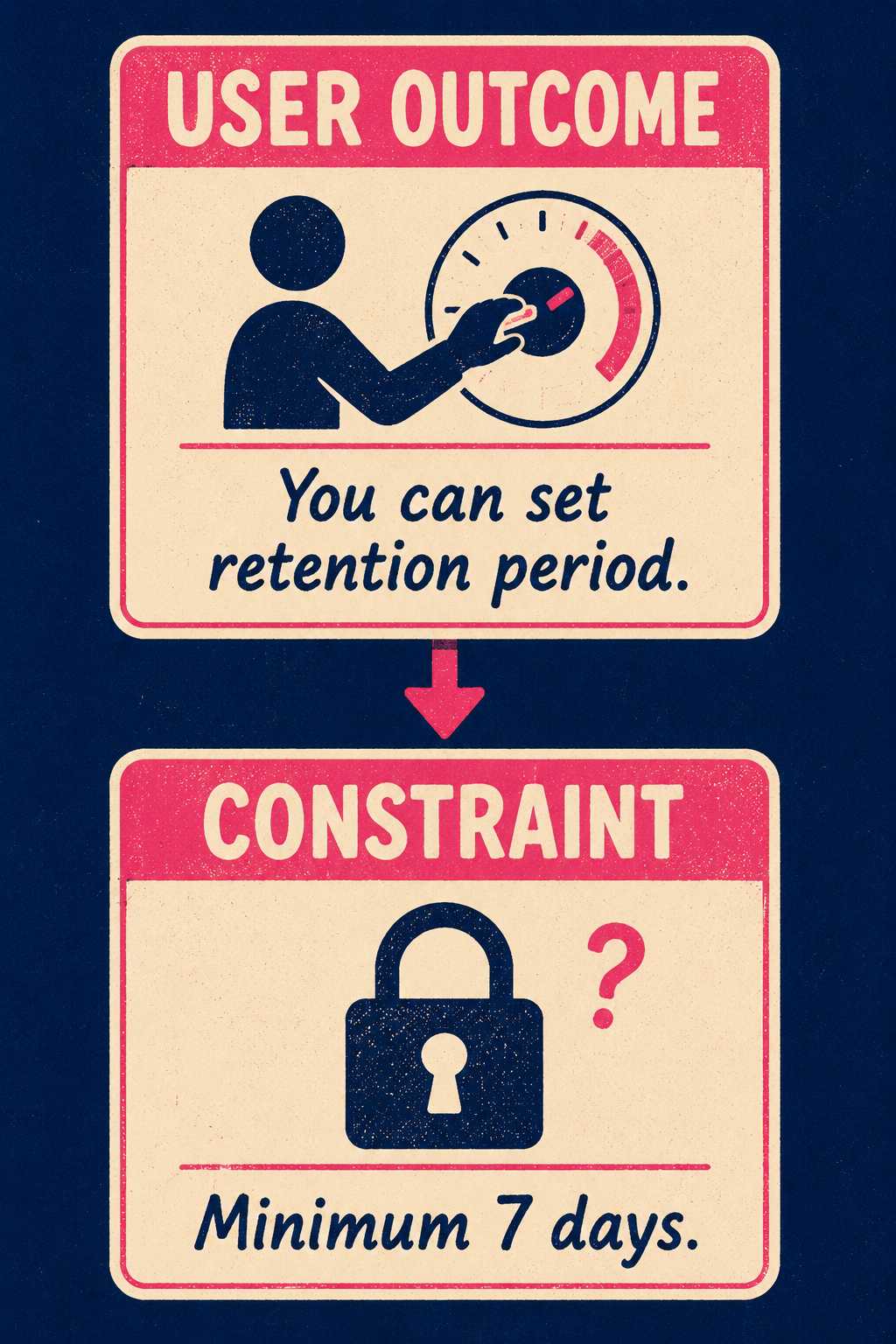
Start every behavior section with the outcome. “You can set a retention period for each workspace. New records are deleted after that period expires.” Only then explain a constraint: “The minimum is seven days because shorter periods can interfere with recovery.” The reader understands the point before meeting the machinery.
That changes the quality of the spec itself. Engineering review improves when reviewers can see the user-visible contract, rather than inferring it from an implementation diagram. It also gives product, support, and technical writing a stable thing to challenge: Is the default sensible? Is the permission rule clear? What happens when the value is invalid?
Use headings that map to real documentation needs. Overview, when to use it, configuration, response, errors, and limitations are not glamorous, but they are useful. Reusable template sets consistently distinguish how-to guides, reference, tutorials, troubleshooting, API references, and release notes because each answers a different reader question. A spec does not need to become six separate documents. It needs enough shape that those documents can later be created without a scavenger hunt.
The same rule applies to examples. Do not write “send foo to bar” and promise to improve it later. Add a believable example when the behavior is designed:
You can setretention_daysto30for thefinance-prodworkspace. If you send3, the API returns400and identifiesretention_daysas the invalid parameter. Existing records keep their original schedule until you save a valid value.
That paragraph contains a user outcome, a concrete input, an expected result, an error, and an edge case. It is already close to reference documentation. It also follows a pattern mature API docs use in practice: status codes, a human-readable message, error type, and the relevant parameter all help a caller handle a failure.
Define terms when they first appear, even when the feature team believes everyone knows them. Spell out unfamiliar acronyms. Replace code references with behavior unless the code reference is genuinely part of the user contract. The curse of knowledge is not a moral failure; it is what happens when experts forget what a new reader cannot infer.
The Last Mile Still Has a Human in It
Extracting user-facing sections from a spec is a head start, not a release process. The final documentation may still need screenshots, a tutorial for the broader workflow, navigation, localization, and troubleshooting shaped around the questions support actually receives. A person outside the feature team should validate it, ideally by trying to use the feature with the draft open.
The handoff gets much easier when the spec marks its boundaries from day one. Add a small label, front matter field, or section convention for publishable behavior and internal implementation notes. Then run a short review before launch:
- Can a reader identify the user problem and the intended outcome without knowing the project’s history?
- Are parameters, defaults, permissions, responses, and limits described as observable behavior?
- Does every error state say what happened, why it happened when safe to disclose, and what you can do next?
- Do examples use realistic values and show the result, including at least one edge case?
- Are implementation notes, code names, and decision logs separated from the material intended for publication?
After launch, treat the extracted docs as the product’s source of truth and update them in the same change as the code. Documentation debt accumulates during development and is closely related to requirements issues, not merely an editorial cleanup problem. Shared version control, review, and test workflows help keep authorship close to the release, which is the practical idea behind docs as code.
A documentation-ready spec makes this maintenance loop less fragile because it preserves the context most likely to disappear: what changed for users, why they would use it, and what happens at the edges.
That is also where Doc Holiday fits. It reads the commits, pull requests, and tickets around each release to draft documentation and release notes, then puts the result in a reviewable pull request. A well-structured spec gives that workflow a clearer behavioral contract to work from; human review makes sure the published version still says what a person outside the room needs to hear.