What Should You Document Before Product-market Fit?


There is a familiar early-stage failure mode. A founder opens the company’s API docs and finds five beautifully formatted pages for an endpoint that may be gone in three months. Then a new engineer asks why the team built that endpoint in the first place, and the answer is scattered across an old Slack thread, a sales call, and someone’s memory.
The first artifact took time. The second one had value.
So, what should you document before product-market fit? Document the things that increase learning velocity: what users actually said, what patterns you are seeing, which trade-offs you made, and what constraints still shape the product. Keep customer-facing reference material light while the product is changing quickly, unless customers genuinely need it to succeed today.
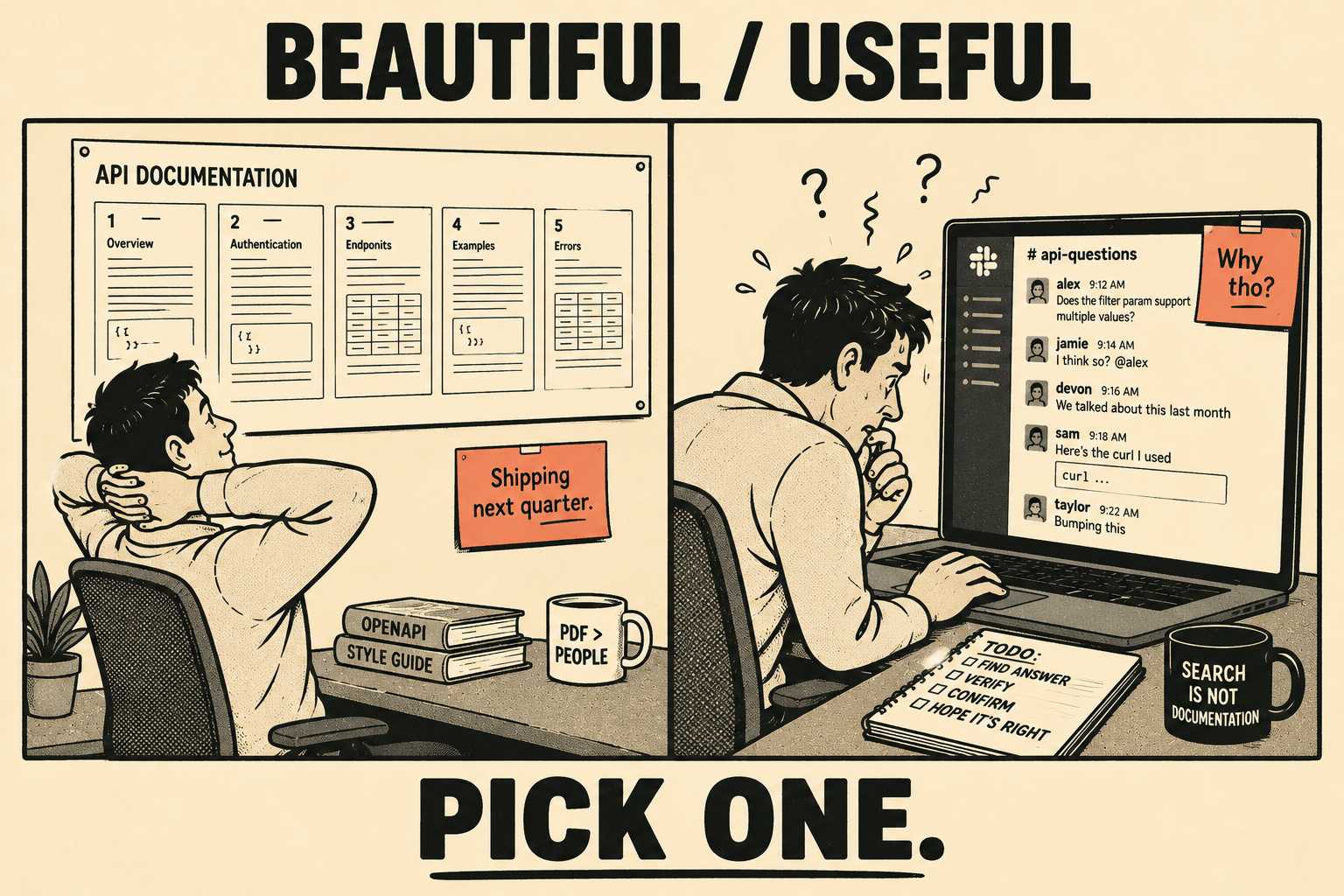
This is less tidy than “document everything,” but it matches the job of a pre-PMF company. You are trying to learn your way toward a product people want. In fast-moving development, teams routinely leave stakeholder concerns, assumptions, constraints, and decision rationale implicit while feature docs drift from the product. That loss of context makes maintenance and knowledge transfer harder than they need to be.
Your documentation should preserve the parts of discovery that would be expensive to rediscover.
Most Documentation Expires Faster Than You Think
An early API reference is usually a bet, not a contract. The same goes for setup guides, screenshots, configuration instructions, and elaborate internal wikis describing a workflow that still changes every week.
You may still need some of these documents. A design partner who cannot integrate without a setup guide has a real problem, and solving it matters more than maintaining a principle. The point is to write the minimum useful version, then let it change or disappear without treating that work as sacred.
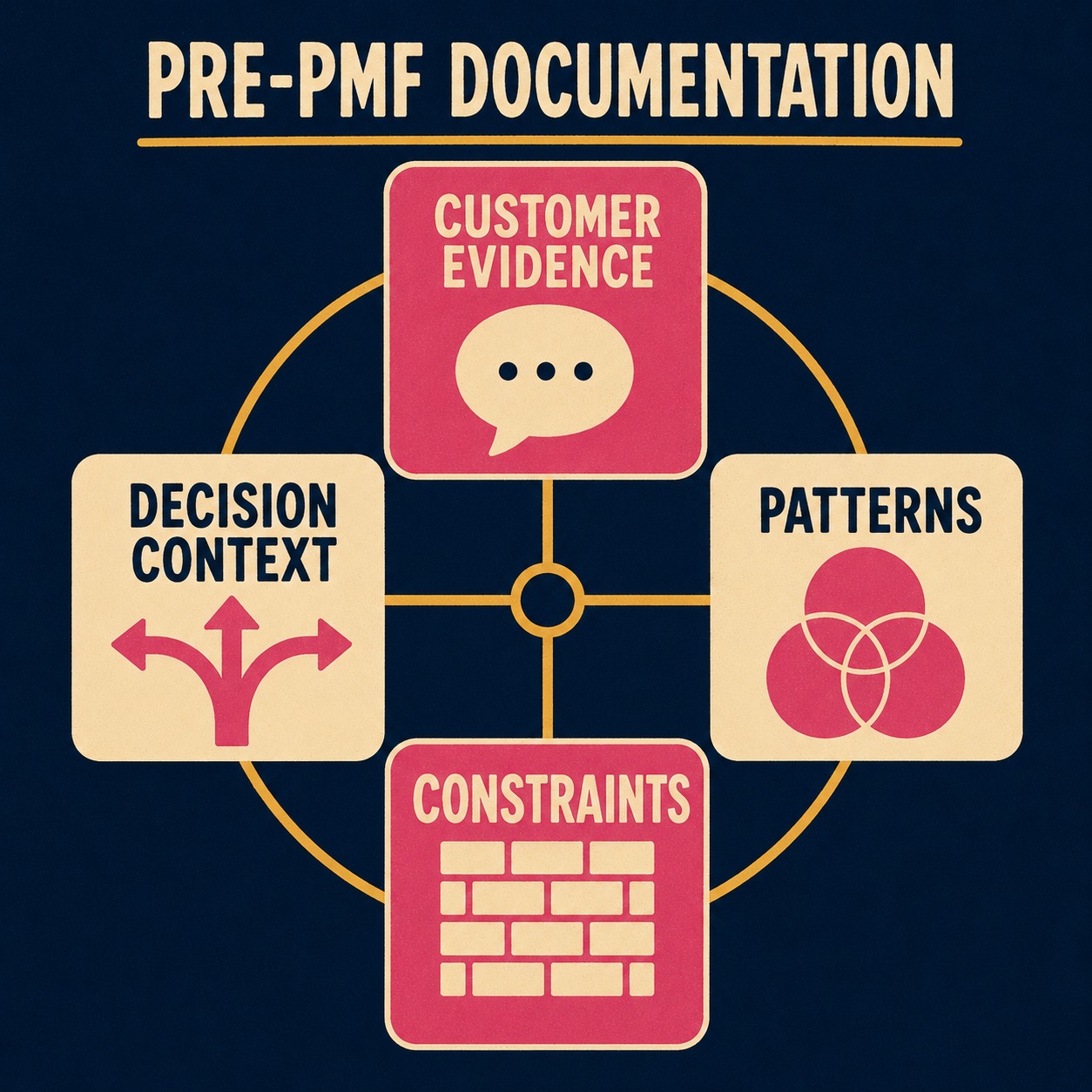
The more durable material lives closer to the problem than to the current implementation. Keep a simple record of four things:
- Customer evidence. Save interview notes, short clips or quotes, support conversations, and the context around a request. In-depth interviews can reveal how different users work, what they are trying to achieve, and which problems matter to them, especially when each research round leaves a usable record.
- Patterns, not just requests. A feature request becomes meaningful when you can see who is asking, what job they are trying to do, and whether the same friction appears across interviews, tickets, and product behavior. A small, searchable repository can track findings over time and reveal patterns that one conversation would conceal. Start with broad tags, then refine them as the body of evidence grows.
- Decision context. When you build, defer, or decline something, write down the customer signal, alternatives considered, trade-off, and condition that would make you revisit the call. A decision record can stay deliberately small: one significant choice, with its rationale, consequences, and trade-offs. The same format works for product decisions.
- Constraints that survive the feature. Record the early user archetypes, positioning choices, system boundaries, regulatory assumptions, and technical decisions that limit future options. These may change, but they change slowly enough to deserve a timestamped explanation.
That is the pre-PMF documentation set. It is compact because it has a narrow purpose: helping the team turn messy customer evidence into better decisions.
A weekly synthesis is often enough. Take the notes, tickets, and requests from the week and write a few sentences on what changed in your understanding. Share findings quickly, because teams use them to prioritize work, refine user needs, and adjust the roadmap; brief summaries work well in iterative teams.
The polished report can wait.
The Thing You Are Really Trying to Save
Pre-PMF documentation is mainly for the people who will join after the company has found some traction.
They will inherit a product whose shape may look obvious in retrospect. It rarely was. They will see a strange limit in the billing flow, an awkward abstraction in the data model, or a feature that feels smaller than its implementation suggests. The valuable answer usually lives in the argument that was available at the time, rather than in a changelog entry.
That argument gets lost quickly because early teams make decisions in rooms, calls, and message threads. The team is small enough that shared context feels free. Then someone leaves, the customer mix changes, and a new teammate has to infer history from the code. Fast-moving teams are particularly prone to leaving assumptions, constraints, stakeholder concerns, and decision rationale implicit.
You do not need a memo for every choice. Save the ones that create a constraint, establish a product belief, or would cause a future teammate to ask, “Why on earth did we do it this way?”
There is a useful precedent in incident practice. A postmortem is a learning record with context, contributing causes, and follow-up actions. Clear triggers, templates, and review keep the system useful without turning it into ceremony.
A pre-PMF team can borrow that idea without pretending every product decision is an outage. Write a short learning memo after a customer segment surprises you, a major hypothesis fails, a design partner churns, or a product choice creates an unexpected trade-off. Those are the moments that deserve more than a thumbs-up reaction in Slack.
Keep the Record Close to the Work
Documentation becomes a tax when it requires a second version of the work. The engineer ships a change, then has to reconstruct the change in a separate tool, then remembers the documentation is already stale next month. Few teams keep that habit for long.
Better systems use the evidence already created during the work. Pull requests bring together the proposal, discussion, commits, checks, diffs, and review feedback that explain a code change. Issue trackers, support systems, design files, and customer notes contain the rest of the trail.
This is the logic behind docs as code: documentation can live in version control and review workflows alongside code, rather than in a separate publishing ritual. The approach works when docs are owned, reviewed, and connected to the workflow that produces the software, with design context kept distinct from reference material.
For a pre-PMF team, that suggests a practical division of labor. Keep the learning log and decision trail intentionally human, because someone must decide what the evidence means. Let the mechanical baseline of release notes, change summaries, and unstable reference docs draw from engineering activity wherever possible.
The expensive failure is rarely a thin API guide. It is repeating a customer interview, an architecture debate, or a failed experiment because the team forgot what it already learned.
Doc Holiday’s documentation platform gives lean teams a way to maintain that baseline without assigning someone to documentation full time. It reads commits, pull requests, and tickets, then drafts updates and release notes as reviewable pull requests. The team can preserve its attention for the learning that will decide whether the product exists six months from now.