The Release Note is a Narrative Artifact


If you ran a development team, and a group of technical writers offered to shadow your engineers and document every change they made for $5.92 an hour, you would probably hire them immediately.
You would hire them because you know that shipping a feature is only half the job. The other half is explaining to the people paying for the software why that feature matters. But you do not have a team of technical writers on standby. Instead, at the end of a long sprint, someone—usually a product manager or a tired engineer—scrapes together commit messages, pull request titles, and Jira ticket numbers. They compile these fragments into a bulleted list, hit publish, and call it a release note.
The result is technically accurate. It is also contextually dead.
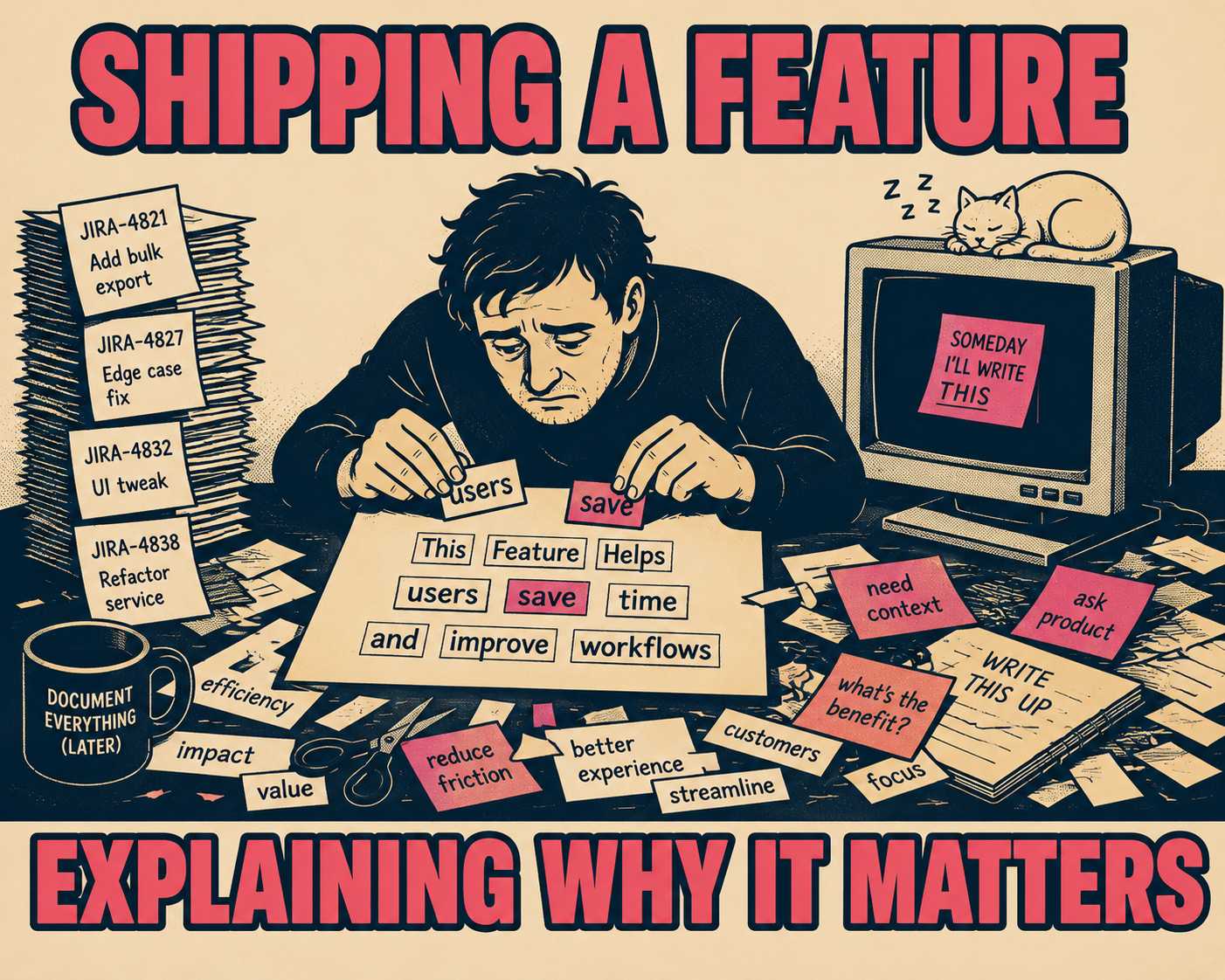
When release notes read like compliance documents, users skim past them. Research across 32,425 release notes from 1,000 GitHub projects found that development teams consistently treat release notes as a technical artifact rather than a communication tool, and that significant discrepancies exist between what producers write and what users actually need to know. When teams treat changelogs as a dumping ground for technical tasks, executives see a list of closed tickets rather than progress toward strategic goals. Meanwhile, competitors with weaker products but better storytelling look more innovative.
Release notes are a narrative artifact, not just a changelog. Good release notes connect technical decisions to user outcomes, position the work in a strategic arc, and give the team credit for solving hard problems. The goal is not to hype incremental work, but to make real progress legible to the people who care.
Here is how to write them.
Start with the User's Problem, Not the Implementation
Most teams write release notes backward. They start with the implementation details because the implementation is what they just spent three weeks arguing about.
A performance optimization announcement often opens with details about query indexing or database migrations. A new API endpoint announcement describes the schema. But the person reading the release note does not care about the database migration. They care that the dashboard no longer takes ten seconds to load.
Lead with the user impact. Show what changed for the user before explaining how it was built. If you reduced load times, open with "Dashboard load times reduced by 40%." If you added a new API endpoint, describe the workflow it enables, not just the schema. Reserve the technical depth for a second layer. Assume the first sentence is read by someone who does not know your stack, because it usually is.
The cognitive science behind this is straightforward. Research on documentation comprehension in software engineering shows that minimizing unnecessary mental effort helps users absorb technical material more effectively. When you force a user to translate a technical change into a business outcome, you are adding cognitive load that serves no one. Do the translation for them.
This is also where the "nobody reads the documentation" myth collapses. A study examining whether software users actually consult documentation found that, contrary to popular belief, users do read it—they just want to understand what changed and why they should care. The notes are not being ignored. They are being read and found useless. That is a framing problem, not an audience problem.
Frame Technical Decisions as Solved Problems
Every release note can answer three questions: What was broken, slow, or impossible before? What trade-off did the team navigate? What constraint did they work around?
When you answer these questions, you frame technical decisions as solved problems rather than just features shipped. This gives engineering work narrative weight. It makes the changelog feel like a roadmap of resolved complexity, not just a list of additions.
Consider the difference between "Refactored authentication module" and "Fixed a session timeout bug that was logging users out mid-workflow." Both describe the same work. The second one explains why it mattered to the person who was getting logged out of a form they had been filling out for twenty minutes.
This framing is particularly important when communicating with non-technical stakeholders. When you explain the constraint you worked around, you help executives understand why the work was difficult and why it took the time it did. You make the invisible labor of software engineering visible. The Pragmatic Engineer has written about how writing is increasingly the tool engineers use to influence beyond their immediate team, and release notes are one of the highest-leverage places to do that.
Use a Consistent Structure So Stakeholders Can Scan Quickly
Stakeholders and users read release notes to extract information quickly. A consistent structure helps them scan and absorb that information without having to learn a new format every time.
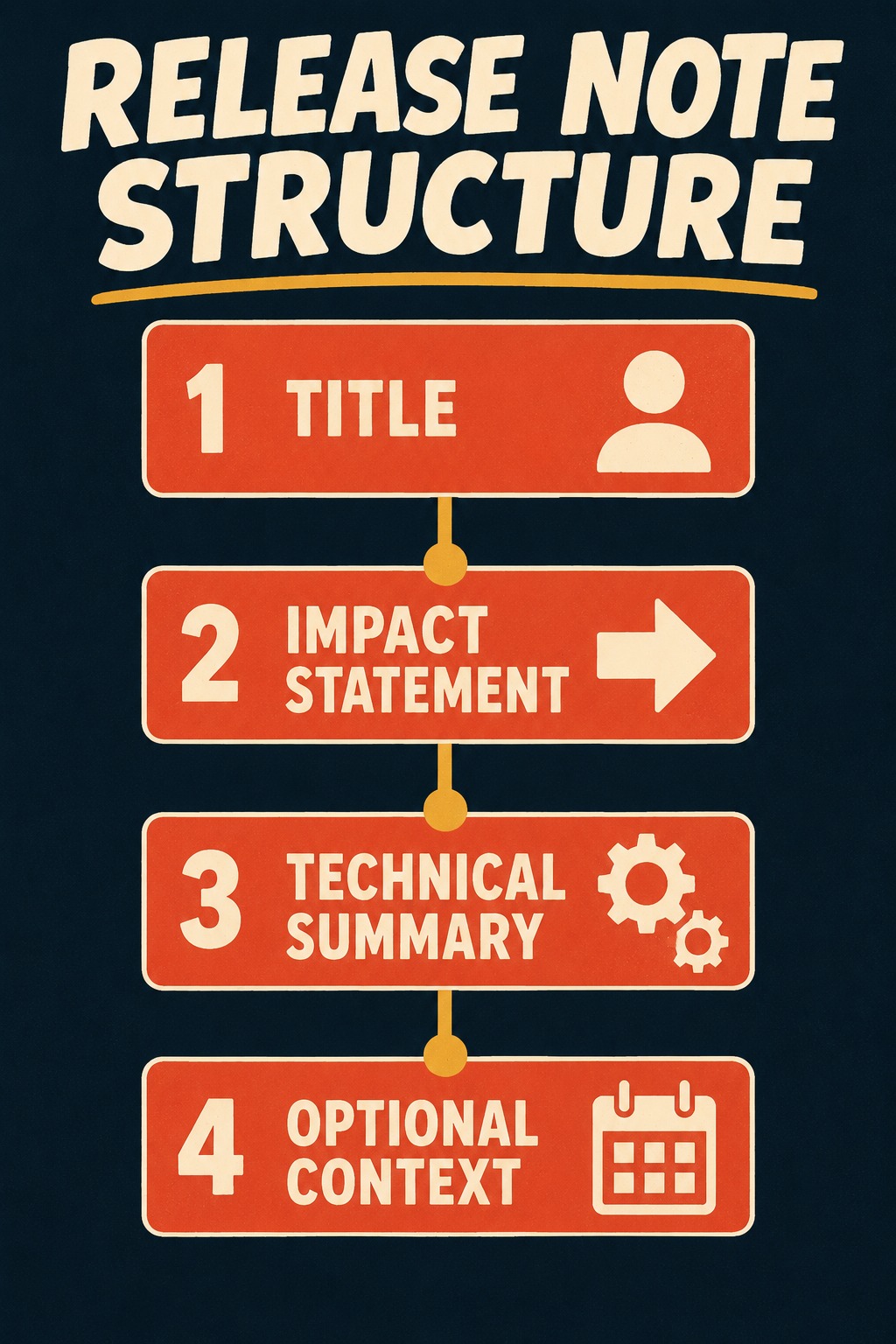
A reliable format includes four components: a title that states the user-facing outcome, an impact statement of one sentence explaining what the change enables, a technical summary of what changed under the hood, and optional context about why the change happened now or what comes next.
Consistency makes your release notes feel authoritative. It also lets readers build a mental model of how your team works. The Keep a Changelog project, which has become a widely adopted standard for open source and commercial software alike, makes the point directly: changelogs are for humans, not machines. Grouping similar types of changes and maintaining a predictable structure helps readers navigate the document without hunting for what they need. When you stick to a predictable structure, you respect the reader's time. That is not a small thing.
Simon Willison, who maintains several widely-used open source projects, argues that the best release notes include an introductory paragraph highlighting major themes, links to relevant documentation, and examples that answer the question "what has changed and why does this matter to me?" The format is flexible; the discipline is not.
Give Maintenance Work Its Due
Not every release is a moonshot. Maintenance, refactoring, and paying down technical debt are necessary and valuable. The mistake teams make is treating these releases as failures of ambition, hiding them behind vague phrases like "bug fixes and performance improvements."
Frame maintenance work clearly. "This release focused on platform stability" signals intentionality. It tells the user that the team is actively investing in the foundation of the product. It also sets up the next release to feel like forward motion, not recovery.
The stakes here are higher than they look. Technical debt has a massive hidden cost. Stripe's research found that engineers spend roughly 33% of their time dealing with technical debt, which translates to over $1.6 million per year for a 50-person team. When you document the work done to manage that debt, you communicate to executives that the engineering team is protecting the company's investment. Framing a refactoring sprint as "we reduced the risk of future outages by eliminating 40,000 lines of legacy code" is not spin. It is accurate.
Maintenance releases also deserve to be treated as a category, not a confession. The Common Changelog style guide notes that refactorings, which may have unintentional side effects, should always be included in changelogs so the community can review them. This is good advice for internal stakeholders too. The alternative—burying maintenance work in vague summaries—trains your audience to assume nothing important happened.
Tie Individual Updates to the Larger Arc
Stakeholders want to see the team moving toward something, not just shipping in isolation. If you are three sprints into a migration, say so. If an API addition is part of a multi-quarter platform evolution, name the arc. If this performance work is the first phase of a broader infrastructure overhaul, tell that story.
Tying individual updates to larger goals is especially important for engineering leaders defending roadmap decisions to executives. It shows that the team is executing against a strategy, not just reacting to tickets. It also helps users understand that the product is being actively developed in a direction, which builds trust in a way that individual feature announcements cannot.
An empirical study of release notes patterns across 69,851 releases in the Google Play Store found that most developers consider release notes useful for notifying their user base, but that the patterns teams use vary widely in their effectiveness. The releases that performed best were those that communicated not just what changed, but where the product was going. Context is not decoration. It is information.
The Resource Problem Nobody Wants to Talk About
Most teams know this is the right way to write release notes. They do not do it because the people who could write well are underwater with feature work. Engineering teams are not staffed to produce narrative documentation at velocity.
Bringing in a technical writer helps, but most teams do not have one on payroll, and contractors are expensive to keep in the loop. Research on technical writing workflows found that technical writers spend only about 20-30% of their time on actual writing; the rest goes to coordination, review cycles, and tracking down the engineers who actually know what a change does. At the pace most engineering teams ship, that overhead compounds quickly.
The blank-page problem is real. The person tasked with writing the release note was not in the design review. They do not remember what user problem the feature was supposed to solve. They write what they can reconstruct from commit messages, which is usually a description of what changed technically, not why it matters to anyone.
This is where an AI documentation system built into the engineering workflow creates leverage. Doc Holiday generates structured release note candidates by pulling context from commits, pull requests, tickets, and team activity. Those candidates are starting points for human editors, not finished copy—the team still decides what to emphasize, what to cut, and how to frame the work for its audience. Doc Holiday does not replace that editorial judgment. It eliminates the blank page, so the team spends its time refining a coherent draft rather than reconstructing context from scratch. The output is consistent, the process is fast, and the team's narrative authority stays intact.