Keeping AI Product Documentation Accurate When Models Change


If you ship a traditional software product, you know exactly when its behavior changes. A developer writes code, a pull request is merged, a build is deployed, and a changelog is written. The causal chain is explicit. But if you ship an AI-native product, the underlying engine changes without your permission. A silent provider update to Claude or GPT-4 shifts how the model handles edge cases, formats outputs, or follows instructions. Your product's behavior drifts, and suddenly, the documentation you wrote last month is no longer describing the product your users are interacting with today.
The core challenge of AI product documentation is that you are documenting a probabilistic system built on dependencies that evolve outside your control. When an LLM provider ships an update, it can introduce negative flips—instances where previously correct behavior suddenly fails, even if the model's aggregate benchmark scores improved. Your API references, prompt engineering guides, and integration examples become subtly wrong. The goal isn't to achieve perfect synchronization manually; that requires heroic effort. The goal is to build an operational system that detects drift, isolates model-dependent documentation, and validates examples automatically.
How to Know When Your Docs Are Lying
Traditional documentation assumes a stable, reproducible product. If a user follows step three, they get result four. In AI products, this assumption breaks down. A model update might improve reasoning but become more verbose, breaking strict length constraints you documented. It might adopt a safer refusal posture, suddenly rejecting prompts that your own tutorials suggest users try.
To know your documentation is wrong, you have to treat the model like a dynamic system component and monitor its behavior, not just its uptime.

The first step is establishing behavioral fingerprints for your model. This means defining a curated set of probes that reflect the specific, high-risk scenarios documented in your guides. You send these probes to the model regularly and capture structured signals: answer structure, refusal style, and formatting adherence. When the model's responses cross predefined thresholds, you have quantifiable evidence of drift, not just a vague feeling that the product feels different.
You also need to monitor for silent infrastructure updates. Providers often update safety policies or serving infrastructure without changing API endpoints, which can cause significant behavioral shifts with no corresponding update to release notes. When Anthropic investigated reports of Claude's degradation, they found that a combination of three separate bugs—including a caching optimization error and a prompt tweak to reduce verbosity—had compounded to make the model seem forgetful and less intelligent. If your documentation promised a specific level of context retention, it was suddenly inaccurate for reasons entirely invisible to your engineering team.
The Triage and Update Workflow
When a model update ships—or when your drift detection alerts you to a silent change—you cannot manually rewrite your entire documentation suite. You need a triage process.
Start by defining production contracts for your application. These are explicit rules for how the model is allowed to behave in your specific context—for example, "JSON outputs must be valid" or "authentication code must pass security tests." Map your documentation to these contracts. When a contract is violated, you know exactly which sections of your documentation are now at risk. This kind of deployer-side governance separates teams that respond to model updates systematically from those that scramble.
Next, organize your documentation updates by risk category. A shift in the model's tone might require a minor note in a best-practices guide. A change in how it handles JSON formatting, however, invalidates your core API integration tutorials and requires immediate attention. Maintain a living document of known model behaviors and edge cases that need verification after every update. This focuses your team's effort on the claims that matter most to users.
Architecting for Instability
You can make this problem more manageable by changing how you structure the documentation itself.
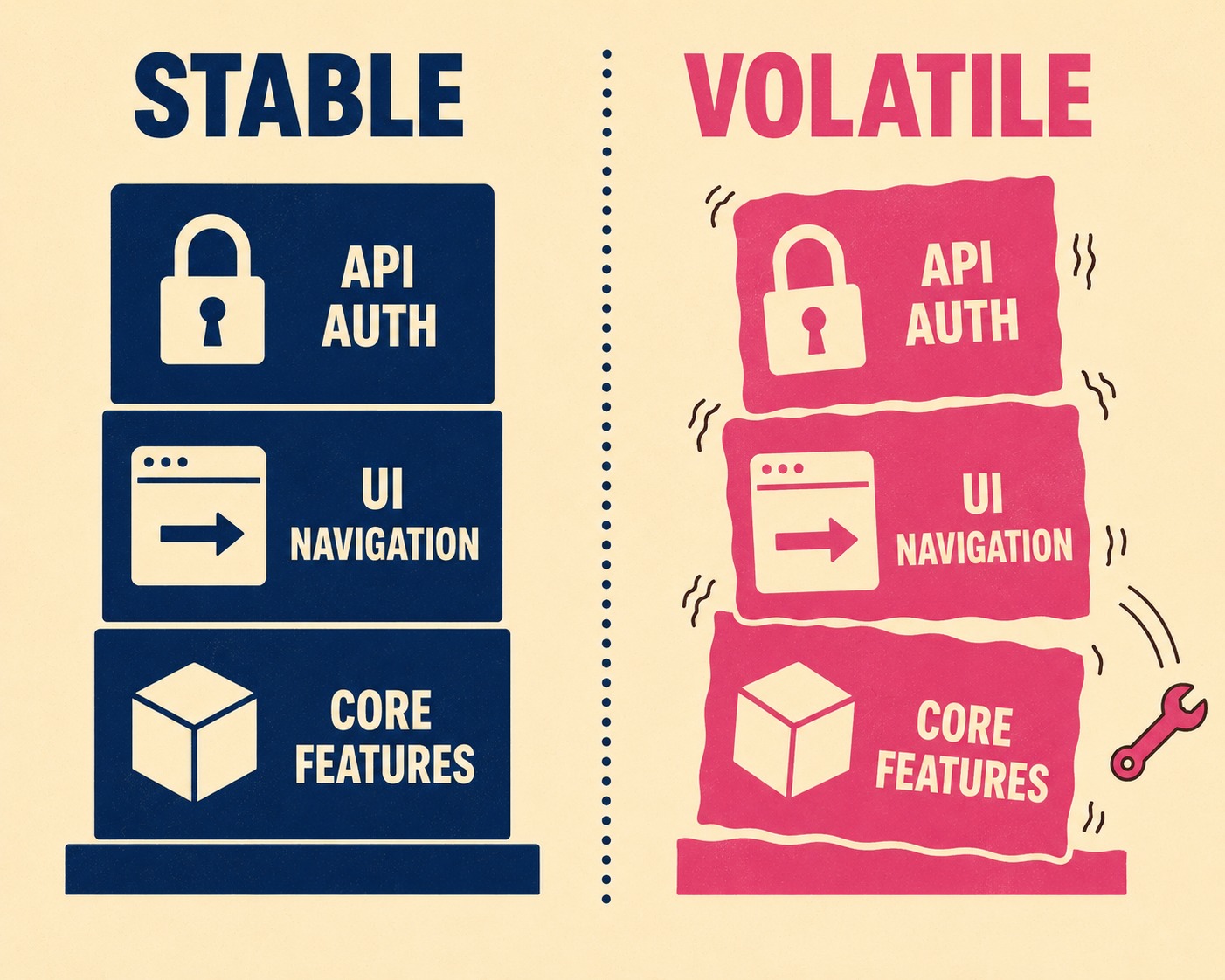
Separate stable product functionality from model-dependent behavior. The mechanics of your API authentication or your user interface navigation won't change when OpenAI updates a model. Keep those sections distinct from the prompt engineering guides or the expected output examples, which are highly volatile.
Use parameterized examples. Instead of hardcoding static responses into your documentation, build a system where examples can be regenerated against new model versions. This is the essence of docs-as-code: treating your documentation with the same version control and continuous integration practices as your software. When a new model version is adopted, your CI pipeline should run your documented prompts against the new model and flag any outputs that deviate significantly from the published examples.
You also need to rethink versioning. Maintaining a single "current" version of documentation is dangerous when users might be pinned to older model versions for stability. Provide version-specific documentation that aligns with the model version the user is actually interacting with. Documentation drift is gradual and invisible—users believe stale content is true, and that erodes trust long before anyone files a support ticket.
Validating the Claims You Make
How do you verify that your documentation still matches reality? You build regression suites for your documentation.
A golden dataset is the foundation of this effort. This is a curated collection of inputs that represent how your system is actually used, paired with expected behavior. Every example in your documentation should be represented in this dataset. Treat it like code: version it, review changes, and grow it continuously as you discover new failure modes.
Run layered evaluations against this dataset. Start with fast, deterministic checks to ensure the model still adheres to the strict formatting rules your documentation promises. Then use semantic checks to ensure the substance of the answers hasn't drifted. If your documentation claims the product can handle a specific complex workflow, your automated testing must execute that exact workflow and verify the result. When a documented output no longer matches the observed behavior, the test fails, and the documentation is flagged for review.
The same principle applies to output quality. GPT-4's behavior measurably shifted across versions in ways that weren't captured in official release notes—code generation accuracy, verbosity, and refusal rates all changed. If your documentation describes expected output quality, you need automated checks that can detect those shifts before your users do.
Communicating Without Causing Panic
When you do update your documentation to reflect model changes, communication strategy matters. You have to explain that the product behaves differently without implying that it is unstable or unpredictable.
Users experience a loss of control and diminished trust when models update silently or features are deprecated without warning. Your changelog is the antidote to this uncertainty.
Frame model improvements operationally. If a model update causes the product to reject certain edge-case prompts it previously accepted, explain this as a refinement of the product's safety or accuracy boundaries, not as a random breakage. Be explicit about what has changed, which documentation sections have been updated, and what users need to do differently. Transparency builds confidence.
The Operational Reality
Keeping AI product documentation accurate is genuinely harder than traditional software documentation. The surface area is enormous, the underlying dependencies are opaque, and the behavior is probabilistic.
But the artifacts that require the most maintenance—the API references describing inputs and outputs, the example galleries showing current behavior, the release notes explaining what changed—are exactly what Doc Holiday generates directly from engineering workflows. By connecting documentation to the codebase, Doc Holiday gives lean teams the structure to validate outputs against actual model behavior and scale updates across versions without manual rewrites. It handles the mechanical synchronization, giving technical writers the operational framework to focus on what actually requires human judgment: deciding which behavioral changes matter to users, and explaining those shifts in a way that builds trust.