How to Keep Documentation in Sync With Product Roadmap Decisions


It is Tuesday morning. A support manager gets a ticket asking how to configure the new role-based access control feature. The support manager opens the documentation portal, searches for "RBAC," and finds a detailed, well-written guide for a permissions model that was replaced three weeks ago.
The customer is confused. The support manager is frustrated. And the documentation team is about to get an urgent Slack message asking why the docs are wrong again.
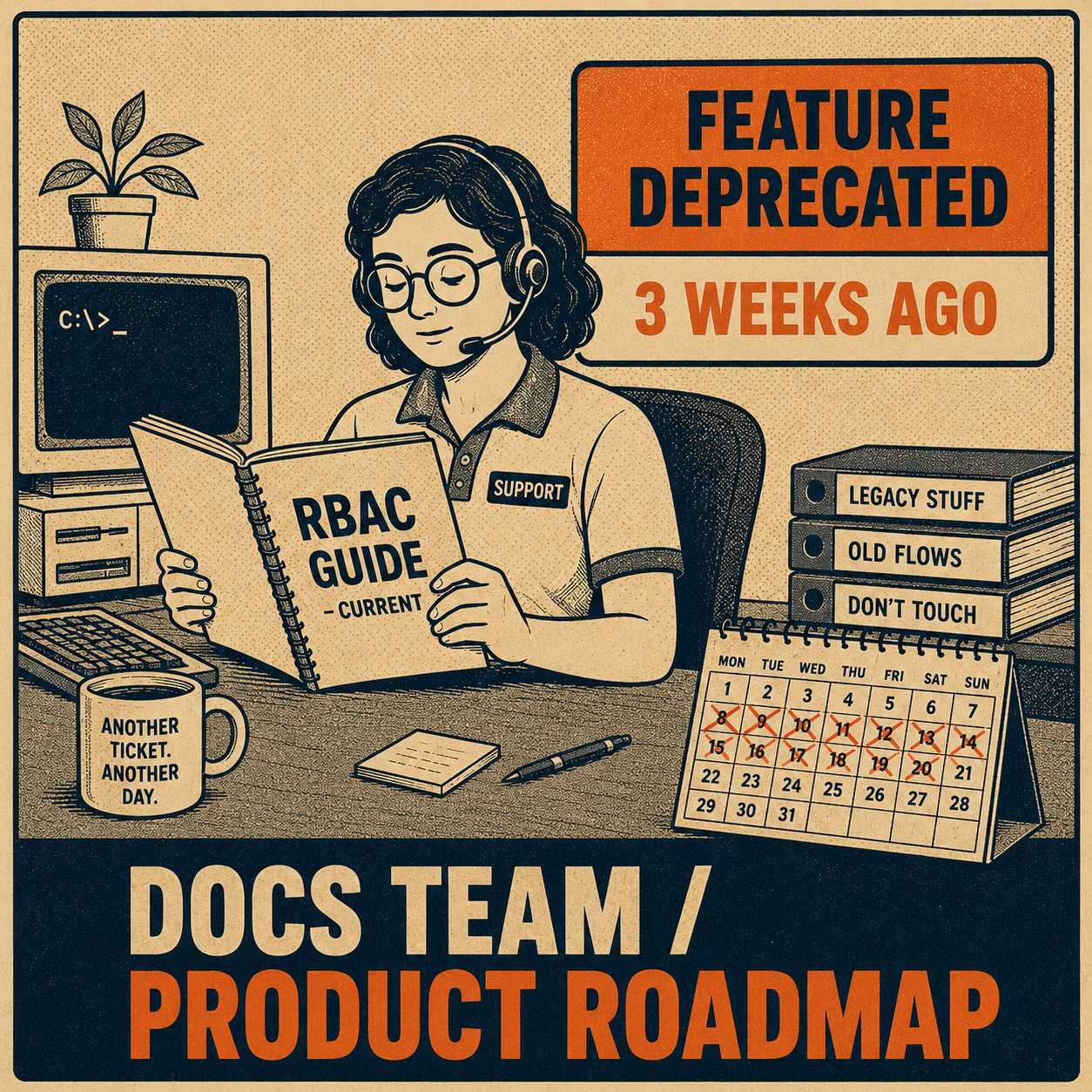
This is the documentation-roadmap alignment problem in its most common form. The answer to it is not a better review process or a more diligent tech writer. The answer is that documentation and the systems that track what is being built need to be connected at the source, not reconciled after the fact.
That is a harder thing to build than it sounds.
Why the Handoff Model Always Breaks
The traditional model is: engineering builds, then someone writes docs later. This creates a structural lag that no amount of process tightening can fix.
Roadmaps change constantly. Features get deprioritized, timelines shift, scope creeps. Documentation teams often find out about changes late, after marketing has already messaged the feature or support is fielding questions. The people who know what changed (the engineers who built it, the product manager who scoped it) have already moved on to the next sprint.
Research on documentation timing consistently shows that the ideal moment to write or update documentation is during code authoring and review, when the developer still has the full context in working memory. Wait two weeks, and the motivation to explain it drops sharply. Wait two months, and the details are gone.
The handoff model puts documentation at the end of that chain by design, which means it inherits every delay and context loss that accumulates along the way.
There is also a second, quieter failure mode: documentation teams often have no visibility into the roadmap until a feature is nearly shipped. They cannot flag that a particular change will require a complete rewrite of three existing articles. They cannot push back on a launch date because the documentation lift is too large. They are reactive by structural necessity, not by choice.
What Alignment Actually Requires
Good roadmap-to-documentation alignment has three components that have to work together.
The first is shared ownership of the first draft. Product managers and engineers know what changed, why it matters, and what the new behavior is. If the ticket description and the commit messages contain that information in a structured way, documentation can be assembled from it rather than reverse-engineered from a PR diff. Research on release note production found that most release notes list only 6 to 26 percent of all addressed issues in a release, largely because the people writing them lack the context to know what mattered. Shared ownership at the ticket level solves that problem upstream.
The second is documentation as a first-class artifact in the engineering workflow, not an afterthought. When documentation tasks live in the same sprint board as engineering tasks, they get the same visibility and the same protection. When they live in a separate system, they get cut when timelines slip. Tom Johnson's extensive writing on technical writers in agile teams documents this pattern in detail: documentation tasks are routinely excluded from sprint point allocations, which means they have no formal protection when scope changes. The fix is not to add more process. The fix is to make documentation a sprint exit criterion.
The third is version-aware documentation that reflects the roadmap state in real time. If a feature gets pushed to the next milestone, the documentation should reflect "Coming in Q2" instead of "Available now." If a feature is deprecated, the documentation should say so immediately, with a clear migration path. Research on API deprecation found that deprecated API elements are commonly documented with missing or unclear replacement messages, which leaves users stranded. The same pattern applies to product features. Users reading outdated documentation do not know the documentation is outdated. They assume the product is broken.
The Systems Fix
The teams that have solved this problem did not solve it by asking tech writers to work harder or attend more meetings. They solved it by connecting the systems that track what is being built to the systems that explain it to users.
In practice, that means: when a ticket moves to "Shipped," a release note draft auto-generates from the ticket description and commit messages. When a feature gets pushed to the next milestone, the documentation reflects the new timeline. When a feature is deprecated, the documentation update is triggered automatically, not discovered three weeks later by a support manager.
DevDocOps research has formalized this approach, framing documentation delivery as a continuous pipeline rather than a discrete handoff, with the same automation principles that govern code delivery applied to documentation. The CALMS framework (culture, automation, lean, measurement, sharing) maps directly onto documentation: automation makes documentation continuous; measurement tracks quality; sharing ensures the output reaches the right audiences.

The SmartNote research from 2025 is worth reading here. It found that experienced developers can spend up to eight hours drafting a single release note document, and that maintainers of large-scale projects sometimes need to synthesize more than 5,000 commits for a single release. That is not a documentation problem. That is a workflow problem that documentation is being asked to absorb.
The role of the human in a connected system shifts. Instead of chasing down what shipped last week, writers validate the output, ensure clarity, and add the strategic context that automation cannot infer. That is where skilled technical writers add the most value: not in the assembly of facts, but in the judgment about how those facts should be communicated.
Doc Holiday is built for exactly this transition. It generates release notes, API references, and changelogs directly from engineering workflows, then routes the output to a reviewer dashboard where a writer or product manager validates, edits, and publishes. The structure it provides (templates, validation gates, multi-product support) is designed for teams that have outgrown the manual process and want documentation that is aligned with the roadmap by default, because it is pulling from the same decisions, the same tickets, the same code.