How to Keep Terraform Documentation Up to Date


A Terraform pull request can tell a clean story. The plan shows the resources that will change. CI/CD validates the configuration. A reviewer approves it. The apply job updates the infrastructure.
Then the documentation loses the plot.
The wiki, Confluence page, or static documentation repository has no programmatic relationship to the plan, the state, or the merge. Someone has to remember that a new security-group rule, module version, or output value also deserves a separate edit. They have to leave the PR, locate the right page, decide what matters, and make the change after the infrastructure work has already finished. That is a surprisingly fragile handoff for a system meant to describe production.
Documentation decay follows from the workflow itself. Technical artifacts maintained on separate paths naturally diverge without an explicit synchronization mechanism. Keeping Terraform documentation current requires it to move through the same deployment path as the infrastructure it describes.
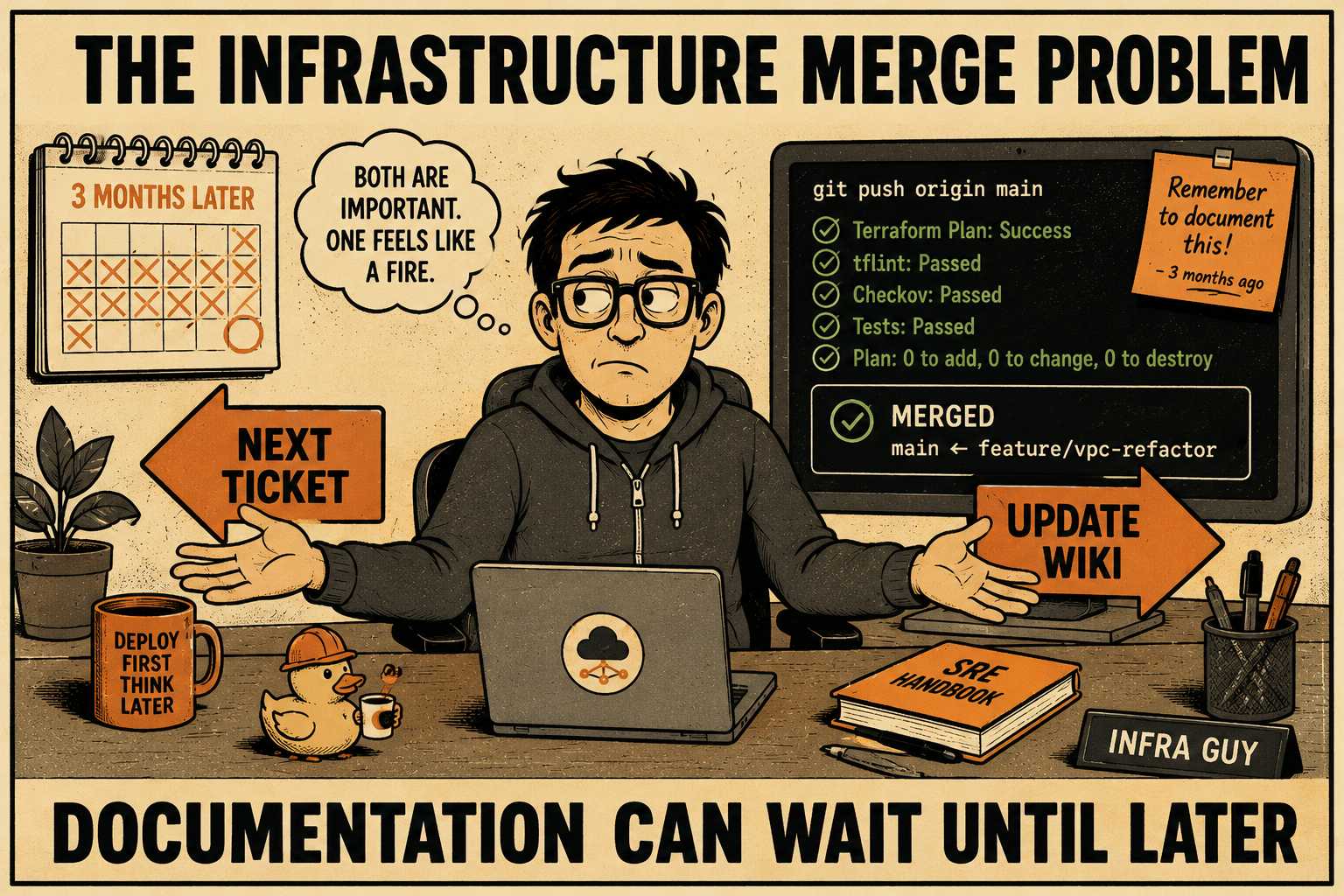
The Wiki Loses the Race at Merge Time
Manual documentation asks engineers to context-switch immediately after a successful merge, just as attention turns to the next ticket. That is not where reliable systems come from. It is where good intentions go to wait for a quieter afternoon that rarely arrives.
Code review does not fix the gap on its own. Reviewers can see the HCL diff and the plan, but a missing or stale external page is usually invisible in the pull request. The change author is also a poor proxy for the future reader. They know why the variable moved, which legacy module it replaces, and which dependent service will need to adjust. Precisely because they know so much, they tend to omit the context someone else will need.
A documentation system should therefore capture two different kinds of information. It needs the facts that infrastructure code can provide, and it needs a deliberate place for the decisions that code cannot explain.
Make the Pipeline Do the Remembering
The practical move is to treat documentation as a CI/CD artifact. Documentation belongs in version control beside the code that produces it, generated and reviewed with the same change. That is the operating model behind docs as code: use software-development tools and processes to create, review, publish, and trace documentation.
A Terraform plan is a strong baseline for this. Before proposing an action, Terraform reads the current state of managed remote objects and compares it with the configuration. Saved plans and state can then be exposed as machine-readable JSON, including configuration, prior state, planned values, resource changes, variables, and checks.
That gives a generator a reliable input instead of a terminal screenshot and a prayer.
The resulting workflow is straightforward. CI generates the structural sections from the plan, module tree, provider requirements, and post-apply state. It writes a documentation preview into the PR, then commits or publishes the approved generated file alongside the infrastructure code. The documentation version now has the same history as the change that produced it.
terraform-docs is a useful starting point, especially for module-level inputs, outputs, and resource documentation. It generates several formats and supports pull-request automation. Most platform teams will still need a thin layer of custom scripting or integration logic to turn plan and state output into their actual documentation system, organize change summaries around their module conventions, and redact organization-specific sensitive fields. The tool solves the module baseline; the workflow has to solve the rest.
Guardrails make that workflow durable. A validation job can fail when a generated section is missing, when a required context template is blank, or when a generated file is out of date with the PR. Protected branches can require a status check to pass before a pull request merges. The guardrail should enforce completion and freshness, not litigate every adjective in a sentence. CI has enough hobbies already.

Generated Facts Still Need an Accountable Human
Automation gives the documentation structure and factual consistency. A human still needs to add the part that explains the decision: why this change was made, what it replaces, what rollout or rollback assumptions apply, and which teams need to know.
Keep those concerns visibly separate in the template. One section should be marked Generated from plan/state/module metadata and treated as pipeline-owned. The adjacent Change context section should require a concise rationale, replacement or deprecation note, dependent-team impact, and an owner. That separation prevents authors from editing the generated facts to tell a more convenient story, while keeping the important story from disappearing into a comment thread.
Assign a named owner for the documentation pipeline, often a senior platform engineer or technical lead. Their responsibility is to maintain the templates, review the quality of generated output, adjust redaction rules, and make sure the automation still reflects how the platform actually works. They should not become the person who manually writes every output table. That would merely move the bottleneck to a more expensive chair.
The audit loop matters too. Terraform's refresh-only planning mode can show differences between recorded state and live infrastructure without modifying remote objects. Run it periodically, regenerate the applied-state documentation from the result, and flag a discrepancy between that output and the published record for review.
Do this carefully. State and JSON output may expose sensitive values, so raw state and plan artifacts require restricted access, while published documentation must be sanitized before it leaves the pipeline. “Automatically copied the production database password into the architecture page” is not the kind of successful automation anyone wants to explain later.
Infrastructure documentation becomes dependable when it is part of deployment, rather than a post-deployment obligation. Once that structure exists, documentation quality becomes a workflow-design problem: visible, testable, and much easier to maintain.
Doc Holiday applies that structure to output generated from engineering workflows, including Terraform change documentation, release notes, API references, and changelogs. It pairs generation from commits and product context with validation steps a technical lead can govern, so the manual process does not have to grow again just to keep the record current.