How to Document LLM API Endpoints


You just shipped a new LLM-powered API endpoint. The latency is acceptable. The prompts are tuned. The team is celebrating.
Then the technical writer (or the engineer tasked with writing the docs) asks a simple question: "What does the response look like?"
The engineer pauses. "Well, it depends."
That is the moment the traditional API documentation model breaks. For decades, API documentation has been built on a simple contract. Input A produces output B. You show a curl command, you show a JSON response, and you move on.
LLM endpoints do not work that way. They are probabilistic engines stuffed into deterministic wrappers. If you try to document an LLM API using the exact same template you use for a REST API fetching user profiles, you will fail. Your users will be confused, your support queue will fill up, and your integration time will spike.
This is not a failure of the model. It is a failure of the documentation framework. You cannot hide the non-determinism. You have to document it.
The Illusion of the Curl Command
Start with the basics. Authentication, headers, and base URLs remain unchanged. Handle these quickly.
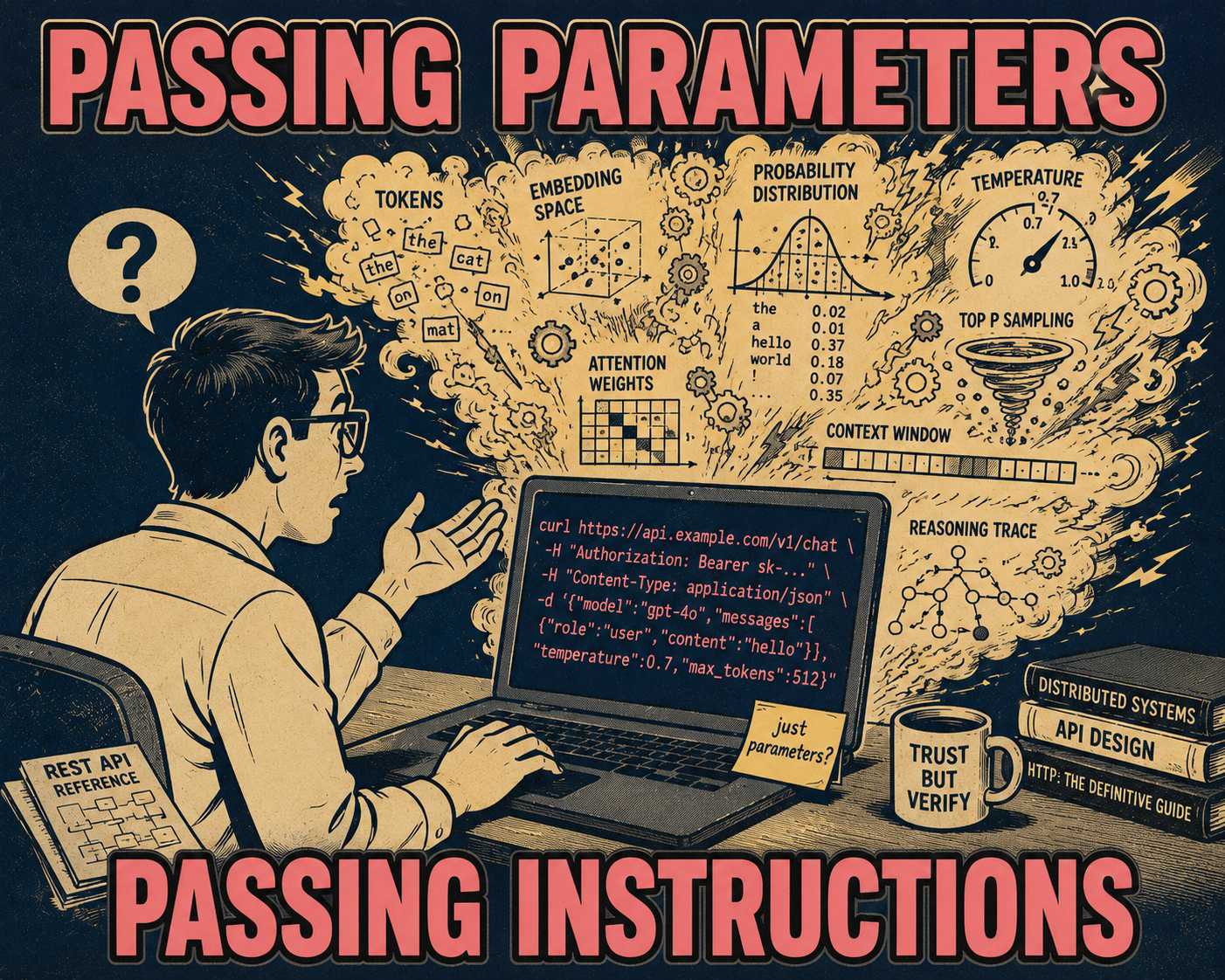
But when you get to the request structure, the illusion of predictability vanishes. You are not just passing parameters. You are passing instructions.
Documenting the request means calling out the constraints that actually matter for LLMs. What is the context window limit? If the user sends a payload that exceeds the token limit, what happens? Do you truncate, or do you throw an error?
If your endpoint supports structured outputs or function calling, be explicit about the schema requirements. Cohere's structured outputs documentation is a good model here: it distinguishes between JSON mode (valid JSON guaranteed) and JSON Schema mode (specific field structure guaranteed), and it calls out which models support which modes. That level of precision is what your users actually need.
Do not just list the parameters. Explain the weight of the parameters. If a system_message field overrides user instructions, say so.
The Request Shape Is Not the Whole Story
The response is where the friction really starts.
You have to explain the variance upfront. What fields are guaranteed? What is probabilistic?
If your API streams responses using Server-Sent Events, you need to document the event lifecycle. When does the stream start? What does a chunk look like? How does the client know the stream is finished? OpenAI's streaming guide is worth reading for how it enumerates every event type the client might receive, including ResponseRefusalDelta and Error, not just the happy path.
More importantly, how should the client handle partial responses or mid-stream errors? If the model times out halfway through generating a paragraph, the client needs to know what HTTP status code to expect and whether the partial text is usable.
If you expose confidence scores or logprobs, explain what they mean in plain English. A confidence score of 0.8 is not an 80% guarantee of truth. It is a measure of the model's statistical certainty about the next token, which is a very different thing.
When the Model Says No
LLMs fail differently than traditional APIs.
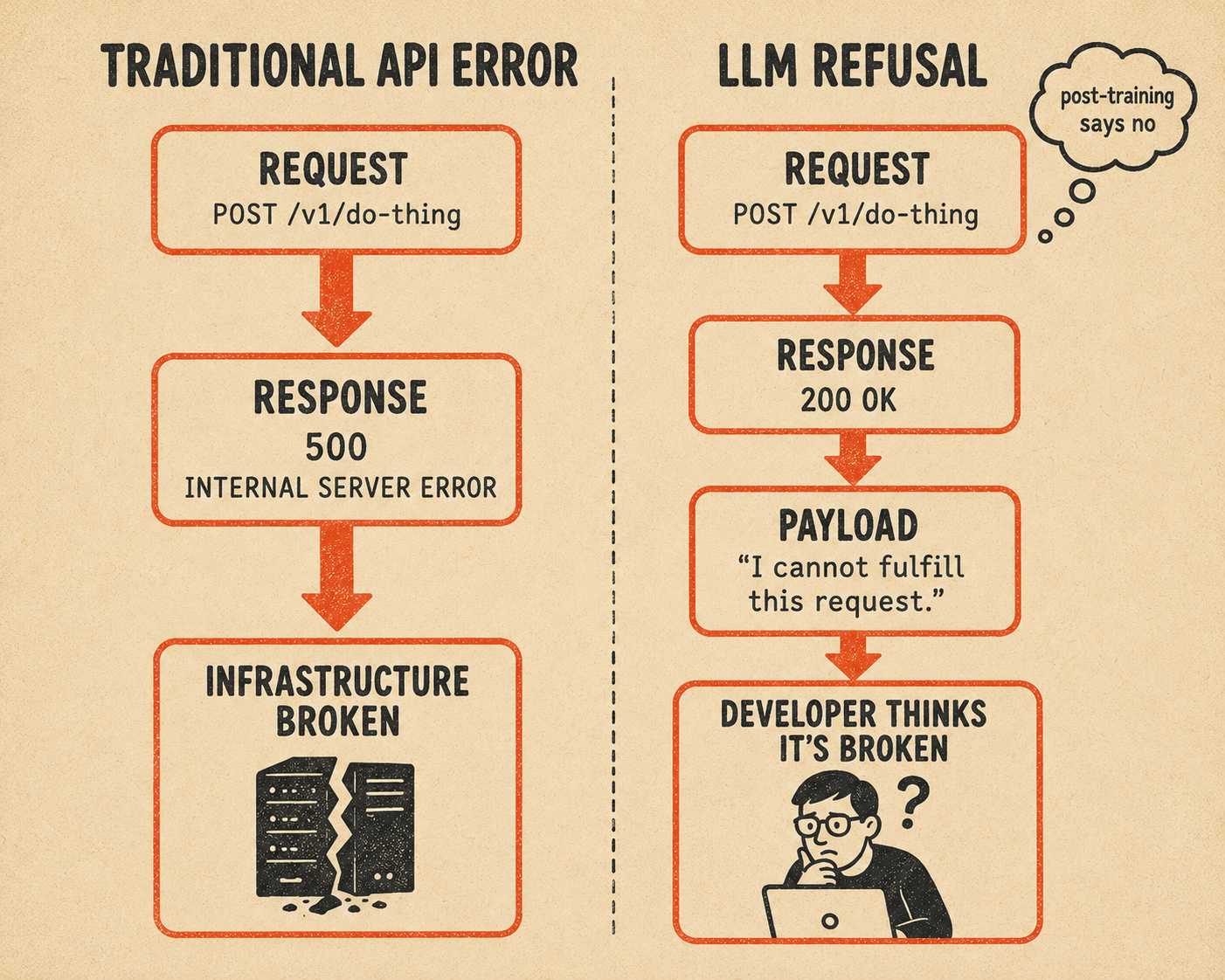
A 500 Internal Server Error usually means your infrastructure is broken. But what does it mean when the model simply refuses to answer?
Refusals are a feature, not a bug, of modern LLMs. They are designed to reject harmful or out-of-policy requests. But to a developer integrating your API, a refusal looks like a broken endpoint. The behavioral layer responsible for refusals is added during post-training, which means it can be triggered by inputs that seem entirely benign from the developer's perspective.
You must document your refusal behavior. Does the API return a 400 Bad Request? Does it return a 200 OK with a payload that says, "I cannot fulfill this request"?
If there are known edge cases, like the model struggling with complex math, or failing to handle negations properly, document them. Show the prompt patterns that produce better results. If the model has been fine-tuned for a specific task, explain the boundaries of that task.
There is also a subtler failure mode worth calling out: the model generating something structurally valid but semantically wrong. A 2025 study across five LLMs found significant output variance even at temperature=0, across identical inputs and configurations. That is not a bug you can fix with a retry. It is a property of the system that your users need to understand before they build on it.
The Cost of a Token
Rate limits for traditional APIs are about protecting infrastructure. Rate limits for LLM APIs are about protecting your wallet.
If your rate limit is designed for cost containment, be honest about it. Explain whether limits are enforced per-token, per-request, or per-minute.
Because LLM applications often require multiple calls to complete a single user action, token consumption can be highly unpredictable. A single request might consume 200 tokens, while the next consumes 4,000. Token-based limits control how much model computation occurs, while request-based limits control concurrency and gateway load. Your users need to know which one they are likely to hit first.
If you charge by the token, link to your tokenizer behavior. OpenAI's rate limit headers are a useful reference: they expose x-ratelimit-remaining-tokens and x-ratelimit-reset-tokens in every response, so clients can track their consumption in real time without waiting for a 429. If you offer burst allowances, document the exact thresholds.
The Operational Reality of Versioning
LLM endpoints change behavior when the underlying model changes.
A traditional API versioning strategy assumes that if the schema doesn't change, the behavior doesn't change. With LLMs, the schema can remain identical while the output quality degrades, improves, or simply shifts.
Explain your versioning strategy clearly. Do you lock clients to a specific model snapshot? Anthropic's model ID documentation is explicit that dateless IDs like claude-sonnet-4-6 are pinned snapshots, not evergreen pointers, and that serving infrastructure can still change around fixed model weights. That distinction matters for debugging unexpected behavioral differences.
If you update the system prompt behind the endpoint, that is a behavioral change. How do you communicate that to your users? Most teams don't have a good answer, which is part of why AI model documentation is so fragmented across whitepapers, READMEs, and blog posts, with version-level changes rarely triggering corresponding documentation updates.
Most teams document LLM endpoints badly the first time because they try to fit non-deterministic behavior into deterministic templates. The fix is to treat the non-determinism as a first-class concept to document, not a weakness to hide.
This is an operational problem. If your team is shipping LLM-powered endpoints as part of a broader API surface, you are likely generating release notes and changelogs every time the model version changes or the prompt template shifts. Doc Holiday generates that output directly from your engineering workflow, giving you the structure to validate and manage documentation updates without rebuilding your entire docs team.