How to Audit Documentation After a Coding Agent Sprint


It usually starts with a support ticket. A customer copies an example from the docs, sends a request that perfectly matches the published API, and gets an error they have never seen before. By the time the engineering team traces the problem, the reality sets in. The code shipped three weeks ago. The documentation is still living in the past.
We are entering a new era of software development where coding agents can ship functional code in hours or days. Tools like Cursor, GitHub Copilot, and Devin pull tickets, write tests, refactor legacy systems, and submit pull requests at a velocity that human developers simply cannot match. But while these agents excel at generating runnable code, they consistently fail to generate matching documentation. The result is a growing documentation debt problem that compounds faster than traditional development cycles ever created.
The problem is not that agents write bad code. The problem is that they ship code silently.
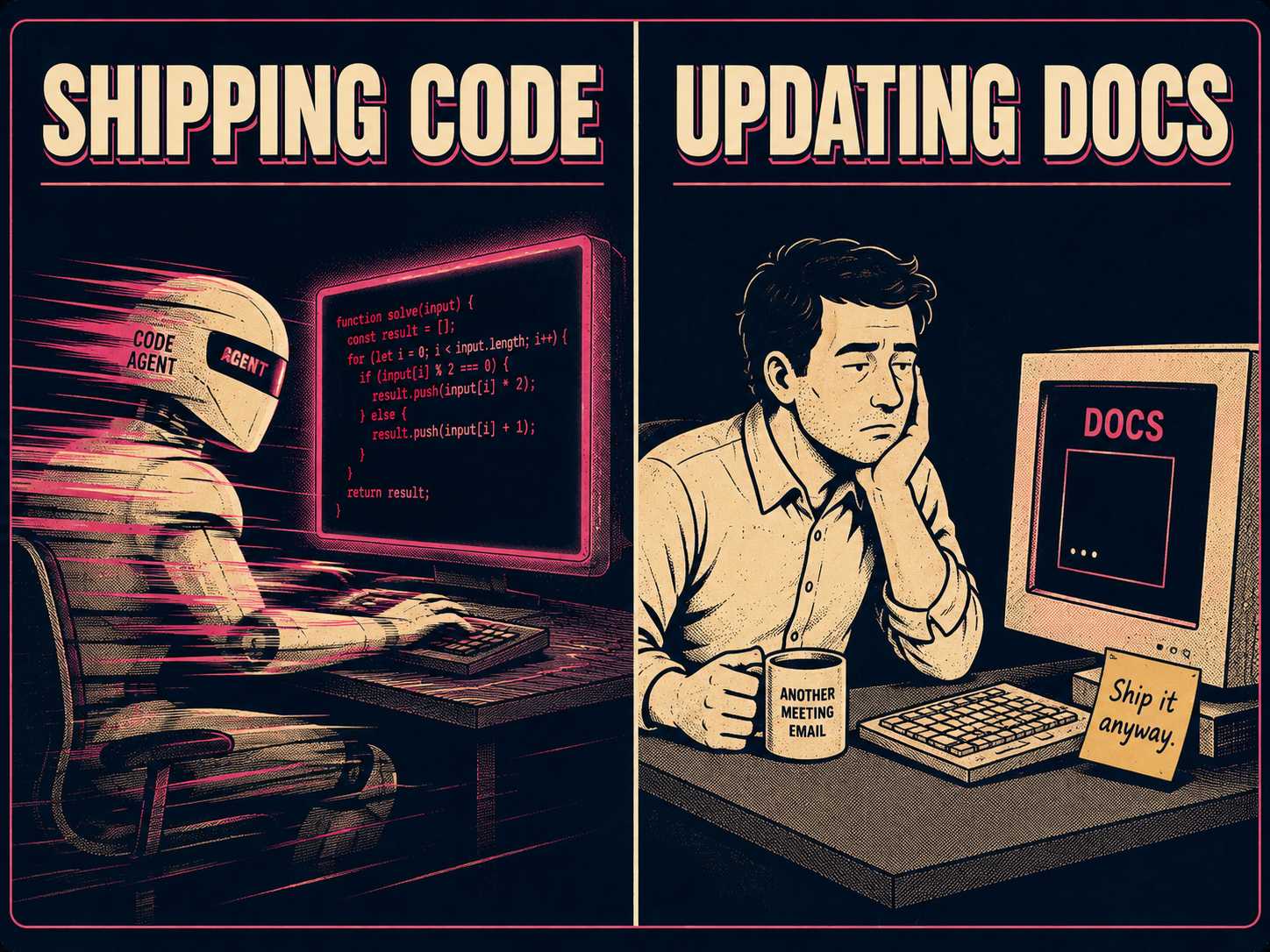
The Silent Accumulation of Documentation Debt
When a human engineer renames a parameter or adds a required field, there is usually a moment of friction. They might update the inline comments, ping the technical writer, or flag the change in the pull request. AI agents do not feel friction. They execute the task and move on.
An analysis of over 33,000 agent-generated pull requests found that while agents frequently touch documentation files, these edits are often merged with little to no human oversight. Reviewers, overwhelmed by the volume of agent-generated code, tend to focus their limited attention on functional correctness and security. They often wave through documentation and styling issues if the core logic appears sound — documentation gaps appear significantly more often in accepted PRs than rejected ones, meaning reviewers are willing to work through them rather than block a merge.
The failure modes are predictable but hard to catch. Agents suffer from context degradation, losing track of the broader system architecture as their context window fills up. They hallucinate API endpoints or invent parameters that sound plausible but do not exist in the codebase. And perhaps most dangerously, they routinely fail to recognize when a localized code change breaks a user-facing example located in a different repository.
Traditional documentation review processes are not built for this. You cannot ask a technical writer to manually diff every agent-generated commit. The volume is too high, the changes are too granular, and the agent did not leave any breadcrumbs explaining why a change was made.
Anyway. The code has shipped. The sprint is over. How do you find the gaps before your users do?
A Systematic Framework for the Post-Agent Audit
You cannot audit an agent sprint by reading the docs and hoping to spot errors. You have to work backward from the code.
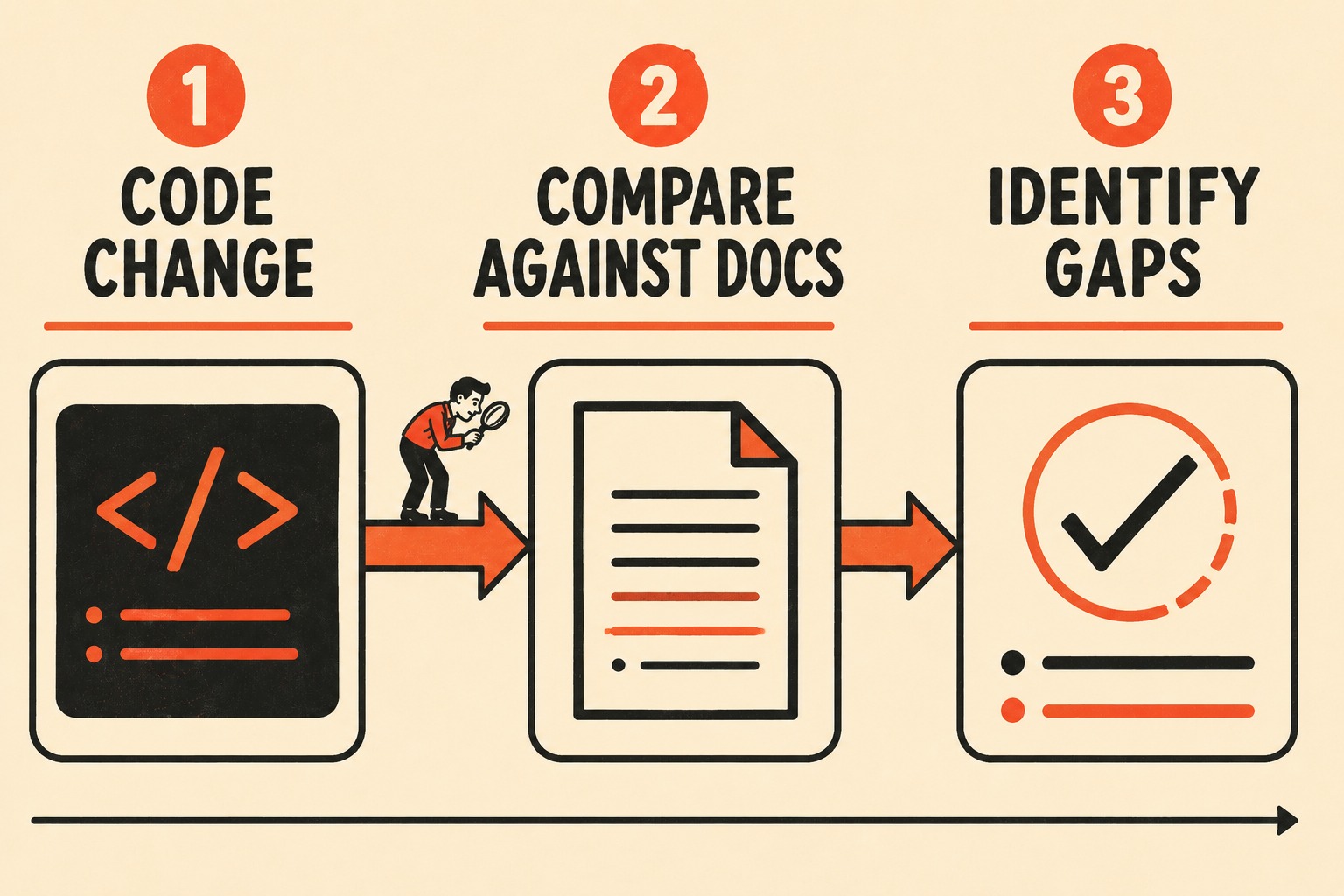
Start by identifying exactly what the agent touched. This means running a git diff analysis across the sprint's commit range. Look for changes in API controllers, database schemas, and public-facing interfaces. Tools that generate release notes directly from git commits can provide a raw, unvarnished list of modifications, stripping away the agent's often overly optimistic pull request descriptions.
Not every code change requires a documentation update. A refactored internal helper function matters to your engineering team, but it does not break a customer's workflow. Filter the inventory to isolate user-facing changes like new endpoints, renamed parameters, deprecated features, and changes to response shapes. If the agent added a required field to an API payload, every example omitting that field is now broken.
This is where the audit gets real. Compare the isolated changes against your existing documentation. Are the old docs now wrong? Did the agent introduce a new feature that remains entirely undocumented? For API documentation, this process can be automated. Tools that compare OpenAPI specifications against live API implementations can instantly flag documentation drift — instances where the code and the docs no longer agree.
Agents are notoriously bad at recognizing the downstream impact of their work. If an agent refactored a data model, did it also update the migration guide? Did it change a default configuration value that requires user action? Identify these breaking changes and prioritize their documentation, as these are the issues most likely to generate immediate support tickets.
Do not ask the agent to remember what it did and write the docs. It will hallucinate. Nearly 50% of AI-generated code reviews and 20% of generated commit messages contain hallucinations, with the most common failure being output that is inconsistent with the actual code change. The generation process must be grounded in the final, merged codebase, not the agent's memory of the task.
Finally, test the regenerated documentation. Do the code examples actually run? Are the parameter types correct? Treating documentation examples as executable tests — where code blocks are run against the live system during the CI/CD pipeline (the automated process that builds and deploys code) — is the only way to guarantee that the docs and the code remain synchronized.
Scaling the Audit
For a small team shipping a few features a week, this audit process might take an hour. But as agent adoption scales, manual auditing quickly becomes a bottleneck. The goal is not to slow down the agents, but to build a documentation infrastructure that moves at their speed.
This is the operational reality Doc Holiday was built for. When agents are shipping code at machine speed, you cannot rely on manual diffs and memory to keep your documentation accurate. Doc Holiday acts as the documentation engine for fast-moving teams, generating release notes, API references, and changelogs directly from your engineering workflows. It pulls the raw truth from your commits and pull requests, giving your team the structure to validate and manage documentation output without rebuilding manual processes from scratch.
You get the speed of agentic development, with the operational control to ensure your users are not left behind.