Documenting Compliance-Driven Changes: Release Notes for Two Audiences


It happens in every regulated engineering organization. An auditor reviews the SOC 2 controls, points to a gap in session management, and opens a finding. The engineering team gets a Jira ticket to implement a 15-minute inactivity timeout. They write the code, merge the pull request, and ship the change.
Then someone has to write the release notes.
If they write for the users, they say: "For your security, you will now be logged out after 15 minutes of inactivity." This is helpful, but it fails the audit. It doesn't reference the control requirement, the risk assessment, or the technical implementation.
If they write for the auditors, they say: "Implemented logical access security measures to enforce a 15-minute session timeout in accordance with SOC 2 CC6.1 and NIST 800-53 AC-11." This passes the audit, but it alienates the users. They don't know what CC6.1 is, and they are just annoyed that their session expired while they were reading a report.
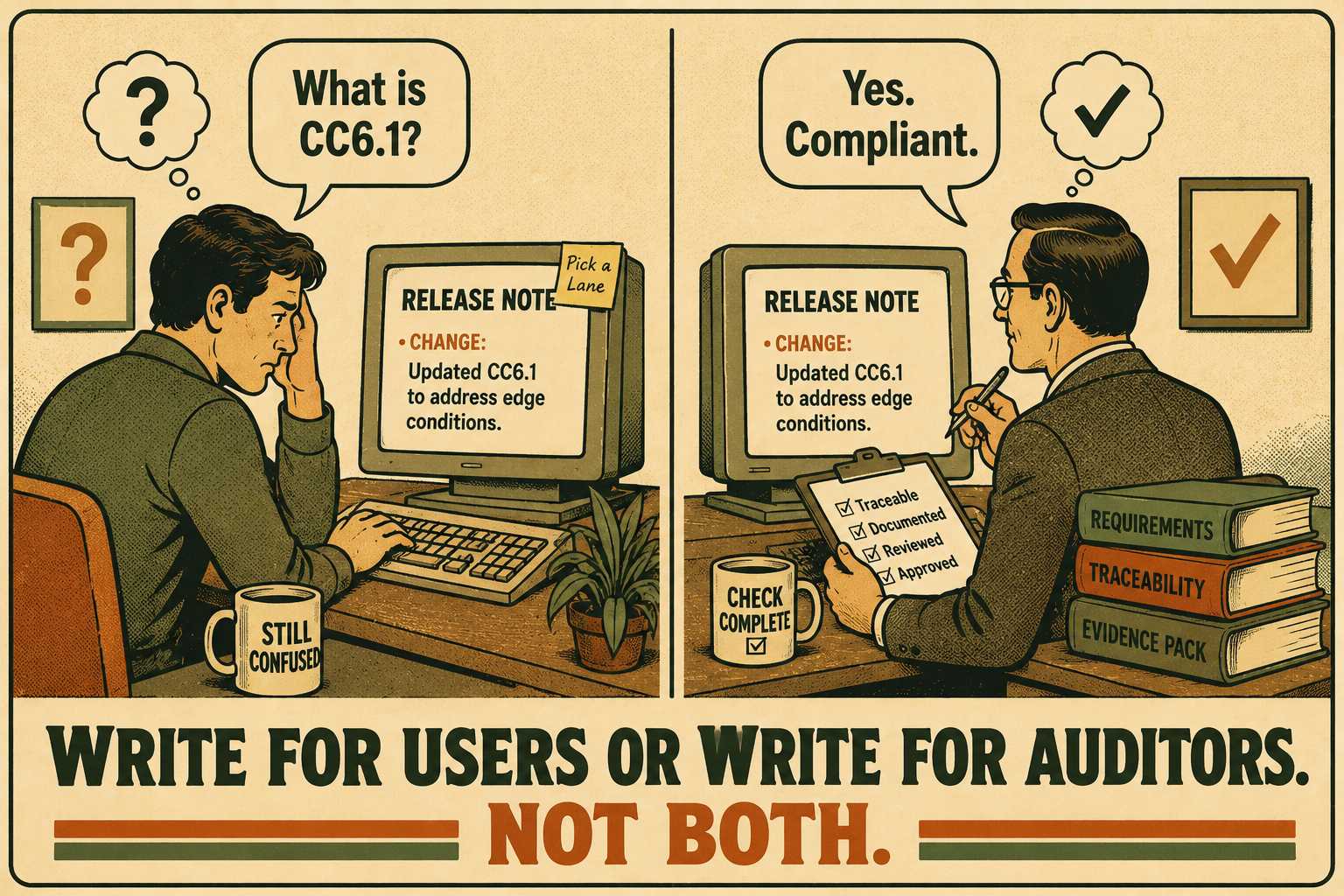
Compliance changes are hard to document because they serve two audiences with incompatible needs. Users want to know what changed and why it matters to them. Auditors want to see evidence that the change was intentional, documented, and traceable to a control requirement. Most teams try to write one artifact that satisfies both audiences and end up satisfying neither.
There is a better way to handle this. It requires understanding what an auditor actually needs, when to separate the audiences, and how to structure the artifacts so that the compliance record is immutable while the user communication remains clear.
The Burden of the Dual Audience
The tension between user communication and compliance documentation is not just a matter of tone. It is a fundamental difference in the purpose of the artifact.
Release notes for users are a marketing and support tool. They exist to drive adoption, reduce confusion, and preempt support tickets — in regulated industries, they are also a compliance requirement. They need to be written in plain language, focusing on outcomes rather than mechanics.
Release notes for auditors are a compliance artifact. They exist to prove that a specific control was implemented according to a defined change management process. They need to be precise, traceable, and immutable.
When you try to combine these purposes, the documentation fails. The plain language required for users lacks the technical precision required for auditors. The control references required for auditors confuse the users.
To solve this, you have to decide whether the change actually impacts the user.
The Framework for Compliance Documentation
Not all compliance changes require the same documentation strategy. The approach depends entirely on whether the change alters the user experience.
When the Change Has No User Impact
Many compliance-driven changes are entirely backend. You might implement a new encryption standard for data at rest, add an immutable audit log for database access, or update the CI/CD pipeline to require peer reviews before deployment.
These changes have zero impact on the end user's workflow. The user does not need to know about them.
In these cases, the release note is purely a compliance artifact. It should be structured as evidence, not communication. It does not need to be written in plain English. The audience is technical auditors.
A good compliance-record release note for a backend change looks like this:
Implementation of Immutable Audit Logging for Database Access
Requirement: SOC 2 CC8.1, HIPAA 45 CFR 164.312(b)
Change: Deployed an append-only logging mechanism to the primary transaction database. All read and write operations are now recorded with cryptographic sealing to prevent alteration or deletion.
Requirement: SOC 2 CC8.1, HIPAA 45 CFR 164.312(b)
Traceability: Jira Ticket SEC-402, PR #1842
This note references the control requirement, describes what was implemented, and provides enough technical detail to demonstrate that the requirement was addressed. It is exactly what auditors look for when reviewing change management evidence.
When the Change Impacts the User
When a compliance change alters the user experience, you have to communicate with both audiences. This is where the translation work happens.
If you implement a session timeout, require complex passwords, or add multi-factor authentication, the user will notice. They need to understand what changed and why.
In these cases, the release note should lead with the user experience change, written in plain language. Then, it should include a dedicated compliance context section for the record.
A good dual-audience release note looks like this:
New 15-Minute Inactivity Timeout
You will now be automatically logged out of the application after 15 minutes of inactivity. This change helps protect your account and sensitive data if you step away from your device. If you are logged out, simply sign back in to continue where you left off.
Compliance Record
Requirement: SOC 2 CC6.1 (Logical Access Controls)
Change: Enforced a 15-minute session timeout across all user sessions to mitigate the risk of unauthorized access via unattended devices.
Traceability: Jira Ticket SEC-405, PR #1850
The user gets the operational translation: "You'll be logged out after 15 minutes. This protects your account." The auditor gets the technical evidence: "Enforced session timeout per SOC 2 CC6.1." Both audiences get what they need, clearly separated.
The Mechanics of Traceability and Immutability
Writing the note is only half the problem. The other half is proving that the note is accurate and hasn't been altered.
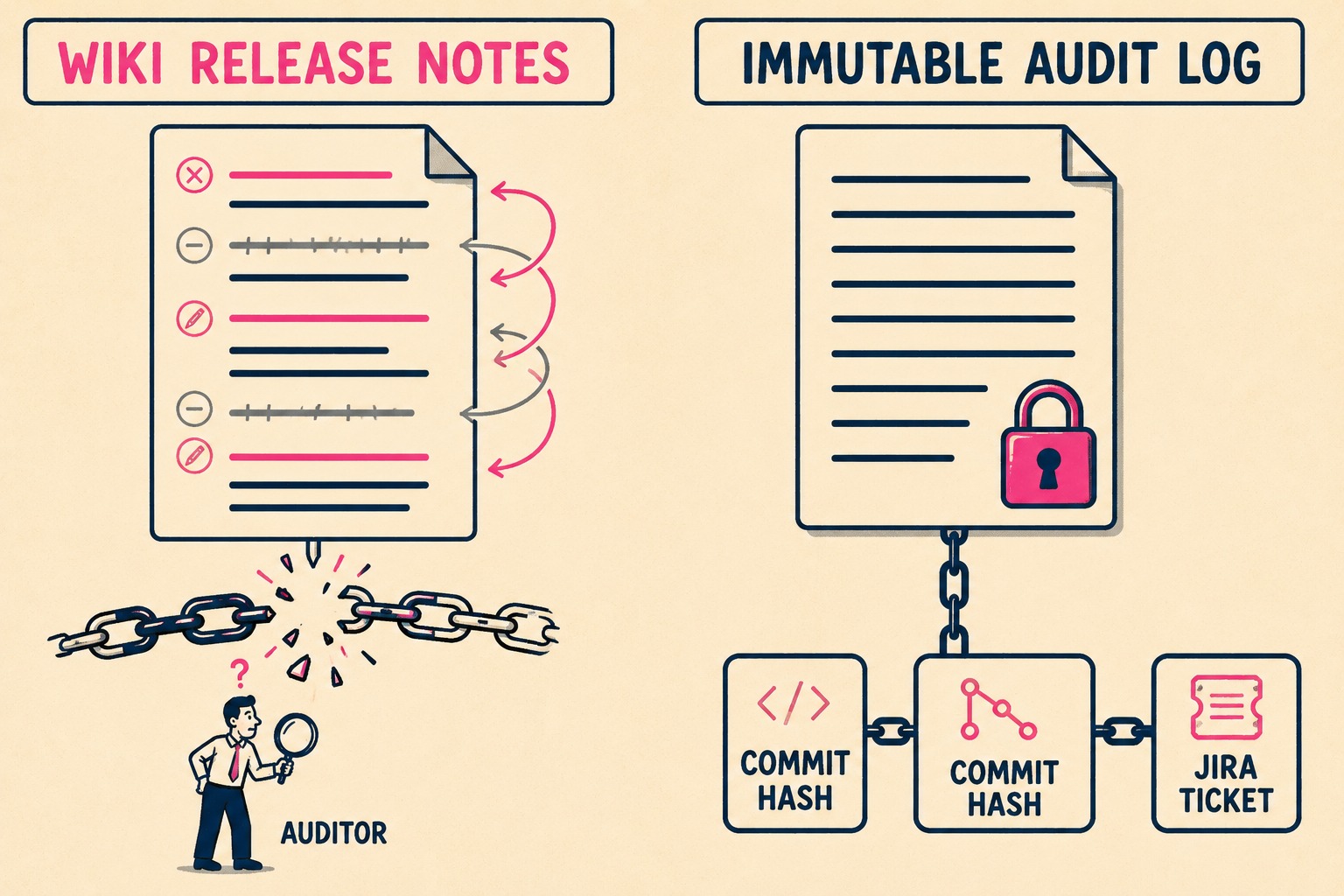
Compliance documentation needs to connect changes to requirements. If your release notes don't link back to the security control, HIPAA safeguard, or certification standard that triggered the work, they are not useful as compliance evidence. Standards like PCI/DSS 6.5.1 and ISO 27001 A.12.1.2 both require that every change be traceable to an initial request, an approval, and a deployment. The traceability chain must be complete.
Furthermore, compliance records cannot be edited retroactively. If your release notes live in a wiki that anyone can edit at any time, they are not reliable audit evidence. Regulations like SEC Rule 17a-4 require financial firms to retain records on indelible media, and the principle extends broadly across regulated industries: documentation that can be silently altered is not documentation. It is a liability. Immutable audit logs use cryptographic sealing and append-only storage precisely to solve this problem.
This is where the engineering workflow becomes an asset rather than a liability.
The inputs for a compliance-driven release note already exist. The Jira ticket is linked to the compliance requirement. The commit messages describe the technical changes. The pull request contains the approvals and the test results. NIST SP 800-53 CM-3 requires organizations to document, retain, and monitor configuration-controlled changes — and the pull request, when properly linked, satisfies that requirement by default.
If you are manually copying and pasting this information into a Google Doc, you are introducing human error and breaking the chain of custody. You are also wasting time.
Compliance-driven release notes are a perfect use case for structured automation. When the documentation is generated directly from the engineering artifacts, the compliance linkage is built in, and the record is immutable from the start.
The Checklist for Compliance Release Notes
Whether you are writing them manually or generating them automatically, a complete compliance-driven release note must include:
- Requirement reference: The specific control or standard that triggered the change (e.g., SOC 2 CC8.1, HIPAA 45 CFR 164.312).
- Description of what changed: A clear statement of the modification.
- User impact statement: An explanation of how the change affects the user workflow, if applicable.
- Technical implementation summary: Enough detail to prove the control was actually implemented.
- Traceability links: References to the ticket, pull request, or commit.
- Timestamp and version marker: Proof of when the change occurred.
The Role of the System
The problem with compliance documentation isn't that engineers don't know how to write. It's that the system forces them to manually reconstruct a narrative that already exists in the code and the ticketing system, and then demands that they translate that narrative for two different audiences.
When you automate the extraction of those artifacts, the problem changes. You no longer have to worry about whether the PR is linked to the release note. It is linked by default. You no longer have to worry about immutability. The system enforces it.
The human writer's job shifts from manually reconstructing the compliance chain to validating accuracy and adding the user-facing translation where needed.
This is what Doc Holiday is built to do. It generates documentation directly from your engineering workflows, pulling the context from Jira tickets and pull requests. It gives you the structure to validate and manage that output, ensuring the compliance linkage is intact and the record is immutable. It turns the burden of compliance documentation into a scalable, automated process.