How to Document Service Mesh Changes Without Making Developers Learn the Mesh


At 2:17 p.m., an application developer starts getting 503s from a dependency that worked at 2:16. They check the last deploy, the database, and the application logs. Nothing obvious has changed.
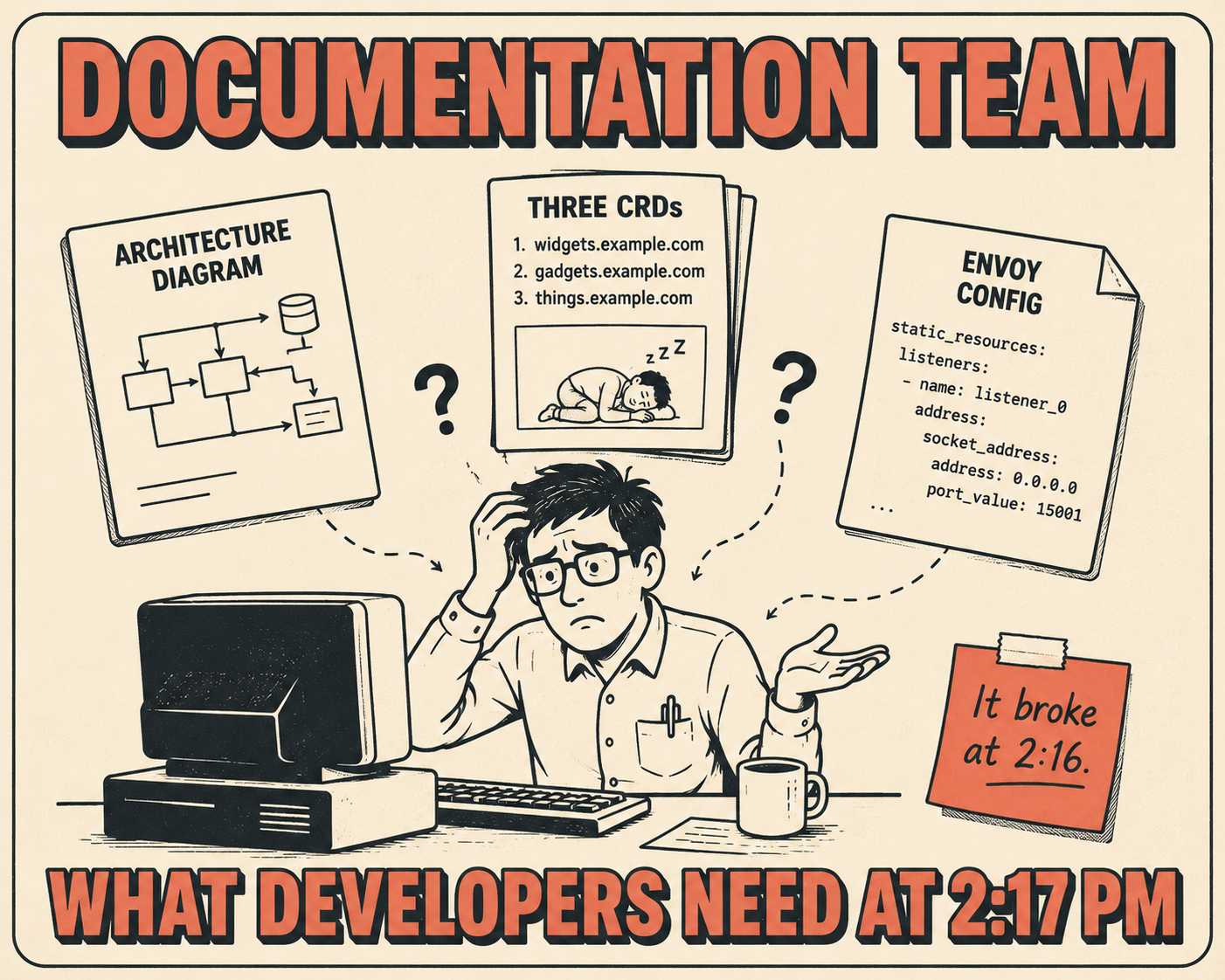
An hour later, someone explains that the platform team enabled strict mTLS for the namespace. The explanation arrives with an architecture diagram, three CRDs, and a link to Envoy proxy configuration. It is all technically correct. It is also the least useful place to start.
Most service mesh changes require no application work at all. When a change does affect an app, developers need to see the required action, affected request path, timing, owner, and verification command before they see a single proxy detail. That is how to document a service mesh change without asking every developer to learn the mesh.
The mismatch matters because support questions cluster around symptoms rather than platform abstractions. A study of 5,497 practitioner questions about service meshes found that roughly half were error-related, with concerns spanning traffic, infrastructure, security, observability, and applications. An architecture-first announcement sends all of those readers to the same long document and makes each of them excavate their own answer. That is an ambitious way to run a help desk.
The First Sentence Should Answer the Ticket
A mesh upgrade, policy shift, or sidecar rollout should open with one of three statements:
Action required: Registerapi.partner.examplebefore 12 September, or calls to that external API will be denied.
Behavior change: Your service receives the same requests, but retries now occur in the proxy. Expect fewer application-level retry logs and inspect thex-envoy-attempt-countheader or mesh traces when debugging latency.
No action required: A sidecar will be added to eligible workloads. No endpoint, authentication, or code changes are expected; CPU and memory requests will increase by the published proxy budget.
That framing does not dumb down the mesh. It chooses the information developers need to make a decision before offering the information needed to operate the system.
When Istio moves a workload from permissive mTLS to STRICT, plaintext traffic is rejected. Its own migration guide demonstrates a legacy client failing after the target namespace is locked down. “mTLS is now enforced” belongs in the first paragraph, along with exactly which callers need a sidecar, a compatible gateway, or a temporary exception.
The risk is not hypothetical. During its large-scale mesh migration, DoorDash found that adding the sidecar surfaced hidden HTTP/1.1 races, HTTP/2 negotiation issues, non-HTTP port exceptions, DNS staleness, timeout mismatches, and circuit-breaker defaults that dropped requests. The proxy did not invent every underlying problem. It did change what developers saw at the boundary, which is the part they have to diagnose at 2:17 p.m.
A short impact card should sit above the architecture section in every change record. Put the scope, expected behavior, required action, rollout window, rollback condition, platform owner, and a verification method in that card. The control-plane diff can follow. It will still be there for the people who need it.
Let Each Team Take the Shortest Path
A platform-wide announcement does not imply a platform-wide action. A frontend team calling an internal API may need only to know that its endpoint and authorization contract are unchanged. A backend team that owns a high-volume dependency may need the new timeout budget, retry semantics, and dashboard links. A team with outbound calls may need a hostname allow-list and a test plan.
A decision tree for the top of the change note
This arrangement also makes operational ownership visible. The application team can handle a client-library upgrade; the platform team should own a sidecar injection failure or an incorrect traffic policy. Blurring those boundaries is how a routine maintenance window turns into a group project nobody volunteered for.
Official migration guides already encode this principle, even when they do not phrase it in developer language. Red Hat advises minimizing simultaneous traffic-management, security, workload, and gateway changes during an OpenShift Service Mesh upgrade, precisely to reduce configuration conflicts. A useful app-team record makes the same separation explicit: this is changing; this is stable; this is who owns each risk.
Show the Request, Then Put the Mesh Behind It
Mesh terminology becomes useful once it is translated into the request path. “A new egress gateway” means “your call to api.partner.example may be blocked until the domain is registered.” “Tracing is enabled” means “the mesh adds or forwards context so one request can appear as a trace across services.” “Retries moved to the proxy” means “one visible client request can produce multiple upstream attempts.”

Istio routes application traffic through Envoy proxies, which can apply traffic rules such as retries, timeouts, circuit breaking, percentage routing, and policies for external services. Envoy documents that a route timeout covers all retries and can expose an attempt count when the relevant option is enabled. Those facts belong beside an example a developer can recognize, rather than in a glossary that arrives after eight screens of YAML.
Before: the application owns the whole observable attempt.
After: the proxy retries an eligible failure.
The precise behavior depends on your policy, which is why documentation should name the retries, total timeout, retryable methods, and idempotency rule. “Retries are now on” is a configuration fact. “A non-idempotent POST must not be retried” is the developer decision it needs to support.
The same translation applies to tracing. OpenTelemetry describes context propagation as the movement of trace and span context across process and network boundaries, commonly through W3C Trace Context headers such as traceparent. Tell teams whether the proxy injects those headers, forwards them, or expects their library to do so. Then give them a request-level check:
Istio's egress documentation takes this same shape: define the external destination, route it through the gateway, send a request, and inspect proxy logs. A change note should reduce that workflow to the exact hostname, command, and expected result for the consuming team.
Illustrative rollout view: Tie the policy event to request impact. A developer should be able to see a rollout marker, latency, error rate, retries, and a trace in one place, rather than infer cause from a proxy configuration file.
!Illustrative service-mesh rollout observability dashboard showing an mTLS enforcement event, latency, 5xx rate, retries, and a request trace.
Sidecars deserve the same plain-language treatment. A Kubernetes sidecar shares a pod's network namespace, runs alongside the app, and has an independent lifecycle; it can therefore affect readiness and resource planning without changing the application image. “No code change” may be true while “increase the pod resource request and expect an extra container in inspection output” is equally important.
Some changes are invisible until they are not. Google Cloud warns that enabling managed CNI can drop or misroute network calls from init containers because the proxy has not started when those calls run. The developer does not get extra points for discovering that through a failed deployment. Put it in the compatibility matrix.
This is also why platform teams need a way to produce the artifact before the announcement is due. The mesh control plane already knows the changed routes, policies, endpoints, and compatibility constraints. Doc Holiday can generate a structured starting artifact from those engineering signals, including endpoint specs, traffic-policy summaries, and compatibility matrices. Platform teams can validate it, segment it for each audience, and publish a developer-facing answer instead of reconstructing one from scratch every release cycle.