How Do You Write Release Notes That Convert Free Users to Paid Customers?


If you ran a mid-sized coffee chain, and you spent thousands of dollars developing a new seasonal drink, you wouldn't just quietly add it to the bottom of the menu board in eight-point font. You'd put a sign on the door. You'd train the baristas to mention it. You'd make sure everyone who walked in knew it existed.
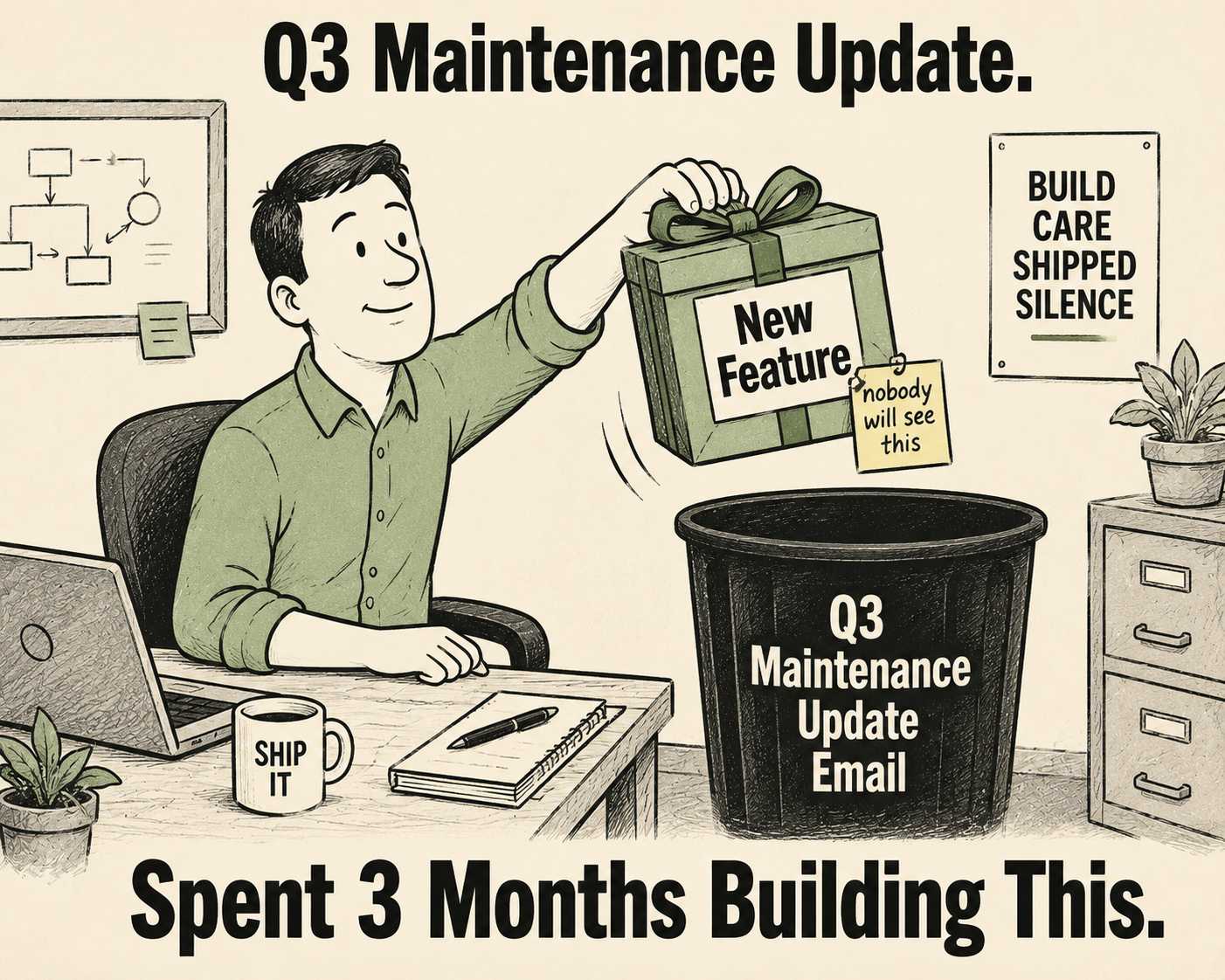
Software companies do the opposite. They spend quarters building features, and then they announce them in a bulleted list at the bottom of an email that starts with "Q3 Maintenance Update."
The assumption is that release notes exist to inform current users about changes, not to drive revenue. But companies with strong product-led growth motions treat release notes as conversion content. They use each release as a structured opportunity to demonstrate value to users who haven't paid yet.
The mechanics of conversion are rarely about aspiration.
A free user doesn't upgrade because a feature sounds cool in theory. They upgrade because of recognition. They see a feature they've already tried to use, or a limitation they've already hit, and they realize the paid tier removes the friction they're currently experiencing. Effective release notes make this value gap explicit without feeling like a sales page. The feature description naturally surfaces what is gated and why that gate exists, turning a technical update into a solution for a specific problem.
That's the whole mechanic. Recognition, not aspiration.
Anyway. The harder question is how to build a release note that reliably triggers that recognition.
The Structure That Actually Works
Most product marketers write release notes like landing page hero copy. They lean heavily on benefit-forward, vague, hype-driven language. This doesn't work.
Free users are often technical or at least operationally sophisticated. They want to know exactly what changed, what it does, and whether it solves their specific problem. A release note needs to be specific enough to be credible and framed enough to highlight value. Instead of "We improved reporting," the better phrasing is "You can now export your entire dataset in one click." Specificity builds trust and clarity, and trust is what converts.
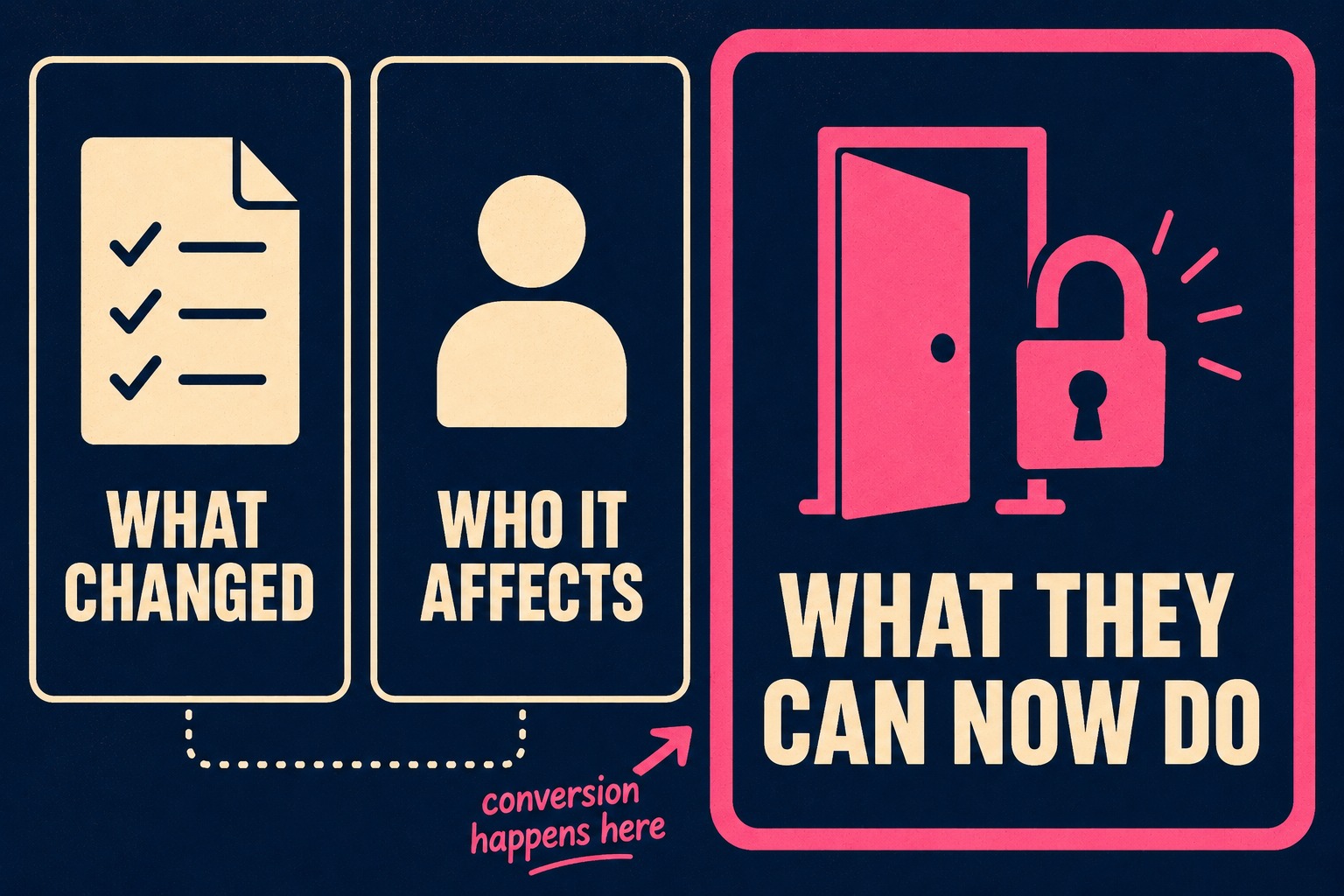
The structure that works follows a simple sequence: what changed, who it affects, what they can now do that they couldn't before. That third element is the one most teams skip. It's also the one that does the conversion work. If a free user reads a note and thinks "I've been waiting for that," you've done your job. If they read it and think "neat, I guess," you haven't.
A release note can include a call to action to upgrade, but only when the feature being announced is directly gated or unlocks a paid-tier capability. If the feature is available to free users, the CTA should drive engagement with the feature, not a sales conversation. Personalized CTAs convert at rates more than twice that of generic defaults, which means "See what else is on the paid plan" will almost always outperform "Upgrade now." The decision of when to include pricing context, when to link to a comparison page, and when to just let the feature speak for itself depends entirely on whether the update directly addresses a known limitation in the free tier.
Not all free users are ready to convert, and not all features are conversion levers. The features with the most potential are usually those that solve problems free users have already encountered in a limited way, or features that unlock workflows they've tried to start but couldn't finish. Behavioral triggers fire when users hit a gated feature or exhaust a usage quota, and release notes that land at that moment of friction are the ones that convert. If the infrastructure exists, different versions of a release note can be routed to different user segments. A power user might need technical specs; a manager needs to know how the feature saves time. If segmenting isn't possible, a single version must focus on the outcome rather than the technical details.
Frequency, Segmentation, and the Operational Problem
If your release cycle is weekly, not every release note is a conversion opportunity.
Some shipped features are maintenance, bug fixes, or enterprise-only additions that don't matter to free users. The principle that changelogs are for humans, not machines applies here: deciding which releases get conversion-focused messaging and which get standard technical updates is crucial to avoid fatiguing the audience. Freemium conversion rates for self-serve SaaS products average between 3% and 5%, which means the margin for annoying people before they tune out is thin. Treating every release as a sales moment trains users to ignore the notes entirely.
Where release notes are distributed also matters. In-app notifications catch users when they're actively engaged with the product, which is when the friction is most salient. Email digests are better for broader summaries, but they require more work to earn attention. The channel shapes the format: an in-app note can be two sentences; an email version might need a paragraph of context to land the same point.
Most teams don't have the operational capacity to write multiple targeted versions of every release note or maintain a rigorous publishing cadence. Writing a conversion-focused version, a technical version, and a manager-friendly version of the same release note, every two weeks, on top of everything else, is not a realistic ask for a lean product marketing team.
This is where Doc Holiday comes in. It's a documentation engine that generates output directly from engineering workflows. Your product marketer writes the conversion-focused framing once, and the system applies it to every relevant release automatically. A senior writer reviews AI-generated drafts in a dashboard, validating accuracy against commits; edge cases are flagged, and patterns are fed back to reduce drift over time. The operational discipline the article has been describing, the kind most teams can't sustain manually, becomes the default instead of the exception.
What to Measure
Release notes are often published and forgotten.
To treat them as conversion content, you need to track whether users who read them upgrade at higher rates than users who don't. The metrics worth watching are: click-through from the note to the upgrade page, time between note publication and conversion, and feature adoption among free users post-release. Pendo's 2024 product benchmarks found that the median feature adoption rate is 6.4%, with best-in-class products reaching 15.6%. Release notes that actively drive users to try a feature, rather than just informing them it exists, move that number.
The experimentation process doesn't need to be elaborate. A holdout group (users who don't receive the conversion-focused version) compared against users who do gives you a clean signal on whether the framing is working. Run it for two or three release cycles, adjust the structure based on what you see, and repeat. The goal is a reproducible system, not a creative breakthrough. The teams that win at this are the ones who treat release notes like any other conversion asset: something to be tested, measured, and improved, not just published.