Scaling Public API Release Notes: The Operational Reality


A developer reads your changelog. They see "Updated authentication flow." They open the authentication reference page. It still shows the old token format. They guess at the new format, their code breaks, and they open a support ticket.
That sequence plays out thousands of times across API ecosystems. The changelog announced the change, but the reference docs haven't caught up. The developer can't use either one to move forward.
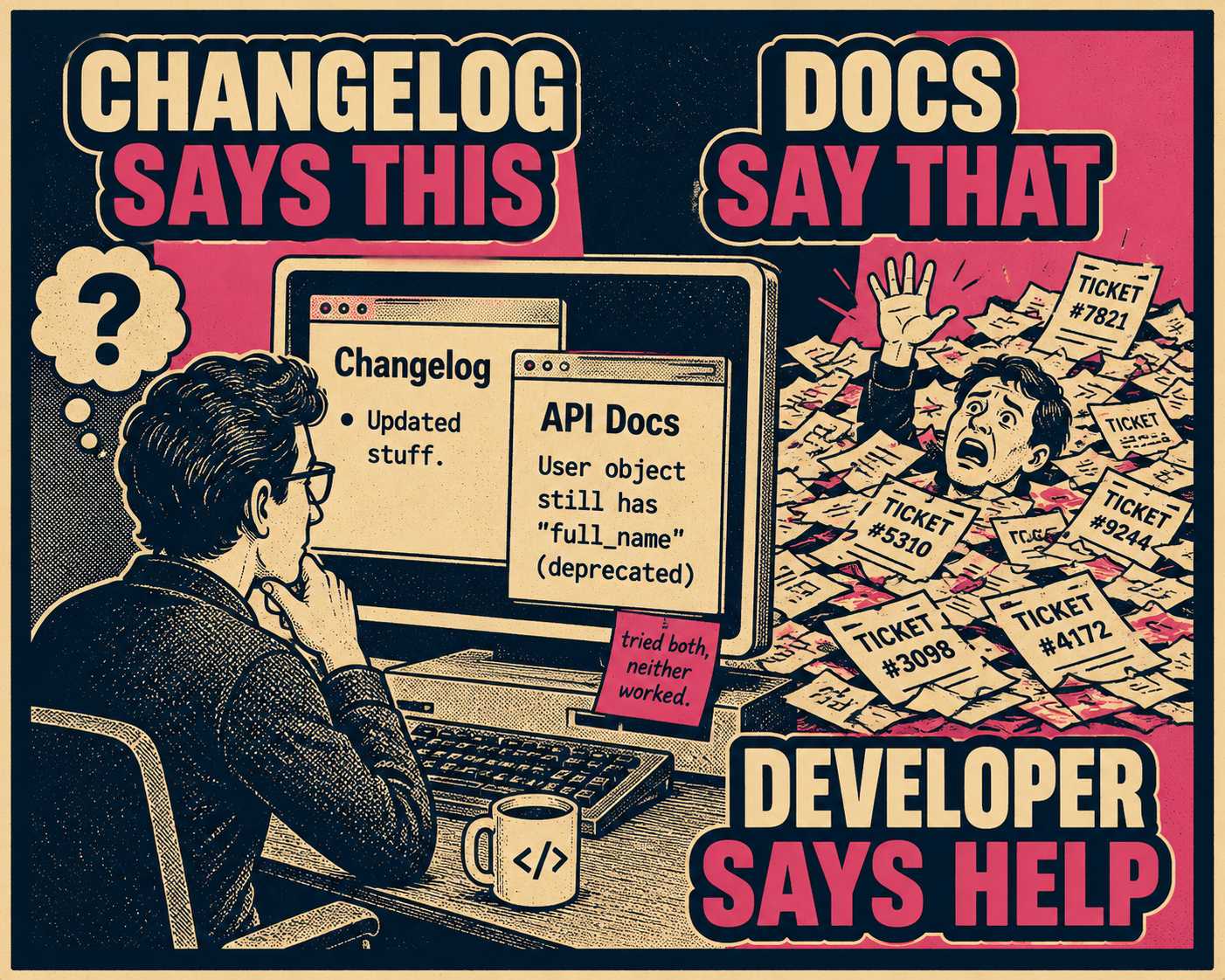
Public API release notes are high-stakes communication. A misstep here—burying a breaking change, using ambiguous language, or omitting migration guidance—erodes developer trust at scale. The larger the audience, the more this compounds.
Most teams default to either engineering-native changelogs or marketing copy. Neither serves the actual user. Engineering-native changelogs are often too raw, dumping git commit messages that mean nothing to an external consumer. Marketing copy is too vague, glossing over technical details in favor of "exciting new features."
To scale public API release notes for a developer base measured in thousands, you need a framework that balances technical precision with accessibility, maintains trust through transparency, and scales without requiring a proportional increase in writer headcount.
What Most Changelogs Get Wrong
Most API changelogs are written from the team's perspective, not the developer's.
The team shipping a feature knows what changed internally. The developer integrating against the API needs to know what they have to do differently. These are different questions with different answers.
A changelog entry that says "Refactored token validation to use JWT" tells a developer that something changed internally. It doesn't tell them whether their integration breaks, what parameter they need to update, or where to find the migration guide.
A good changelog entry meets a simple test. A developer who reads only that entry should be able to determine whether their integration requires changes, and if so, exactly what those changes are.
Write for the Migrator, Not the Reader
Release notes for public APIs are action documents. The developer reading them needs to know what changed, why it matters to their integration, and what to do about it.
Structure each entry to answer those three questions in order.
Specificity is more important than brevity. Vague language like "improved error handling" is worse than verbose clarity. A better entry reads: "POST /users now returns 409 Conflict with error code duplicate_email instead of 400 Bad Request."
That precise description gives developers confidence they understand the change.
Why Breaking Changes Need Separate Treatment
Mixing breaking changes with additive ones is the most common structural failure in API changelogs.
Breaking changes—like removed endpoints, renamed parameters, or changed response schemas—require the developer to modify their integration. Additive changes—like new optional fields or endpoints—can be safely ignored.
Burying both types in a single chronological list puts the burden on developers to read every entry to find the ones that require action.
Lead with impact classification. Frontload the hierarchy: breaking, deprecated, new, fixed. This allows someone maintaining a production integration to assess exposure in seconds.
If you are deprecating an endpoint or changing a required field, the release note must include working code samples or a link to migration docs. Developers need to act immediately without opening a support ticket.
Version Public APIs with Discipline
There is an operational difference between internal versioning and public-facing release notes. Internal versioning can be messy, reflecting the chaotic reality of software development. Public-facing release notes must map cleanly to semantic versioning or date-based releases.
Translate engineering reality into a stable external narrative.
If an API publisher fails to communicate changes clearly, customers lose trust in versioning as a communication tool. This forces the publisher to support older versions to accommodate stragglers, which further contributes to bad versioning practices.
The Bottleneck of a Single Writer
For a team managing an API used by thousands of developers, release notes can't bottleneck on a single technical writer.
You need a system where engineers contribute structured notes early in the development cycle. A writer or product manager then validates and refines them, and the final output ships with the release.
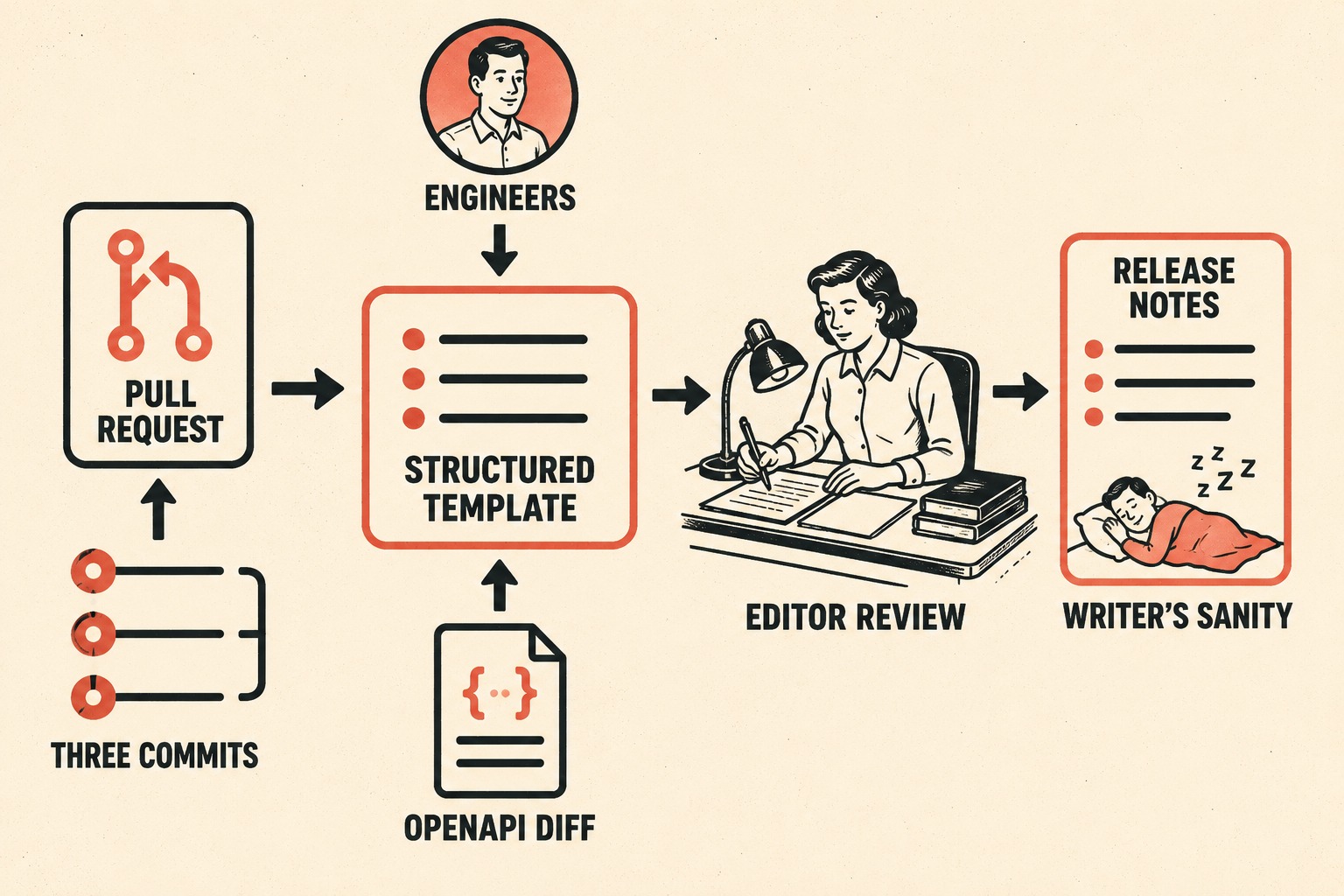
Tooling makes this repeatable. Structured issue templates, pull request conventions, or automation that surfaces changes from commit history and OpenAPI diffs can streamline the process.
Automation plays a crucial role here. It can generate a first draft from pull requests, API specification diffs, or issue tracker metadata.
This is an input to the editorial process, not a replacement for it. The writer's job becomes validating technical accuracy, rewriting for clarity, and ensuring the migration path is complete. This is faster than starting from scratch and scales better than asking engineers to write polished prose.
How to Validate Without Drowning
Teams must validate release notes before publication.
Route notes to the engineers who made the change for technical review. Run them past a developer relations team for accessibility checks. Maintain a backlog of common developer questions to stress-test clarity.
At this scale, a confusing release note generates support load that drowns the team. Validation is not overhead; it is loss prevention.
For a team managing a public API with a large developer base, the ideal system generates a structured draft directly from the engineering workflow—pull requests, OpenAPI diffs, issue tracker updates—and hands that draft to a skilled writer or product manager for substantive editorial work. That means catching technical errors, rewriting for clarity, stress-testing migration steps, and identifying anything that will generate a support ticket before it reaches developers.
This is the difference between release notes that scale with the API and release notes that become the bottleneck. Doc Holiday generates release notes and API references from these engineering workflows, giving the writer the raw material and structure to do that editorial work well—without rebuilding large headcount to keep up with API velocity.