New Engineers Are Slow Because Your Documentation Is


You hired a senior engineer with twelve years of experience and budgeted for them to start owning features by week two.
Day one is environment setup. Day five is spent hunting for an undocumented API contract with a legacy backend service. By month one, they haven't shipped anything meaningful. Month two, they are trying to reconstruct the rationale behind a 2022 architecture decision because nobody wrote down why you chose a custom state manager instead of the standard library.
By month three, they are finally shipping at the pace you expected in week two.
We assume senior engineers ramp faster. Reality is that domain knowledge, codebase complexity, and team dynamics take 60 to 90 days to absorb, regardless of a developer's résumé (the 90-day onboarding gap is well-documented).
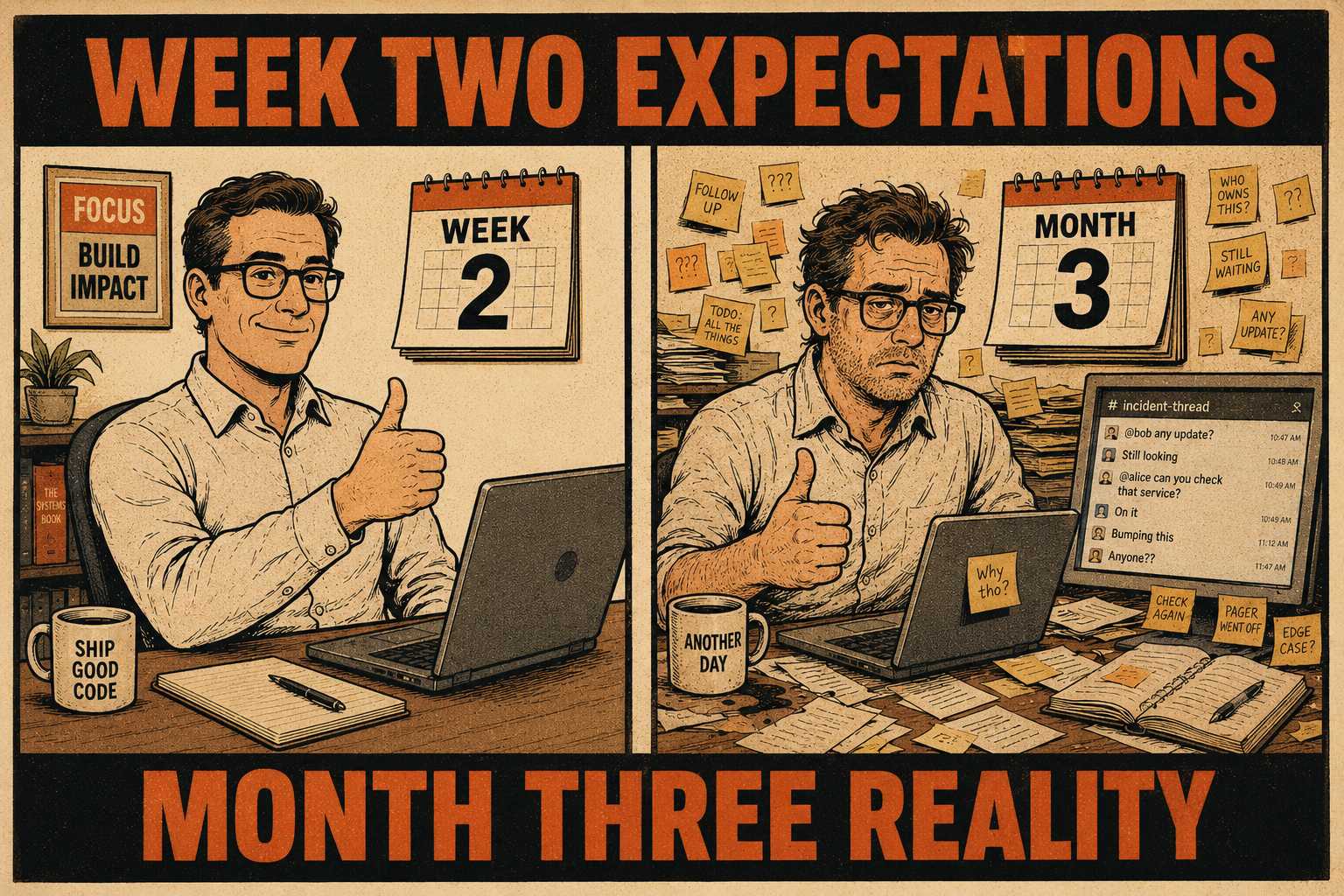
Every engineering organization pays this knowledge transfer tax. But most leaders budget for a 30-day ramp when the reality is 90. That gap costs you a senior engineer's salary every quarter.
If a team hires five engineers a year at $150,000 each, the difference between a three-week ramp and a three-month ramp is tens of thousands of dollars in lost productivity per hire. And that is just the direct cost. It does not count the capacity drain on your existing senior engineers who spend hours each week answering questions that should have been documented — context-switching alone is one of the leading productivity killers for developers.
The Architecture Is in the Slack History
The root cause is rarely technical incompetence. The root cause is that documentation is missing, outdated, or scattered across tools that do not connect to actual workflows.
New engineers don't know what they don't know. They cannot find answers even when documentation exists. The institutional knowledge — the "tribal knowledge" — lives in Slack threads, senior engineers' heads, and undocumented edge cases that only surface when something breaks. Research on agile software teams at NTT found that a substantial portion of project knowledge is never captured in any formal artifact — it exists only in conversations and individual memory.
A senior engineer joining your team from a SaaS company might know React perfectly. But they need to learn your specific payment processing flows, your regulatory requirements, and your fraud detection patterns. Their senior title means they ask better questions and connect dots faster. It does not mean they can magically absorb undocumented domain knowledge.
When knowledge is locked in the heads of veteran developers, new team members cannot learn efficiently. The ACM has noted that insufficient or outdated documentation is one of the most consistently cited barriers to effective onboarding in software organizations. The onboarding process becomes a slow drip of ad hoc knowledge transfer.
The Unwritten Rules of Shipping
Structured onboarding documentation needs to cover more than just how to run the build script. It must capture the operational reality of the system.
This includes system architecture and data flows. It includes deployment and release processes. It includes code review norms and approval workflows. It includes debugging playbooks for common failure modes.
Crucially, it must include the unwritten rules that govern how work gets prioritized and shipped. Who makes final calls on database schema changes? Which engineer quietly reviews every pull request touching authentication? When do you escalate to the CTO versus handling it in the team channel?
When these rules are missing, new hires either break them and cause friction, or they proceed too cautiously and slow their own progress. They interrupt senior engineers for basic context, creating a snowball effect of context-switching that degrades the productivity of your most valuable people. A 2026 multivocal literature review synthesizing 87 academic and practitioner sources identified communication gaps and insufficient documentation as two of the ten most significant challenges in software engineering onboarding.
Why Documentation Decays (and Why We Let It)
This documentation often doesn't exist, or it decays rapidly.
Teams prioritize shipping over documenting. Under tight project deadlines, documentation is often deprioritized in favor of faster feature delivery. Knowledge transfer happens verbally and never gets written down. Documentation becomes stale the moment systems change.
This is a structural problem, not a competence problem.
No one owns the maintenance loop. A mapping study on documentation in continuous software development found that developers consistently perceive documentation as a secondary task that delivers less immediate value than writing code — a perception that is individually rational and organizationally catastrophic. The result is a fragmented documentation system that cannot support a growing engineering team.
The Pipeline Approach to Knowledge
The solution is documentation that stays current because it is generated from the workflows where changes actually happen.
This isn't about maintaining separate onboarding wikis that require manual updates. It is about pulling real-time documentation from the engineering pipeline — release notes, changelogs, API references, system diagrams that update when code ships. CI/CD pipelines (the automated systems that build, test, and deploy software) are already generating this information as a byproduct of normal engineering work. The question is whether it gets captured and organized, or lost.
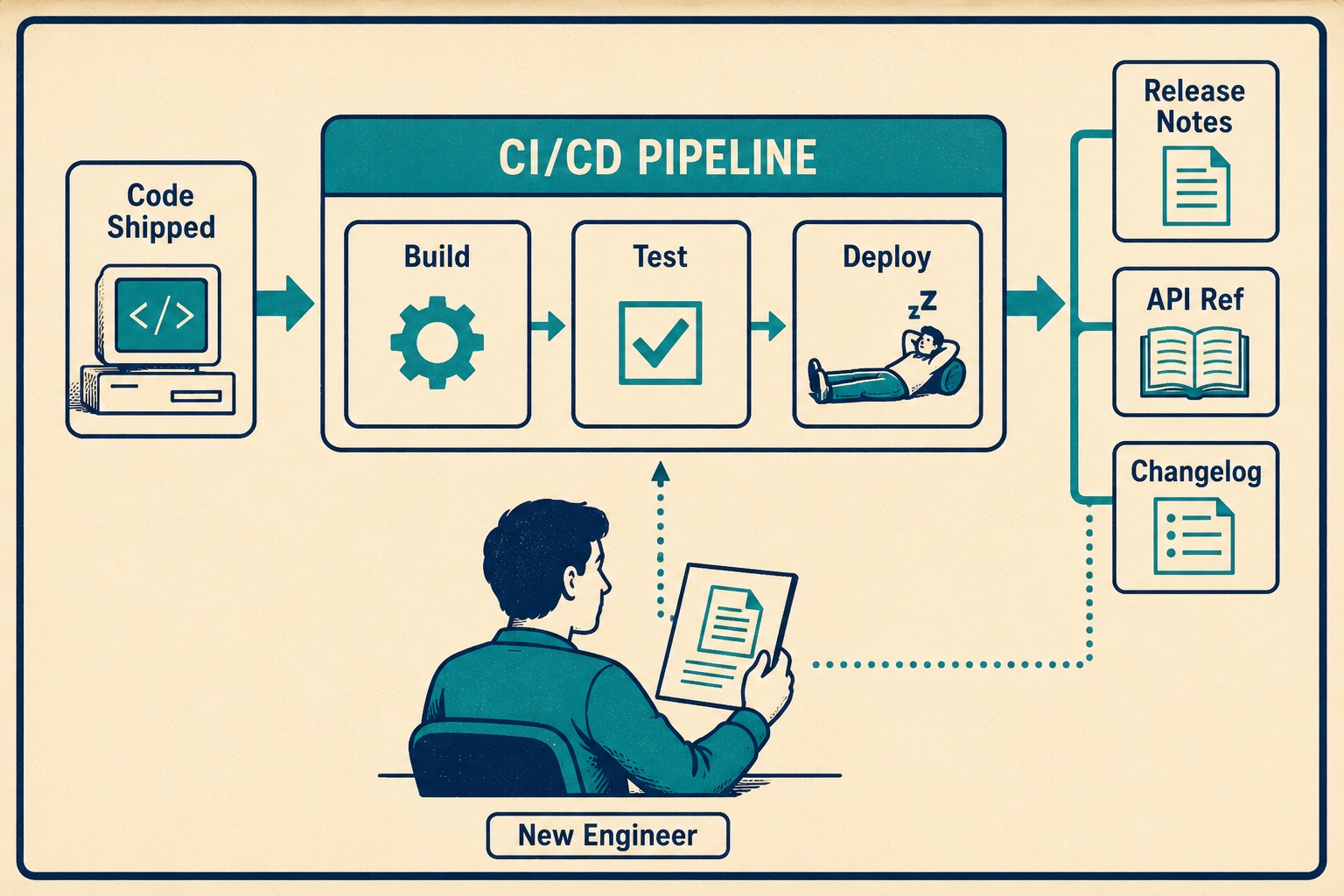
Operationally, this means new engineers get structured paths through documentation that reflects the current state of the system. They can trace how recent changes connect to the architecture they are learning. They have self-service access to answers that would otherwise require interrupting a senior engineer.
Onboarding becomes a repeatable process instead of an ad hoc knowledge dump. Organizations with a structured onboarding process see new hires reach productivity up to 50% faster, and the Brandon Hall Group found that a strong onboarding process can improve new hire productivity by over 70%. The engineering team that ships documentation as a byproduct of shipping code is the one that scales without breaking.
The Quality Control Layer
Structured documentation output still needs a human who understands the system to organize it, validate accuracy, and fill in the contextual gaps that matter for new engineers.
This is where technical writers or senior engineers who understand knowledge management add leverage. They are not generating documentation from scratch. They are governing and curating output that is already being produced by the engineering workflow.
Unmanaged AI systems fail at this. They struggle to maintain architectural coherence without human governance. But managed systems scale. AI drafts from commits, humans review in a dashboard, edge cases are flagged, and patterns are fed back to improve the system. Qualitative research interviewing 27 professional developers and managers found that turnover-induced knowledge loss affects code quality and team productivity in ways that are difficult to recover from without deliberate knowledge management practices.
When new engineers can onboard themselves through structured, current documentation, ramp time drops. Senior engineers get their focus time back. Teams can scale hiring without breaking their existing engineers.
Doc Holiday generates the documentation artifacts that feed this system — release notes, API references, changelogs — and gives teams the structure to validate, organize, and maintain that output as onboarding infrastructure. Documentation stops being a lagging artifact and starts being an operational asset that actually supports how teams grow.