How to Structure Release Notes to Reduce Churn in Self-Serve SaaS


The enterprise software buyer gets a quarterly business review. They get an account manager who takes them to dinner. They get a customized slide deck showing exactly how much money the software saved them over the last ninety days.
The self-serve SaaS user gets none of that.
They evaluate value in total silence. They log in, try to accomplish a task, and either succeed or fail. If they succeed, they keep paying. If they fail, or if they simply forget why they started paying in the first place, they cancel. There is no account manager to save the deal. The product either proves its worth continuously, or it gets discarded.
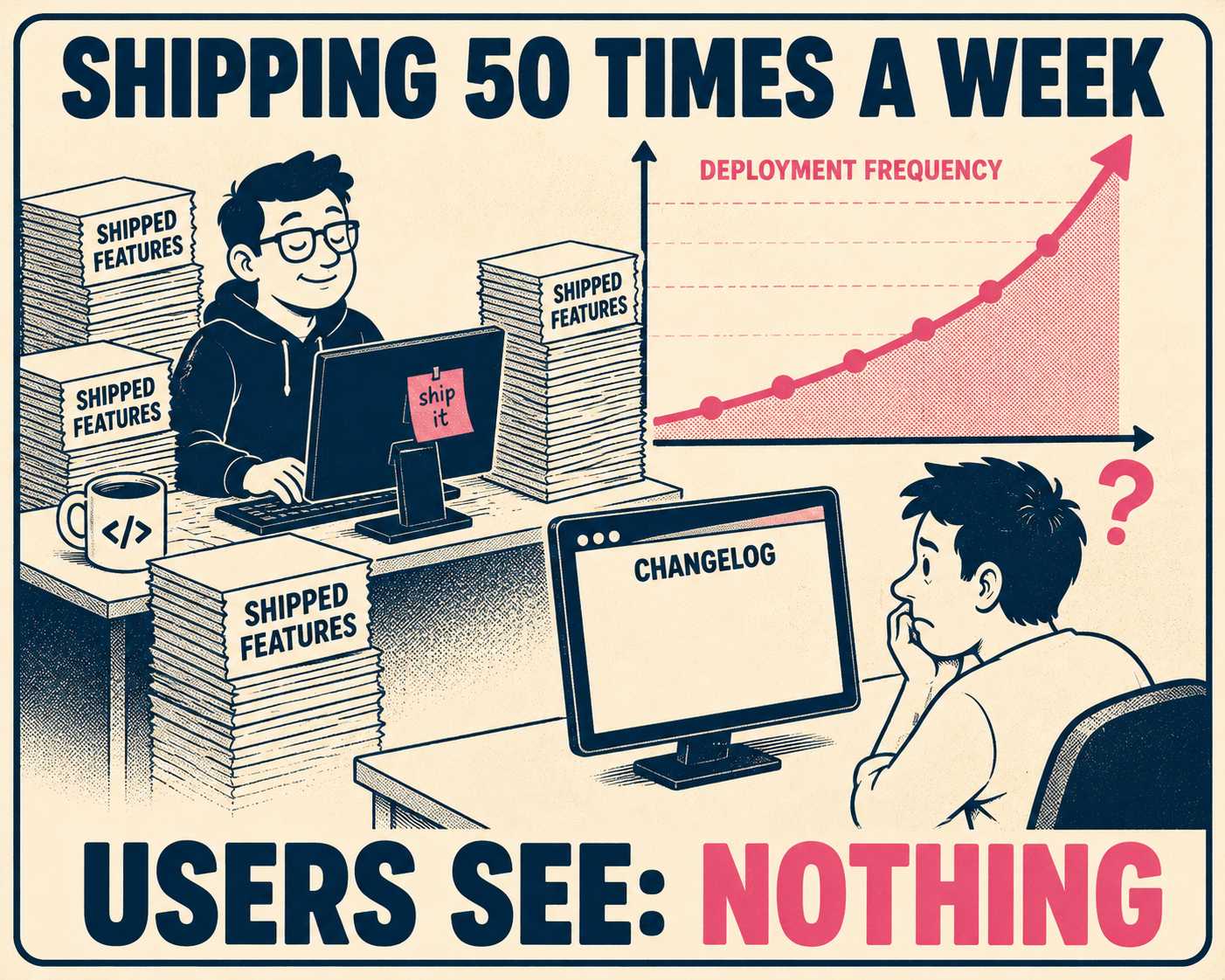
This is the central problem of self-serve retention. Many product teams ship features constantly. They run two-week sprints, deploy code daily, and operate with high velocity. But they fail to translate that velocity into perceived value because their release notes are buried, generic, or written like internal engineering logs.
Properly structured release notes reduce churn by surfacing continuous value delivery at moments when users are already engaged with the product. They remind users that the product is actively improving in ways that matter to them. They turn invisible backend work into visible customer benefit.
The Silence of the Self-Serve User
When a self-serve product goes quiet, users fill in the blanks themselves. A lack of visible updates creates the impression that the product is in maintenance mode, even if the engineering team is shipping behind the scenes.
Churn often begins long before the actual cancellation. Subscription value is continuously re-evaluated against recurring costs, and once dissatisfaction crosses a threshold, behavioral inertia is overcome and churn occurs rapidly. A customer stops seeing the value, stops using relevant features, or simply believes the product no longer meets their evolving needs. Clear product communication disrupts this drift.
But this only works if the updates reach the user at the right time and in the right place.
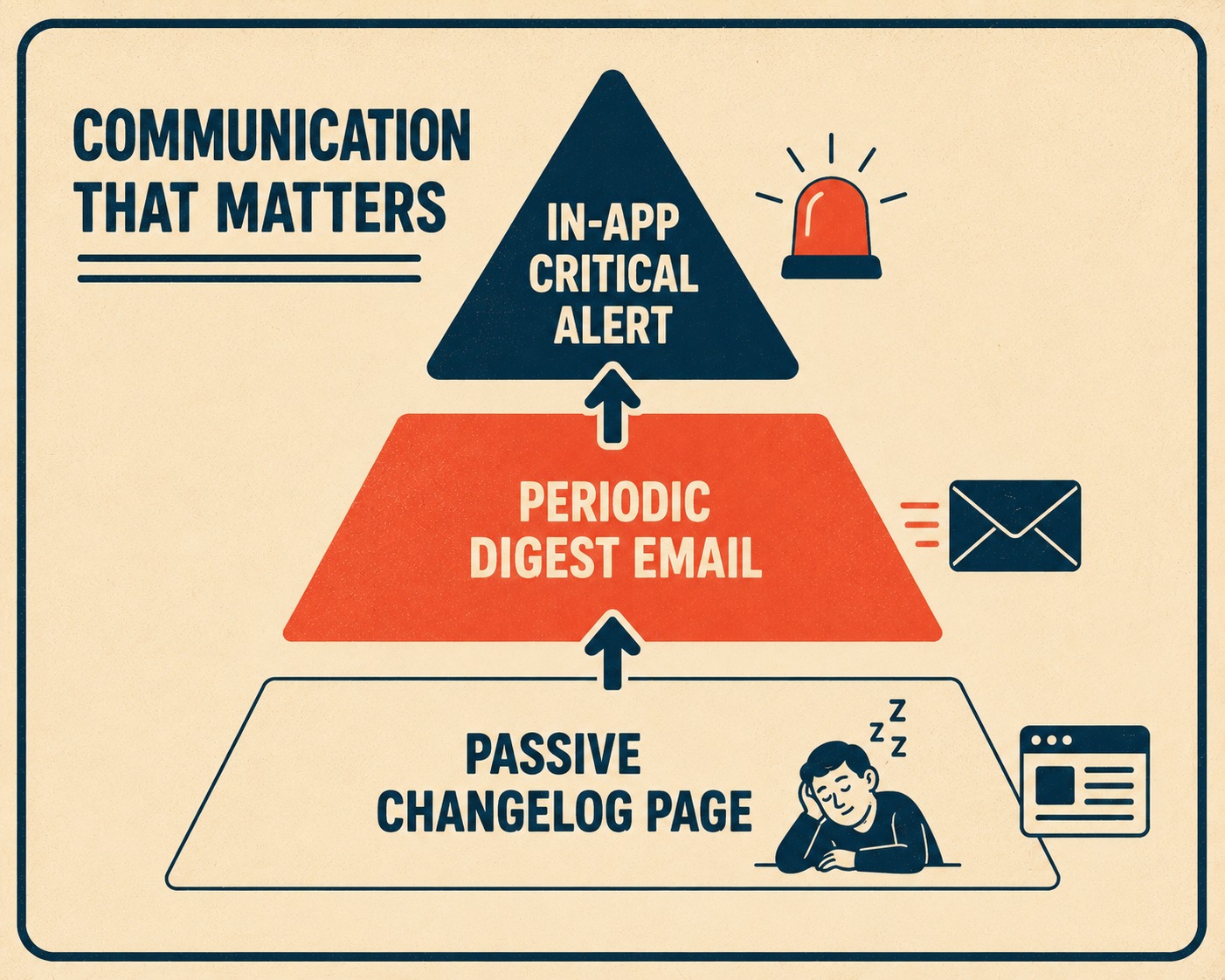
Placement and delivery timing are critical structural decisions. Burying updates on a static changelog page guarantees they will be ignored by the majority of the user base. Conversely, blasting every minor bug fix via email trains users to ignore you. Studies show that 73% of users unsubscribe from notifications due to receiving too many irrelevant or poorly timed messages, and that 52% of users who disable notifications will eventually churn entirely.
The most effective approach is contextual delivery. In-app announcements surface updates when users are actively in the product and in the right mindset to try new features immediately. If a new feature improves a common workflow, showing it inside the product creates less friction than expecting customers to find it on their own. For lower-urgency updates, a periodic digest email respects user attention while ensuring important information still reaches them.
The tradeoff between interruption and visibility is real. Push every update and you create noise. Push nothing and you become invisible. The answer is a tiered system: critical changes get pushed proactively, incremental improvements live on a passive changelog page, and periodic digests bridge the gap for users who are engaged but not daily-active.
Writing for the Person, Not the Ticket
The single biggest failure mode in release notes is the curse of knowledge. When you spend six weeks building a feature, you understand the architecture, the edge cases, and the technical debt you paid down. It is very hard to imagine what it is like to not know those things.
So you write about the hard part.
You write: "Refactored the authentication service to handle token refresh automatically."
The user does not care about the hard part. They care about the outcome. They need to know what they can do now that they couldn't do before, or what friction has been removed.
The customer-facing version is: "You'll stay logged in longer without having to re-enter your password."
Framing for user benefit, not engineering effort, is what separates a changelog from a commit log. The difference between "added support for OAuth 2.0" and "faster, more reliable login" is the difference between a user ignoring the update and a user recognizing the ongoing value of their subscription.
This reframing is not just cosmetic. Segmentation matters here too. Not all releases matter equally to all users, and sending every update to every user trains them to ignore you. Role-based or usage-based filtering ensures users only see changes that matter to their specific workflow. Administrators need to know about new permission controls. Power users need to know about advanced keyboard shortcuts. Casual users only need to know about improvements that impact their daily tasks. Applications that offer segmented, targeted updates see meaningfully higher engagement and lower opt-out rates than those that blast generic announcements to the entire user base.
A changelog should also tell a story of the product getting better at solving the user's problem. When updates are presented as a disconnected list of tickets, the user has to do the cognitive work of figuring out what it all means. Grouping related changes and calling out themes does that work for them. If you ship a series of small performance improvements, a minor UI tweak, and a new export format, group them under a theme like "Faster reporting workflows." This narrative coherence helps users understand the broader trajectory of the product. It shows that the team is investing in quality and refining workflows, not just shipping random code.
This narrative can also serve as an engagement hook. Research on app updates shows that feature introductions increase both opening frequency and usage time per session. A concise update that highlights one meaningful improvement to a previously abandoned workflow can pull a dormant user back in. Include a clear call to action that invites users to try the new feature.
What Does Not Work
Engineering-first language fails. Burying critical updates in walls of text fails. Inconsistent cadence fails.
Release notes that only appear when something breaks fail spectacularly. Treating the changelog as a compliance checkbox instead of a retention tool is a missed opportunity to reinforce perceived value. Subscription loyalty is sustained by transparency and the continuous perception of fairness. If the only time a user hears from the product team is when there is an outage, their perception of the product's value will inevitably decline.
Atlassian ran directly into this problem when their cloud products moved to continuous delivery. Their research found that 50% of administrators felt they had inadequate information about product changes. After shifting to a structured release note content type tied directly into their feature release systems and delivered through multiple channels, they saw a 300% increase in engagement with release notes. That is not a small number. It suggests the demand for structured release communication was always there. The supply was just missing.
The Operational Reality
Executing this consistently at scale is incredibly difficult, especially for lean teams.
Writing effective release notes for every release requires deep product knowledge, user empathy, and the discipline to maintain quality under velocity pressure. According to DORA's research, elite-performing engineering teams deploy multiple times per day. CI/CD pipelines (continuous integration and continuous delivery, the practice of automating code testing and deployment) have made it operationally feasible for mid-sized teams to ship dozens of times per week. The documentation process has not scaled with the deployment process.
The person who understands the code does not always understand the customer's context. The person who understands the customer does not have time to rewrite every release note manually. After a long sprint, the release notes get rushed, skipped, or written in engineering jargon because it is faster. This is where many teams fail. Not because they don't ship, but because they can't document what they ship in a way that lands with users.
The gap between deployment frequency and documentation quality is where churn quietly accumulates.
This is exactly the problem Doc Holiday is built to close. It generates release notes directly from engineering workflows, pulling from commits, pull requests, and product specs to produce a baseline draft. A senior writer or product lead reviews the output, reframes it for user value, and manages it at scale through a structured validation workflow. The velocity of the engineering team actually translates into the perceived value that keeps self-serve users subscribed, without requiring a content team to manually rewrite every release from scratch.