How to Document API Versioning Strategies for Enterprise Customers


If you want to kill an enterprise deal in the final weeks of procurement, hand their architecture review board a single, undifferentiated changelog and tell them it's your versioning documentation.
They will look at the 80-page scroll of minor tweaks, bug fixes, and breaking changes. They will realize their engineering team will have to manually parse this document every quarter to figure out if their integration is about to break. They will calculate the operational cost of that maintenance. And then they will ask for a discount, or they will walk away.
Enterprise customers evaluate API versioning documentation as part of technical due diligence because poor versioning practices create compounding integration costs. Their procurement teams want proof that your deprecation timelines won't strand their implementation six months after launch. This is a revenue problem. Deals slow or die when buyers can't assess version stability risk, and the documentation gap is usually the proximate cause.
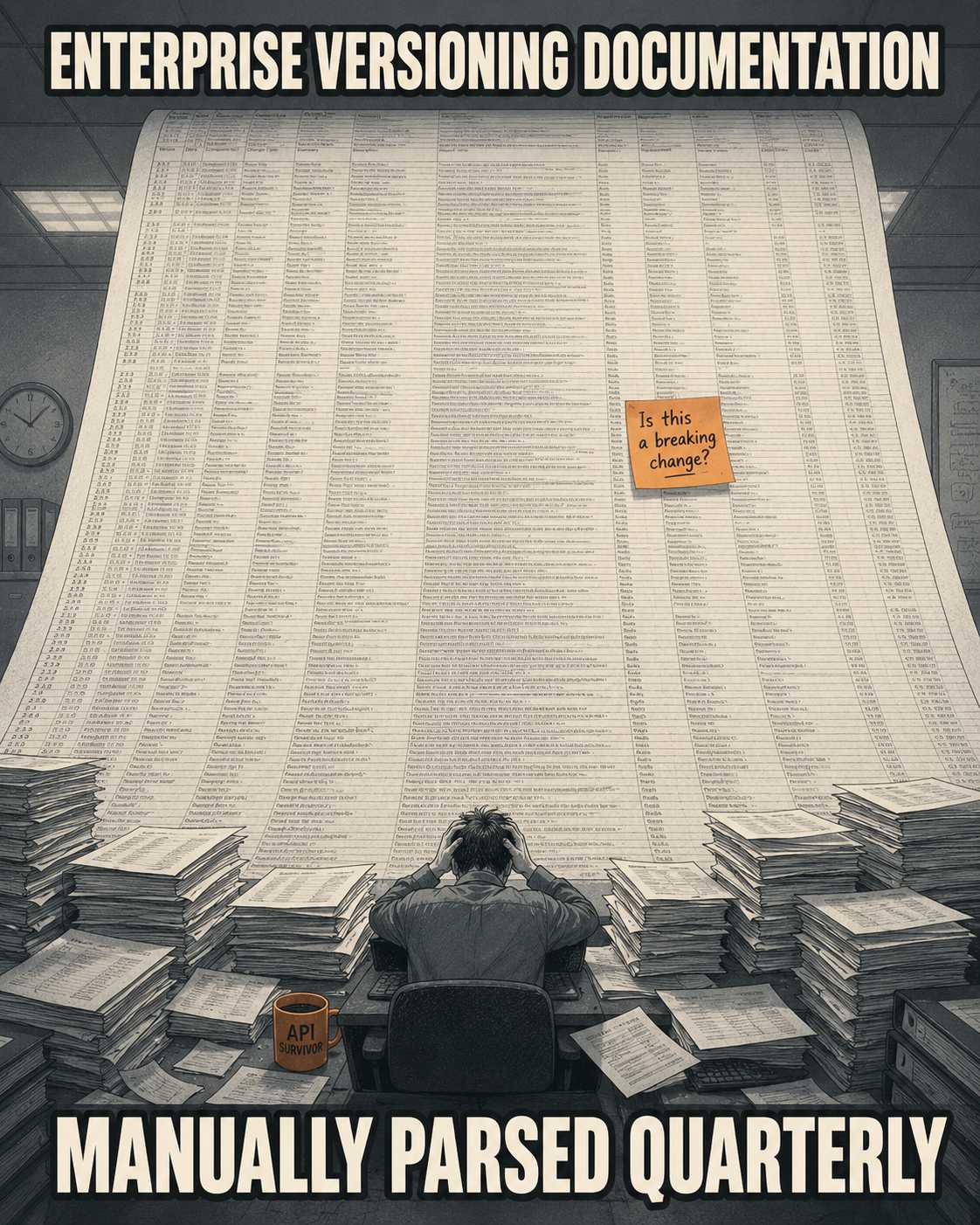
Here is what comprehensive API versioning documentation must include to pass enterprise review — and why most teams are still getting it wrong.
The Philosophy, Not Just the Notation
Enterprises need to understand your decision criteria for when breaking changes trigger a major version versus a minor update. They need to understand your philosophy, not just your notation.
Document whether you follow semantic versioning, date-based versioning, or a custom scheme. Explain how customers should interpret version numbers when planning integration work. If you use date-based versioning (as Stripe does), explain that every date represents a pinned version of the API and that backwards-incompatible changes are tied to new dates. If you use semantic versioning, explicitly define what constitutes a breaking change in your system. Is adding a new required request field a major version bump? Is changing an error message format a breaking change? Is removing a deprecated parameter with 90 days' notice a patch or a major?
Write it down. The ambiguity here is where enterprise deals start to stall.
This is also where governance documentation belongs, and most teams leave it out entirely. Enterprises want to know not just what versions exist today, but how you decide when to introduce breaking changes, who approves deprecations, and whether customers get advance access to beta versions for testing. That governance context belongs in the same artifact as the technical versioning details. A procurement team reviewing your API strategy is trying to assess institutional risk, not just technical risk. They want to know if your deprecation decisions are made by a committee with a formal review process or by a single engineer at 11 p.m. on a Friday. (The answer matters more than you'd think.)
Contractual Clarity on Deprecation
Enterprise customers build multi-year roadmaps. They need contractual clarity on how long a given API version will receive security patches, when it will stop receiving feature updates, and when it will be fully sunset.
Include the notice period you commit to before deprecating any endpoint or parameter. State the minimum support windows for each version tier. If you guarantee that a major version will be supported for at least 24 months after the next major version is released, that is a commitment procurement teams can underwrite. If your policy is "we'll email you a few months before we turn it off," they will price that risk into the contract — and that price will come out of your margin.
The table below shows the kind of version lifecycle structure that enterprise buyers expect to see documented:
The specific windows in your policy will vary. The point is that they need to exist, be written down, and be findable by someone who isn't a developer. InfoSec reviewers and legal teams are looking for this information too, and they are not going to read your OpenAPI spec to find it.
Separate References, Migration Guides, and the People Who Need Both
For each currently supported major version, maintain separate reference documentation showing exactly what endpoints, parameters, and response shapes are available.
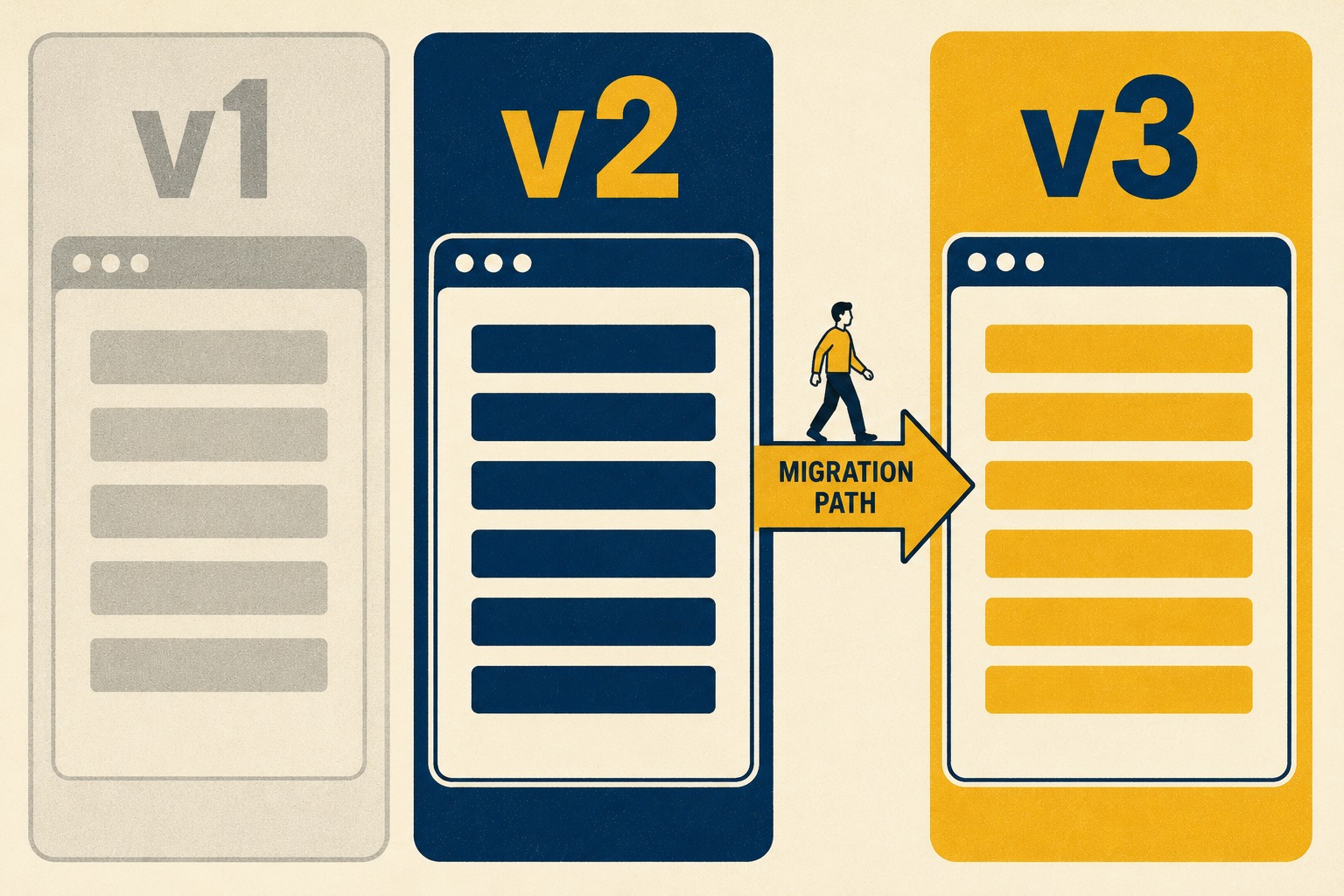
Customers integrating against v2 shouldn't have to read v3 docs and guess what's been removed. They shouldn't have to mentally diff across changelog entries to reconstruct the state of the API at a specific point in time. Version-specific endpoint documentation is non-negotiable for enterprise buyers. If they are paying you six figures, they expect a reference that accurately reflects the version they are actually using.
Migration guides are a separate problem. Enterprises don't just need a changelog — they need a runbook their engineers can follow to port existing integrations without starting from scratch. Migration guides for each major version transition should show request and response examples side-by-side. They should flag breaking changes in context. If an endpoint was removed, the guide must explain the new pattern for achieving the same outcome. If a data structure changed, the guide should map the old fields to the new ones. This is how you reduce the engineering effort required for version upgrades, which directly reduces the friction of enterprise renewals.
One thing that often gets missed: your API versioning documentation will be reviewed by at least four different audiences during an enterprise deal. Procurement wants to know about deprecation notice periods and contractual commitments. InfoSec wants to know about your backwards compatibility policy and the exceptions that override it. Solution architects want to understand the versioning scheme and how to plan integrations against it. Implementation engineers want the migration guides and version-specific references. A single versioning strategy document should serve all of them, or you'll answer the same questions in every deal cycle — usually in a security questionnaire, a technical call, and a follow-up email, in that order.
Backwards compatibility commitments deserve their own section in this document. State which types of changes you will and won't make within a major version. More importantly, state under what circumstances you might break that contract. Critical security fixes, legal or regulatory requirements, and upstream provider changes are common reasons for emergency breaking changes. Google's API Design Guide recommends a minimum 180-day deprecation window for beta-channel functionality before removal — a concrete benchmark worth referencing when setting your own policy. Documenting these exceptions clearly means that when they happen, you're not violating the documented trust of your enterprise customers — you're invoking a clause they already agreed to.
The Operational Tax of Versioning
This is real work. Someone has to keep v1, v2, and v3 documentation accurate and up to date as patches and clarifications flow in.
Most companies underinvest here. They end up with reference docs that diverge from actual API behavior, which creates support load and erodes customer trust faster than almost anything else. A customer who files a support ticket because the documented behavior doesn't match the actual behavior has just discovered that your documentation is a liability, not an asset.
Maintaining multiple versioned API references simultaneously is an operational tax that scales with the complexity of your product. The teams that handle it well tend to have one of two things: dedicated technical writers assigned to API docs, or a system that generates version-specific references directly from their OpenAPI specs and keeps them in sync as the API evolves. Most lean teams have neither, which is why versioning documentation debt accumulates so reliably.
This is where the ROI of AI documentation tooling is clearest. Generating version-specific references from OpenAPI specs or API gateway configs eliminates the manual sync problem. The documentation stays accurate because it's derived from the source of truth, not maintained in parallel with it.
If your API versioning documentation is thin or scattered across changelog entries, you're adding friction to every enterprise sales cycle and creating support burden for every customer trying to upgrade. The structure required — versioning philosophy, deprecation policy, version-specific references, migration guides — is predictable and automatable. Doc Holiday generates versioning documentation directly from your OpenAPI specs and release metadata, then provides the validation structure to ensure deprecated endpoints are flagged, migration paths are documented, and version-specific references stay accurate as your API evolves. For teams that don't have dedicated technical writers assigned to API docs, it's the system that makes comprehensive versioning documentation scalable without adding headcount.