How to Build a 30-60-90 Day Documentation Plan for Engineering Onboarding


If you hire a senior engineer today, they will spend their first three weeks asking where the staging environment credentials live. You have not hired a senior engineer. You have hired an expensive archeologist.
The tribal knowledge problem is the quiet tax on engineering scale. A team of twenty can run on Slack messages and oral history. A team of two hundred cannot. When new hires take months to reach productivity, the instinct is often to blame the hiring process, the complexity of the codebase, or the onboarding buddy. But the problem is usually the documentation.
Building a 30-60-90 day documentation plan for engineering onboarding is not about writing a comprehensive encyclopedia of every system your team owns. It is about sequencing knowledge. You need to give new engineers the context they need to make their first commit in week one, the depth to understand architecture by month two, and the ownership to maintain the system by month three.
Here is how to structure that progression.
Days 1–30: Time to First Commit
The goal of the first thirty days is not comprehensive system knowledge. The goal is reducing time-to-first-commit.
A new engineer does not need to understand the historical nuances of why you chose a specific database architecture on day three. They need to know how to set up their local environment, how to get a PR approved, and who to ask when the deployment script fails.
There is a meaningful difference between documentation a new hire will actually read and documentation that should exist but won't get opened for months. The first thirty days require the former. Google's engineering productivity research found that the three top hindrances to developer ramp-up were learning a new technology, poor or missing documentation, and finding expertise. Documentation was second on that list — not tooling, not codebase complexity. Documentation.
Identify the five highest-value documents for early onboarding. These typically include the local environment setup guide, the "first deploy" walkthrough, the team directory and communication norms, a high-level architecture overview, and the incident response basics. That last one matters more than most teams think. A new hire who breaks something and has no idea what to do next learns a very specific lesson about your team's culture, and it is not a good one.
These documents must be current. If they are not, you are actively teaching your new hires that your documentation cannot be trusted. The fix is to tie the documentation to the onboarding process itself. If the new hire finds a broken step in the setup guide, their first task is to fix it. This turns onboarding from a passive reading exercise into an active maintenance process — and it catches drift faster than any quarterly audit.
Pairing schedules and recorded walkthroughs are underused in this phase. A recorded architecture walkthrough, even a rough one, gives new hires something to watch before their first pairing session. They arrive with context instead of questions. Shopify's engineering leaders describe the value of onboarding documentation in terms of context, not procedure: knowing where to find information, understanding the CI/CD pipeline (the automated process that moves code from a developer's machine to production), reading architecture and internal system designs. That is stable content. It is worth creating well.
The metric for this phase is straightforward. If a new hire cannot make a meaningful commit by the end of week two, something in the documentation is failing them. Top-performing engineering organizations achieve time-to-first-commit in three to five days. The median is two to three weeks. The difference between those two numbers is not talent. It is systems.
Days 31–60: From Execution to Understanding
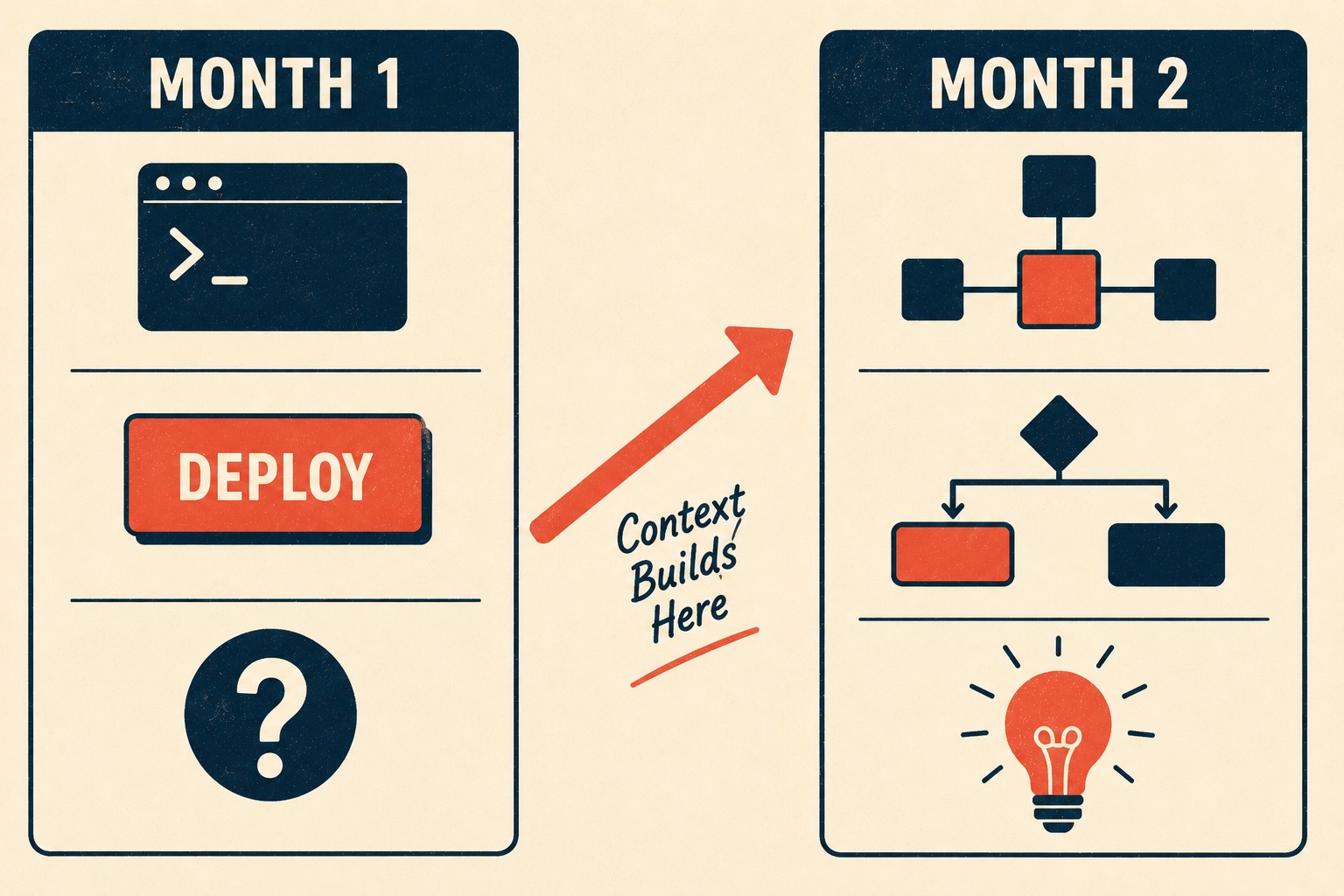
By month two, the new engineer can deploy a fix. Now they need to understand how the team makes decisions.
This is where the documentation shifts from procedural to structural. You are moving from "how do I run the tests?" to "why did we build the testing framework this way?" This requires a different class of documentation entirely.
Architecture Decision Records, or ADRs, are the most valuable artifacts for this phase. First described by Michael Nygard in 2011, an ADR is a short document that captures the context, decision, and consequences of a significant architectural choice. When a new hire wonders why the team uses a specific message broker instead of the industry standard, the ADR explains the constraints that existed at the time. This prevents the engineer from proposing a rewrite based on incomplete context — a pattern that wastes enormous amounts of senior engineer time in organizations that lack this kind of documentation.
Postmortems serve a similar function. They are not just records of failure; they are maps of the system's fragile edges. Reading past postmortems teaches a new hire where the dragons live. The Google SRE team treats these documents as essential learning artifacts, not blame logs. That framing matters. A new hire who reads postmortems as learning material arrives at their first incident with far more context than one who has never seen them.
During this phase, the new hire should also learn how to contribute to documentation as part of their normal workflow. Documentation is not a separate chore done at the end of a sprint. It is part of the definition of done. If they change a deployment script, they update the runbook. If they add a new service dependency, they update the architecture diagram. Treating documentation as code — applying version control, code review, and automated checks to documentation the same way you apply them to software — is the operational model that makes this sustainable.
You can measure the success of this phase with a simple checkpoint. By day 60, the new hire should be able to explain the core architecture of their primary service to someone else. If they cannot, the structural documentation is failing them.
Days 61–90: Ownership and the Feedback Loop
By month three, the new hire is no longer new. They are a contributing member of the team. The final phase of the onboarding plan is assigning them ownership.
Give the engineer ownership of one specific documentation area — a service, a subsystem, or a set of runbooks. They are now responsible for ensuring that documentation remains accurate. This is how you make documentation maintenance a shared responsibility rather than a technical writing team problem. Most engineering teams do not have dedicated technical writers. The documentation must be engineer-generated, which means it must be lightweight and enforced through process.
The most important tactic in this phase is using the recently-onboarded engineer to audit the onboarding documentation. The person who just finished the 90-day plan has something no senior engineer has: fresh eyes. They remember exactly what was confusing, what was missing, and what was out of date. A quarterly documentation audit led by someone who joined in the last six months will catch staleness that a senior engineer, who has long since internalized the workarounds, will never notice.
You also need to evaluate whether the onboarding documentation is actually working. Look at the time to productivity. Look at the number of repeat questions in Slack. Survey new hires at the 30, 60, and 90-day marks about their confidence in the systems. If developers are taking more than two to four weeks to ship meaningful code, documentation gaps are likely the blocker.
The Maintenance Problem
A 30-60-90 day plan is pointless if the documentation is six months out of date by the time the next cohort starts. Documentation debt is not a discipline problem. It is a resource allocation problem.
You cannot ask engineers to manually maintain every piece of documentation while also demanding higher feature velocity. Stripe's Developer Coefficient research found that developers spend enormous amounts of time dealing with technical debt, with poor documentation being a primary contributor. The 2023 DORA State of DevOps Report found that high-quality documentation leads to 25% higher team performance relative to low-quality documentation. The investment pays off. But only if the documentation stays current.
The practical answer is to automate the volatile layer. Tie documentation updates to the PR process — if a developer changes the deploy process, they update the doc, and the PR review checklist enforces it. If a developer changes an API endpoint, the CI/CD pipeline should flag if the API spec is not updated. Run automated checks for broken links and deprecated API references. Docs-as-code tooling makes this possible without requiring a separate documentation infrastructure.
For the stable layer — the ADRs, the architecture overviews, the team handbook — you need ownership models that make it clear who is responsible when something drifts. Assign a named owner to every significant document. Set up quarterly reviews. Make documentation ownership a visible part of how engineers are evaluated.
Many teams are now using tools like Doc Holiday to produce draft documentation — release notes, API references, integration guides — pulled directly from engineering workflows. Onboarding owners and senior engineers then review, validate, and restructure that output before it reaches new hires. The tool provides a starting point; the humans determine what is accurate, what is missing, and how it should be organized. The 30-60-90 plan still requires human strategy and curation, but it does not require manually writing every document from scratch. This allows the plan to scale without requiring every engineer to become a technical writer.
It is a system that actually works. And it beats hiring expensive archeologists.