Documenting Pricing Tier Changes Without Confusing Existing Users


The new pricing page is live. The design is clean. The tiers make sense. The marketing team is celebrating. Then the support queue starts lighting up.
It is 9:15 AM, and a customer who signed up three years ago wants to know if they are losing their API access. A user mid-contract is asking if their renewal rate just doubled. Another customer is furious because a feature they use daily is now listed under an "Enterprise" tier they do not pay for.
You documented the new pricing perfectly. The problem is that you documented it for people who do not use your product yet.
When a pricing change goes live, existing users do not read the announcement to find out what new value they are getting. They read it to find out what they are losing. They scan for the catch. This is not them being difficult; it is a well-documented cognitive response. Loss aversion research from Kahneman & Tversky shows the pain of losing something feels significantly more intense than the pleasure of gaining something of equal value. Your documentation strategy has to account for that psychological state, not ignore it.
How They Read the News
When you change pricing, you are fighting the status quo bias. Users prefer things to stay exactly as they are. Any change requires them to do work, and if that work produces an unclear answer, they assume the worst.
If you send an email pointing to a new pricing page, existing users have to map their current plan to a new tier. If they cannot figure it out immediately, they assume they are being forced into an expensive upgrade or losing features they depend on.
This means your documentation cannot just be a list of new prices. It has to be a translation layer.
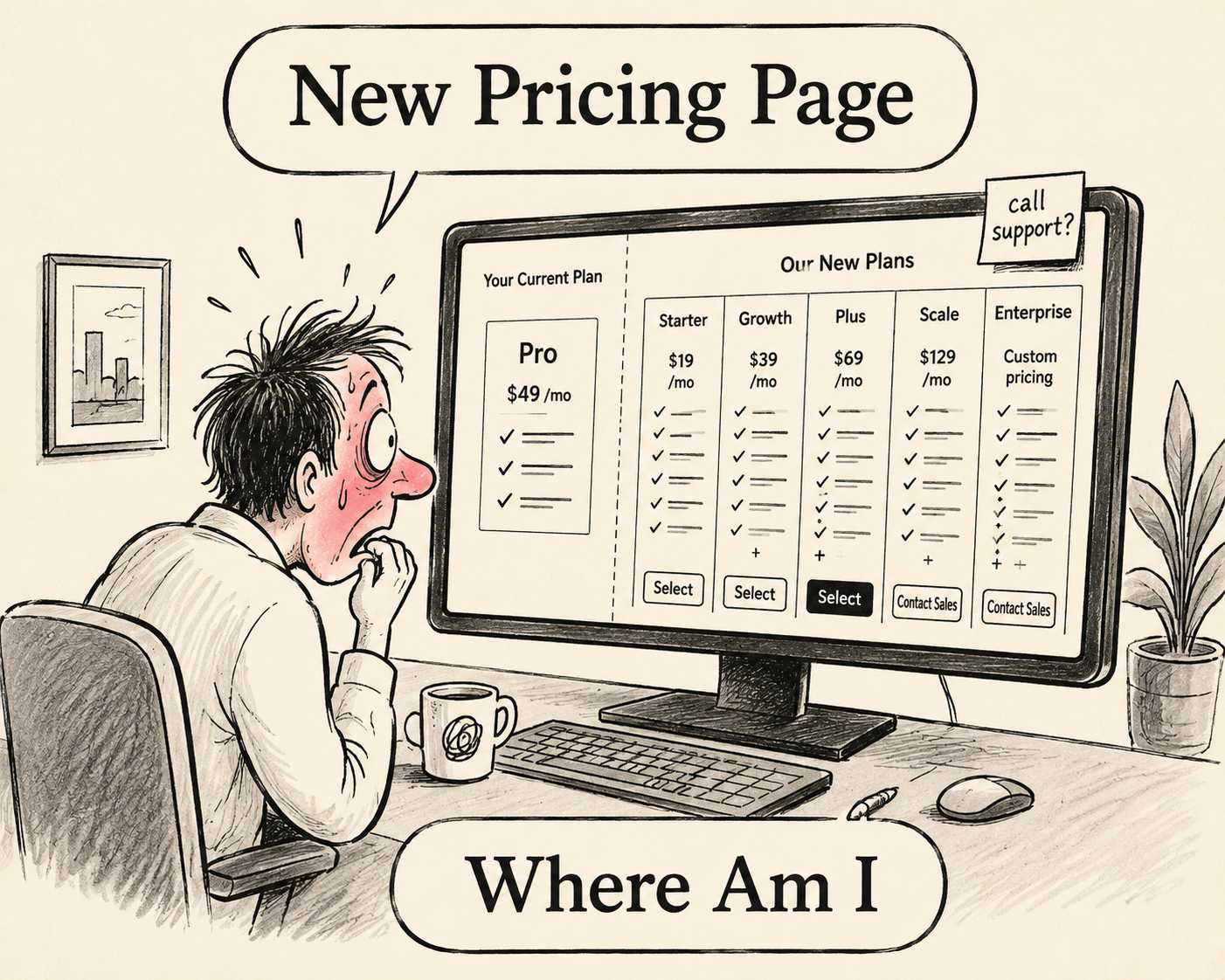
The first thing a user needs to see is not a marketing pitch about added value. It is a clear, personalized answer to the question: "What happens to my account today?"
What Needs to Exist Before You Hit Send
Before the announcement goes out, you need a specific set of documentation artifacts ready. Not drafted. Ready.
You need a migration guide that maps old plans to new plans explicitly. Comparison tables are the right format here because they support compensatory decision-making: users weigh multiple attributes at a glance rather than trying to hold plan details in working memory. The table needs to show what existing users keep, what changes, and when. Anything left ambiguous will generate a support ticket.
You also need an internal escalation matrix. When a high-value customer threatens to churn because their bill is going up significantly, the support team needs to know exactly what concessions they are authorized to offer without asking for permission. In the absence of clear direction, reps will improvise, and improvisation during a pricing migration is how you create inconsistent commitments that haunt you for years.
The ChartMogul pricing migration is a useful case study here. When they moved their entire legacy customer base from customer-based pricing to revenue-based pricing, they did not flip a switch. They segmented the customer base by plan and price, prepared customizable messaging templates built around empathy, and worked through migrations in batches so they could refine their approach as they went. Some customers accepted the new pricing with little resistance. Others required weeks of back-and-forth, and in cases where the price increase was extreme, ChartMogul developed a system of gradual pricing alignment, rolling out the increase in increments over time rather than asking for the full amount upfront. Their migration story took 1.5 years to complete. That is not a failure; that is what a responsible migration actually looks like.
Your support team also needs a knowledge base article ready before the announcement goes out, not after the first confused ticket arrives. Proactive self-service documentation is one of the most reliable ways to reduce ticket volume during a pricing rollout. If users can find the answer themselves, they will. If they cannot, they will write to you.
The Grandfathering Coordination Problem
Grandfathering (letting existing users keep their old pricing while new users pay the new rates) is a common strategy to prevent immediate churn. It solves a revenue problem, but it creates a documentation problem that most teams underestimate.
Now you have multiple cohorts of users operating under different rules.
If a grandfathered user looks at your public help center, they might see instructions for a feature they have access to, but the documentation says it requires the "Pro" tier. They are on a legacy "Basic" tier. Do they still have it? The documentation does not say. So they file a ticket.
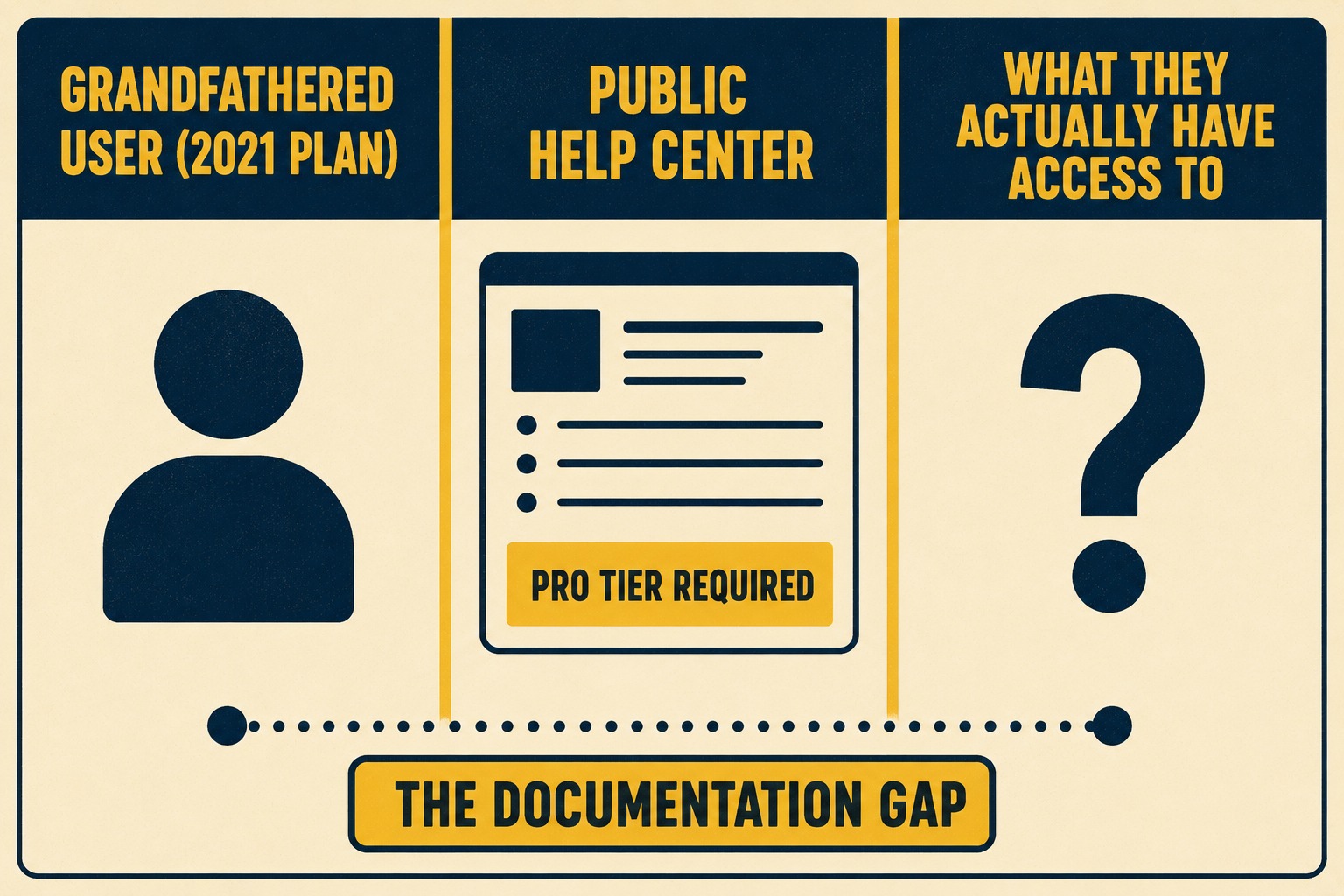
This is where versioned documentation becomes critical. Your changelogs and release notes need to reflect changes in product access, not just code changes. A changelog is a chronological record of modifications, and when those modifications include moving a feature behind a new paywall, that needs to be documented clearly for each affected cohort. The release note format is the right vehicle for this because it signals to users that something about their product experience has changed, not just the marketing copy.
The engineering side of this is equally thorny. Plan versioning requires checking which version of a plan a customer is on before determining their feature access, and legacy customers who upgrade or downgrade mid-cycle need a clear policy for which price they land on. If that policy is not documented internally before the migration begins, your engineering team will make ad hoc decisions that contradict what your support team is telling customers.
The common failure mode is not that companies document the new pricing poorly. It is that they document the new pricing clearly and leave existing users guessing about their status. The new pricing page is beautiful. The legacy customer's account page says nothing. That gap is where the support tickets come from.
Where the Speed Bottleneck Actually Lives
You could try to solve this by throwing more writers at the problem, manually keeping every version of the documentation updated for every cohort.
The pace of modern software delivery makes that unworkable. Pricing changes often move faster than documentation teams can coordinate across stakeholders. The bottleneck is rarely the writing itself. The bottleneck is the coordination between product, legal, engineering, and support — four teams with different timelines, different vocabularies, and different definitions of "ready."
This is why teams look to AI for documentation generation. AI can compress the time it takes to draft a release note or update a changelog entry.
The limitation is not AI capability. Unmanaged AI does not inherently know that a pricing tier change requires updating a specific set of legacy support articles, or that a grandfathered user on a 2021 plan has different access rules than someone who signed up last month. That institutional context lives in people's heads, not in the codebase. Tom Johnson's research on technical writing augmentation shows that the cyborg model (humans and AI working together in a continuous loop) is what actually produces reliable output at scale; the human is not a safeguard against bad AI, but the quality multiplier that takes good AI output and makes it accurate. AI drafts from engineering context; a senior writer reviews for accuracy, catches the edge cases, and flags the places where the output does not match what a legacy customer will actually experience.
Maintaining clarity across multiple user cohorts when product access rules change is a systems problem. It requires a workflow that connects what engineering is building directly to what users are reading, with enough structure to keep different cohorts straight. That is the operational model behind Doc Holiday: changelogs, release notes, and API references generated directly from engineering workflows, with a human review layer that catches the version-specific details AI would not know to flag without institutional context.