Designing Scalable API Changelogs


A senior engineer at a mid-stage SaaS company realizes three days after launch that no one updated the public changelog for a breaking change in the authentication flow.
By the time they backfill it, twelve developers have already opened support tickets. Two have written angry Twitter threads. One major integration partner has quietly started evaluating competitors.
The changelog existed. It just didn't keep up.
When you have ten endpoints and three releases a quarter, a manually written changelog works fine. When you have a hundred endpoints, weekly releases, and six teams touching the API simultaneously, the changelog becomes a bottleneck. Developers complain that updates are late, inconsistent, or missing context. Internal teams complain that writing changelogs is a tax on velocity.
The problem is not that you don't ship changelogs. The problem is that changelogs don't scale the way the product does. The gap between "we have a changelog" and "our changelog actually works for the developers using our API" widens fast, and it widens in three specific ways.
When the API Outpaces the Writer
The first sign that your changelog process is breaking is usually a lag.
Releases ship. The changelog doesn't update for a few days. Then a week. Then someone realizes a breaking change went out three weeks ago and the entry still says "pending." By then, the damage is done. Developers who hit the undocumented change have already filed tickets, written workarounds, or made incorrect assumptions about how the API behaves.
This happens because changelog writing is treated as a post-release chore. It is not embedded in the release process. It is the thing someone does after the thing is done, which means it is the first thing that gets dropped when the next release is already in flight.
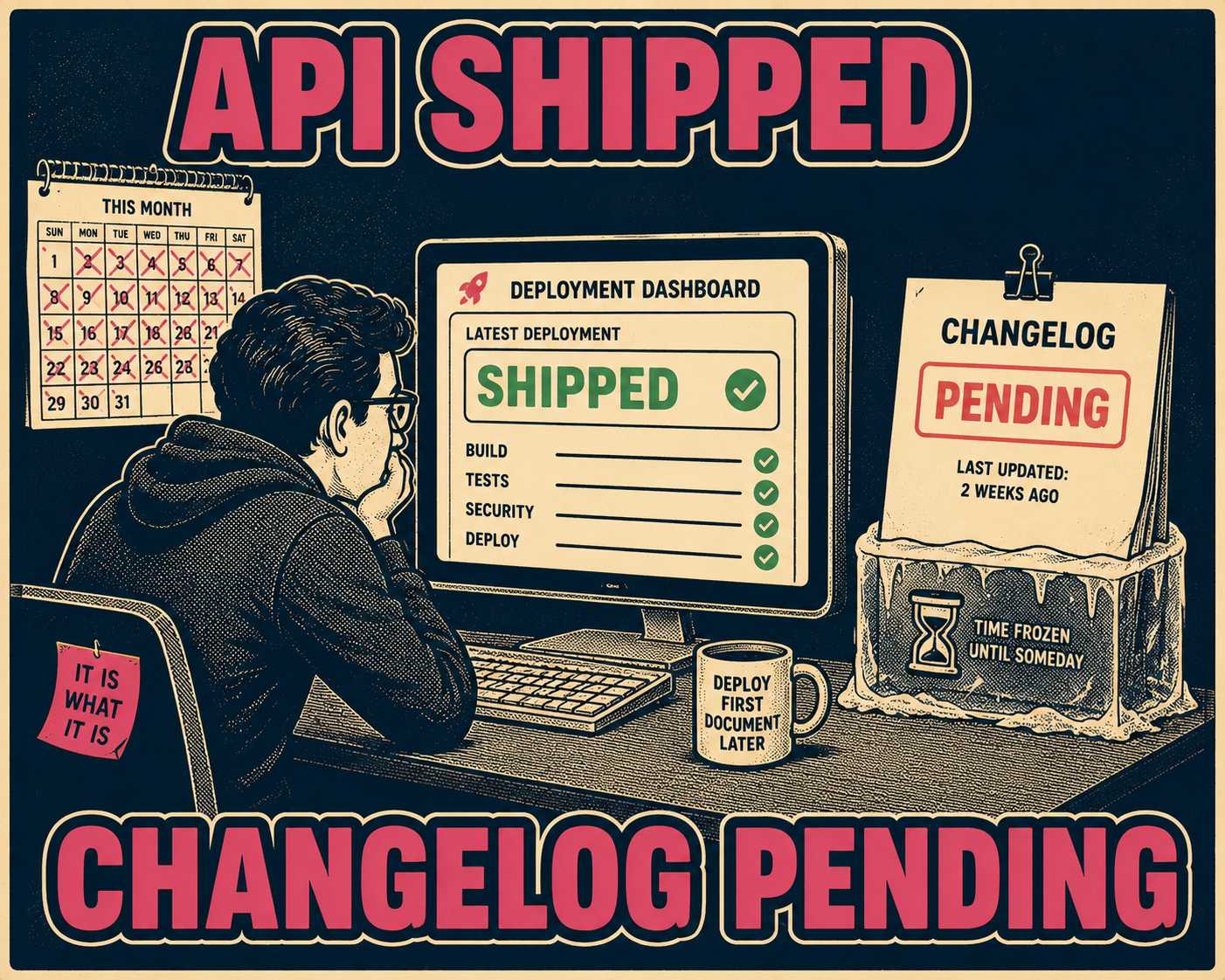
The structural fix is to move changelog generation upstream. You encode changelog-relevant data at the commit, PR, or release-tag level, and updates are compiled automatically when the deployment runs.
Stripe has done this for years. Their API changelog is programmatically generated and receives updates as soon as services are deployed with a new version. The changelog entry is not a separate writing task. It is a byproduct of the version change module that ships with the code.
For teams that aren't rebuilding their infrastructure from scratch, the practical path runs through Conventional Commits. The specification is a lightweight convention on top of commit messages: feat: for new features, fix: for patches, and BREAKING CHANGE: in the footer for anything that breaks existing integrations. Tools like semantic-release and conventional-changelog read those signals and compile changelog entries automatically.
For OpenAPI-based APIs, tools like oasdiff go further. They diff two OpenAPI specifications and detect over 470 distinct changes, breaking and non-breaking, covering every way an API modification can affect an integration. You can run this as a CI check on every PR and block merges that introduce undocumented breaking changes.
The key distinction is what automation handles versus what it doesn't.
Automation handles aggregation, formatting, and tagging. It collects the signals you've embedded in commits and PRs, structures them into a consistent format, and assigns them to the right version. What it cannot do is write the migration advice. It cannot assess whether a change that is technically non-breaking is practically disruptive. It cannot explain why a field was deprecated, or what the replacement pattern looks like in real code. Those require a human. The goal is to make the human's job a review, not a blank page.
Stripe took this further in 2024 with a redesigned changelog that lets developers filter and search for relevant updates, includes step-by-step upgrade guidance for breaking changes, and provides concise summaries of API, SDK, and platform updates. The changelog is not just a record. It is a navigational tool.
One Size Fits Nobody
Here is a thing that is true and easy to forget: your API has multiple audiences, and they care about completely different things.
Backend engineers integrating your core endpoints care about rate limit changes, authentication updates, and response schema modifications. Frontend teams consuming your API through a JavaScript SDK care about new response fields and deprecated methods. Webhook-heavy integration partners care about payload structure changes, retry behavior, and delivery guarantees. A changelog that tries to serve all of them equally tends to serve none of them well.
As the developer community grows, the one-size-fits-all changelog breaks down. Developers start skimming and missing things. Or they stop reading entirely because the signal-to-noise ratio is too low. Either way, the support tickets keep coming.
The structural response is to build a changelog that developers can filter by concern. The three most useful dimensions are API surface area (which endpoints or product areas are affected), criticality (breaking vs. non-breaking vs. additive), and impacted SDK or client library.
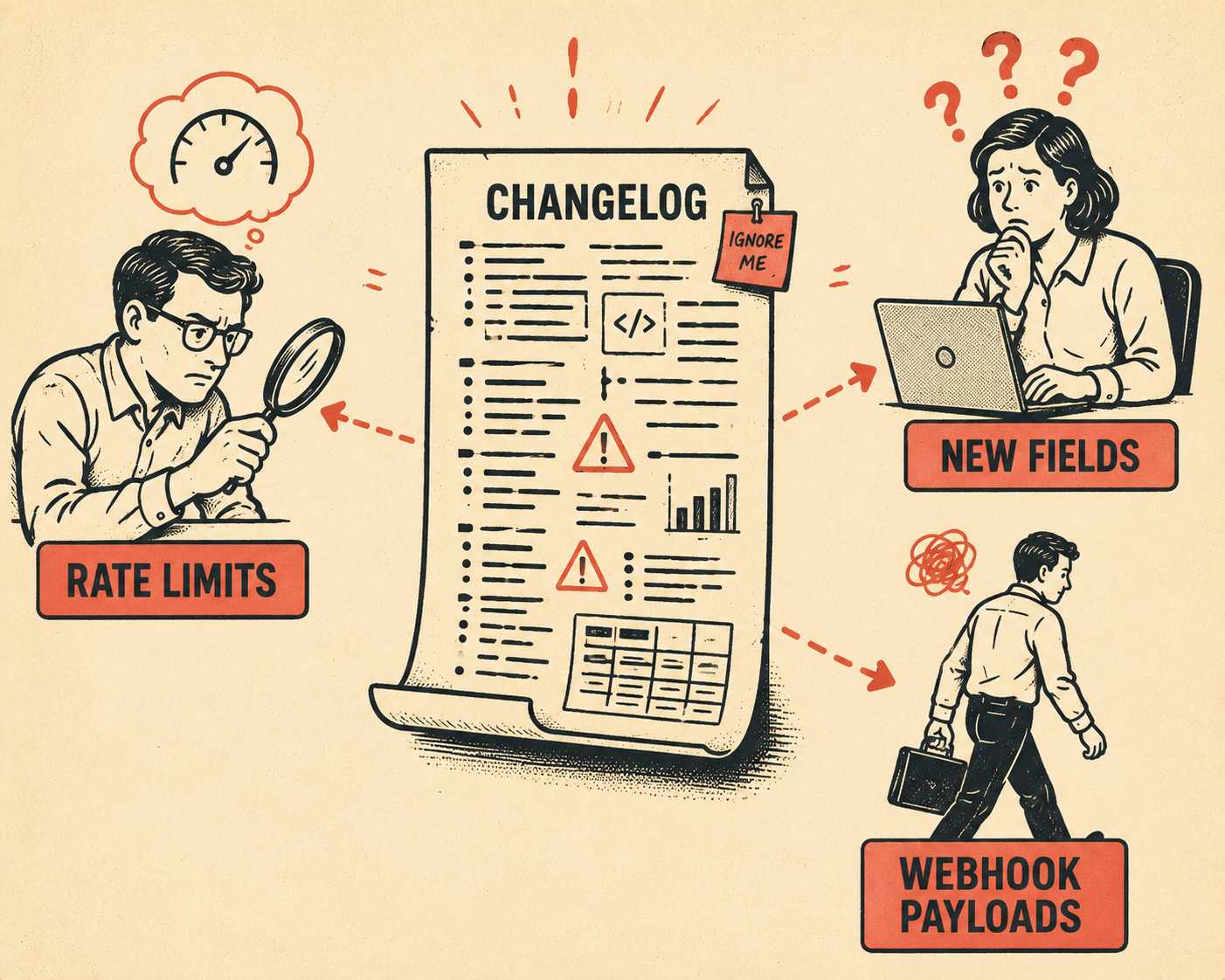
GitHub handles this well. Their REST API breaking changes page lists changes by API version, specifies exactly which endpoints are affected, and explains the migration path for each one. Breaking changes are released in a new API version with advance notice. Additive changes are available in all supported versions. The taxonomy is clear and consistent, which means developers can quickly determine whether a given release affects their integration at all.
Delivery mechanisms matter as much as structure. Developers should be able to subscribe to changelog updates through the channel they actually monitor. Email digests work for some teams. RSS feeds work for others. Webhook subscriptions for changelog updates themselves are increasingly common, particularly for integration partners who want to trigger automated compatibility checks when the API changes.
Some teams maintain separate internal and public changelogs. The internal changelog captures everything: the rationale, the tradeoffs, the edge cases, the things that didn't make it into the public entry. The public changelog is curated for the external developer audience. The tradeoff is maintenance overhead. You're now keeping two documents in sync, which reintroduces the manual work you were trying to eliminate. Teams that go this route usually automate the public version from the internal one, with a review step to strip out anything that shouldn't be public.
The UX of the changelog itself is underrated. Developers scan, not read. Breaking changes need to surface immediately, visually distinct from feature additions. Stripe separates technical details into a collapsible section within each changelog entry so that developers who want the full picture can get it, while developers who just need to know if they're affected can get that answer in three seconds.
The practical checklist for audience-aware changelogs:
- Tag every entry by API surface area and criticality before it ships
- Provide at least one delivery mechanism beyond "check the website" (email digest, RSS, or webhook)
- Make breaking changes visually distinct from additive changes
- Include a one-line summary of impact at the top of each entry, before any technical detail
- Link directly to the affected endpoint documentation and the migration guide
Six Teams, Six Different Tones
When multiple teams ship API changes independently, changelogs become a patchwork.
One team writes precise technical diffs. Another writes something that reads like a product announcement. A third writes a single sentence with no context. A fourth writes nothing at all because they didn't realize the changelog was their responsibility.
Developers get confused. They stop trusting the changelog. They start relying on support tickets and Slack messages instead, which is exactly the behavior you were trying to eliminate.
The consistency problem is not a writing quality problem. It is a process problem. Teams that produce inconsistent changelogs are not bad writers. They are teams that were never given a clear template, a clear owner, or a clear definition of "done" for a changelog entry.
The fix has two components: structure and enforcement.
Structure means giving every team a template they fill in rather than a blank page they stare at. The template should answer four questions: What changed? Why did it change? What breaks if you don't update? What is the migration path? Those four questions cover the information a developer needs to assess impact and act. Everything else is optional.
Enforcement means making the changelog entry a required artifact in the release process, not a nice-to-have. Some teams add a changelog linting step to their CI pipeline that checks for required fields before a release can proceed. Others add changelog review to the PR checklist alongside code review. The mechanism matters less than the fact that it is required, not requested.
Twilio moved to a "docs as code" philosophy for exactly this reason. Documentation is treated like code: tested, reviewed in pull requests, and deployed alongside the features it describes. Authors push commits to GitHub and collaborate on pull requests. Preview deployments let reviewers see the rendered documentation before it ships. The result is a documentation process that has the same review rigor as the code it documents.
The centralized versus distributed ownership question is worth addressing directly.
Centralized ownership (one team writes all changelogs) produces consistent output but creates a bottleneck. The central team becomes a dependency for every release. At high release velocity, this doesn't scale. Distributed ownership (each team writes their own) scales better but produces inconsistency unless the governance structure is strong enough to enforce it.
Most teams at scale end up in a hybrid: teams write their own changelog entries within an enforced template, a central reviewer does a consistency pass before publication, and automated linting catches the structural violations before the reviewer ever sees them. The reviewer's job is judgment, not formatting.
Deprecated features deserve special attention. "This is going away" is not a changelog entry. A useful deprecation notice includes the replacement, the timeline, and a concrete migration example. GitHub provides at least 24 months of support for previous API versions after releasing a new one. That timeline is communicated clearly in the changelog, which means developers can plan their migration without guessing.
The table below summarizes how the three challenges map to structural interventions:
What the Best Changelogs Have in Common
Stripe, GitHub, and Twilio have all invested heavily in their changelog infrastructure, and the pattern is consistent across all three.
The changelog is not a document that someone writes. It is an output of the engineering process. The signals are captured at the source (commits, PRs, OpenAPI diffs), aggregated automatically, and reviewed by a human before publication. The human's job is to add judgment, not to reconstruct the record from memory three days after the release.
The changelog is structured for the reader, not the writer. Breaking changes are visually distinct. Entries are tagged and filterable. Migration guidance is included, not linked to from a separate page that may or may not be up to date.
The changelog is delivered through multiple channels. Developers who monitor RSS get it. Developers who prefer email get it. Integration partners who want to trigger automated checks when the API changes get it.
None of this is easy to build from scratch. But the teams that have built it have largely stopped getting support tickets about undocumented breaking changes. That is a meaningful outcome.
The hardest part is not the tooling. The hardest part is changing the mental model: from "the changelog is something we write after we ship" to "the changelog is something we generate from how we ship." Once that shift happens, the rest is plumbing.
Doc Holiday is built around that second mental model. It generates release notes, API references, and changelogs directly from engineering workflows: AI drafts from code commits, a senior writer reviews for accuracy in a dashboard, edge cases are flagged, and patterns are fed back to reduce errors over time. For teams that want the output of a well-run changelog process without rebuilding the entire pipeline from scratch, it is worth a look.