Why Your API Documentation is Always Wrong


The endpoint still says user_id is a string. It's been an integer since the March release. You know this because three external developers filed support tickets about it in the same week, and your senior engineer spent an afternoon on a call explaining something that should have been a five-minute read.
The documentation wasn't wrong because anyone was careless. It was wrong because the system that produces documentation and the system that ships code are two different systems, and they have never been in the same room.
That's the real problem. And it's worth being precise about it before reaching for a solution.
Why the Backlog Always Wins
When an engineer closes a pull request, the feature ships. The documentation update becomes a task. Tasks go into backlogs. Backlogs are where good intentions go to age gracefully.
This isn't a discipline problem. Even teams with strong documentation cultures experience drift. The Postman 2024 State of the API Report, which surveyed over 5,600 developers and API professionals, found that 39% of developers cite inconsistent documentation as their biggest collaboration roadblock. Nearly half rely on colleagues to explain APIs verbally because the written docs can't be trusted. That's not a niche complaint from teams with bad habits. That's the median experience.
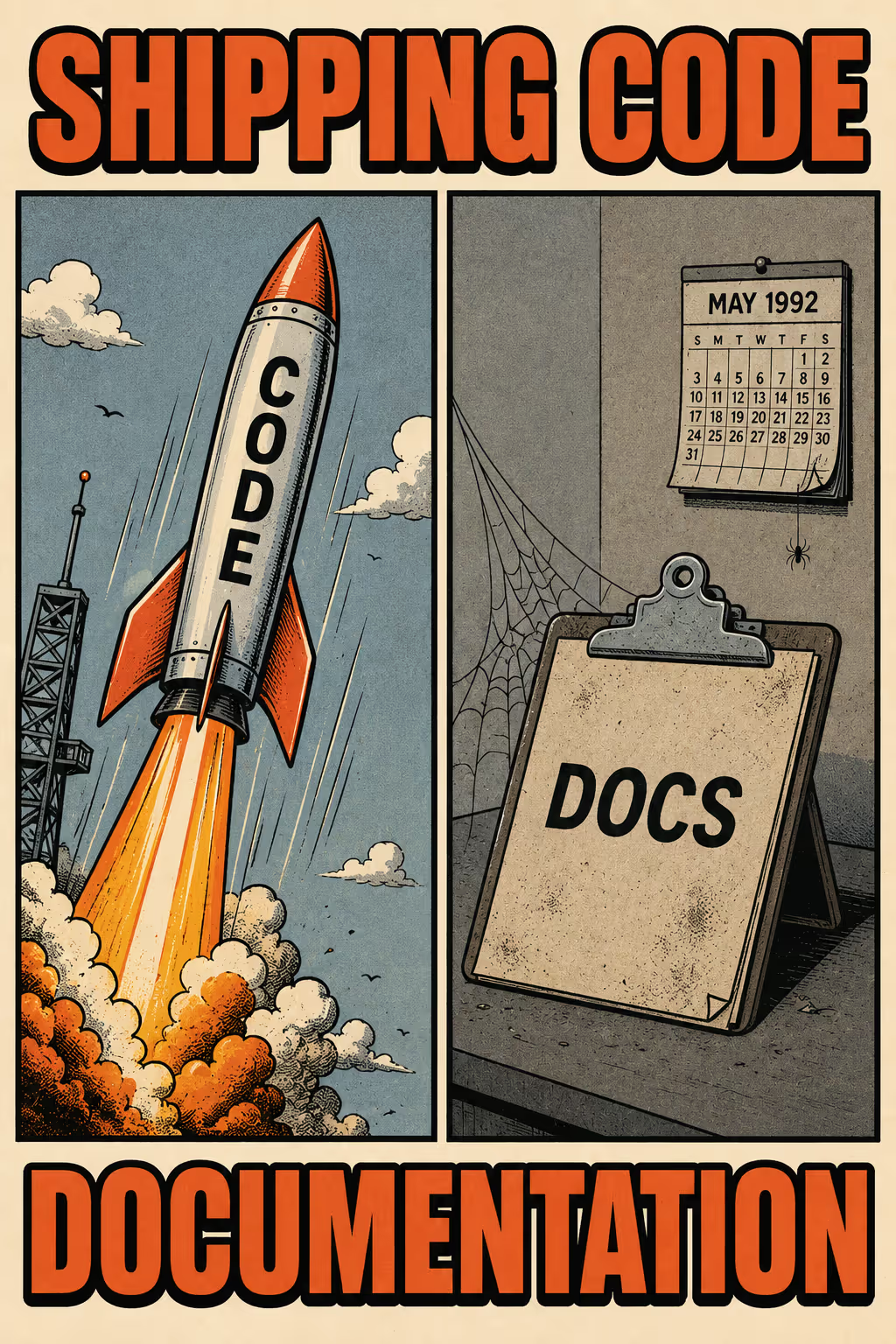
The structural reason is simple: documentation updates are almost never in the critical path for shipping code. The PR gets merged, the deployment goes out, and the docs task sits in the backlog until someone notices the gap. Sometimes that someone is a developer on your team. More often, it's an external developer who filed a support ticket.
Wiz's analysis of API drift in cloud environments found that what starts as a minor documentation lag can escalate into functional breakage and, in security-sensitive contexts, critical exposure. The root causes they identified are consistent: development velocity outpaces documentation, teams work in silos, and there's no clear ownership for keeping the spec current. These aren't exotic failure modes. They're the default outcome when documentation lives outside the engineering workflow.
The Things Teams Try That Don't Work
There are three standard responses to documentation drift. All of them help at the margins. None of them solve the structural problem.
The first is hiring dedicated technical writers to manually track changes. This works until it doesn't. A 2023 review of technical writer to developer ratios found that while 1:7 or 1:10 are often cited as targets, real-world ratios range from 1:12 to 1:200, depending on the organization. Three writers doing everything manually cannot keep pace with a 20-person engineering team shipping weekly. The headcount math doesn't work, and even if it did, the writers are still dependent on engineers to surface what changed.
The second is inline code comments that generate docs. JSDoc, OpenAPI annotations, and similar tools are genuinely useful when maintained rigorously. The problem is that "maintained rigorously" is doing a lot of work in that sentence. Engineers under deadline pressure deprioritize annotation updates the same way they deprioritize everything that isn't in the critical path. The OpenAPI Specification provides a formal standard for describing HTTP APIs that allows both humans and computers to understand service capabilities, but a standard is only as good as the discipline behind it.
The third is CI checks that block merges if documentation isn't updated. This creates friction. It slows down shipping. Engineers find workarounds, or the check gets disabled after the third time it blocked a hotfix at 2 a.m. The intent is right; the execution creates a different kind of problem.
None of these approaches are wrong, exactly. They just treat the symptom. The symptom is missing documentation updates. The disease is that documentation updates are a separate task from shipping code.
What Changes When Documentation is Part of the Workflow
The teams that have actually reduced drift share a common pattern: they stopped treating documentation as a downstream artifact and started treating it as a byproduct of the engineering workflow itself.
Squarespace's engineering team documented this shift in their 2025 write-up on docs-as-code. Their approach: documentation lives in the same repository as the code, goes through the same pull request review process, and deploys through the same CI/CD pipeline. A PR that changes an API endpoint includes the documentation update for that endpoint. They ship together or they don't ship.
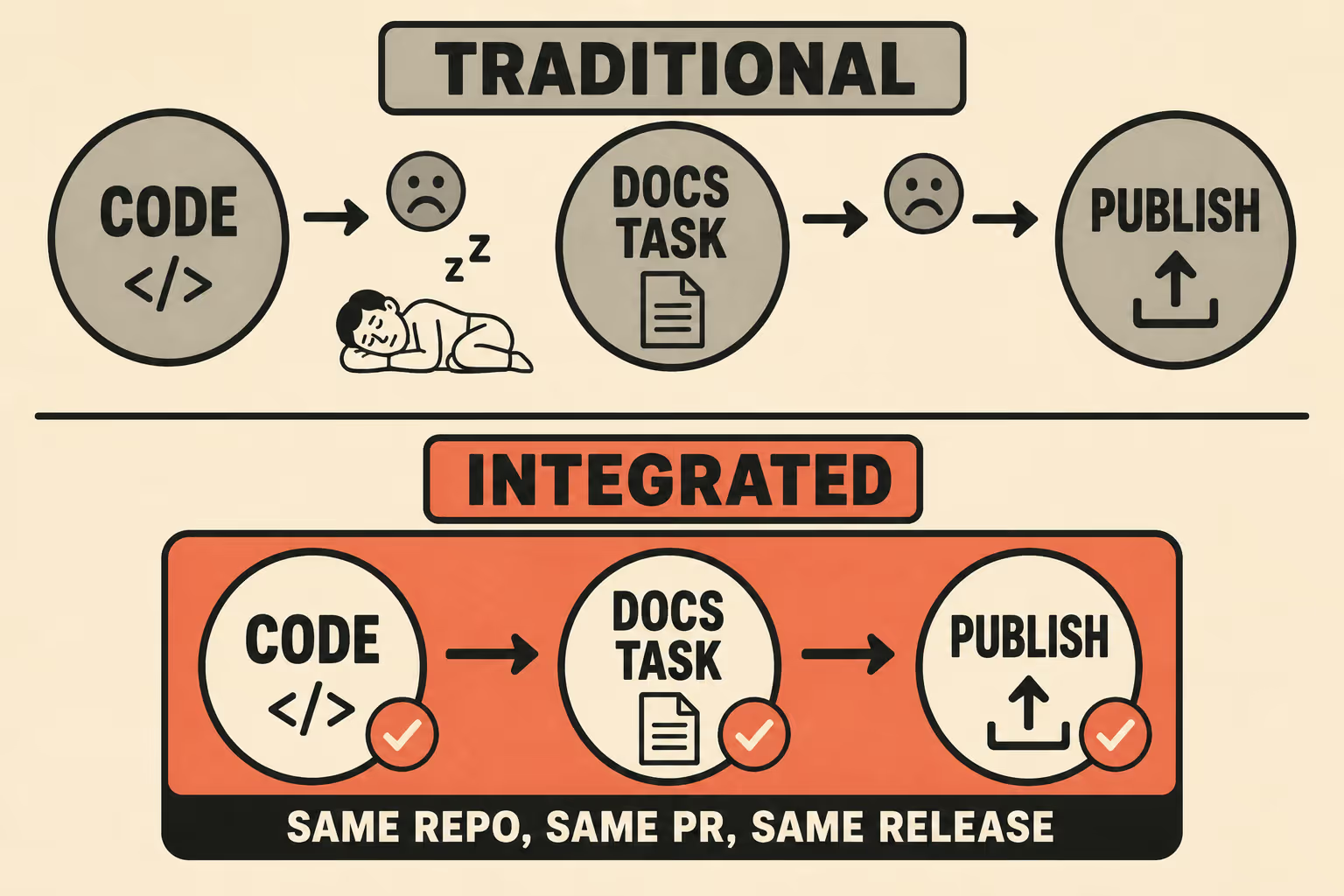
Grab reached the same conclusion independently. In their account of adopting docs-as-code, they found that the documentation process had been "disconnected from an engineer's everyday activities, making technical documentation an awkward afterthought." Moving docs into the same repository as the code made updating them part of writing code, not a separate task that followed it.
The Write the Docs community's guide on docs-as-code frames the underlying principle clearly: you should write documentation with the same tools as code, using version control, code review, and automated tests. When that's true, the documentation and the code have the same owner, the same review process, and the same deployment cycle.
This is the structural fix. It doesn't require more headcount. It requires the documentation system to be inside the engineering workflow rather than adjacent to it.
Anyway.
The practical implication for lean teams is significant. If you've reduced documentation headcount or are operating with a small team, you can't solve the sync problem by adding more manual process. You need a system that does the repetitive work and gives your best people leverage. DocNova's analysis of documentation economics puts the cost of a single documentation-related support ticket at $50 to $100 of staff time, with documentation-related tickets representing 40 to 60% of total developer support volume for API products. That's not a rounding error. That's a budget line.
One technical writer managing an automated system can keep pace with a 20-person engineering team. The writer's role shifts from manual tracking to governance and validation: reviewing generated drafts, adding context, ensuring consistency, and publishing at scale. The human judgment stays in the loop. The manual grind that causes drift gets eliminated.
If your API documentation is drifting out of sync, the fix isn't hiring more writers or asking engineers to care more. It's changing the system so documentation updates are no longer a separate task. Doc Holiday generates API references, endpoint documentation, and changelogs directly from engineering workflows, pulling from releases, commits, and pull requests, and provides the structure for a technical writer to validate, refine, and publish at scale. You keep the institutional knowledge in the loop. You stop losing it to the backlog.