Automating Documentation for Microservices Architectures


If you ran a mid-sized engineering organization, and someone told you that every time a developer shipped a feature, they also had to manually update three different wikis, a spreadsheet, and a Word document, you would probably fire that person.
Yet, this is exactly how most teams manage documentation in a microservices architecture. We broke our monoliths into dozens of independent services to move faster. We gave teams the autonomy to choose their own databases, their own deployment cadences, and their own API versions. And in doing so, we accidentally created a system where documentation debt scales linearly with every new service we spin up.
By the time a technical writer finishes documenting the API for the user service, the payments team has shipped a breaking change, the inventory service has deprecated an endpoint, and the search service has changed its response schema. The architecture is distributed, but the documentation burden is centralized.
The tension is obvious. Microservices were supposed to make development faster, but they've made documentation slower.
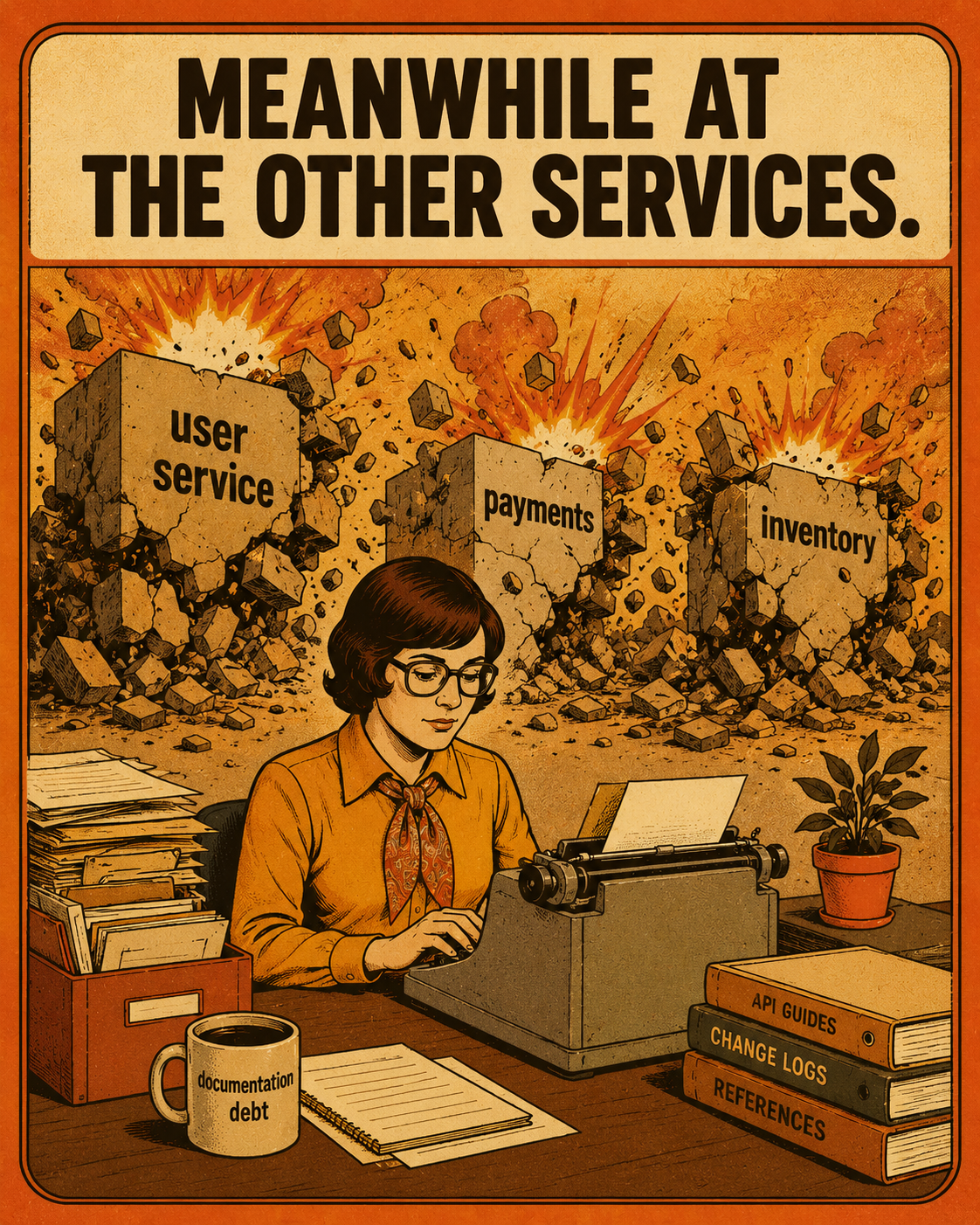
This happens because the very things that make microservices powerful (distributed ownership, frequent deployments, and cross-service dependencies) are the exact things that make them impossible to document manually. Conway's Law tells us that system architecture mirrors the communication structure of the teams that build it. In a microservices organization, that means each team owns its own contracts, its own versioning, and its own deployment cadence. When a system is composed of 20 independent services, there is no single codebase to read. There is no single deployment to track. The system's behavior emerges from the interaction of its parts, and those parts are changing every day.
Anyway. Elite performing teams now deploy multiple times per day, and we seem to be having trouble figuring out how to tell anyone what that code actually does.
What Automation Actually Means Here
When we talk about automating documentation, we aren't talking about throwing a large language model at a repository and hoping it writes a good README. We are talking about extracting the truth of the system from the artifacts the system already produces.
The contract between services should not live in a wiki. It should live in the code. Whether you use OpenAPI specs for REST, GraphQL schemas, or gRPC proto files, the documentation must be generated from the definitions embedded in the codebase. If the code changes, the documentation changes. If the code breaks the contract, the build fails. A University of Helsinki study on API breakage detection in microservice architectures found that using self-documenting services and machine-readable API specs makes it possible to automatically detect contract violations between services, something that manual documentation cannot do at all.
Service-level release notes shouldn't be written from memory on a Friday afternoon. They should be extracted from commit messages, pull request descriptions, and CI/CD metadata. GitHub's own documentation platform supports automatically generated release notes that pull directly from merged pull requests. When a service deploys, the pipeline should automatically generate a changelog that maps the code changes to user-facing behavior.
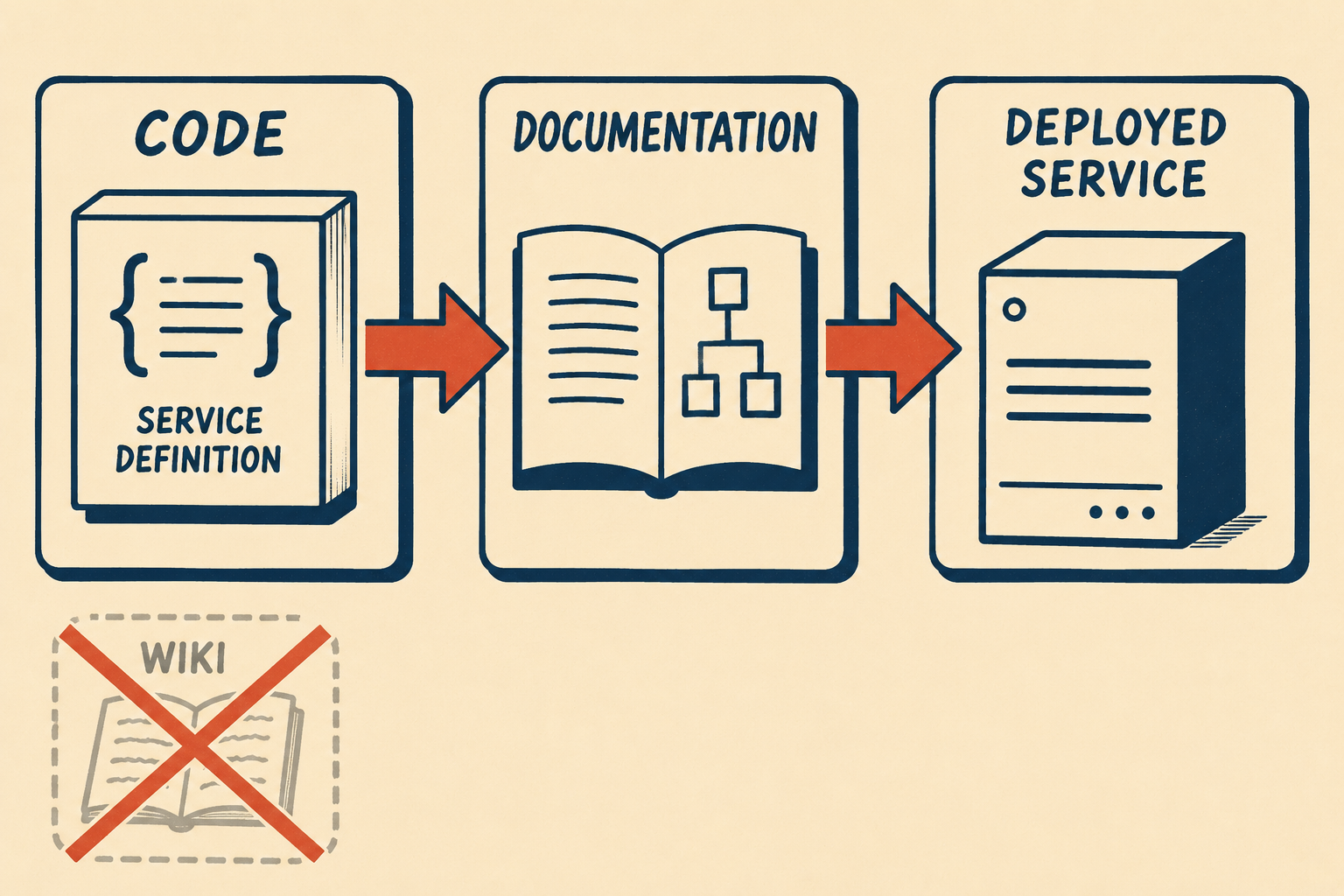
A microservice architecture needs a map. Who owns the billing service? What does it depend on? What is its current SLA? This information decays instantly if maintained manually. Spotify's engineering team built Backstage specifically because, at scale, the answer to "who owns this service?" was genuinely unclear without a centralized catalog. A service catalog must track ownership, dependencies, and current versions automatically, pulling data from the infrastructure itself.
When an API changes, the documentation must flag it. But more importantly, it must map that change to the services that consume it. Research on breaking changes in API evolution shows that inconsistent handling of breaking changes erodes trust in versioning as a communication tool, forcing API publishers to support multiple old versions indefinitely. Automation should produce changelogs that explicitly highlight breaking changes and provide migration paths for the teams affected.
The Standardization Tradeoff
The most common objection to this approach is that it requires too much uniformity. "Our services aren't standardized enough to automate," an engineering manager will say. "The payments team uses Go and gRPC, the frontend team uses Node and GraphQL, and the legacy system is a Java monolith with a REST API."
This is true. Heterogeneous tooling makes automation harder. But automation works best when it forces convergence on standards.
The ROI of standardizing schemas to enable automation is higher than the cost of maintaining bespoke documentation per service. If you want automated API docs, you have to agree on how APIs are defined. If you want automated release notes, you have to agree on how commits are formatted. The automation is the reward for the discipline.
There is also a difference between internal and external documentation needs worth recognizing here. Internal teams need service catalogs and dependency maps to understand the blast radius of their changes. External API consumers need reference docs and migration guides to integrate safely. Automation can handle both, but the tooling and workflows are different. Solve the internal visibility problem first.
The Human Layer
Even with full automation, someone needs to validate that the generated docs accurately represent intent.
Automation can tell you that an endpoint changed from GET /users to POST /users/search. It cannot tell you why that change was made, or what edge cases the new endpoint introduces. It can flag a breaking change, but it cannot write the migration guide that explains the business logic behind it.
IEEE research on software documentation issues found that documentation problems are not primarily about volume or tooling, but about accuracy and intent: the gap between what the system does and what the documentation says it does. Automation closes the volume gap. Human oversight closes the accuracy gap.
The goal isn't to remove humans from the loop. The goal is to let one skilled technical writer manage documentation for 20 services instead of struggling to keep up with 5. The writer shifts from being an author of first drafts to an editor of generated content. They validate the output, flag the gaps, and ensure the architectural narrative remains coherent.
Stripe's Developer Coefficient report found that developers spend an average of 17.3 hours per week dealing with maintenance issues, with poor documentation being a primary contributor to roughly $85 billion in annual productivity loss. The technical writer who governs automated documentation output is not a cost center. They are the person preventing that number from getting worse.
Where to Start
If you are managing 15 services and your documentation is currently a collection of outdated Confluence pages, do not try to automate everything at once.
Start with the highest-churn, highest-impact services. Automate API reference docs before you automate conceptual guides. Get release notes generating reliably from your CI/CD pipeline (the automated system that builds, tests, and deploys code) before you try to auto-generate architecture diagrams.
A practical sequence looks something like this:
- Audit which services have OpenAPI specs, GraphQL schemas, or proto files already in the codebase. These are ready for automated doc generation immediately.
- Establish a commit message convention (such as Conventional Commits) across teams. This is the prerequisite for automated release notes.
- Stand up a service catalog that pulls ownership and dependency data from your infrastructure. Backstage is the most common open-source option.
- Wire breaking-change detection into your CI/CD pipeline so that contract violations surface before deployment, not after.
The Workforce Transformation
You are probably managing this transition with a lean team, or perhaps after headcount reductions. You do not have the budget to hire a technical writer for every squad.
The smart move is to give your most experienced technical writer the tools to manage automated documentation output across the entire service mesh. Their job is no longer to write the docs. Their job is to govern the schema standards that make automation possible, validate what the system generates, and ensure consistency across the architecture.
That is the workforce transformation path that works.
Doc Holiday generates API documentation, release notes, and changelogs directly from engineering workflows, and provides the structure to validate and scale that output without rebuilding a large documentation team. It is the infrastructure for the technical writer who is now managing documentation for 15 services instead of writing it all manually.