When Release Notes Cause Buyer's Remorse


If you sell enterprise software, there is a dangerous period between the day the contract is signed and the day the customer feels they know what they bought. During those first 90 days, the customer is actively building their mental model of your platform. They are mapping their workflows to your features. They are deciding, quietly, whether they made a mistake.
Then, you ship a feature.
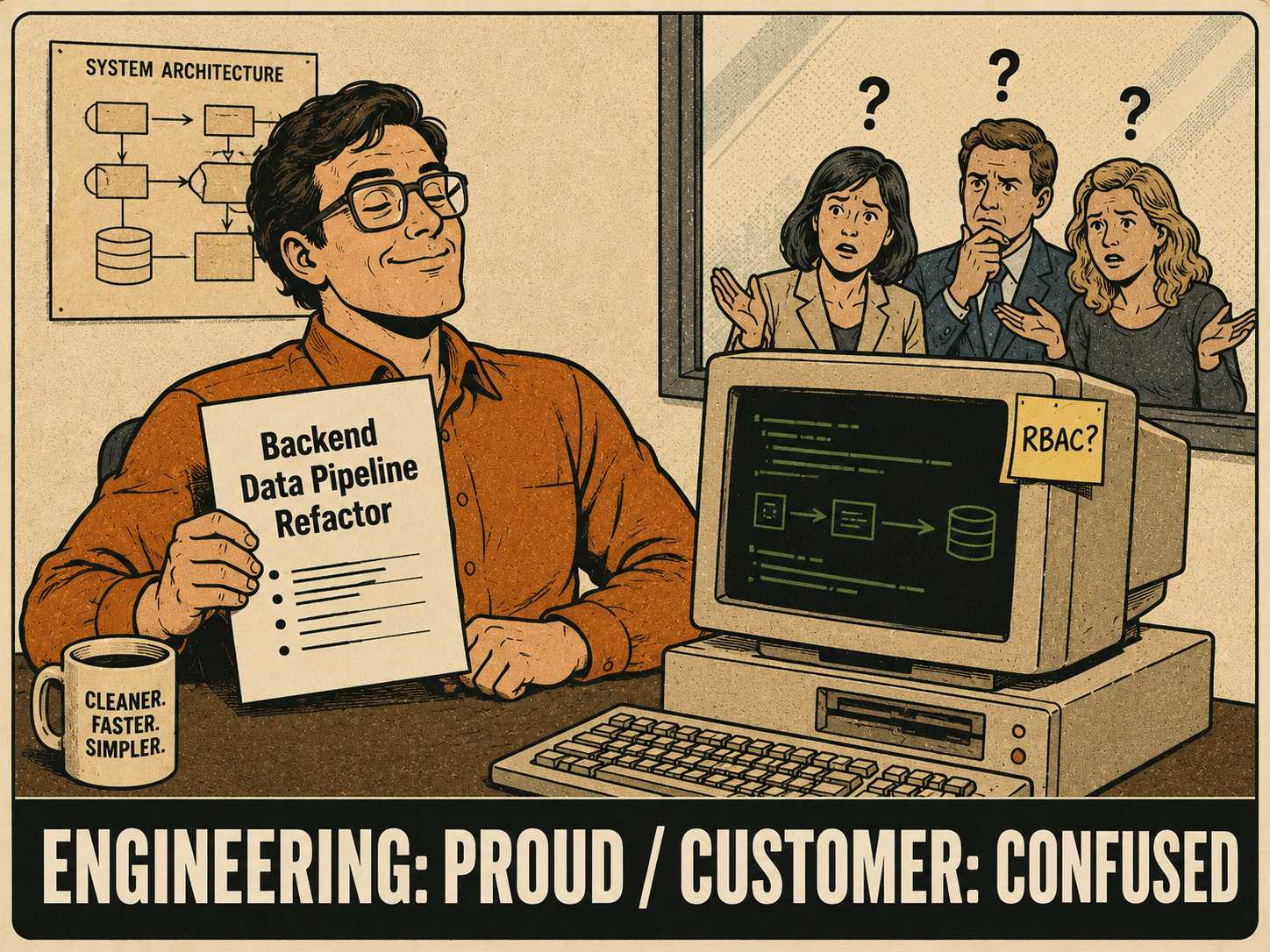
Your engineering team is proud. They write a detailed release note explaining the refactor of the backend data pipeline and the new configuration options for the API. They publish it to the changelog. The new enterprise customer reads it, realizes they do not understand any of the words, and wonders if they just bought a system designed for a completely different kind of company.
This is how routine product communication breaks trust.
When a customer is in active onboarding, every communication from your company is evidence of your competence. A poorly targeted release note does not just confuse them. It forces them to reconsider their purchase decision. Nearly 3 in 5 companies already regret at least one recent software purchase, and poor onboarding communication is a primary accelerant. The way you communicate changes during this critical window determines whether the customer sees your product as stable and evolving, or chaotic and overwhelming.
What Actually Needs to Reach Them
The most common mistake companies make with release notes is treating them as a chronological dump of engineering activity. If an engineer worked on it, it goes in the log.
This approach works for open-source libraries where the audience is other developers who want to see every commit. It is disastrous for enterprise customers in week three of onboarding.
Not every backend change needs to reach a customer who just signed a contract. If you optimized a database query that the customer has never run, telling them about it adds cognitive load without adding value. New users are already contending with an overwhelming volume of information about a product they are still learning. Piling on internal infrastructure updates is not transparency. It is noise.
The filter is simple: does this change affect the customer's current mental model of the product? If no, hold it back or route it only to your CSM team. If yes, it requires communication. But the type of communication depends on the change. Minor UI tweaks or bug fixes can be bundled into a weekly summary. Structural changes, the ones that alter how the product fundamentally works, need to be handled differently.
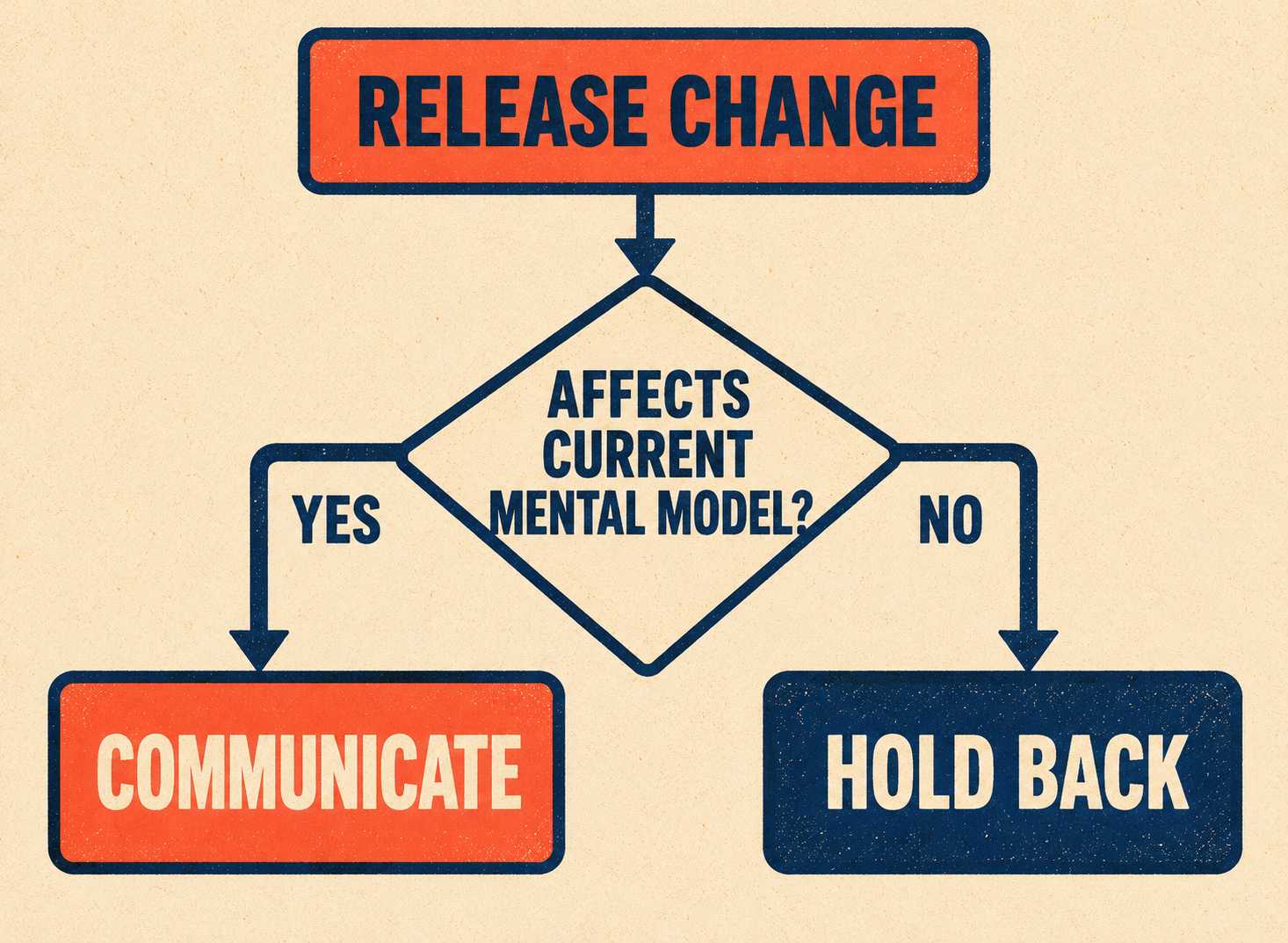
There is also a category of change that should never reach the customer at all during onboarding: internal refactors, dependency upgrades, and performance optimizations that have no user-facing effect. Changelogs are for humans, not machines, and a human in their first month of using your product is not the right audience for a note about migrating your message queue.
The Context Gap and How to Close It
When you write a release note for your entire user base, you are writing for an audience with vastly different levels of institutional memory.
A customer who has used your product for three years understands why a feature was built a certain way and why it is now changing. A customer in their first month does not. If you write the release note assuming the three-year context, the new customer is lost. If you write it assuming zero context, the three-year customer is patronized.
The solution is not to write a perfectly balanced, generic note. The solution is to front-load context only when the change invalidates something the new customer just learned. Research on onboarding documentation consistently shows that new users need a stable initial mental model before they can absorb changes to that model. If you change something before they have fully understood it, the change does not register as an update. It registers as evidence that the product is unstable.
Consider a change to how user permissions are inherited. Here is what the same change looks like written two different ways for a customer in week three of onboarding.
Bad copy (written for the general changelog):
"We have migrated the RBAC inheritance model to match the v2 API structure. Child groups no longer inherit implicit write access from parent nodes."
This is technically accurate. It is also terrifying to a new customer who just spent a week setting up their permission structure and does not know what RBAC stands for.
Good copy (written for an onboarding customer):
"We are updating how user permissions work to make it easier to manage large teams. Previously, if you gave a team access to a project, all sub-teams automatically got the same access. Now, you control sub-team access explicitly. If you set up your permissions before Tuesday, we have preserved your existing structure. Here is how to use the new controls."
The second version acknowledges the change, explains the benefit, and immediately addresses the new customer's primary fear: Did you just break the thing I just built? That fear is what triggers buyer's remorse. Addressing it directly is the entire job of onboarding-aware communication.
Framing Breaking Changes Without Triggering Panic
Breaking changes are the hardest test of customer trust. During onboarding, a breaking change feels like a bait-and-switch. The customer bought a product that worked a certain way. Now it works differently. The question running through their head is not "how do I migrate?" It is "did I buy the wrong thing?"
You cannot hide a deprecation. They need to know. But the framing has to reinforce that they are on a stable platform with a clear roadmap, not a chaotic system where things disappear without warning.
The rule for communicating breaking changes during onboarding is to lead with the migration path, not the deprecation. If you are removing a reporting module, do not start the note with "The Legacy Reporting Module will be deprecated on Friday." Start with the new capability. "The new Advanced Analytics suite is now the default reporting tool. It replaces the Legacy Reporting Module, which will be retired on Friday. Here is how your existing reports map to the new system."
This positions the change as an upgrade rather than a loss. The customer's mental model shifts from "something was taken away" to "something better replaced it." That shift is the difference between a support ticket and a satisfied onboarding call.
A systematic review of breaking change communication across major software ecosystems found 66 documented strategies for communicating, preventing, and recovering from breaking changes. The strategies that consistently reduce downstream disruption share one characteristic: they lead with the path forward, not the problem.
When the CSM Needs to Step In
Not all release notes should be delivered passively through a changelog. High-impact changes during the first 90 days require proactive intervention from the Customer Success Manager.
The question of when to route a release note to the CSM team rather than the general changelog comes down to two variables: the change's relevance to the customer's active onboarding goals, and the change's potential to confuse or alarm someone who is still forming their baseline understanding of the product.
A useful heuristic: if a CSM would need to explain the change in a call anyway, the change should be routed to the CSM first. The CSM becomes the delivery mechanism, not the changelog. They can provide the operational context that a release note cannot. "I saw the product team just released the new API endpoints. I know we were planning to build the integration next week. Let's use the new endpoints instead. It will save us a day of work."
This is the difference between a passive changelog and a proactive customer success motion. Enterprise customers expect this level of attention during onboarding. The CSM who surfaces a relevant product change before the customer notices it is demonstrating exactly the kind of partnership that drives renewal.
For changes that are irrelevant to the customer's current onboarding phase, the CSM should do nothing. Introducing irrelevant features during an onboarding call dilutes the focus of the plan. Timing matters more than channel when announcing a new feature. A user who sees an announcement for a capability they have no context to use will not adopt it. They will just feel overwhelmed.
The Timing Problem
If a feature ships the day before an onboarding kickoff call, the CSM has a decision to make. Do they mention it in the first call, or wait until the customer has the context to care?
The answer depends entirely on the feature's relationship to the customer's stated goals. If the feature directly addresses a problem the customer mentioned during the sales process, the CSM should bring it up immediately. It is concrete evidence that the company listens and ships fast. That is a powerful trust signal at the start of a relationship.
If the feature is unrelated to their immediate goals, the CSM should ignore it. There is no version of "let me tell you about this new thing we just shipped that has nothing to do with your onboarding plan" that makes the customer feel better about their purchase.
The harder case is a breaking change that ships mid-onboarding. If the customer is actively building something that will be affected, the CSM needs to get ahead of it immediately, before the customer discovers it on their own. A customer who discovers a breaking change by watching their integration fail has a very different experience than a customer who receives a proactive call from their CSM explaining what changed and what to do next. Proactive communication before issues arise is one of the most reliable drivers of enterprise customer retention.
A Decision Framework for Your Team
The goal of all of this is to give your team a repeatable way to make these calls without requiring judgment from scratch every time. Here is how to think about it:
Route to the general changelog when the change is minor, has no user-facing impact on current workflows, and requires no action from the customer.
Route to a segmented, onboarding-aware variant when the change affects something the new customer is actively using or learning, requires context to understand, or touches a part of the product they have already configured.
Route to the CSM team for proactive delivery when the change is a breaking change, when it directly addresses a goal the customer stated during sales, or when the change is significant enough that a customer discovering it passively would likely call support or question their purchase.
Hold it entirely when the change is internal infrastructure, has no user-facing effect, and would only add noise to an already information-dense onboarding period.
The underlying principle is that the decision to renew is made in the first 90 days. Every piece of communication during that window either builds the customer's confidence in their purchase or erodes it. Release notes are not exempt from that dynamic.
Most release note tools generate a single output for all users at once and do not give you the structure to act on any of this. Doc Holiday generates the base content directly from engineering activity, then gives you the structure to create onboarding-specific variants, hold back irrelevant changes, and route high-impact updates to your CSM team for white-glove delivery. That is the operational gap this framework describes.