The Wiki That Outlives the Engineer


When a senior engineer gives notice, a quiet panic ripples through the organization. It's rarely about the code they wrote. Code can be read. Code can be refactored. The panic is about the context.
If you run an engineering team, you know the drill. Someone leaves, and suddenly nobody knows why the billing service restarts itself every Tuesday at 3 AM. The problem isn't that the engineer is leaving. The problem is that the organization's memory is leaving with them.
When employees depart, they take their institutional knowledge with them. The cost is staggering. Replacing an experienced employee can cost between 50% and 200% of their salary. But the real cost isn't recruitment. It's the productivity sinkhole that opens up when the remaining team has to reverse-engineer decisions that were never written down.
Most internal wikis, Notion workspaces, and Confluence instances decay into noise within 18 months. This isn't a platform failure. It's an architectural flaw in how we think about documentation. We treat knowledge capture as a discretionary task tied to specific people, rather than a structural output of the work itself.
If your knowledge base depends on someone remembering to update a page, it's already dead. It just doesn't know it yet.
We keep buying new wiki software, hoping this time will be different.
How Knowledge Bases Collapse
Knowledge bases don't fail all at once. They fail in three distinct ways, usually in this order.
The first failure mode is the context that never makes it to the wiki in the first place. It lives in Slack threads, pull request comments, and the heads of the people who built the system.
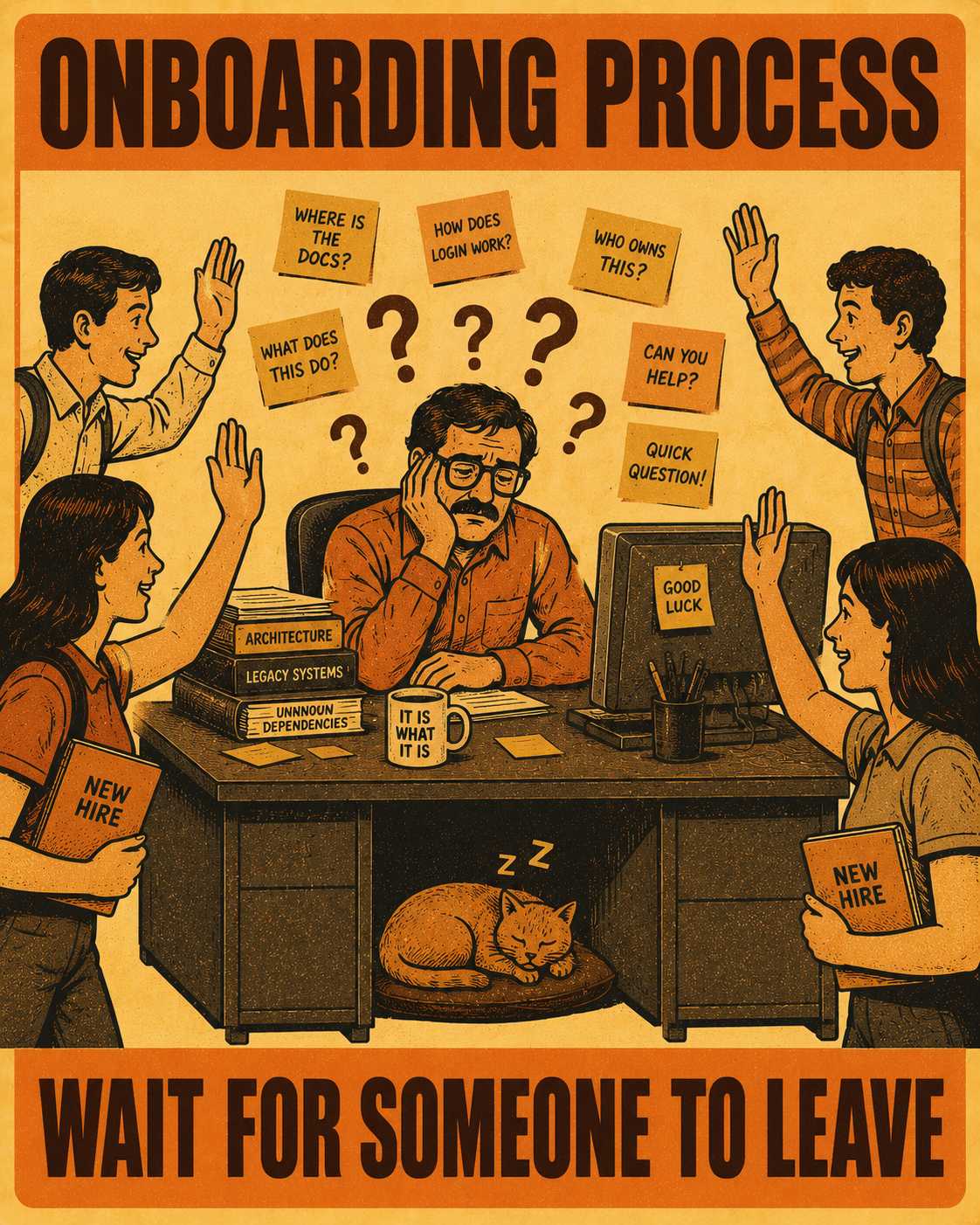
When a new hire joins, they aren't onboarded by reading documentation. They are onboarded by interrupting senior engineers. This creates a bottleneck. The senior engineer's time is consumed by answering the same questions, and the new hire's velocity is throttled by the senior engineer's availability. When the senior engineer leaves, the bottleneck becomes a hard stop. The edge case that only one person knew about, the API behavior that was never written down, the deployment process that broke (because the person who understood it left): these are the hidden costs of tribal knowledge. A five-year longitudinal study of engineering and technical workers found that knowledge loss creates a knowledge deficit that is unlikely to be filled over time, with surviving employees' knowledge accounts remaining stable overall.
The second failure mode is documentation that is accurate on launch day but never updated. Software is dynamic; wikis are static.
A systematic mapping study of documentation in continuous software development found that one of the biggest challenges is documentation becoming out-of-sync with the software. As the product evolves, the documentation drifts. Dependencies age. APIs change. Within a few sprints, the wiki is no longer a source of truth; it's a historical artifact. Developers learn to distrust it, which means they stop reading it, which means they definitely stop updating it.
The third failure mode is the organizational memory that depends on a few senior engineers. This is the "bus factor": the number of people who can leave before the project stalls. When critical knowledge is held by a single person, the organization is exposed to immense risk. Research on turnover-induced knowledge loss in software teams confirms that when project members leave, the knowledge they hold may become lost, diminishing organizational learning. The solution isn't to ask that one person to write everything down before their exit interview. By then, it's too late.
Generating Output Instead of Writing Pages
The alternative to a person-dependent knowledge base is a system that generates documentation as a byproduct of the work itself.
The most durable knowledge bases are fed by automated pipelines. When a developer merges a pull request, the commit metadata should automatically generate a draft release note. When an API changes, the code annotations should update the reference documentation. When an incident occurs, the postmortem should pull directly from the ticketing system. Research on automated release note generation (the ARENA system) demonstrated that it's feasible to identify changes in commits between releases and generate structured notes directly from that metadata.
The goal is to make documentation a structural output, not a discretionary task.
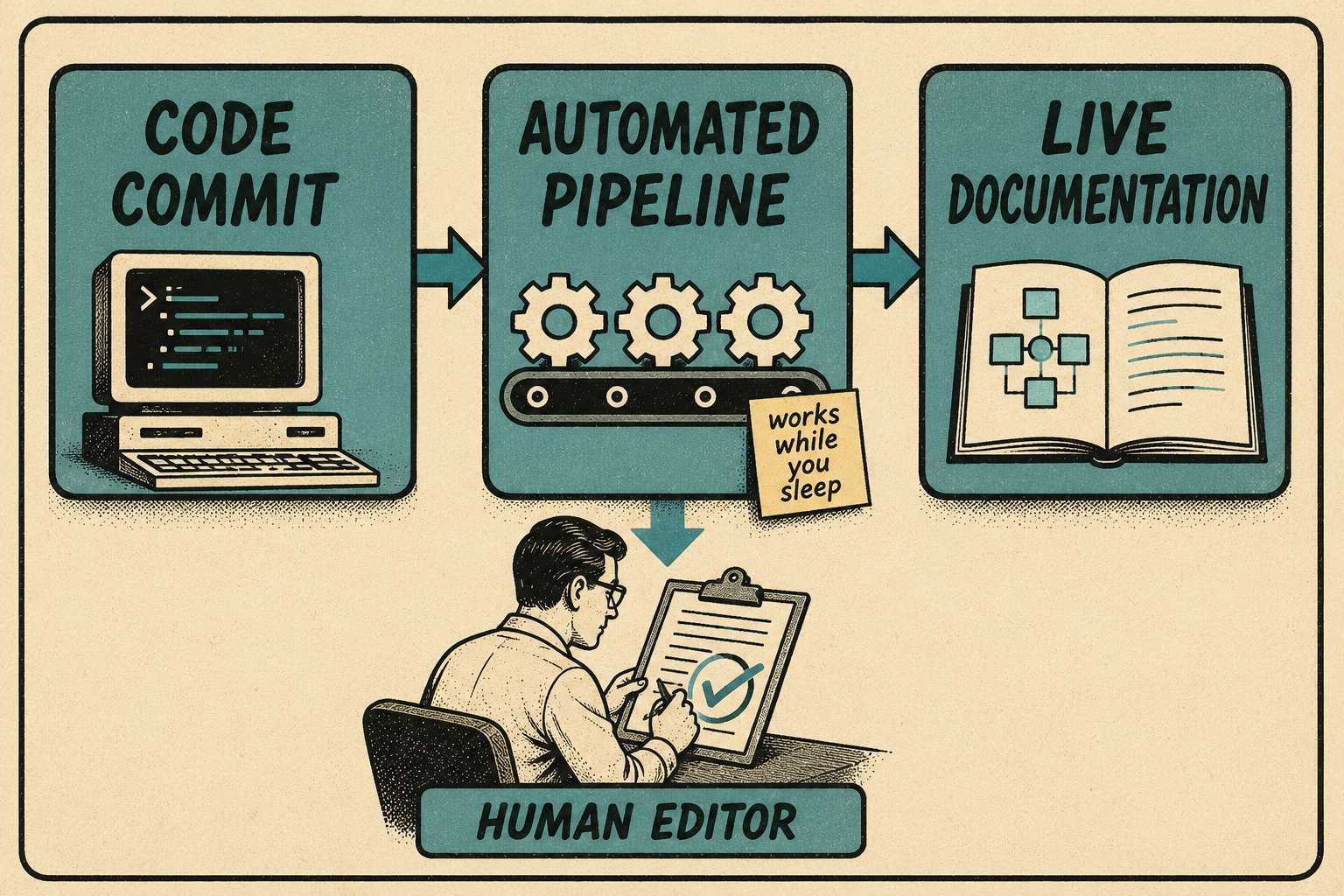
When documentation is generated from the source of truth (the code, the deployment logs, the customer support tickets), it survives turnover. It doesn't depend on someone remembering to update a page. It updates because the system updated. This is the essence of "docs as code." It brings the rigor of software development (version control, automation, and continuous delivery) to documentation. Google's internal documentation team solved a similar problem by integrating documentation into the engineer's workflow, storing Markdown files in the same repository as the code, which quickly gained adoption across hundreds of developer projects.
Managing the Machine
Automated documentation pipelines produce speed and consistency. They solve the blank page problem. But they do not solve the context problem.
This is where the human element becomes a quality multiplier rather than a bottleneck. Automated pipelines still need a human editor to catch gaps, resolve ambiguity, and maintain narrative coherence. The same person who used to write all the release notes by hand can now oversee an automated process that produces five times the output, then focus their time on the 20% that needs human judgment.
This is a workforce transformation. The senior technical writer or engineering lead who used to spend their week manually compiling release notes from Jira tickets now oversees an automated process. They take the generated output and apply judgment. They add the "why" to the automated "what."
Unmanaged AI fails. Managed AI scales. The automation provides the raw material; the human provides the insight.
Building an Operational Record
The most useful internal knowledge bases don't just pull from engineering. They pull from the entire organization.
A truly resilient knowledge base integrates engineering commit messages, support ticket trends, sales engineering feedback, and customer success case studies. When these inputs are structured and integrated, the knowledge base becomes a living operational record rather than a static document dump. A release note that links directly to the customer support thread that triggered the fix. An API reference that surfaces the most common support questions about that endpoint. This cross-functional integration reduces silos and speeds up execution across departments. It turns the knowledge base from a historical artifact into an active operational tool.
The operational reality is that most companies don't have the resources to staff a large technical writing team. And even those that do face constant churn. The solution isn't to hire more writers and hope they stay. It's to build documentation systems that generate output from engineering workflows and give a skilled human the structure to validate, manage, and scale that output.
Doc Holiday generates release notes, API references, and changelogs directly from code and deployment metadata, connecting codebases, product specs, ticketing systems, and support channels into a single documentation pipeline. It gives lean teams the infrastructure to maintain a knowledge base that survives turnover, without requiring manual rewriting every sprint.