The Silent Cost of a Fractured Voice


Your authentication team writes a dense paragraph about OAuth 2.0 token expiration. Your UI team writes a breezy, emoji-laden sentence about a new button color. Your backend team pastes a Jira ticket title: "Fixed race condition in data pipeline."
All three ship in the same release. Your customers read them in sequence and feel the whiplash.
They're trying to figure out whether they need to update their API keys. Instead, they're navigating three different mental models of what matters. The authentication team thought they were writing a technical spec. The UI team thought they were writing marketing copy. The backend team thought they were checking a compliance box.
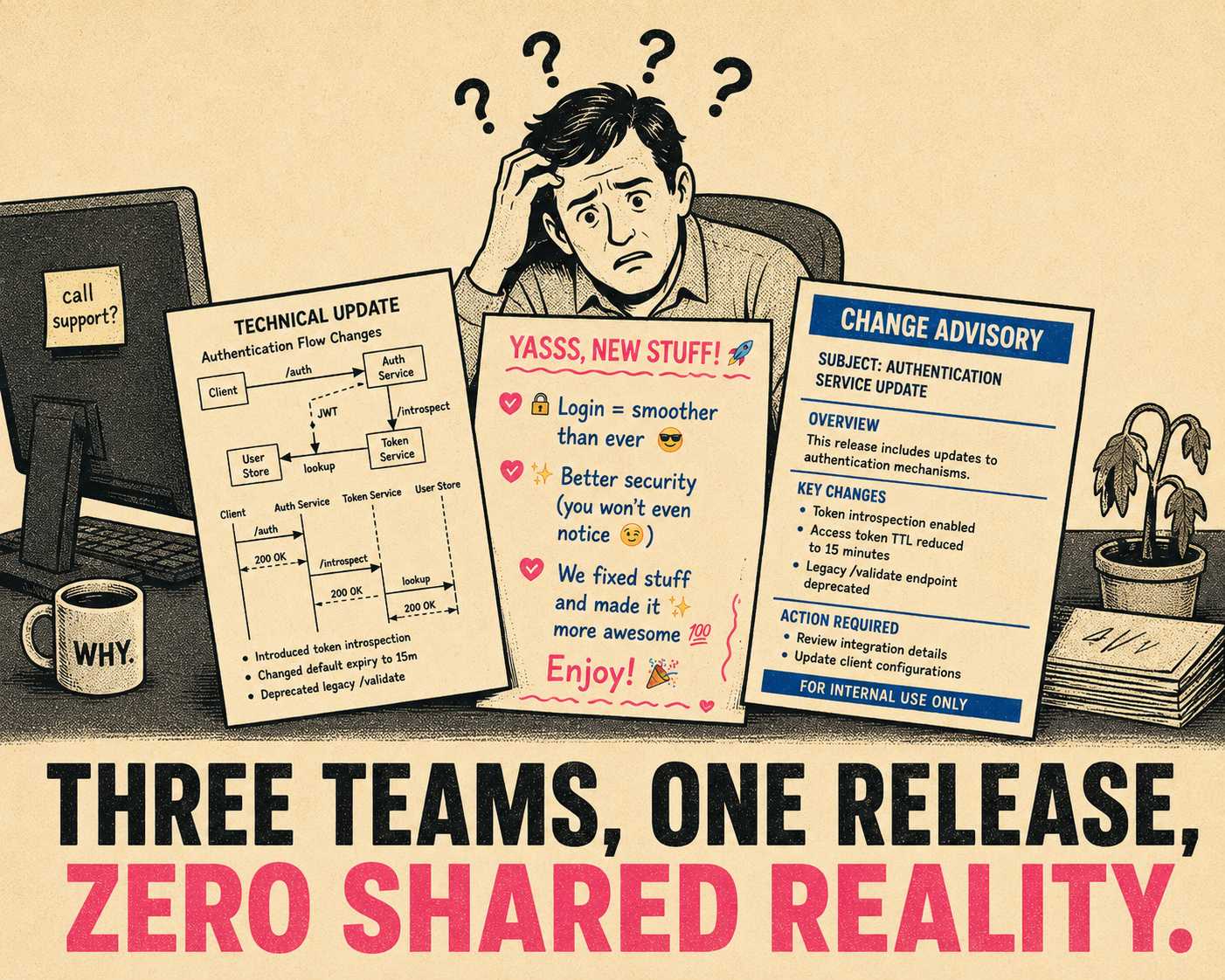
That's the problem. When you multiply individual judgment across ten teams and fifty releases a quarter, the voice of your product fractures completely. And customers notice. When documentation becomes unpredictable, cognitive load increases and comprehension drops. If a customer has to translate your internal implementation details into their own workflow, many of them will give up and file a support ticket instead. At an average cost of $25 to $35 per ticket, a single confusing release can cost tens of thousands of dollars before anyone has fixed a single bug.
What "Consistent Voice" Actually Means Here
When people talk about voice in technical documentation, they usually mean brand personality. Are we playful? Are we authoritative? Do we use contractions?
At scale, voice means something more operational than that. It's the predictable structure of the information. It's reliable levels of technical detail. It's uniform decisions about what gets mentioned and what doesn't.
A consistent voice reduces the friction between shipping a feature and a customer adopting it. When a user reads a release note, they know exactly where to look to find the impact on their workflow. They don't have to decode the idiosyncrasies of whoever wrote it that week.
An empirical study of 32,425 release notes across 1,000 GitHub projects found significant discrepancies between how release note producers and users perceive the same documents. Producers tend to overlook crucial information, especially around breaking changes. Users struggle with inadequate layouts that bury the details they actually need.
The goal isn't perfecting prose. The goal is reducing cognitive load.
Why the Usual Fixes Don't Hold
The instinct is to write a style guide. You produce a 20-page document explaining active voice and sentence length and tell the engineering team to read it.
They don't. Or they read it once and forget it. A style guide is a reference document, not a workflow constraint.
The next instinct is to centralize the writing. You hire a technical writer or designate a product manager to review every release note before it ships. This works when you have one product and one release a month. When you move to continuous delivery (shipping updates weekly or daily rather than on a fixed cycle), that single reviewer becomes a bottleneck. The documentation queue slows down the release velocity.
You can hire more writers, but then you're just adding more voices to harmonize. Decentralized authorship inherently creates consistency challenges, and routing everything through a human chokepoint is an organizational anti-pattern. The teams that have tried it report the same outcome: the bottleneck moves, but the inconsistency doesn't go away.
Research on software release engineering confirms this pattern. A study on continuous delivery practices found that increasing release frequency without redesigning the underlying process typically increases failure rates rather than reducing them. The same logic applies to documentation: doing the old process more often doesn't produce better output. It produces more of the same inconsistency, faster.
What Actually Works
The consistency layer has to move out of individual judgment and into a repeatable structure. Voice has to be defined as a set of enforceable rules.
What's the default verb tense? How do you describe deprecated features? When do you explain why a change was made, rather than just what changed? These are decisions that good writers make intuitively. At scale, they have to be made explicitly.
This starts with a voice rubric. You document the decisions that create consistency. But documenting them isn't enough. You have to encode them into the starting point.
Templates are often treated as fill-in-the-blank forms, which engineers quickly learn to customize into irrelevance. A good template does something different. It predefines the section order. It establishes expected detail levels. It models the phrasing patterns that create a recognizable voice. It eliminates most of the variation before anyone starts writing.
Content governance research confirms that shared standards, when embedded into tools and workflows rather than stored in reference documents, are what actually produce cohesion at scale. The organizations that achieve consistency aren't the ones with the best style guides. They're the ones that made the style guide irrelevant by encoding its decisions upstream.
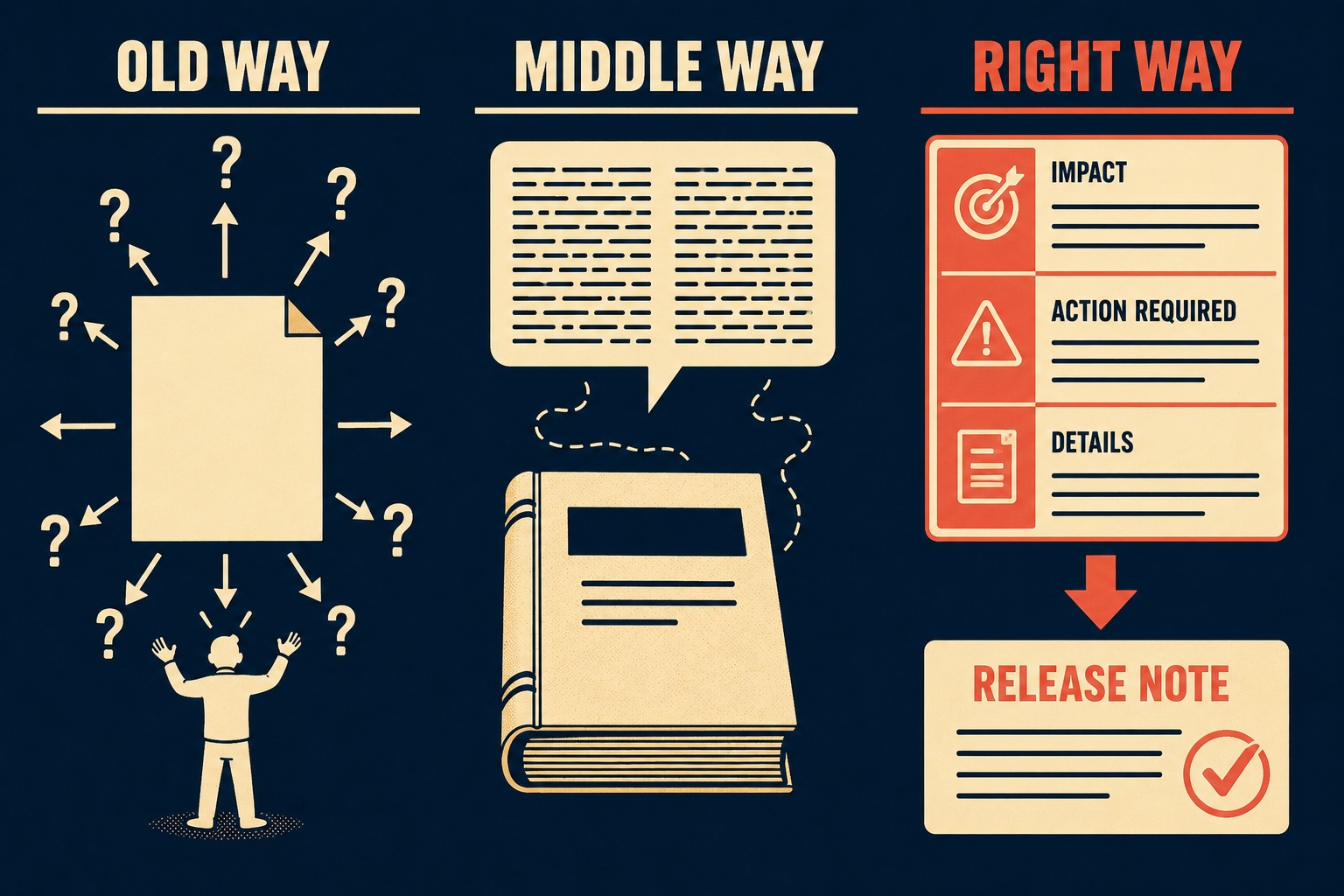
Even then, someone needs to review the output and catch drift before it ships. For small teams, that's one senior writer or a product operations lead. For larger teams, manual review at that volume becomes unworkable.
The solution is to separate generation from validation. Let the system produce consistent first drafts. Focus human effort on edge cases and strategic decisions.
Recent work on LLM-powered release note generation shows that AI can capture the semantic relationship between code changes and natural language to produce high-quality summaries at scale. The same research notes that unmanaged AI struggles to maintain architectural coherence and can produce verbose or inconsistent output without proper governance. The operative word is unmanaged. AI that encodes your voice rules directly in the generation layer produces consistency by default. The human role shifts from writing each note to governing the system that writes them.
Research on automated documentation in DevOps environments found that continuous automated documentation, when properly integrated into engineering workflows, significantly reduces the lag between a release and its documentation, while improving consistency across outputs. The key finding: the pipeline has to be designed for documentation from the start, not treated as an afterthought.
A separate large-scale analysis of mobile app release notes found that apps with longer, more informative release notes tend to have higher average user ratings. Users notice when you respect their time. The correlation between documentation quality and product perception is real.
The Professionalization of Release Notes
Consistent voice isn't a luxury or a brand exercise. It's operational hygiene.
When your customers can trust that every release note will give them the context they need in a predictable format, they actually read them. That reduces support load, improves adoption of new features, and turns release notes from a compliance step into a functional communication tool.
The teams that have figured this out treat voice consistency the way they treat code quality: not as a creative preference, but as a structural property of the system. They define the rules once. They validate the output. They refine the rules when exceptions reveal gaps.
Doc Holiday generates release notes directly from engineering workflows, with voice consistency built into the generation process. A technical writer or product operations lead defines the voice parameters once, then validates output rather than authoring from scratch every time. The result is hundreds of release notes that read like they came from the same editorial brain, because they did.