How to Localize Release Notes Without Slowing Down Your Ship Cycle


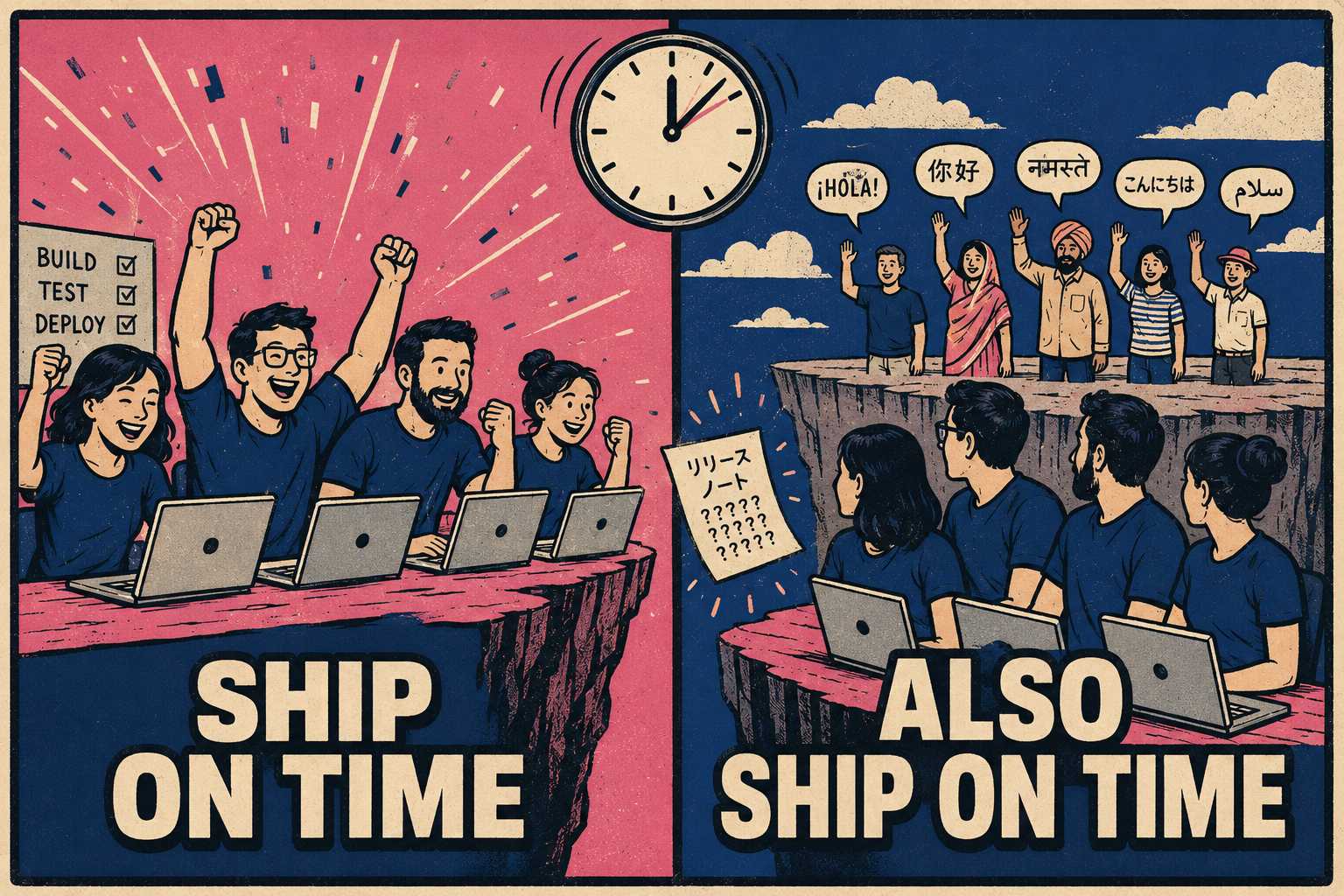
It is 2:00 PM on a Thursday, and the release branch is finally cut. The engineering team has spent the last three weeks wrestling with a gnarly architectural refactor, and the build is green. The release notes are drafted, approved, and ready to go. There is just one problem: thirty percent of your enterprise customers operate in Germany, Japan, and Brazil, and their customer success managers are politely but firmly refusing to send out English-only documentation for a major update.
You have two choices. You can delay the release by four days while an external agency translates the notes, which makes the engineering team furious. Or you can ship the English version now and send the translated versions next week, which makes the international customers feel like an afterthought.
This is the operational tension of software localization. Release notes are tied to the unforgiving cadence of deployment schedules, but translation workflows are historically asynchronous, expensive, and slow. If you manage a product with a global footprint, you cannot afford to alienate non-English users, but you also cannot let localization dictate your release velocity. The solution is not to ask translators to work faster. It is to restructure the localization pipeline so it runs in parallel with development, rather than trailing behind it.
What Actually Needs Translation
Not every line of a release note carries the same weight. Treating all content as equally critical is the fastest way to bloat your localization budget and stall your release cycle.
A standard release note contains several distinct components: feature descriptions, bug fix summaries, breaking changes, deprecation notices, and security advisories. Each of these serves a different purpose and requires a different level of linguistic precision.
Feature descriptions are essentially marketing copy. They explain the value of a new capability and persuade the user to adopt it. This requires nuance, brand voice consistency, and an understanding of the customer's business context. If you are selling enterprise software, a clunky translation here can undermine the perceived quality of the product. This content demands human review.
Bug fixes, on the other hand, are highly technical and execution-oriented. A user reading a bug fix summary just wants to know if the specific issue they reported has been resolved. This content is often repetitive and formulaic. It is an ideal candidate for machine translation with minimal post-editing, provided your terminology database is well-maintained.
Breaking changes, deprecation notices, and security advisories occupy a unique middle ground. They are not marketing copy, but they carry significant operational risk. If a Japanese enterprise customer misunderstands a deprecation timeline because of a poor translation, the resulting support escalation will cost far more than the translation itself. These sections require high accuracy and often benefit from a final check by a native speaker who understands the technical domain.
The customer segment also dictates the localization strategy. A self-serve, consumer-facing app might prioritize conversational feature descriptions, while a B2B infrastructure platform must ensure absolute precision in its API deprecation warnings. You have to map the translation effort to the business risk.
The Workflow Trade-Offs
Once you know what needs translating, you have to decide how to translate it. The market offers several operational models, each with distinct trade-offs between speed, cost, and quality.
In-house translators provide the highest quality and brand consistency. They understand the product architecture and the company's tone. However, maintaining a full-time localization team for every target language is prohibitively expensive for most organizations, and they can easily become a bottleneck during peak release periods.
Translation agencies offer scalability. You can hand off a massive batch of content and get it back in multiple languages. The trade-off is latency. The typical turnaround time for an agency is measured in days, not hours, which makes them a poor fit for continuous deployment cycles. They also operate asynchronously, requiring a project manager to shuttle questions between translators and engineers.
Freelance networks provide flexibility and can be more cost-effective than agencies, but the quality is often inconsistent. You are relying on individuals who may not have deep context on your specific software domain, and managing a roster of freelancers adds administrative overhead.
The modern compromise is machine translation post-editing (MTPE). An engine generates the first draft, and a human linguist reviews and refines it. This approach combines speed with human judgment, significantly reducing turnaround times and costs. Citrix's localization team used a persistent MT workflow to raise their documentation coverage from 40% to 100% across five languages, processing seven million words with light post-editing. However, MTPE requires robust quality assurance infrastructure. If the source text is ambiguous or the terminology database is outdated, the human editor will spend as much time fixing the machine output as they would have spent translating from scratch.
At the far end of the spectrum is fully automated machine translation. It is instantaneous and nearly free, but it carries the highest risk of introducing embarrassing or misleading errors, particularly with domain-specific technical terminology.
Designing a Localization-Ready System
If you want to localize release notes without blocking the release, you have to separate content creation from translation. The most common failure mode is treating release notes as free-text prose documents that are finalized on a Friday afternoon and then emailed to a vendor.
A localization-ready system treats release notes as structured data. It starts by maintaining a stable, version-controlled English source of truth. Instead of drafting notes in a Google Doc, the content should be generated directly from the engineering workflow, pulling from commit messages, pull requests, and Jira tickets. LLMs can generate structured release notes from commit histories, and experienced developers can spend up to eight hours drafting a single release note document by hand — a number that scales badly with weekly ship cadences.
This structured format allows you to isolate the components that need translation. You can automatically route the marketing-heavy feature descriptions to a human review queue, while sending the routine bug fixes through an MTPE pipeline.
The cadence of your releases also dictates your batching strategy. If you ship continuously, trying to translate every minor patch in real-time will exhaust your localization budget. A better approach is to translate the major weekly or monthly rollups, ensuring that international customers get a comprehensive, high-quality update, even if it arrives slightly after the underlying code is deployed.
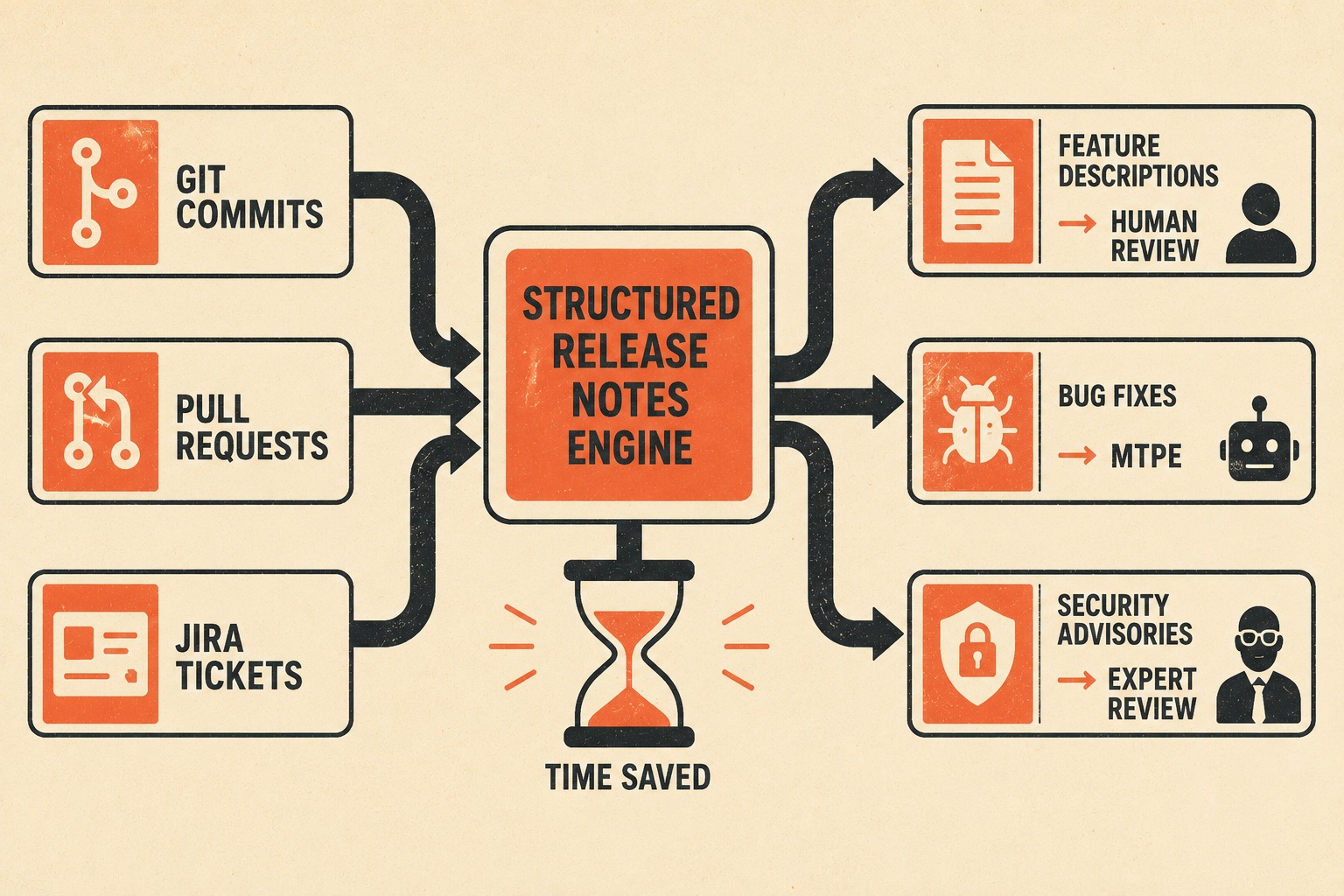
Version control is critical here. When a late-stage bug requires a change to a feature description just hours before the release, the system must be able to flag that specific string for re-translation, rather than requiring a manual review of the entire document. Continuous localization only works if the translation pipeline is as tightly integrated with the codebase as the testing suite.
The Role of AI in the Pipeline
Large language models have altered the economics of translation. They can produce coherent, contextually appropriate drafts at near-zero marginal cost. They are particularly adept at handling the structured, technical language typical of software documentation. Domain-specific fine-tuning shows that providing an LLM with a terminology database and in-domain examples produces significantly better results than general-purpose translation, particularly for technical vocabulary.
But an LLM is not a replacement for a localization strategy. Unmanaged AI will confidently invent terminology, flatten your brand voice, and occasionally hallucinate technical details. Domain-specific terminology remains a documented challenge for MT systems, even for modern neural models. The value of AI in this context is not to replace human translators, but to radically reduce the scope of their work.
When an AI system has access to your company's terminology database, past release notes, and product context, it can generate a highly accurate first draft. The human editor is then elevated from a translator to a reviewer. They focus on ensuring domain accuracy, preserving the brand voice, and catching culturally awkward phrasing. AI handles the volume; humans provide the governance.
Measuring What Works
You cannot optimize a process you do not measure. To know if your localized release notes are actually working, you have to look beyond translation speed and cost per word.
The most immediate indicator of failure is your support queue. If a release note is poorly translated, international customers will file tickets asking for clarification on features that were supposed to be self-explanatory. Tracking support ticket volume by region immediately following a release provides a clear signal of localization quality.
Regional adoption rates offer another lens. If a new feature sees rapid uptake in the US but stagnates in France, the localized documentation might be failing to communicate the value proposition clearly.
You can also instrument this directly through Net Promoter Score (NPS) and Customer Satisfaction (CSAT) surveys, segmented by region. Analyzing these scores by market helps identify which regions require more localization investment.
The goal is to find the threshold of "good enough." Perfect translation is an academic exercise; effective translation is a business requirement. When the cost of improving the translation exceeds the cost of the customer confusion it prevents, you have found the right balance.
This brings us to the underlying infrastructure problem. Release notes are hard to localize when they are inconsistently formatted, written in different styles by different engineers, and scattered across various tools. You cannot build a fast, reliable translation pipeline on top of a chaotic source document.
This is where Doc Holiday changes the operational model. It is a documentation engine that generates structured, version-controlled release notes directly from code commits and engineering tickets. It creates a stable, consistent English source of truth that translation workflows can ingest cleanly. Because the output is structured, you can easily route different components to the appropriate translation tier, whether that is an MTPE pipeline or a human review queue. It also gives you a system to validate output before it ships, which matters when you are localizing at scale and the cost of a mistranslated deprecation notice is a wave of enterprise support tickets. It gives lean teams the architecture to validate, manage, and scale their documentation without letting localization slow down their ship cycle.