How to Write a Blameless Post-Mortem for Engineering and SRE Teams


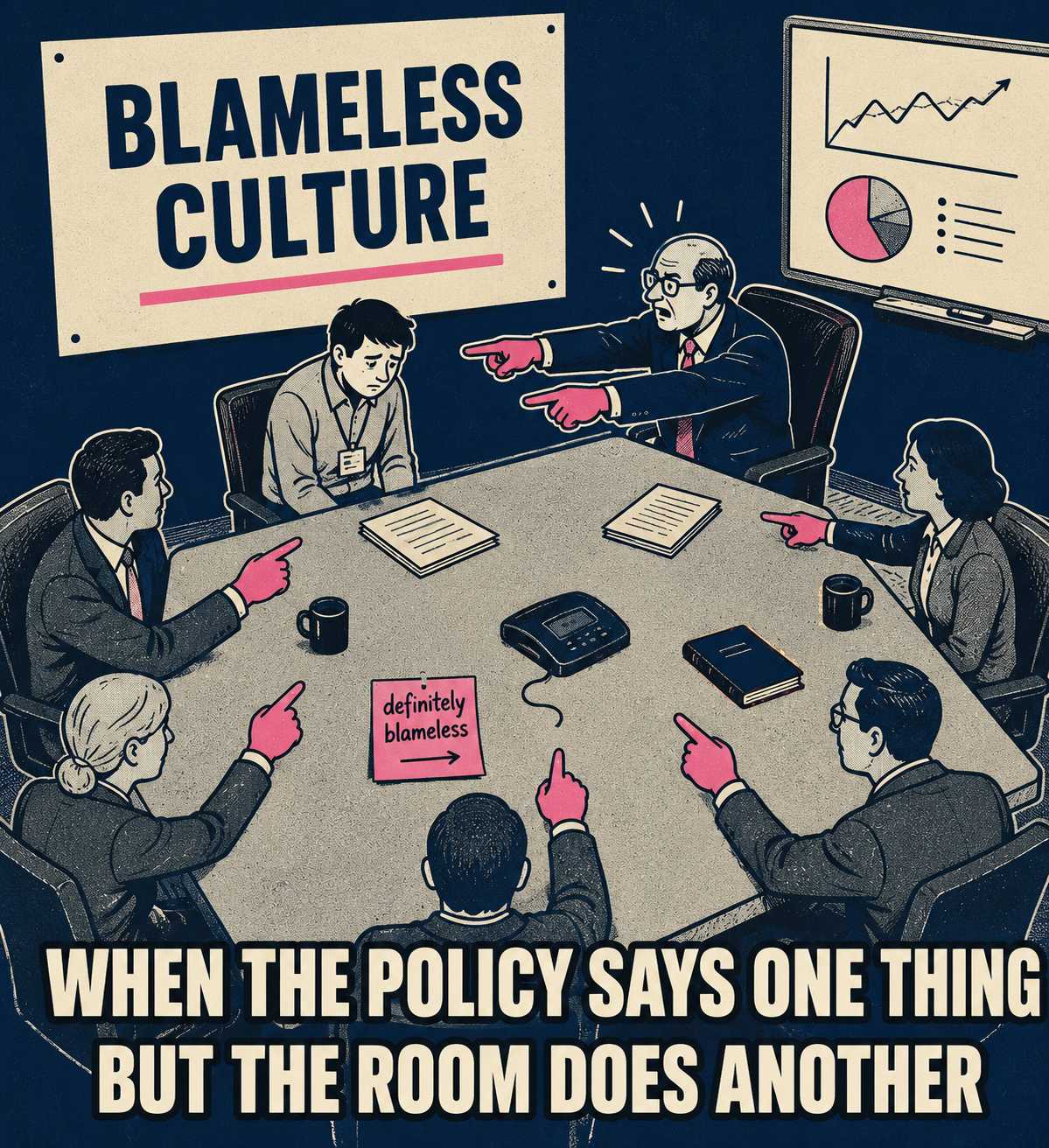
The incident response template said "Blameless Culture" in bold at the top. The meeting had been going for forty minutes. The VP of Engineering leaned forward and asked, "Why didn't you check that before deploying?"
The engineer who triggered the incident became quieter and quieter. By the end of the hour, everyone in the room knew exactly whose fault it was, even though no one said it explicitly. This pattern repeats itself across engineering organizations everywhere: the policy says blameless, the culture says otherwise, and the gap between those two things is where trust goes to die, as Tian Pan's analysis on blameless postmortem practices makes clear.
If you are reading this, you probably just experienced an incident. An outage, a failed deployment, a data loss event. You need to produce a document that satisfies multiple audiences at once: engineering leadership, affected customers, executives who want accountability without a witch hunt, and the team members who were directly involved and are currently dreading this process.
The post-mortem will be referenced later during performance reviews, architectural decisions, and budget conversations. It has political weight whether you want it to or not.
You are navigating a political minefield disguised as an engineering document. Here is how to do it well.
What Blameless Actually Means in a Room Full of People
There is a persistent misconception that "blameless" means pretending no one was involved or that no decisions were bad.
It doesn't.
Blamelessness means the focus is on the systemic conditions that allowed the incident to occur, not the moral judgment of the people who executed under those conditions, a principle the Google SRE Book's chapter on postmortem culture treats as foundational. The goal is to make it safe to admit what you did so the team can learn what actually happened. When engineers fear blame, important details get hidden, critical mistakes go unmentioned, and the real causes of incidents stay buried. The result is that organizations repeat the same failures over and over.
We need to distinguish between blamelessness and accountability, because they are not the same thing. Blamelessness is about psychological safety. Accountability is about who owns the fix. Blame is backward-looking; it assigns fault for past actions. Accountability is forward-looking; it assigns ownership of future actions, a distinction that incident.io's research on why post-mortem action items fail puts at the center of effective incident review.
The old view of human error treats mistakes as evidence of character flaws. If someone caused an incident, they must be careless or incompetent. This view attaches an individual's character to their actions and assumes negligence or bad intent led to the error, which PagerDuty's guide to blameless postmortems traces back to what researchers call "the bad apple theory." The new view, developed through research in healthcare and aviation, treats human error as a symptom of a systemic problem. The question shifts from "who failed?" to "what conditions made this failure possible?"
If you follow the old view, you respond to an incident by finding the careless individual so they can be reprimanded. This impulse to blame has the unintended effect of disincentivizing the knowledge sharing required to prevent future failure. Engineers will hesitate to speak up. Mean time to acknowledge increases. Mean time to resolve increases. The incident gets worse.
The uncomfortable truth is that even in organizations with explicit blameless policies, being associated with a major incident impacts your reputation. It might not show up in a performance review, but engineers remember. This fear prevents honest sharing. Engineers minimize their role, focus on external factors, or hide information. The post-mortem might be blameless on paper, but the social dynamics aren't, as Tian Pan's analysis on blameless postmortem practices documents in detail.
The most important factor in making blamelessness real is not the policy document. It is how leadership behaves during and after incidents. Leaders need to model the behavior. When senior engineers share times they've made similar mistakes, it signals: we're all learning here.
How to Structure the Document So People Actually Read It
A useful post-mortem document needs a specific architecture, and the sections matter for reasons beyond organization.
The incident summary is what broke, when, and what the user-facing impact was. Keep it brief. This is the section executives will read first, and it should answer their questions before they ask them.
The timeline is a neutral, timestamped sequence of events and decisions. The critical discipline here is to focus on what information was available at each decision point, not whether the decision was "right" in hindsight. Hindsight bias is one of the most dangerous cognitive traps in post-mortem writing. Knowing the outcome, it is easy to see the event as predictable despite there having been little or no objective basis for predicting it at the time, a bias that PagerDuty's guide to blameless postmortems recommends countering by starting the timeline before the incident and working forward, not backward from resolution.
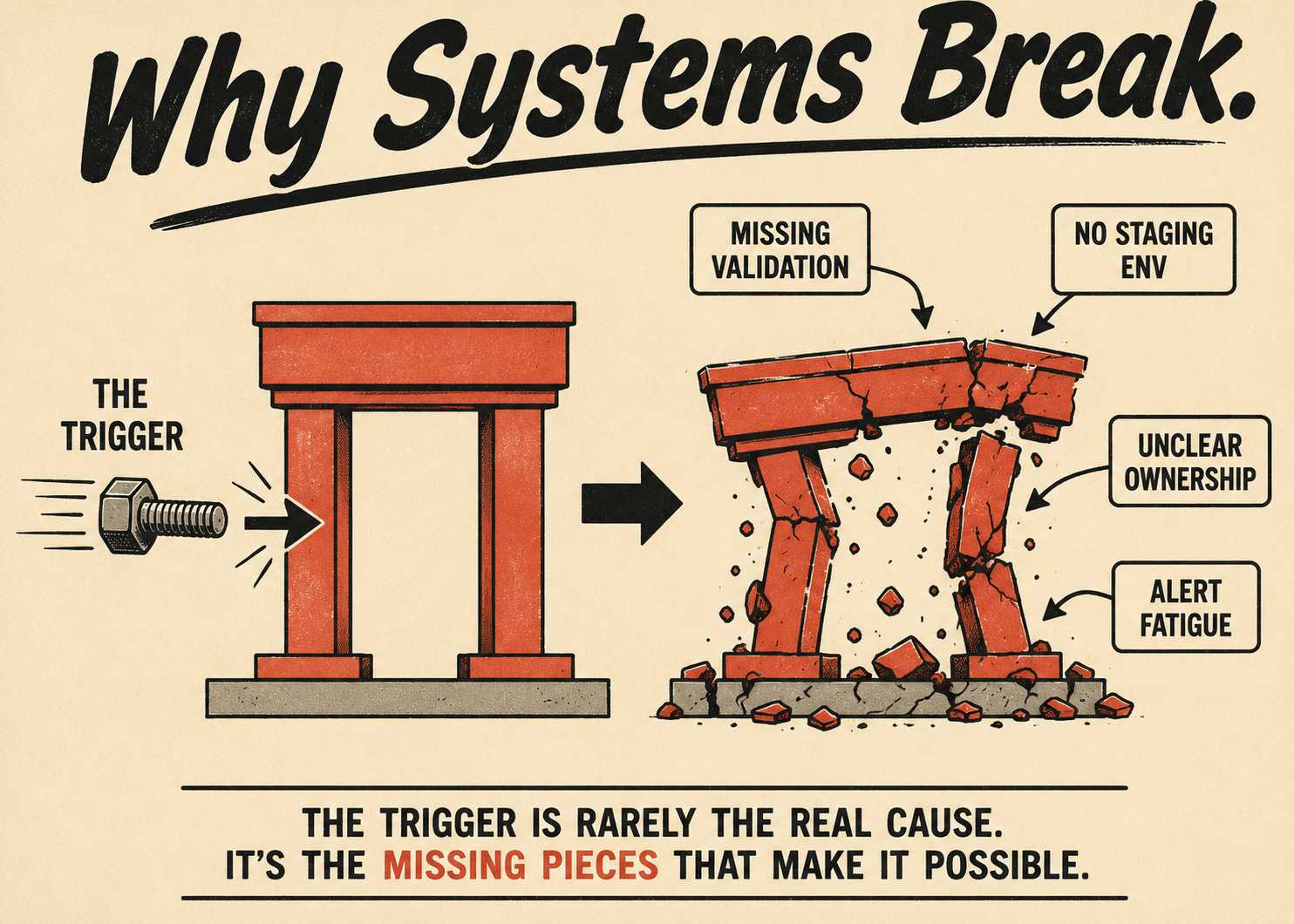
The root cause analysis is where most post-mortems go wrong. The key is to distinguish between the trigger and the underlying conditions. The trigger is what broke. The underlying conditions are why the system was fragile to that trigger. In complex systems, there is no single root cause. Small, apparently innocuous failures join to create the opportunity for a systemic accident. Each small failure is necessary, but only the combination is sufficient to permit failure, a point that Salesforce Engineering's critique of the five-whys method makes compellingly. The traditional five-whys approach assumes a linear chain of causation that rarely exists in production systems.
The contributing factors section is where you surface the things that made the incident worse or harder to resolve: tooling gaps, missing documentation, unclear ownership, alert fatigue, a staging environment that didn't reflect production. These are the systemic conditions that allowed the trigger to become an outage.
The action items section is the section that determines whether the post-mortem was worth writing. More on that below.
Writing the Timeline Without Pointing Fingers
The timeline is where blame usually creeps in, often through language choices that seem neutral but aren't.
Use passive or system-focused language where the agent doesn't matter. "The deployment was triggered" rather than "Alice triggered the deployment." When you do name people, frame them as the information conduit, not the isolated decision-maker. "Based on the available metrics, the on-call engineer determined the service was healthy and proceeded with the rollout."
Include the context that was present at the time of the decision. "The alert fired, but the team had seen similar alerts resolve on their own during the previous two weeks, so the decision was made to wait before rolling back." That sentence does something important: it explains why a reasonable person made the call they made. It doesn't excuse the outcome. It explains the conditions.
If someone made an objectively bad call, describe the environmental pressures that made that call seem reasonable in the moment. PagerDuty's guide to blameless postmortems recommends asking yourself why a reasonable, rational, and decent person may have taken the action that seems to have caused the incident. This thinking turns attention to the multiple systemic factors that led to the incident.
The language you use shapes the thinking in the room. "What information was available when that decision was made?" produces a different conversation than "Why did you make that decision?" The first is an investigation. The second is a tribunal.
When the "Cause" Was a Person
Sometimes the trigger really was a person's mistake. A fat-fingered command. A missed step in a runbook. A configuration change that wasn't tested.
Reframe individual errors as gaps in the system's defenses. If one person's typo can take down production, the problem is not the typo. As Salesforce Engineering's critique of the five-whys method argues, the problem is that the system allowed a single typo to propagate to production without any checkpoint catching it.
Ask the structural questions: why was this mistake possible? Why didn't we catch it in review? Why didn't we have a rollback strategy? Why was there no staging environment where this would have been caught? Why did the deployment pipeline not validate the configuration before applying it?
The question is never "why did this person fail?" The question is "what would need to change so that this type of failure doesn't bring down the system?" As the Google SRE Book's chapter on postmortem culture puts it, you can't fix people, but you can fix systems and processes to better support people making the right choices when designing and maintaining complex systems.
This reframing is not about letting people off the hook. It is about asking the question that produces actionable answers. "Alice should have been more careful" produces no action item. "The deployment pipeline should validate configuration against the schema before applying it" produces a ticket, an owner, and a deadline.
Making Action Items Survive the Sprint Boundary
Post-mortem action items have a quiet extinction rate. Teams run thorough debriefs, produce honest analysis, and leave the room aligned. Then the follow-ups silently die. The failure is not in the post-mortem itself. It is in what happens after, which incident.io's research on why post-mortem action items fail calls "the last mile problem of post-mortems: brilliant documents that produce zero change."
The most common failure modes are predictable: no named owner, the wrong tracking tool, vague wording, and zero follow-up cadence. When ownership belongs to "the team," it belongs to nobody. When the action lives in the post-mortem document instead of your real task tracker (Linear, Jira, whatever your team actually opens every day), it is already dying.
A good action item has five elements: a named individual owner, a verifiable verb, a specific outcome, a home in your real task tracker, and a deadline. "Improve monitoring" is a wish. "Add latency alerting to the checkout service by Q2, owner: SRE team" is an action. You can verify if it is done.
Distinguish between "prevent this exact incident" and "reduce the blast radius of incidents like this." The first is often impossible. The second is always achievable. Prioritize observability, rollback mechanisms, and automation over process changes that rely on people remembering to be careful. A process change that requires vigilance will fail the moment someone is tired, distracted, or new.
Systemic actions fail because they are framed as engineering tasks when they are leadership problems. "Fix team ownership" is not something an engineer can put in a sprint. Incident.io's research on post-mortem action items recommends escalating with a concrete ask, a measurable consequence, and a named decision-maker at the right organizational level. "Component X has no designated owner, which meant it took 40 minutes to find someone who could investigate during the last incident. Can we assign ownership to Team Y by end of month?" That is an escalation. "Resolve ownership ambiguity" is not.
Actions survive on rhythm, not good intentions. A standing question at sprint planning ("any open incident actions?") takes two minutes and keeps follow-ups alive. A dashboard of open action items lets leadership notice patterns without micromanaging. Closing a post-mortem should be a conscious act: either the actions are done, or they are explicitly deprioritized with a documented reason. Passive drift into nothing is the default outcome if you don't actively prevent it.
The Handoff to the Rest of the Organization
Writing the post-mortem is only half the battle. The real work is ensuring the system learns from it.
Every post-mortem should generate updates to runbooks, deployment checklists, and onboarding materials. It should surface gaps in your documentation about how the system actually behaves under failure conditions. The lessons learned should feed into your next architectural review. The timeline and root cause analysis are reference material for future incidents; they document decision-making patterns and system behavior that aren't captured anywhere else.
This is where documentation drift usually happens. The incident is resolved, the post-mortem is filed away, and the operational knowledge never makes it back into the daily workflows. The runbook that should have been updated isn't. The onboarding guide that should mention this failure mode doesn't. The next engineer on call encounters the same conditions and has no record that this has happened before.
The best post-mortems become living documentation. They don't just explain what went wrong; they change how the organization understands its own systems. That only happens if there is a deliberate process for taking the insights from the post-mortem and pushing them back into the operational documentation that people actually use.
Doc Holiday is built for exactly this moment. It generates documentation output directly from engineering workflows: release notes, runbook updates, incident summaries. AI generates documentation draft candidates from code commits and post-mortem actions; a senior engineer validates accuracy and edge cases in a dashboard before anything is published, and the patterns that pass review scale across the organization. The post-mortem doesn't get filed and forgotten; it becomes the source material for the documentation that prevents the next incident.