How to Use Documentation as a Deliberate Onboarding Accelerator


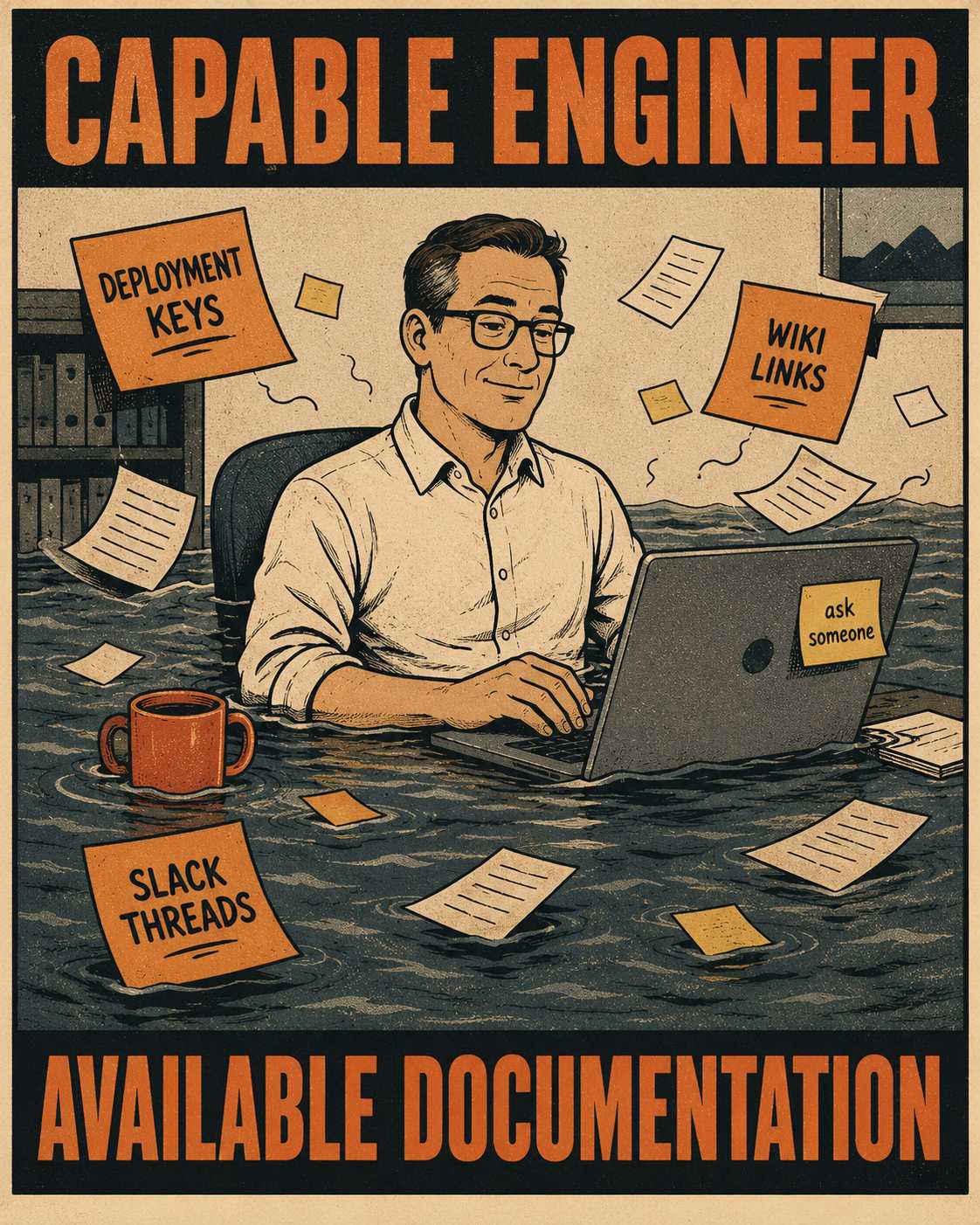
Imagine hiring an experienced senior engineer, someone with a decade of building complex distributed systems, and watching them spend their first three weeks asking where the deployment keys live.
It happens everywhere. The engineer is capable, the team is capable, but the process of getting the engineer to write their first meaningful commit feels like wading through molasses. The standard response is to point the new hire toward a wiki full of documentation. They open it, scroll through thirty pages of outdated architecture diagrams, and inevitably end up messaging the team lead on Slack anyway.
The problem is not that the documentation doesn't exist. The problem is that the documentation was written for reference, not for learning. It assumes the reader already knows the very things a new hire needs to learn.
Most engineering teams treat documentation like an encyclopedia. It is a repository of facts, a place to look up a specific API endpoint or a deployment command. But for a new engineer, an encyclopedia is useless without a syllabus. They don't know what they don't know, which means they don't know what to search for.
Effective onboarding documentation is not a reference library. It is a guided path through the codebase, the architecture, and the team's practices. It answers the questions new engineers reliably ask, in the exact order they ask them.
The Difference Between Reference and Curriculum
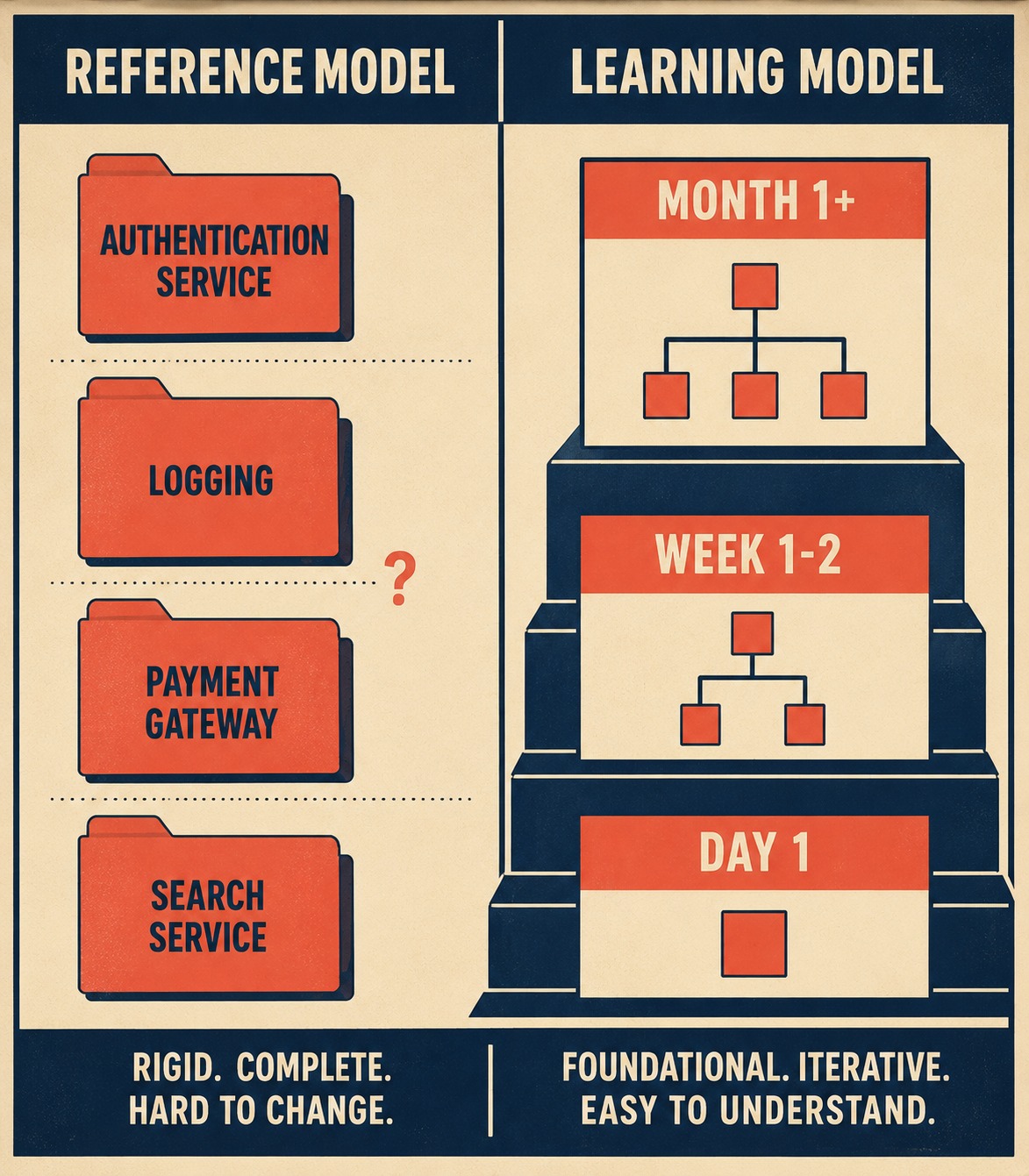
When documentation is organized for reference, it groups information by system or component. The authentication service has a folder. The payment gateway has a folder.
When documentation is organized for learning, it groups information by time and necessity. Day one content is different from week one content. Month one content is different from month six content.
New engineers cannot absorb the entire architecture of a mature product on their first day. They need minimum workable knowledge: how to run the application locally, where the codebase lives, and who to ask when things break.
Once they have that, they need foundational knowledge: the data flow, the key abstractions, and the architectural patterns the team uses. Only after they understand the foundations do they need the depth, the edge cases, the legacy decisions, and the cross-system dependencies.
If you give a new engineer the depth before they have the foundations, you overwhelm them. If you give them the foundations without the minimum workable knowledge, they can't even start the application to see the foundations in action.
Making Implicit Knowledge Explicit
A significant portion of what makes an engineer productive on a specific team is tacit knowledge, as research into software development teams has consistently found. It is the understanding of why the system is built the way it is, what alternatives were considered, and what constraints shaped the final design.
This knowledge rarely makes it into the official documentation. It lives in the heads of the senior engineers who built the system. When a new engineer joins, the only way they can acquire this knowledge is by interrupting those senior engineers with questions.
These interruptions are expensive. Context switching can consume up to 40% of an engineer's time. Every time a senior engineer stops writing code to explain a legacy design decision to a new hire, the team's overall productivity drops. And the compounding effect is real: if a team is onboarding three engineers at once, the senior engineers are fielding the same questions three times.
Good onboarding documentation makes this implicit knowledge explicit. It includes decision context. It doesn't just explain what the authentication service does; it explains why the team chose OAuth2 over JWTs three years ago, and why they haven't migrated yet.
One of the most effective ways to capture this context is through Architecture Decision Records (ADRs). An ADR is a short document that captures a single architectural decision, the context in which it was made, and the consequences of that decision. Spotify's engineering team found that ADRs significantly reduced the knowledge lost during team transitions and made onboarding measurably faster. When a new engineer asks, "Why did we build it this way?", the answer is already documented. Microsoft's Azure Well-Architected Framework treats ADRs as a core deliverable for any solution architect, noting that they should document not just the decision made but the alternatives ruled out.
What the Documentation Set Should Actually Contain
What should this documentation actually look like? It doesn't need to be a thousand-page manual. It needs intentional coverage of the questions that always come up.
An architecture overview with clear entry points for different roles is the starting point. A frontend engineer needs a different entry point than a backend engineer, and trying to serve both with the same document usually serves neither. Annotated code walkthroughs for core workflows are more valuable than abstract descriptions: show the new engineer how a request travels from the client, through the API, to the database, and back again. A glossary of internal terminology and abbreviations matters more than most teams realize. Every company has its own language, and a new engineer who doesn't know what "the monolith" or "the pipeline" refers to will spend days confused before they ask.
Runbooks for common debugging scenarios are the most immediately useful documentation a new engineer can have. When a specific alert fires, what are the first three things they should check? This is the kind of knowledge that senior engineers carry in their heads and new engineers have to learn through painful experience. Writing it down takes an hour. Not writing it down costs weeks.
The ADR repository ties it all together. It is the institutional memory of why the system looks the way it does.
Maintaining the System Without Heroics
The most common objection to building comprehensive onboarding documentation is the maintenance burden. Codebases change constantly. If the documentation doesn't change with them, it becomes outdated, untrustworthy, and eventually, ignored. Medium's engineering team found this out the hard way: their handbook hadn't been thoroughly updated in two years, and nobody owned it, so it was full of outdated information when new engineers needed it most.
The solution is not to hire more people to maintain the docs. The solution is to tie the documentation to the systems that already generate technical content. When release notes, API documentation, and changelog entries are automatically generated from engineering workflows, they stay current without requiring manual rewrites.
A senior engineer or technical writer can then curate and contextualize this material into onboarding-friendly paths, rather than authoring it from scratch. The authoring problem becomes a curation problem, which is significantly more tractable.
Measuring the Impact
How do you know if this approach is working? You measure the speed of onboarding.
The time it takes a new engineer to make their first meaningful commit (their time-to-first-commit) is a leading indicator of organizational health. If it takes an engineer weeks to push code, the environment is full of friction. If it takes them days, the environment is enabling them. One organization tracked this metric and drove the window from 80 days to four, not through heroics but through systematic reduction of onboarding friction.
You can also measure the reduction in Slack questions directed at senior engineers during a new hire's first month. Feedback from 30-day retrospectives can identify exactly where the documentation failed and where it succeeded. Research at Google found that time-to-first-code-change is one of the most reliable ways to evaluate whether onboarding programs are working, and that the speed at which developers ramp up predicts their long-term output patterns.
Recent data shows that developers who use AI tools to assist with onboarding reach their 10th pull request nearly twice as fast as those who don't, with daily AI users hitting that milestone in 49 days compared to 91 days for non-users. Only 12% of employees strongly agree their organization does a great job onboarding them. The bar is low, and the opportunity is real.
The speed of onboarding is also a leading indicator of retention. Replacing an engineer costs between 50% and 200% of their annual salary. Engineers who feel supported and productive in their first months are far less likely to leave.
The Operational Reality
The bottleneck for most teams is not knowing what to write. It is keeping the documentation synchronized with a codebase that changes every day.
Doc Holiday generates foundational technical content (API references, release notes, feature descriptions) directly from engineering workflows. It pulls from code commits and pull requests, creating a continuous stream of accurate documentation.
This gives a senior engineer the raw material they need to build structured onboarding paths. They don't have to manually rewrite changelogs or hunt down what shipped last sprint. They can focus on curating the curriculum, adding the necessary context, and guiding the new hire. The structure Doc Holiday provides makes it possible to maintain onboarding documentation as a living system, not a one-time project that slowly rots in a wiki.