How to Get Your Engineering Team to Give Useful Documentation Feedback


If you want to know what a team actually values, look at what they rubber-stamp.
If you ran a software team, and a critical design document or API reference sailed through a review cycle with three approving "LGTMs" and zero substantive comments, you would probably feel good about shipping. The dashboard says the document was reviewed. The compliance checkbox is ticked. The system worked.
Then, two weeks later, the support tickets start arriving because the instructions are missing a critical dependency step. Engineers are back in Slack explaining the exact same concepts they supposedly just documented. The system, it turns out, did not work.
The problem isn't that engineers don't care about documentation. The problem is that most documentation feedback is entirely performative.
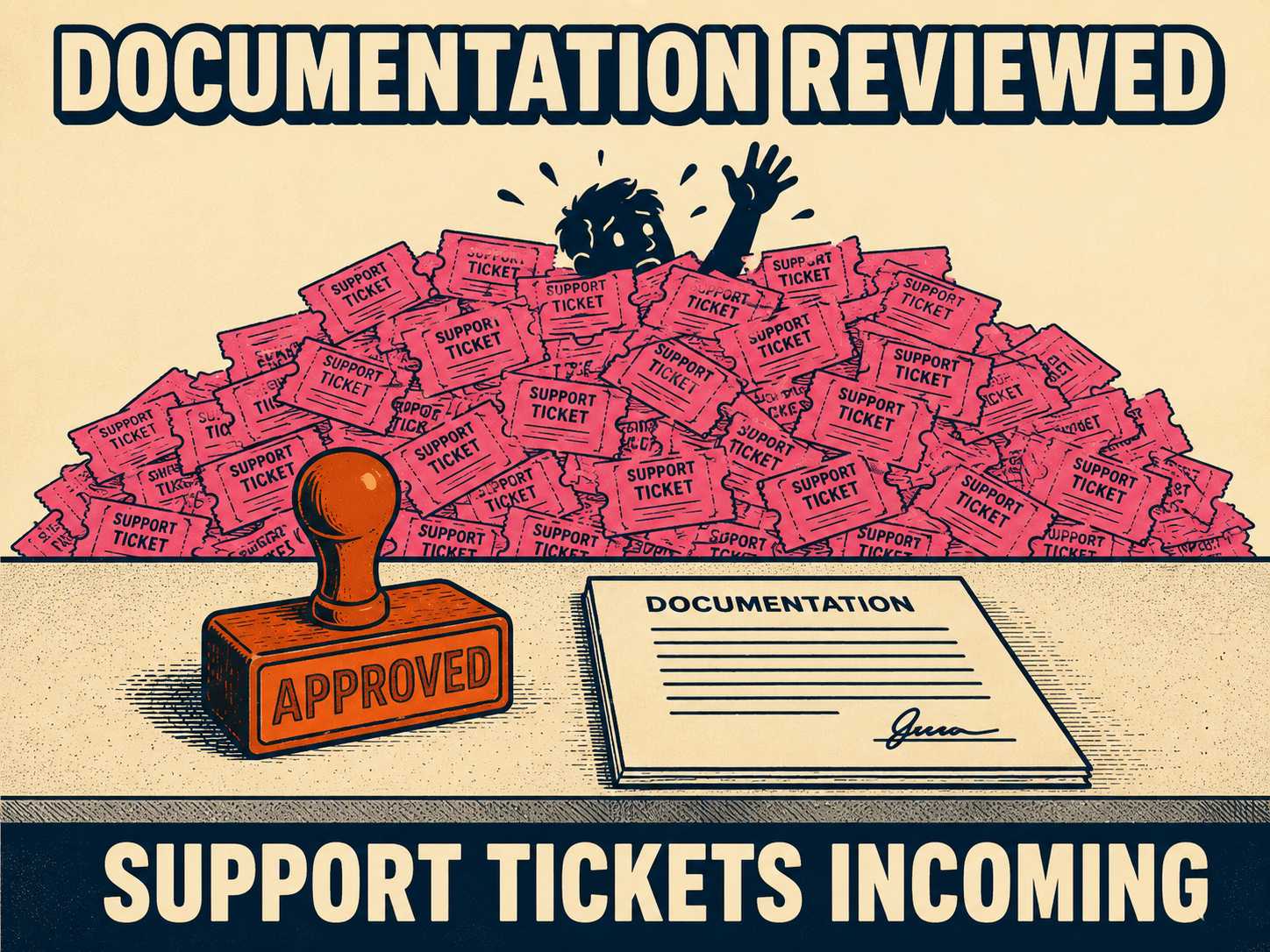
People leave comments to prove they reviewed the text, not because they found something worth fixing. They point out a missing comma. They suggest a slightly different phrasing for a variable name. They drop a vague "this section feels confusing." The result is a document that passes review but still fails the user.
If you want better documentation, you have to teach your team how to give better feedback. It requires shifting the review process from a grammar check to a usability test.
Stop Reviewing for the Writer
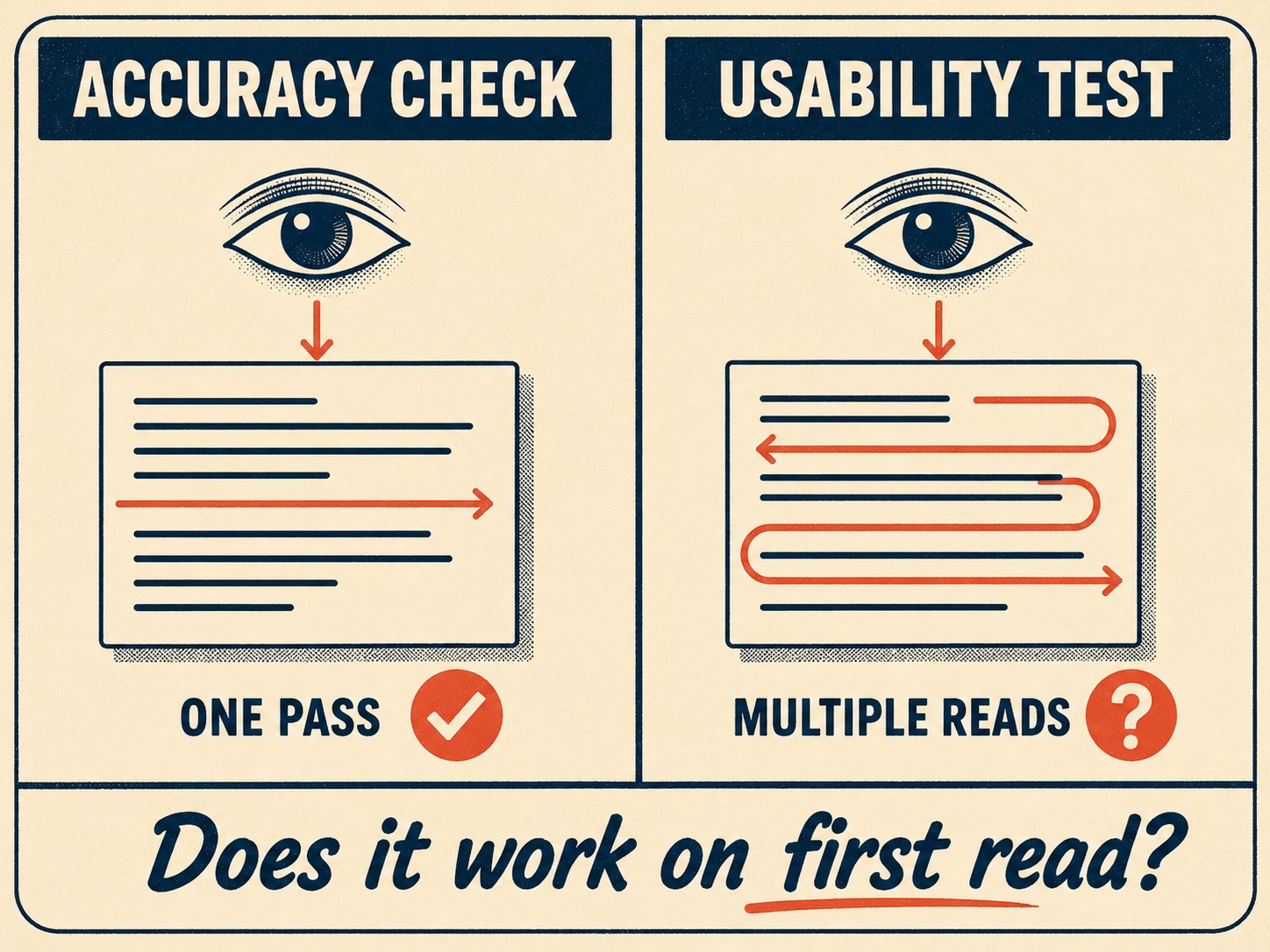
The most common mistake engineers make when reviewing documentation is reading it to see if it is technically accurate.
Accuracy is necessary, but it is not sufficient. A document can be 100% technically accurate and completely useless to someone trying to accomplish a task. When reviewers focus only on accuracy, they miss the cognitive load they are placing on the reader. DORA's research has shown that high-quality documentation significantly amplifies the impact of technical capabilities on organizational performance. But that quality is defined by attributes like clarity and findability, not just technical precision.
Useful feedback improves the reader's experience. This means the reviewer has to actively simulate being a user who does not already know how the system works.
When reviewing, the questions shouldn't be "Is this statement true?" The questions should be: Did I understand this on the first read, or did I have to loop back to parse the sentence? Would someone less familiar with this system understand what this acronym means? Are the examples realistic, or are they abstract "foo/bar" placeholders?
When reviewers ask these questions, their feedback changes. Instead of "Fix this typo," the feedback becomes "I didn't understand what 'session token' referred to until paragraph three—define it on first use."
Specificity Separates Feedback from Frustration
"This is confusing" is not useful feedback.
It is an expression of frustration. It tells the writer that a problem exists, but it provides no diagnostic information about what caused the problem or how to fix it.
Effective feedback must be concrete, specific, and tied to observable elements of the work. When feedback is vague, the writer has to guess what the reviewer meant, which often leads to the wrong fix.
Teach your team to diagnose the confusion. If a section is hard to follow, what makes it hard to follow? Is the prerequisite knowledge not stated? Is a critical step missing from the sequence? Is the text describing a visual interface that needs a screenshot?
A useful comment looks like this: "This section assumes the user has already configured the IAM roles, but we haven't mentioned IAM roles yet. We should add a prerequisite warning here." That is an actionable observation that makes the document structurally better.
The Style Trap
One of the fastest ways to ruin a documentation culture is to let reviewers rewrite the document in their own voice.
Engineers are highly opinionated. If you give an engineer a document, they will almost certainly find a way they would have written it differently. But mistaking style for structure creates unnecessary friction and wastes time.
If a reviewer wouldn't rewrite a sentence the exact same way, that is not necessarily a problem. If the reader has to reread a sentence three times to parse it, that is a problem.
Reviewers need to learn the difference between "I prefer this phrasing" and "This phrasing obstructs comprehension." If the feedback is purely stylistic, it should be flagged as a non-blocking suggestion or dropped entirely. If the feedback is structural, it requires a fix. By enforcing this distinction, leaders can prevent review cycles from devolving into endless debates over word choice.
Say What Works
We have trained people to believe that reviewing a document means finding flaws. If a reviewer doesn't leave a comment asking for a change, they feel like they haven't done their job.
But useful feedback also acknowledges what works. If a section is particularly clear, say so. If an example made a complex concept suddenly click, highlight it.
This does two things. First, it tells the writer what to protect during the revision process. If they know a specific analogy landed well, they won't accidentally edit it out while fixing something else. Second, it builds a culture where people actually want to participate in documentation reviews. If the only feedback writers ever receive is a list of their failures, they will stop asking for reviews.
The Operational Reality
You cannot fix documentation feedback by just telling your team to leave better comments. The organizational dynamics have to support the behavior you want.
If engineers are expected to review a 10-page technical spec in five minutes between meetings, they will not give useful feedback. They will skim it, find a typo to prove they looked at it, and stamp it with an LGTM. If the review process is treated as a bureaucratic formality before shipping, people will treat it like a formality.
Google's engineering practices make the case that treating documentation like code—integrating it into the traditional engineering workflow with clear ownership and review expectations—is critical for scaling quality.
Leaders need to build time and accountability into the process. Amazon's document-based meeting culture offers one model worth borrowing: meetings begin with silent reading time so everyone actually digests the material before discussion starts. Another option is assigning specific reviewers to specific sections based on domain expertise, rather than blasting the document to a 50-person channel and hoping someone reads it.
When feedback systems break down, the cost is invisible but massive. Documentation ships that technically describes the feature but doesn't help anyone use it. Support tickets pile up. Engineers spend hours rewriting the same explanations in Slack over and over. The documentation exists, but it isn't doing its job.
This problem gets significantly harder at scale. As you add more docs, more reviewers, and more variability in what "useful feedback" means across different teams, maintaining quality becomes a heavy operational burden. Unmanaged AI tools can exacerbate this by generating massive volumes of technically plausible but structurally confusing text that overwhelms reviewers.
This is where Doc Holiday changes the operational model. Doc Holiday is a documentation engine that generates structured first drafts directly from engineering workflows, like code commits and pull requests. But generation is only half the battle. Doc Holiday provides the scaffolding for teams to validate, manage, and scale that output systematically. It doesn't replace the human judgment required to give good feedback—it gives lean teams a consistent, structured foundation to apply that judgment against, ensuring that when engineers do spend time reviewing docs, they are refining clarity and usability, not fixing basic structural drift.