How to Create an Effective Year-in-review Product Changelog


If you want to understand how a software company views its users, look at how it summarizes a year of work.
Some teams dump 200 Jira tickets into a chronological list. This proves they view users as compilers who need a complete transaction log. Other teams write a marketing manifesto that vaguely gestures at "synergy" and "empowerment," proving they view users as easily distracted targets who will not notice the absence of substance.
The teams that actually retain users and align stakeholders do something different. They treat the year-in-review product changelog as a narrative artifact. They recognize that a year is not just a unit of time, but a unit of strategy. And they know that summarizing 12 months of shipping is an operational problem that requires a repeatable, structured workflow, not a frantic December scramble through Git commit histories.
The answer to how you build one starts with a question most teams skip entirely.
The Scoping Problem
A team that ships continuously will easily accumulate hundreds of changes in a year. The most common mistake is assuming the year-in-review is a comprehensive historical record. It is an argument about where the product went.
Before you pull a single data point, you have to decide who this document is for. The audience determines everything downstream: length, technical depth, tone, what gets emphasized, and what gets dropped entirely.
Investors care about metrics and strategic direction. They want to see that the team shipped against a coherent thesis, not just against a backlog. Power users want feature depth and roadmap hints. They are the ones who will actually read every section, so they reward specificity. Casual users need proof the product is actively maintained. For them, the year-in-review is essentially a trust signal, and a short one is better than a long one.
Once the audience is clear, the filter becomes obvious. You cannot include every minor bug fix. Instead, you combine related changes into narrative arcs. If you shipped six small updates to the reporting dashboard over eight months, that is not six changelog entries. That is one entry about a rebuilt reporting engine. You promote the features that support the year's positioning, surface the changes that answer frequent support questions, and drop the minor fixes entirely unless they closed a major, highly visible pain point.
This filtering discipline matters more than most teams realize. The average feature adoption rate across products is just 6.4%, meaning the vast majority of what a team ships goes largely unnoticed by users. The year-in-review is one of the few moments where you can actively close that awareness gap — but only if you lead with the changes that actually matter to users, not a comprehensive inventory of everything that merged.
There is also a consistent discrepancy between what producers think users want and what users actually read, documented in empirical research on release note production and usage. Producers tend to over-document internal implementation details. Users want to know what changed in their workflow. The year-in-review is a chance to correct that gap at scale.
How You Actually Structure It
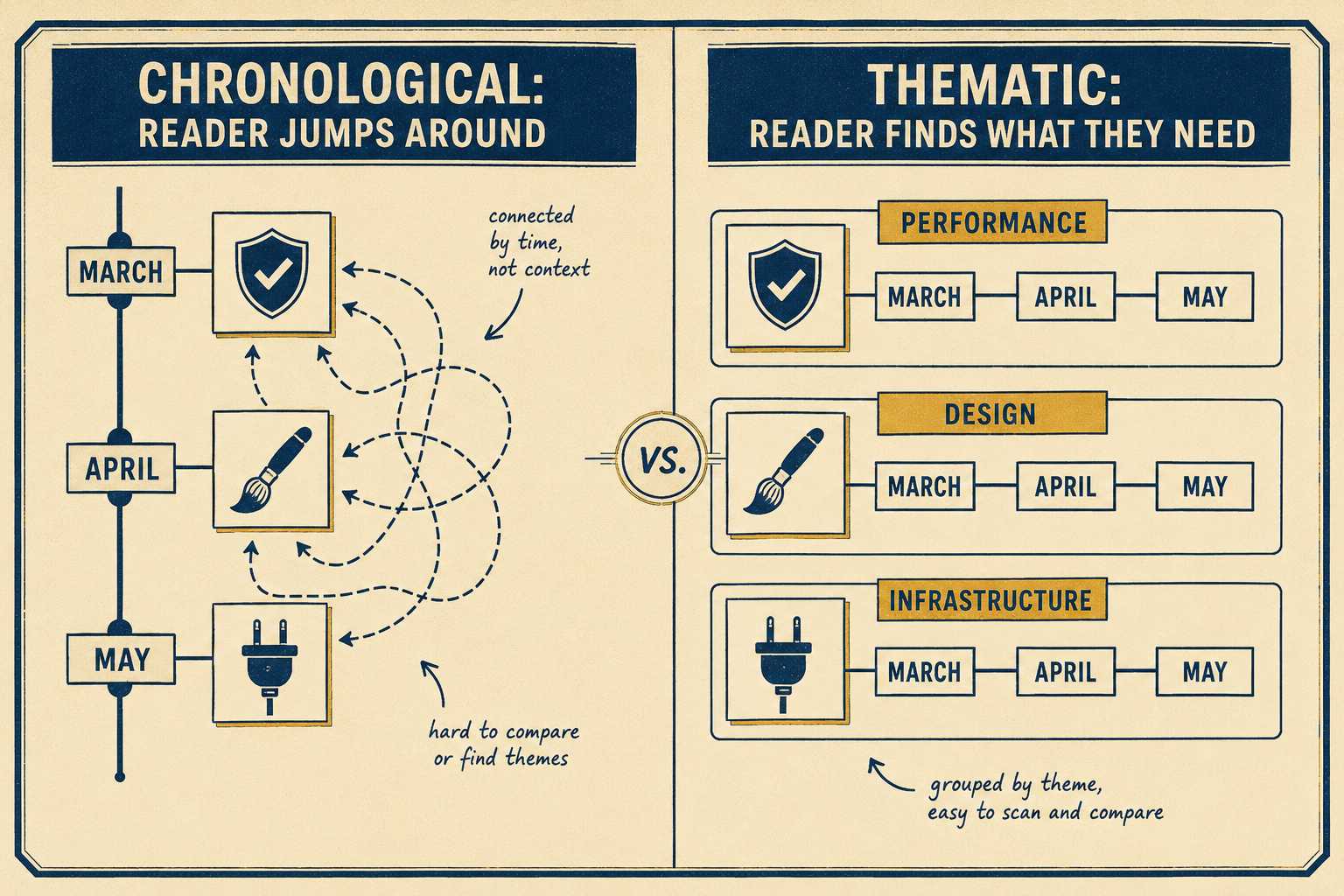
Monthly chronological organization is the default for most teams. It works fine for products with rigid, predictable release cycles, but for most SaaS platforms, a chronological log forces the reader to jump between unrelated contexts — a security patch in March, a UI overhaul in April, an API endpoint in May. Reading it feels like reviewing someone else's calendar.
Thematic grouping works better for products with diverse user bases. Grouping changes by category (Security & Compliance, Performance, New Integrations) allows different segments to skip straight to what they care about. A developer who wants to evaluate your API changes does not need to wade through UI updates first.
The most effective structure, though, is the narrative arc. This approach organizes the year around problems and solutions. It starts with the tension — the workflow bottlenecks users faced at the start of the year — moves to the turning point, and ends with the transformation. This structure demonstrates strategic coherence. It proves that the team was not just shipping random features, but systematically dismantling user friction.
The narrative arc also has a practical advantage: it forces the team to articulate why they built what they built. That is useful for investor relations, useful for onboarding new customers, and genuinely useful for internal alignment.
When describing individual items within any of these structures, calibrate the depth carefully. The year-in-review is not the place for full technical specifications — that is what individual release notes are for. Each entry should communicate what changed, why it matters to the user's workflow, and link out to detailed documentation. Give readers enough specificity to evaluate the impact, but not so much that the document becomes a reference manual.
The Part About Tone and Proof
The tone of a year-in-review should lean slightly optimistic without overselling. It should sound like a progress report from a competent team, not a celebration of a flawless victory. The most credible changelogs highlight real improvements, acknowledge where the product still has gaps, and preview what is coming next.
One of the better examples of this balance is Pitch's annual year-in-review email, which lists major features shipped during the year while ending with an explicit commitment to build more for users in the coming year. It is not triumphalist. It is forward-looking without being vague.
Visual presentation is not optional for most audiences. Plain-text changelogs work for highly technical, internal-only audiences, but most year-in-reviews benefit from screenshots, before-and-after comparisons, or embedded short demos. Visual proof makes claims credible and helps non-technical stakeholders understand what actually changed without having to parse API documentation.
Then there is the question of metrics. Should you include adoption numbers, performance benchmarks, or customer quotes? If the changelog is public-facing, quantitative proof points add significant credibility. If it is internal-only, stakeholders almost always want to see impact data. The risk is turning the changelog into a marketing document that loses its technical grounding. The balance depends on the audience identified in the planning phase, and it is worth deciding explicitly before drafting rather than adding metrics opportunistically as you go.
Where the Process Usually Breaks Down
This is the part nobody talks about in guides to year-in-review changelogs, because it is unglamorous: the actual compilation.
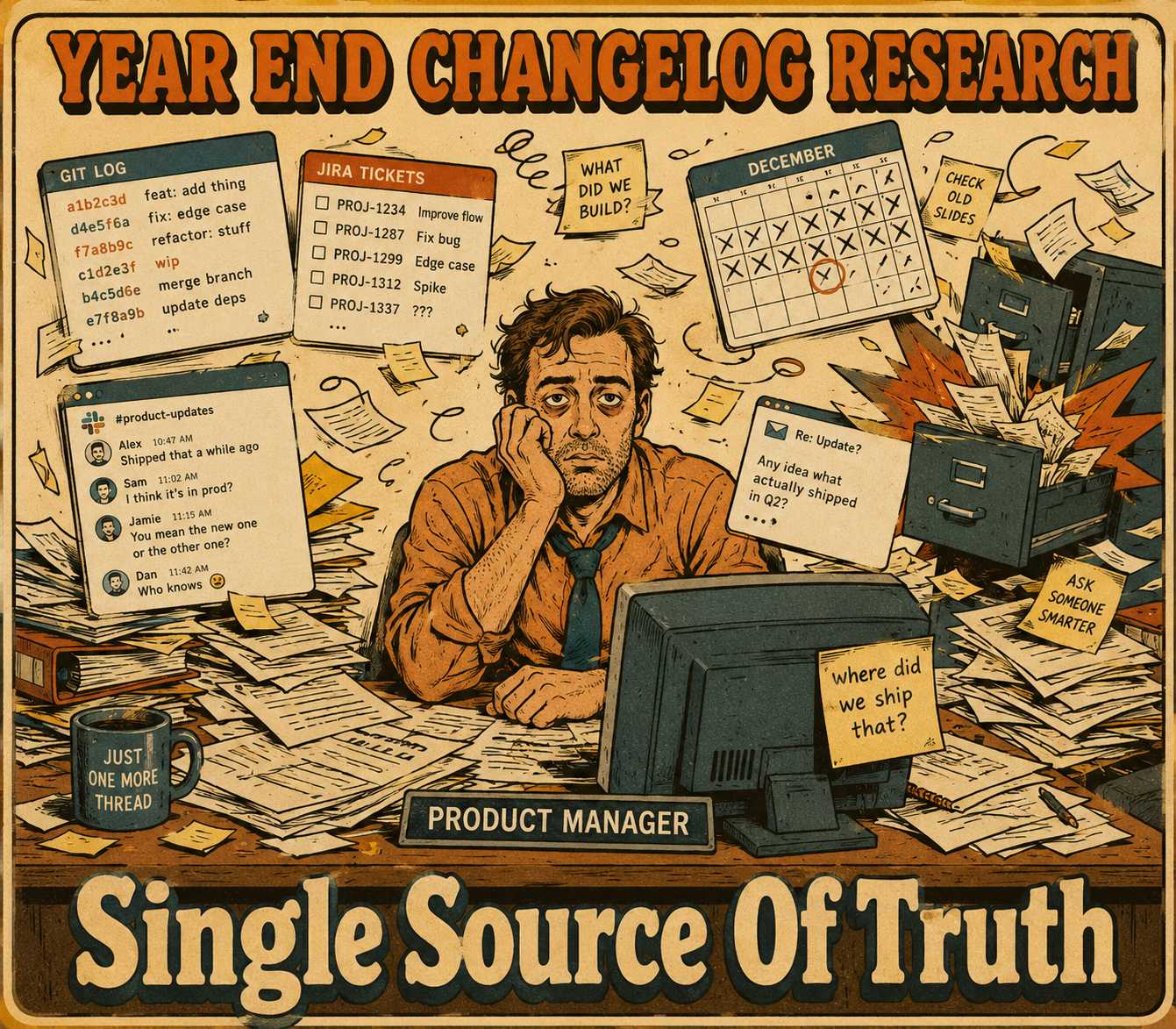
Most organizations do not have a single source of truth for product changes. Information is scattered across Git commit histories, project management tools, support ticket systems, and the fragmented memories of product managers who have since moved on to other priorities. The year-in-review is, before it is a writing problem, a data-assembly problem.
The compilation process usually involves a single owner — often a PM in smaller teams, or a technical writer or product marketer in larger organizations — going back through the year. They pull data from multiple systems, interview engineers about what actually shipped versus what was planned, and cross-reference against the original roadmap to understand what was deferred and why.
This requires access to engineering systems and the authority to ask clarifying questions. It also requires the ability to synthesize that information for a non-engineering audience. The owner needs to be fluent in both worlds, which is why the role often falls uncomfortably between product and marketing.
Timing is critical. Most teams start drafting two to three weeks before publication to allow for review cycles. Starting earlier means chasing a moving target as new changes ship in December. Starting later guarantees rushed writing and zero time for stakeholder input.
A practical checklist for the compilation phase:
- Pull the full list of shipped items from your project management tool, filtered by the year
- Cross-reference against Git commit history to catch anything that shipped without a ticket
- Interview at least one PM and one engineer per major product area to surface context that did not make it into tickets
- Review the support queue for the year to identify which changes resolved the most-reported issues
- Compare the final list against the original roadmap to understand what was planned versus what actually happened
- Group related items into narrative arcs before writing a single word of prose
The distribution strategy must match the audience identified at the start. This might mean an email to the customer base, a dedicated blog post, an in-app announcement, or a specific investor update. Many teams create different versions of the same core document for different stakeholders — a high-level summary for the public blog, a detailed, metric-heavy version for investors.
Publishing is not the end. The year-in-review often surfaces confusion about changes users did not know about, or reveals that certain improvements did not land as intended. A plan to handle the feedback, route support questions, and capture the insights for next year's roadmap is part of the process, not an afterthought.
The year-in-review is ultimately a documentation problem that starts in engineering. The teams that do it well are the ones who have been capturing context throughout the year — not just at the end of it. Doc Holiday generates documentation directly from engineering workflows like code commits, which means the raw material for a year-in-review is being assembled continuously, not excavated in a panic every December.