How to Build a Stakeholder Approval Process for Release Notes That Doesn't Suck


It's 4:00 PM on a Thursday. The release is ready to go. The code is merged, the tests are green, and the product manager is practically vibrating with anticipation to tell customers about the new feature.
But the release notes aren't out.
They aren't out because legal hasn't reviewed them. Legal hasn't reviewed them because they were sent over in a Google Doc an hour ago. The Google Doc also includes comments from three different marketing managers arguing about whether to use the word "streamline" or "optimize." The lead engineer is currently typing a very long Slack message explaining why both words are technically inaccurate.
If this sounds familiar, you don't have a release problem. You have an approval problem.
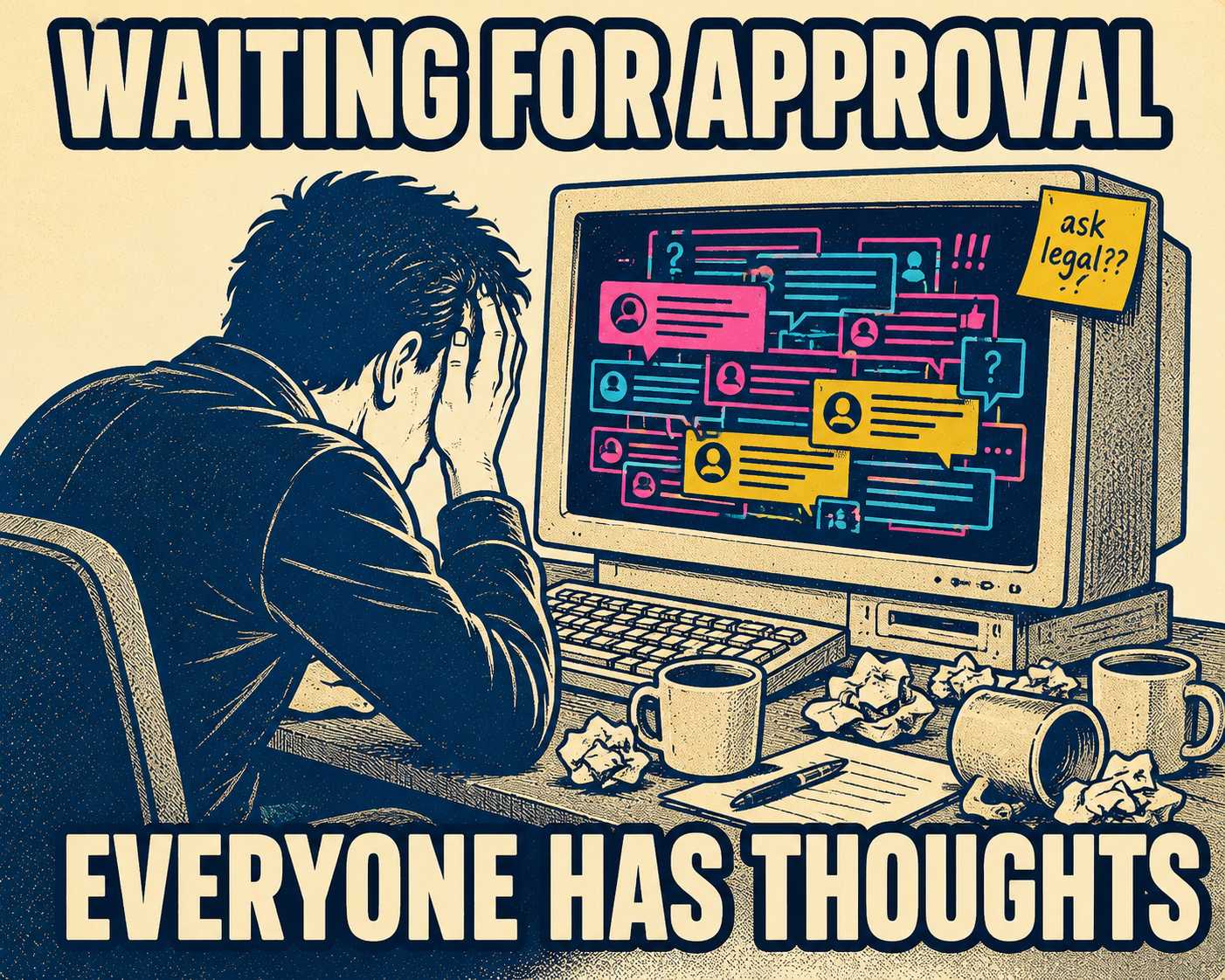
Most companies treat release notes as an afterthought, scrambling to write them at the last minute and then throwing them over the wall to a dozen different stakeholders for review. This turns every release into a five-day approval circus. But it doesn't have to be this way. You can build a lightweight process that actually gets the right eyes on the content without turning your release cycle into a hostage negotiation.
Here is how you do it.
Map the Real Approvers
Start by looking at your current approval chain. It is almost certainly too long.
Most organizations involve too many people in the review process because they confuse "people who want to know what we're shipping" with "people who need to approve what we're saying about it."
The RACI framework offers a useful lens here: it distinguishes between stakeholders who are Responsible, Accountable, Consulted, and Informed. For release notes, most of your current approvers probably belong in the "Informed" column, not the "Accountable" one. The distinction matters because only accountable stakeholders should have the power to block a release.
You need to identify the minimum set of reviewers who can block a release for legitimate reasons. Usually, this is a very short list. Product management needs to approve for messaging accuracy. Legal needs to approve for compliance-sensitive changes. Sometimes, customer success needs to approve for high-touch enterprise clients. That's it.
Everyone else is just noise.
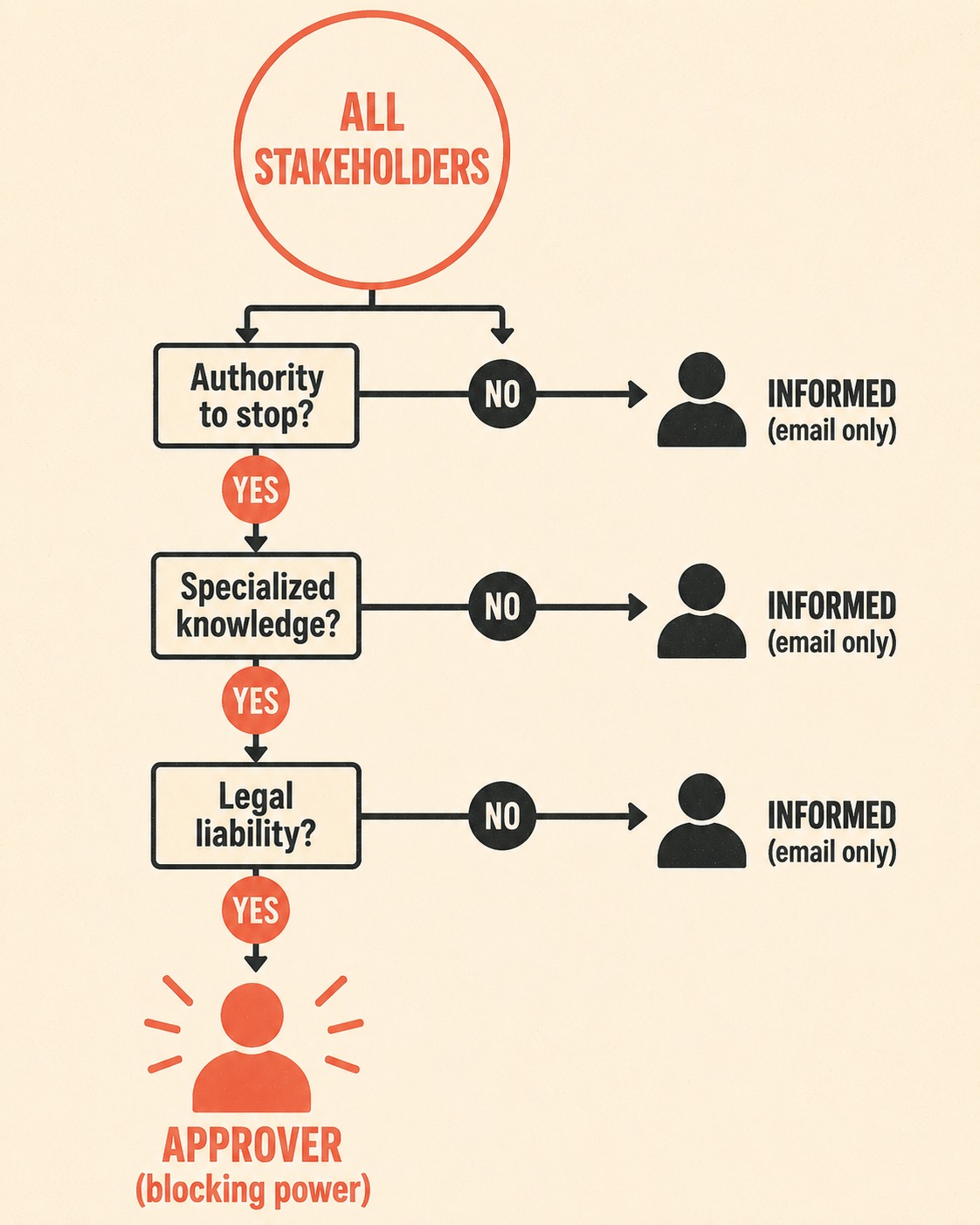
An approval chain of 8+ people is a recipe for delay. A right-sized chain of 2–3 gatekeepers is a recipe for velocity. If you're struggling to cut people out, use a simple decision tree:
- Does this person have the authority to stop the release?
- Does this person have specialized knowledge required to verify the accuracy of the notes?
- Does this person hold legal or compliance liability for the content?
If the answer to all three is no, they don't get a vote. They get an email when the notes go live.
Design the Workflow
Once you know who needs to approve, you need to structure review windows that respect both urgency and quality.
There is a meaningful difference between a batched release and a hotfix. If you're doing a batched release at the end of a sprint, you can build a 48-hour review window into the schedule. If you're shipping a hotfix for a critical bug, approval needs to happen in under two hours. Your process needs to accommodate both, and the ITIL change management framework has a useful model for this: it classifies changes as standard (pre-approved, low-risk), normal (require review), and emergency (require immediate escalation). Mapping your release notes to these categories gives you a defensible basis for different review timelines.
You also need to set SLAs that actually stick. What happens when a stakeholder ghosts the review request?
The answer is default-approve policies. If legal doesn't respond within 24 hours, and the change doesn't touch regulated features, it ships. If the product manager doesn't review the notes by 3:00 PM on release day, they ship as drafted. You have to establish these rules up front, so that silence is treated as consent, not a blocker.
Many companies use tiered review to manage this. Low-risk changes (like minor UI tweaks) get one approver. High-visibility changes (like a major new feature or a pricing update) get the full committee. The trick is defining "high-risk" in a way that everyone agrees on before the release, not during it.
Automate the Mechanics
This is where most processes break down. Approval shouldn't require the release manager to manually email five people, track responses in a spreadsheet, and chase down stragglers in Slack.
Good tooling makes the right thing the easy thing. You need automatic notifications when a draft is ready. You need inline commenting so feedback doesn't scatter across three different communication channels. You need version control so you know exactly which draft got approved. And you need automatic escalation if someone misses their SLA.
Integration is key here. If your release notes are generated from Jira, GitHub, or Linear, your approvers should be notified in the same system where they already live. If your company lives in Slack, approval should be a button click in a Slack channel, not a context switch to a different app.
Even with good tooling, things can fail. You might see approval by committee devolving into bikeshedding over word choice. Solve this by separating technical accuracy review (which is blocking) from tone and polish review (which is advisory). This is a practical application of the separation of concerns principle — the same idea that keeps software architecture clean also keeps review processes from collapsing under their own weight.
You might see reviewers sitting on drafts because they're waiting for "more context." Solve this by requiring that release notes drafts include links to the original tickets, PRs, or design docs.
You might see last-minute rewrites that bypass the approval process entirely. Solve this by making post-approval edits require the same sign-off as the original draft.
And you might see stakeholders who approve without reading. Solve this by requiring that approvers leave at least one comment or explicitly confirm they reviewed the content — no silent thumbs-up allowed.
But what if you've built a tight approval workflow, and stakeholders still block releases or ghost reviews?
That is a political problem, not a process problem. You have to escalate it. Frame it as a question of whether the company is willing to delay customer communication to accommodate internal review delays. If the answer is yes, ask who owns that decision. Usually, when forced to own the delay, stakeholders find a way to review faster.
This is where Doc Holiday changes the math.
Doc Holiday outputs structured release notes directly from engineering commits and tickets. This means drafts are ready for review earlier in the cycle — often before the code is even merged. Stakeholders get more time to review without extending the release timeline. The platform provides a validation layer where technical writers or product managers can quickly verify accuracy and flag ambiguities before the draft ever reaches executive review. It doesn't eliminate the need for human sign-off, but it removes the bottleneck of waiting for someone to write the first draft under time pressure. It turns approval from a last-minute scramble into a manageable, scalable workflow.