How Release Notes Improve Net Promoter Score


If you ran a mid-sized SaaS company and your NPS dropped six points in a quarter, you would probably do what most teams do: schedule a retrospective, review the open support tickets, and look for a product problem to fix.
But here is the thing. The support tickets are often not about the product being broken. They are about the product being different. A button moved. A workflow changed. A feature that used to live in one menu now lives in another. The product works exactly as intended. The users just have no idea what happened, and nobody told them.
That gap, between what the engineering team shipped and what the customer understood, is where NPS points go to die.
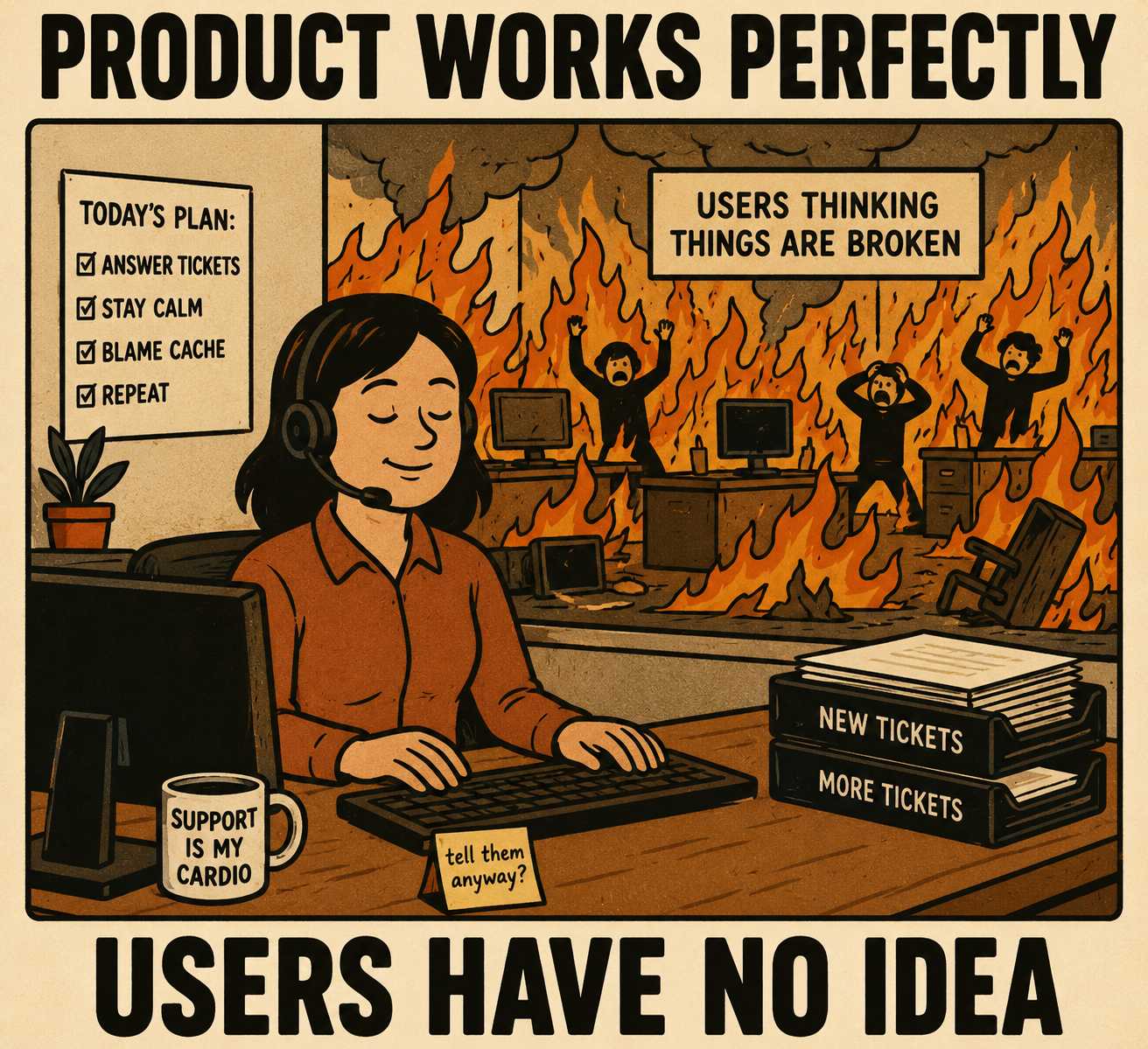
Release notes are the mechanism that closes it. Not as a compliance exercise, not as a documentation chore, but as one of the highest-leverage communication touchpoints a software team has. Users who understand what changed and why are dramatically less likely to contact support, assume the product is broken, or tell their colleagues to look elsewhere. The research on this is not subtle: detractors account for 80 to 90 percent of a company's negative word-of-mouth, and the most common trigger for detractor creation in software is not a bad feature. It is a surprise.
The Three Ways Releases Create Detractors
The failure modes are specific enough to name.
The first is the stealth update. A UI element moves, a default setting changes, or a workflow gets restructured, and users encounter it cold. Their immediate assumption is that something is broken. They file a support ticket. The support team explains it was intentional. The user is annoyed that they were not told. That annoyance is now part of their relationship with the product.
The second is the unexplained removal. A feature disappears without context. To the engineering team, this is a deprecation that was overdue. To the user who built a workflow around it, it feels like a punishment. The absence of explanation makes it worse. If you had told them why, they might have understood. Without the why, they assume you do not care about their use case.
The third is the breaking change with no warning. An API endpoint changes behavior. An integration stops working. A script that ran cleanly last week now throws errors. These are the most expensive failures, because they do not just frustrate users. They cost them time and credibility with their own stakeholders.
All three of these are preventable with proactive communication. Customer service research consistently shows that informing customers before they encounter a change reduces complaints significantly and improves satisfaction scores. The psychology is not complicated: uncertainty feels like a problem. Information resolves it.
What Passives Are Actually Waiting For
Preventing detractors is the floor. The more interesting opportunity is in the passive group.
Passives, the users who score you a 7 or 8, are often treated as a rounding error. They are satisfied enough to stay, not engaged enough to advocate. Most NPS frameworks treat them as a background condition rather than an active target.
This is a mistake. Peer-reviewed research on NPS and online word-of-mouth found that passives are the most heterogeneous group in the entire NPS distribution. Unlike detractors and promoters, who behave fairly predictably, passives are genuinely on the fence. Some of them are one good experience away from becoming promoters. Some are one bad surprise away from becoming detractors. They are not neutral. They are undecided.
What moves a passive to a promoter is a signal that the product team is listening. Not a survey. Not a customer success check-in. A release note that says: "You asked for this. Here it is."
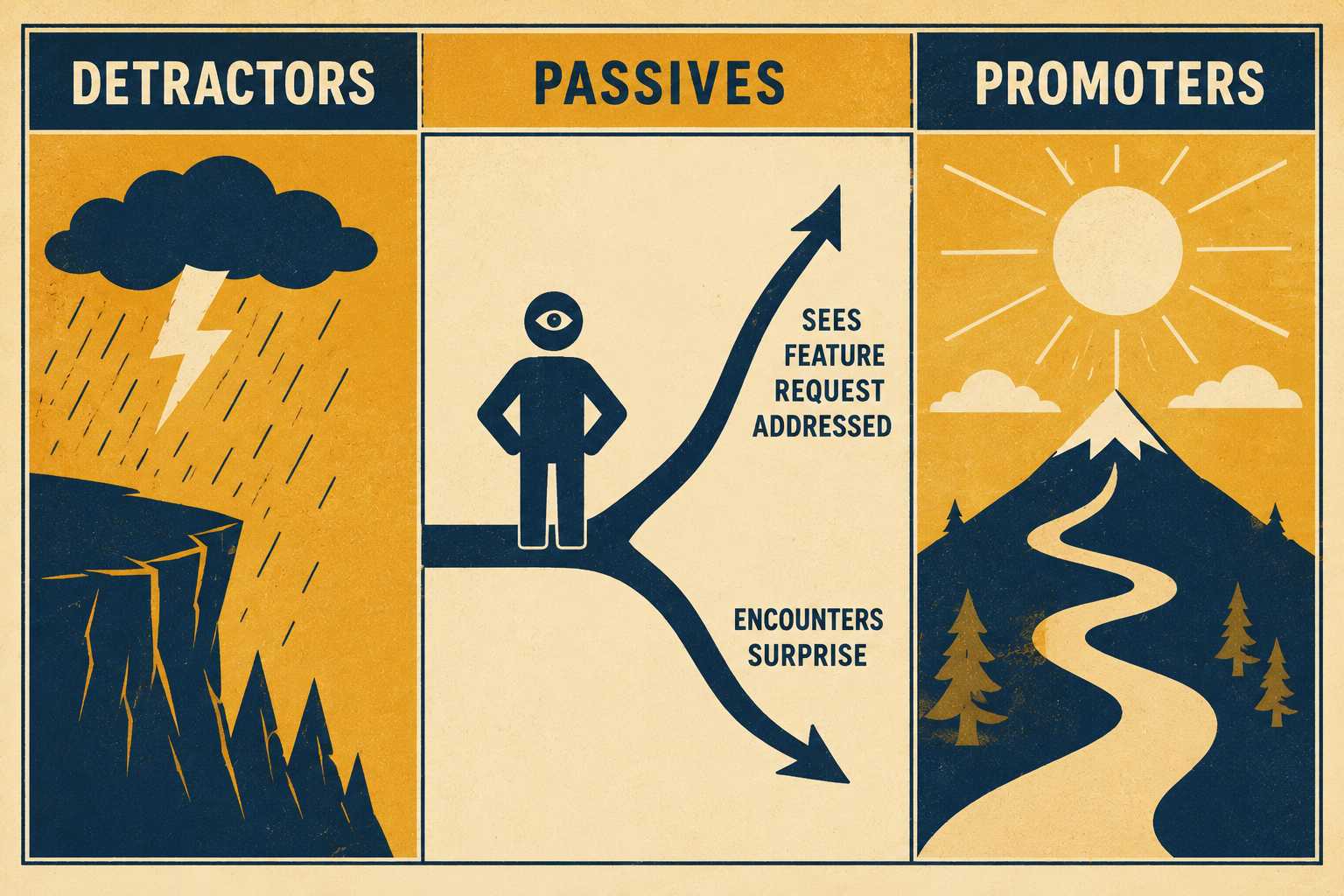
When a user submits a feature request and three months later sees a changelog entry that directly addresses it, something shifts. The relationship stops feeling transactional. The product stops feeling like a vendor and starts feeling like a collaborator. That shift is what promoter behavior is made of.
Good release notes do this at scale. They demonstrate product velocity, signal responsiveness, and show customers that their feedback has weight. Intercom has written about the changelog as a primary mechanism for feature awareness and adoption, noting that the goal is not just to announce changes but to inspire customers to use the product in more powerful ways. That is the passive-to-promoter lever in practice.
What Promoters Need from You
Promoters do not need to be convinced. They are already advocates. What they need is material.
In B2B software, the person using the product is rarely the person renewing the contract. Promoters are internal champions. They are making the case to their CFO, their VP of Engineering, their procurement team. A well-maintained changelog is their evidence. It shows that the product is actively developed, that the team ships consistently, and that the investment is compounding over time.
Documentation quality has a measurable effect on perceived product quality. A 1996 IEEE study of over 500 hardware customers found that satisfaction with documentation played a critical role in explaining overall satisfaction with the primary product. The same dynamic applies to release notes. Sloppy, inconsistent, or absent changelogs signal that the team does not care about the customer experience. Thorough, well-written ones signal the opposite.
This is the ammunition promoters use when they are selling your product internally. Give them something to point to.
The Anti-Patterns That Undo All of This
The failure modes in release note writing are as specific as the failure modes in release communication generally.
Writing for engineers when your users are not engineers is the most common one. "Refactored the authentication microservice to reduce latency" is a changelog entry. "Logging in is now twice as fast" is a release note. The difference is not just style. It is respect for the reader's context.
Burying critical changes in low-priority sections is the second. Users scan. If a breaking change is in the fourth paragraph of a minor update announcement, it will be missed. The frustration that follows is entirely avoidable.
Inconsistent formatting is underrated as a trust signal. If one release note is a detailed paragraph with screenshots and the next is a single bullet point with a typo, users notice. SaaS retention research identifies trust and perceived reliability as key intangible factors in renewal intent, distinct from the product's functional value. Sloppy release notes erode both.
Finally, tone. Excessive apology for minor bugs makes the product seem fragile. Owning decisions cleanly, explaining the reasoning, and moving on projects confidence. Users can handle trade-offs. What they cannot handle is uncertainty about whether the team knows what it is doing.
The Operational Problem Nobody Talks About
Most teams know release notes matter. The problem is not motivation. It is bandwidth.
Engineering velocity has increased steadily. The average SaaS team ships far more frequently than it did five years ago. Human writers have not scaled at the same rate. Asking a product manager to manually synthesize pull requests into customer-facing communication for every release is a workflow that breaks under load. It is not a sustainable model.
The teams that maintain quality and cadence are the ones that have built structure into the process. When commit messages follow a consistent format and pull requests include a required "user impact" field, the raw material for release notes is generated as a byproduct of writing code. The drafting becomes a translation problem rather than a research problem. That is a solvable problem.
The remaining challenge is the translation itself: taking technical data and turning it into communication that serves the customer without losing accuracy or voice. That requires a system with human oversight built in, not bolted on afterward.
Doc Holiday is built for exactly this. It pulls from engineering systems to generate release notes, changelogs, and customer-facing update communications, and it gives the technical writer or product manager a structured review layer to validate output, catch edge cases, and maintain voice consistency before anything reaches the customer. The goal is not to remove human judgment from the process. It is to make human judgment the last step rather than the only step.