Coordinating Multi-Team Release Notes: A Practical Playbook


It is Friday afternoon. The backend infrastructure team just shipped a major authentication refactor. Simultaneously, the frontend product team deployed a new dashboard that depends on those authentication changes. Both teams merged their code. Both teams updated their internal trackers. Now, someone—likely a product operations lead, an engineering manager, or a senior technical writer—has to produce a single, coherent release note that explains what just happened to users, support, and marketing.
This scenario is not unusual. It is the default operating condition for any organization running multiple product teams on independent sprint cycles. DORA's research, drawing on over 39,000 professionals across a decade of study, consistently shows that high-performing engineering organizations deploy frequently—sometimes multiple times per day. At that cadence, release windows overlap constantly. The question is not whether your teams will ship in the same week; it is whether you have a system to handle it when they do.
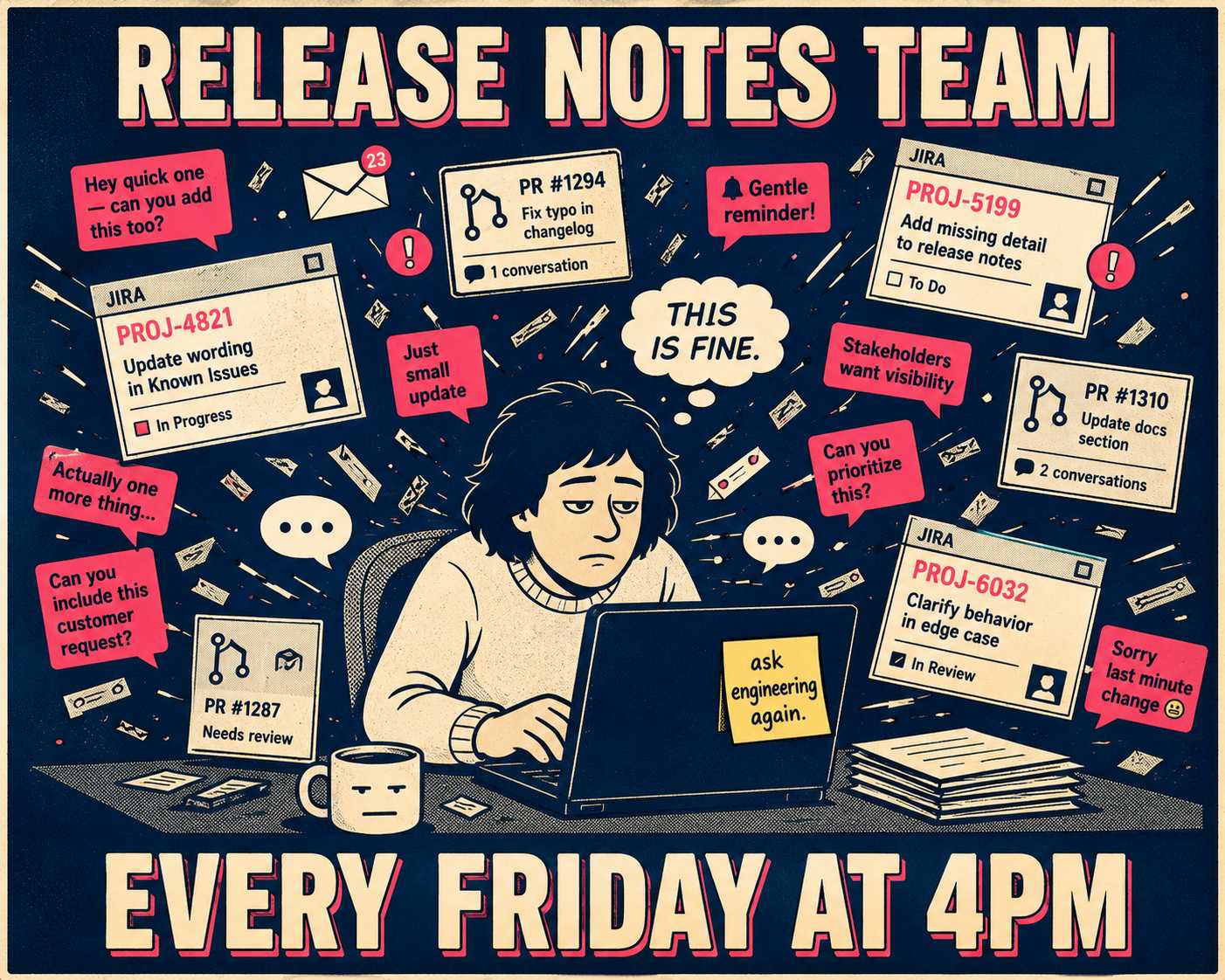
The complexity of multi-team release notes is not a failure of individual engineers. It is a predictable structural outcome. As Martin Fowler explains in his analysis of Conway's Law, organizations naturally produce systems—including communication systems—that mirror their internal structure. Two teams with separate backlogs and separate sprint rhythms will produce separate changelogs. That is not a bug; it is how autonomous teams stay productive. The friction emerges at the integration point: when someone has to synthesize those separate changelogs into a single, coherent document for the outside world.
This article provides a structured, operational playbook for handling multi-team release notes that go live in overlapping timeframes. Not theoretical advice—a system you can implement immediately.
Why This Is Actually Hard
It is tempting to treat multi-team release coordination as a simple editing task. It is not. The challenges are structural, and they compound quickly.
The most common starting point is that teams use different tools and different conventions to describe their work. One team might rely on detailed Jira tickets, while another uses brief pull request titles. A comprehensive analysis of 1,529 release note issues on GitHub found that the production dimension—automating and standardizing the release note process—accounts for nearly 47% of all issues developers encounter. The second-most-common problem is content completeness: producers are more likely to omit information than to include incorrect details, especially for breaking changes.
Formatting inconsistency compounds this. One team labels a change a "Feature," another calls a similar change an "Enhancement." One team lists breaking changes at the bottom; another buries them in the middle. When you combine two changelogs written in different dialects, the result reads like a document translated twice.
Then there is the overlap problem. When two teams both touch authentication—one refactoring the backend service, one updating the login UI—their changelogs describe different aspects of the same user-facing change. Publishing both entries creates duplication and confusion. Choosing one over the other creates internal friction.
Ownership is often the most overlooked issue. The Good Docs Project's release notes template guide notes that while many teams contribute to release notes, they must have a single owner—and that ownership can vary widely by organization. Without a designated owner, the task defaults to whoever is most willing to do it, which is rarely the same person twice. The result is inconsistent quality and, eventually, burnout.
Finally, different stakeholders need different information from the same release. Support needs to know about bug fixes and workarounds. Marketing wants to highlight new capabilities. Engineering cares about breaking changes and migration paths. Internal release note guides from practitioners consistently identify this audience fragmentation as one of the highest-friction points in release communication. Trying to serve all of these audiences in a single document without a clear structure is how you end up with a release note that satisfies no one.
The Decision Framework: One Note or Two?
The first decision is whether to publish a unified release note or separate notes for each team. There is no universal answer, but there are clear criteria.
A unified note makes sense when the changes are tightly coupled or affect the same user workflows. If the frontend and backend teams collaborated on a single feature—say, a new OAuth2 login flow—a single note provides the clearest experience for the user. Unified notes are also preferable when the overall volume of changes is low, since separate notes can feel artificially fragmented.
Separate notes make sense when teams operate genuinely independent products or services with distinct user bases. A developer API and a consumer-facing mobile app may share infrastructure, but their users have different contexts and different stakes in any given release. In that case, separate notes are appropriate—but even then, cross-functional dependencies must be explicitly called out in both documents.
The key question is not "which team shipped more?" but "does the user experience these changes as one thing or two?" That answer should drive the structure.
Structure by Function, Not by Team
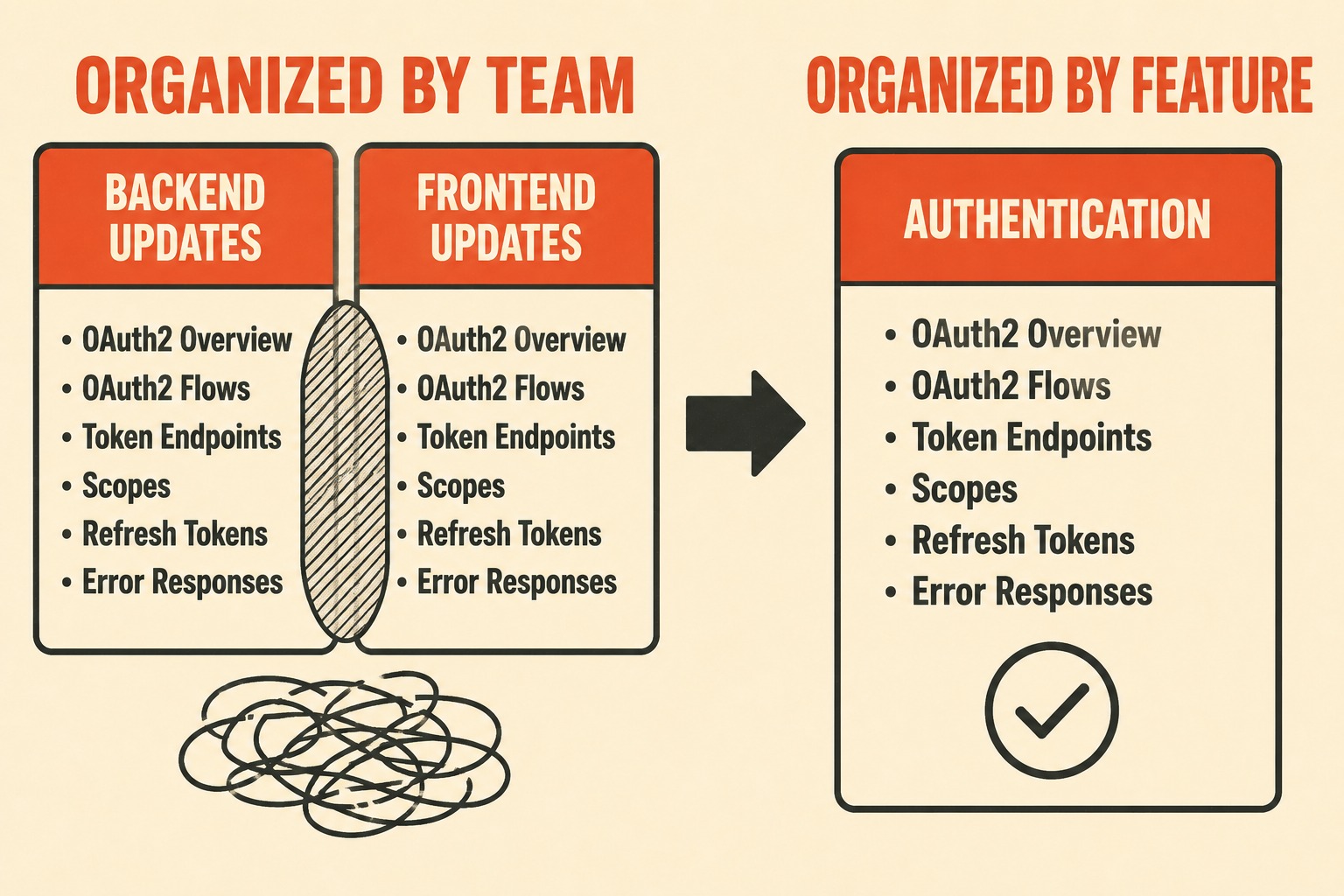
When creating a unified release note, the most important structural decision is to organize by feature area rather than by team. Users do not care about your internal organizational chart; they care about how the product works. Team Topologies research emphasizes that stream-aligned teams should own outcomes, not just outputs—and the release note is an output that should reflect user outcomes, not team boundaries.
Instead of sections titled "Backend Updates" and "Frontend Updates," use categories like "Authentication," "Dashboard," and "API." This approach naturally deduplicates overlapping changes. If both teams touched authentication, their updates can be combined into a single, coherent narrative under the "Authentication" heading. The focus shifts from "who did what" to "what the user can do now," which also helps defuse the internal politics of whose work gets top billing.
What to Collect Before You Write
Effective release notes require more than a list of pull request titles. Before drafting begins, collect specific metadata from each team. The Conventional Commits specification provides a useful model here: it structures commit messages to explicitly distinguish features (feat:), bug fixes (fix:), and breaking changes (BREAKING CHANGE:), making downstream changelog generation significantly more reliable.
Adapt that logic into a metadata collection checklist for your teams:
Collecting this metadata upfront eliminates the frantic, last-minute clarification requests that delay publication and frustrate engineers who have already moved on to the next sprint.
Assigning Ownership That Actually Holds
A release note process without clear ownership is a process that will fail under pressure. The Good Docs Project recommends designating a single owner who coordinates input from multiple contributors. In practice, that means four distinct roles:
The collector gathers inputs from the various teams using the shared metadata schema. This is often a product operations lead or a technical project manager. The consolidator drafts the unified note, ensuring consistent tone, structure, and deduplication. This is typically a technical writer or a senior product manager. The validator reviews the draft for technical accuracy—engineering leads from the involved teams, not asked to rewrite the document but to confirm that nothing is wrong or missing. The final approver has the last word before publication. This should be a single, designated individual; approval-by-committee is how release notes get stuck in revision loops for days.
The Shared Changelog Schema
Consistent metadata collection only works if all teams describe their changes in the same format. The Keep a Changelog standard, widely adopted across the open-source ecosystem, provides a practical taxonomy: Added, Changed, Deprecated, Removed, Fixed, and Security. The Common Changelog style guide extends this with a useful rule: breaking changes should be prefixed in bold with Breaking: and sorted before other changes within their category.
Provide teams with concrete examples, not just category names. The difference between a useful entry and a useless one is specificity. "Fixed an issue with authentication" tells a reader nothing. "Fixed an issue where OAuth tokens expired prematurely under heavy load when concurrent requests exceeded 50 per second" tells them exactly whether this fix is relevant to their situation. That level of specificity is what separates a release note that reduces support tickets from one that generates them.
Version Numbering When Two Teams Shipped
Version numbering becomes complicated when multiple teams ship simultaneously. Semantic Versioning 2.0.0 is clear on the rules: increment the major version for backward-incompatible changes, the minor version for new backward-compatible features, and the patch version for backward-compatible bug fixes. The version number is a contract with your users, and violating it—shipping breaking changes in a minor release, for instance—erodes trust quickly.
When combining releases, the version number of the unified note must reflect the most significant change across all teams. If one team ships a bug fix and another ships a breaking API change, the unified release is a major version bump, full stop. This is non-negotiable from a technical standpoint. Where marketing versioning diverges from technical versioning—as it sometimes does in consumer products—that distinction should be handled in the communication layer, not by misrepresenting the technical version.
Surfacing Breaking Changes and Cross-Team Dependencies
Breaking changes deserve their own section at the top of the release note—not buried after the feature announcements. Research into release note production consistently finds that producers are more likely to omit breaking change information than any other category. When a breaking change is undocumented, the consequences are not minor: builds break, production systems fail, and engineers spend hours debugging changes they did not know were coming.
Cross-team dependencies require the same level of explicitness. If the frontend dashboard requires the new backend API to function, the release note must state this clearly. If a deployment is staggered—the backend ships Monday, the frontend ships Wednesday—users and operators need to know what state the system will be in during that window. This transparency is not just good documentation practice; it is how you prevent support tickets and maintain trust with technical users.
Deconflicting Overlapping Changelogs Without Forcing Rewrites
When two teams submit changelogs that touch the same feature, the consolidator's job is to synthesize, not to adjudicate. Do not ask teams to rewrite their original entries. Instead, use their entries as raw material.
If one team writes "Updated the auth service to support OAuth2" and another writes "Added OAuth2 login buttons to the login page," the consolidated note should read: "Added OAuth2 support for user authentication, including updated backend services and new login page integration." Both contributions are represented. Neither team had to redo work. The user gets a coherent narrative.
This synthesis approach also handles the internal politics more gracefully than any other method. Teams want credit for their work, and they should get it—but credit in a release note is not a byline. It is the accurate representation of what changed and why it matters. A well-synthesized entry that accurately describes both teams' contributions is more respectful of their work than a fragmented two-part entry that forces the reader to mentally combine them.
The Consolidation Workflow in Practice
The consolidation process should not require synchronous all-hands meetings. When both teams have already shipped, the workflow runs as follows: the designated collector pulls the standardized metadata from each team's tracking tools—this should take minutes, not hours, if the schema was followed. The consolidator drafts the unified note, structuring it by feature area and synthesizing overlapping changes. The draft is shared asynchronously with the engineering leads, who are asked only to verify technical accuracy and flag any missing breaking changes—not to rewrite the document. The final approver signs off, and the note is published.
The entire process, when the schema is in place and ownership is clear, should take a few hours at most. The reason it currently takes longer in most organizations is not that the work is inherently complex; it is that the inputs are inconsistent and the ownership is unclear. Fix those two things, and the rest follows.
Making This the Default, Not the Exception
The operational complexity described here—changelog collection, deduplication, consolidation, schema alignment—is a predictable outcome of decentralized development workflows. It is not a sign that your teams are failing; it is a sign that your organization is scaling. The goal is to build a system that treats multi-team weeks as a normal operating condition rather than a one-off scramble.
Doc Holiday generates release notes directly from engineering activity, applying consistent structure and categorization regardless of which team shipped when. For organizations managing overlapping release cycles, that structure provides a foundation for validation and review without manual consolidation overhead. The result is a unified release note that accounts for both teams' work without confusion, duplication, or the political fallout that comes from an ad hoc process. The playbook above gives you the framework to get there; the right tooling makes it sustainable.