How to Automatically Sync Productboard Features Into Release Notes


A product team spends three months defining a feature in Productboard. They write customer-centric descriptions, they map out the target audience, and they tag it to a specific release version. The engineering team builds it. The deployment goes out on a Tuesday afternoon.
On Wednesday morning, the product manager opens a blank document to write the release notes. They stare at the ticket trackers, trying to remember what the customer-facing benefit of "Refactored the authentication middleware" was supposed to be.
This is the reality for most product teams. The strategic intent lives in Productboard. The code lives in production. The release notes sit somewhere in between, usually constructed by manually copying and pasting information that was already written down somewhere else. By the time features ship, someone has to manually translate roadmap language into customer-facing updates, and that translation step introduces delay, inconsistency, and the risk that what shipped does not match what was promised.

The operational cost of this lag is measurable. Poor documentation practices cost mid-sized engineering teams $500K to $2M annually in lost productivity and context switching. When documentation trails deployment, support teams field preventable tickets. Product managers become human routers for basic questions.
Teams that sync this workflow automatically ship release notes faster and avoid the "what actually changed?" scramble after every deploy.
The Mechanical Failure of Manual Handoffs
Product teams use Productboard to track what is being built and why. Engineering teams ship code. Release notes need to reflect both the strategic intent captured in Productboard and the actual implementation that went out.
Manual handoffs create three specific failure modes.
First, features ship but do not make it into the notes. An engineer pushes a minor improvement that was not strictly part of the sprint plan. It goes live, but because it was not on the product manager's radar, it goes undocumented.
Second, features get noted but do not actually ship. A feature gets pulled from the release at the last minute because of a failed test, but the release notes were drafted two days ago and nobody remembers to update them.
Third, the notes are vague summaries that do not match what users will actually experience. "General bug fixes and performance improvements" is not a release note. It is a placeholder that signals someone ran out of time or patience.
A large-scale empirical study of 32,425 release notes found that producing them is a collaborative, time-consuming task that varies wildly depending on the stakeholders involved. The most common failure is that notes are written for the people who built the software, not the people who use it.
The instinct is to force product managers to write release notes faster. However, they are bottlenecked by the need to extract information from systems they do not control.
What an Automated Sync Workflow Actually Looks Like
The solution is not to change the culture. The solution is to change the system.
An automated sync workflow treats release notes as a byproduct of the existing product management process.
Start with the Productboard side. Features are already tagged with release metadata: target version, status, and a customer-facing description.
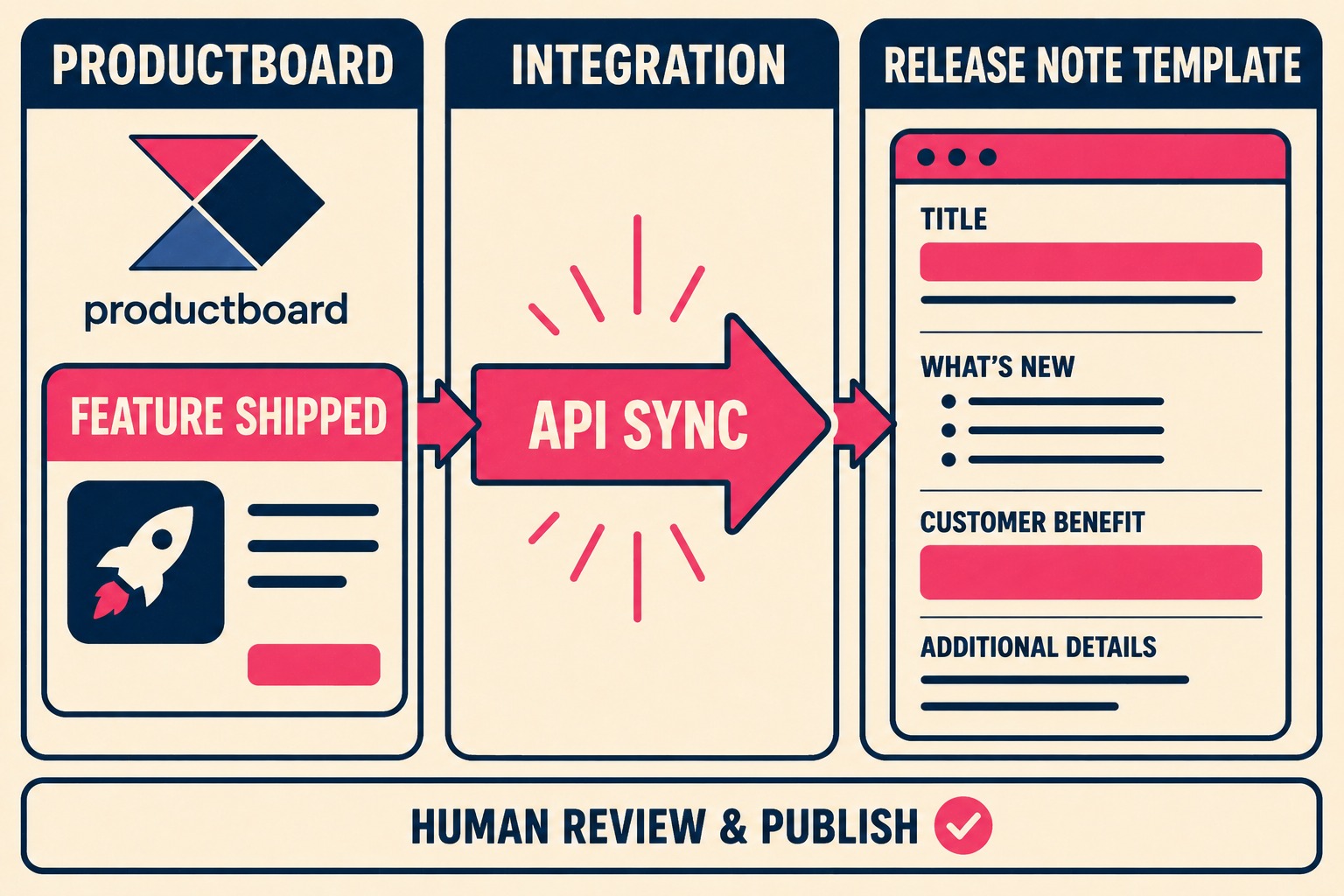
The integration layer watches for status changes in Productboard (like "shipped" or "released"). When a status changes, the system pulls the relevant feature data via the Productboard Features API and routes it into a structured release note template.
The output is a draft that includes the feature name, the user-facing benefit, and any context the product team already wrote. It is not a perfect final document. It is a starting point that is mostly complete and factually accurate.
A technical writer or product manager then reviews the draft. They adjust the tone for the audience, add examples or screenshots if needed, and publish. The automation removes the data-gathering step, not the judgment step.
The Friction of Building It Yourself
Connecting Productboard to a release notes system requires deciding how to map Productboard's internal structure onto customer-facing categories.
Productboard uses features, components, and releases. Customer-facing release notes use categories like new features, improvements, and fixes. You have to build the logic to translate between the two.
You also need logic to handle edge cases. What happens when a feature spans multiple releases? What happens when a feature gets pulled at the last minute? What happens when a feature affects different customer segments differently?
Most teams either hardcode these rules into a script that breaks whenever the roadmap structure changes, or they give up and go back to manual updates.
The Requirements for a Production-Ready Workflow
A production-ready version of this workflow handles Productboard's release and feature schema without custom mapping for every new product area.
It lets you define templates that match your release note style, whether that is a changelog, a feature announcement email, or a What's New page.
It gives you a validation step so a human can review what is about to go out and catch anything the sync missed.
It updates in near-real-time so your release notes reflect the current ship state, not the state from three days ago when someone last ran the export script. The 2024 DORA State of DevOps Report found that elite engineering teams deploy on demand, with changes taking less than a day to move through the pipeline. Release communication needs to operate at that same speed.
The Operational Unlock
When a feature ships in Productboard, Doc Holiday pulls the metadata, applies your release note structure, and produces a formatted draft that preserves product intent while translating it into customer-ready language.
The output includes the feature description, the user benefit, and the relevant context, all pulled directly from the single source of truth. A product manager or technical writer then validates the draft, adjusts for clarity or tone, and publishes.
The structure ensures that what goes out matches what actually shipped, without forcing someone to manually cross-reference the roadmap, the ticket tracker, and the deploy log. For teams operating with reduced headcount or no dedicated release comms function, this gives one person the ability to maintain accurate, timely release notes at the speed the engineering team actually ships.
The goal is not to eliminate human judgment from release notes. It is to eliminate the manual data-gathering work that delays publication and introduces errors. Productboard already contains the canonical record of what was built and why. The right sync workflow gets that information into release notes automatically, so the humans involved can focus on clarity, messaging, and making sure what goes out actually helps users understand what changed.