How to Announce a SaaS Price Increase in Release Notes Without Triggering a Support Avalanche


It is Tuesday morning, and your product team just pushed the latest release notes live.
Between a minor bug fix for the analytics dashboard and an update to the API rate limits, there is a single sentence: "We are updating our pricing tiers to better reflect the value of the platform." It links to a pricing page where the numbers are 30 percent higher than they were yesterday.
By noon, the support queue is overwhelmed. Three enterprise accounts have emailed their customer success managers asking to cancel. A mid-market customer has posted a screenshot of the release notes on social media, calling it a bait-and-switch.
This is what happens when you treat a pricing change like a feature update.
You have already decided to raise prices. You do not need a debate about the macroeconomic environment or a pros-and-cons analysis of margin expansion. You need a tactical blueprint for how to write the announcement, where to put it, and how to frame it so customers understand the value exchange rather than just seeing a bigger number.
Pricing changes are among the most consequential communications a software company publishes. The stakes are high. Bad framing triggers cancellations. Good framing preempts objections and positions the increase as tied to real product improvements. The release notes or changelog is often where customers see it first, which makes the execution of that specific document critical.
When to Tell Them
Timing is the first variable you control, and it is also the easiest one to get wrong.
The standard advance notice window for B2B SaaS is 30 to 90 days. For annual subscribers, 90 days is the baseline. It covers most enterprise procurement cycles and respects budget planning timelines. For monthly subscribers, 30 days is the absolute minimum. Enterprise contracts with custom terms sometimes require 180 days or more, so check your agreements before you set the announcement date.
Less than 30 days is not a process gap. It is a trust violation.
When a core tool increases pricing by 60 percent with only 30 days of notice, customers feel trapped. They do not have time to evaluate alternatives. They pay the higher price, but they begin looking for an exit. The churn you were trying to avoid shows up six months later, at renewal, when the customer has had time to shop around.
On the question of whether to put the pricing change in the same release note as feature updates: keep them separate. Bundling a price increase with a feature launch dilutes both messages. The feature launch gets overshadowed by the pricing news. The pricing announcement gets lost in the feature list. Neither serves the customer well. A standalone pricing announcement signals that you are treating this as a significant business communication, not a footnote.
You should send three emails. An announcement at day zero. A reminder at day 60. A final notice at day 83. The release notes entry should go live on the same day as the first email, so the public record and the direct communication are synchronized.
Framing the Why, and the Difference Between Strong and Weak
The most common mistake in pricing announcements is vague corporate language. "Continued investment in our platform" means nothing to a customer whose bill just went up.
You have to connect the price increase to tangible improvements the customer is already receiving.
When Notion shifted its pricing model and eventually raised its Business tier from $15 to $20 per user, they tied it to the inclusion of advanced features and the broader rollout of their AI capabilities. They did not apologize. They explained what the product could do now that it could not do before. The announcement was confident, not defensive.
Slack took a similar approach when they rolled out their first major pricing change. They raised the per-user price, but they paired the announcement with a simplification of their free plan and expanded access to new features. They also offered to extend existing rates for customers who renewed early for another year. The value exchange was clear, and the loyalty incentive gave customers a reason to act rather than cancel.
The contrast with Mailchimp's 2019 pricing overhaul is instructive. They changed how audiences were defined, starting to charge for unsubscribed contacts. The average list size increased by 23 percent, driving up costs significantly for many users. The backlash was immediate because the price increase felt punitive, not additive. It was a structural change disguised as an update, and the framing did nothing to explain the value customers were receiving in return.
The Netflix 2011 pricing debacle is the canonical example of what happens when framing fails entirely. Netflix raised prices by 60 percent and announced plans to split its DVD and streaming services into separate companies, but they never explained the strategic rationale clearly. They lost 800,000 subscribers in a single quarter and their stock dropped 77 percent in four months. The CEO later publicly acknowledged the failure of communication. The price increase itself was defensible. The framing was not.
Strong opening sentences for a pricing announcement are direct and value-led. Weak ones are apologetic or abstract. The table below illustrates the difference:
The weak versions are not just bad writing. They are signals that the company is not confident in the decision. Customers read that signal and respond accordingly.
The Grandfathering Decision
Every price increase forces a decision about existing customers. Do they stay on their current pricing, or do they move to the new tiers?
Grandfathering honors the old price for early customers. It builds loyalty and prevents immediate churn. It also creates a permanent drag on revenue and introduces significant complexity into billing systems. Maintaining multiple pricing tiers for different customer cohorts is administratively expensive, and it creates confusion in support when customers on different plans compare notes.
There is a middle path.
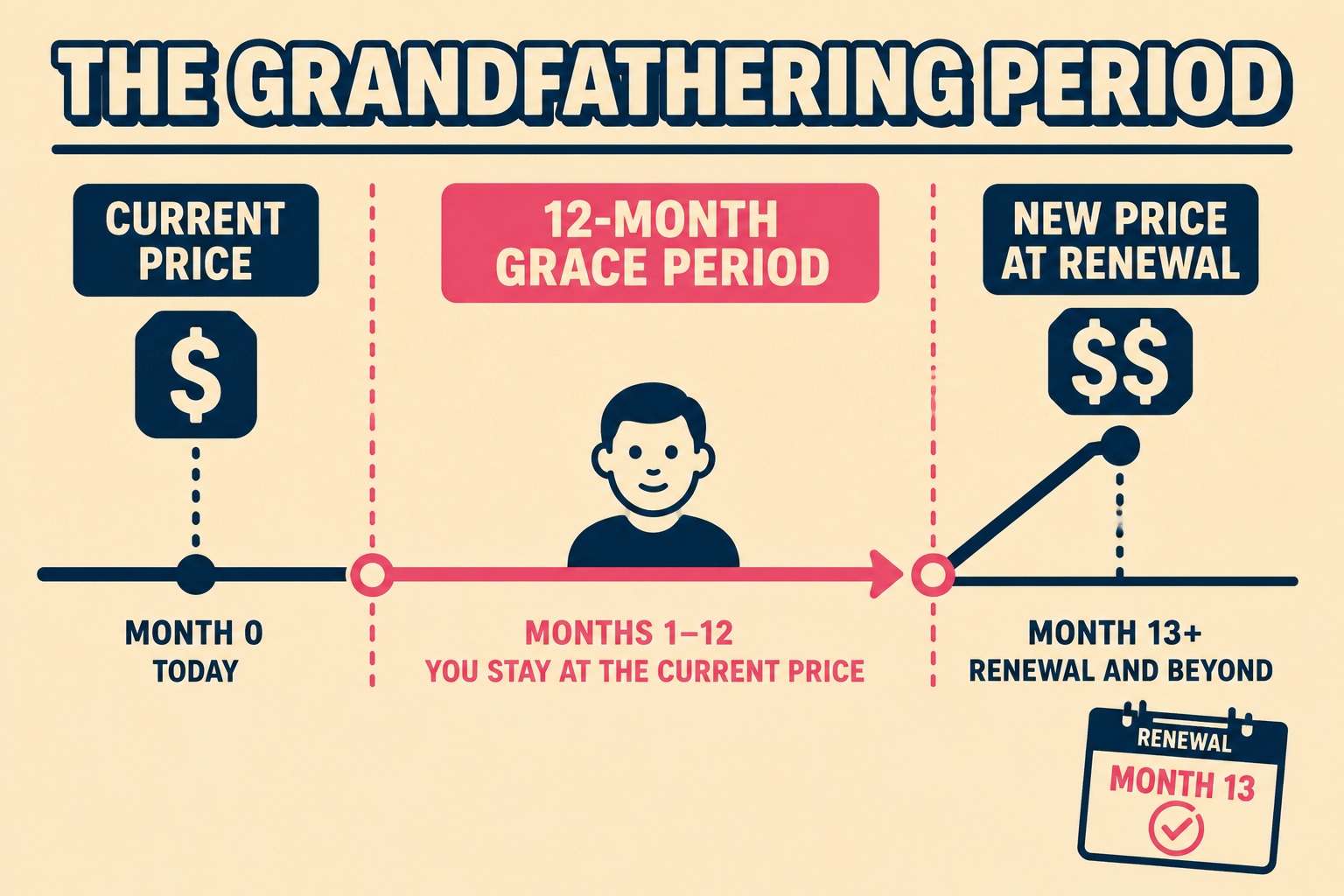
For significant increases (roughly 20 to 40 percent), a time-limited grandfather period is often the most effective structure. Existing customers keep their current price for 12 months from the announcement date, then transition to the new price at renewal. This gives customers a full budget cycle to plan for the new cost. It creates urgency without pressure. And it avoids the long-term complexity of permanent grandfathering while still generating goodwill.
If you choose to migrate existing customers immediately, segment the communication. A 10 percent increase for a small account requires a clear email. A 40 percent effective increase for an enterprise account requires a phone call from a customer success manager before any email goes out. Accounts that receive a personal call before the announcement email have significantly lower churn rates on price increases than accounts that learn about the change through email alone.
A few objections will come up regardless of how well you communicate. Customers on annual contracts who face a mid-term price increase need a clear answer about whether the new pricing applies at renewal or immediately. Nonprofits and educational institutions often have custom pricing arrangements that require individual outreach. Enterprise accounts with negotiated deals need their account executives involved before the announcement goes live. These are not edge cases. They are predictable, and they should be addressed in a linked FAQ rather than forcing customers to contact support to find out where they stand.
The Problem with the Changelog
Release notes are a high-trust surface. Technical users and budget holders go there to track product changes. They assume what is there is accurate and complete.
This makes them a powerful channel for pricing announcements, but only if you use that trust carefully.
You cannot bury a pricing change in a feature list. When you hide a price increase in changelog prose, you signal that you are ashamed of it. You break the trust that makes release notes valuable in the first place. Customers who discover the change by accident, rather than through a direct announcement, feel deceived. That is a worse outcome than the price increase itself.
Companies that handle continuous change well treat their release notes as structured communication. Atlassian moved to highly structured release notes specifically to build trust with users during continuous product updates. Their research showed that 50 percent of administrators felt they had inadequate information about product changes. Structured, predictable release notes reduced that gap and increased engagement by 300 percent.
Pricing announcements require the same editorial oversight. They are business decisions, not engineering outputs. Most automated release notes generators pull from product data and commit history. A pricing change does not appear in a commit. It needs to be injected manually, with clear fields for the effective date, the affected tiers, the rationale, and the next steps.
The announcement should include a comparison table showing old and new pricing, a link to the updated pricing page, and a link to a dedicated FAQ. Do not force customers to hunt for details. The release notes entry should be self-contained enough that a customer who reads it knows exactly what is happening to their account, when, and what to do if they have questions.
Most companies do not execute pricing changes often enough to build institutional muscle memory. It is a high-stakes, low-frequency event. When the time comes, product and finance teams often scramble to draft the communication from scratch, with no template, no coordination with customer success, and no pre-drafted response templates for the support team. The first 48 hours after publication are the most critical. Inbound volume spikes. Support teams need to be briefed before the announcement goes live, not after.
A well-designed documentation system solves this by maintaining a reusable pricing announcement template integrated with the regular release notes workflow. This ensures consistency across every pricing change, regardless of which team member is drafting it.
Doc Holiday generates structured release notes from engineering activity and allows editorial teams to inject manual entries, like pricing changes, into the same validated pipeline. This creates a single source of truth for customer-facing updates, whether those updates come from code commits or CFO decisions, with the same editorial oversight and support team coordination built in.