AI-Aware Commit Message Conventions for Engineering Teams


You are staring at a git log that looks immaculate. Every message starts with a neat feat: or fix:. The capitalization is consistent. The line lengths are perfect. Commitlint would give it a gold star.
Then a subtle bug takes down the checkout service. You run git blame, find the commit that introduced the flaw, and read the message: fix(checkout): update validation logic for edge cases.
That is a perfectly formatted, entirely useless sentence. It tells you what changed, which you already knew from the diff. It tells you nothing about why it changed, what edge cases were considered, or whether the developer who merged it fully understood the code. In an era where a significant percentage of production code is drafted by GitHub Copilot, Cursor, Claude Code, or any number of other AI tools, this lack of context is not just inconvenient. It is a structural problem.

We are using commit conventions designed for a 100% human-authored world to manage a codebase that is increasingly machine-generated. 41% of all code is now AI-generated or AI-assisted, with 82% of developers using AI tools weekly. The conventions have not caught up.
The solution is not to abandon structure. It is to adapt it. Commit conventions in an AI-assisted environment must capture not just what changed, but where the suggestion came from, what alternatives were discarded, and what assumptions were baked in before the merge.
A Log Full of Perfect, Useless Commits
Traditional commit message conventions were designed around a simple premise: the developer who wrote the code understands it, and the commit message is their chance to explain their reasoning to future readers. That premise breaks down when the code was drafted by a model.
An AI coding assistant can generate a complex refactor or introduce subtle logic changes in seconds. A developer, pressed for time, might review the suggestion, see that the tests pass, and merge it. The diff shows the new logic. The AI-generated commit message summarizes the syntax changes. But the commit log, the only durable record of why a change was made, is silent on the rationale.
This is the core problem. AI tools optimize for functional correctness, not historical context. They do not know your business constraints, your tech debt, or the architectural tradeoffs your team debated in a Slack channel that no longer exists. When a future maintainer encounters an edge case six months later, they need to know if the code was a deliberate architectural decision or just the first suggestion an LLM offered that happened to compile.
The commit message is the only place that distinction can live.
There is also a compounding problem. As AI tools generate more code, the volume of commits increases. More code ships faster. Pull requests per author increased 20% year-over-year, while incidents per pull request rose 23.5%. More code is shipping, and more of it is breaking. The commit log is the one artifact that could help teams understand why, but only if it was written to capture that information in the first place.
What the Diff Can't Tell You Anymore
There are two things that become far more important in an AI-assisted workflow: attribution and rationale.
Attribution is not about blame. It is about signal. If a piece of code was generated by a model, it may contain hidden assumptions, hallucinated dependencies, or insecure patterns inherited from the model's training data. AI-generated code introduced over 10,000 new security findings per month across repositories studied by Apiiro, with architectural design flaws spiking 153%. Future maintainers need to know how much scrutiny a change received. A commit that was AI-suggested and then carefully reviewed by a senior engineer carries different weight than one that was AI-suggested and merged in thirty seconds.
Rationale is the harder one. AI tools summarize what changed. They do not document why you accepted it. The human developer must capture that reasoning. Why was this approach chosen over alternatives? What constraints drove the decision? What assumptions is the code making? If an AI tool suggested a complex regex or a database optimization, what made it worth accepting?
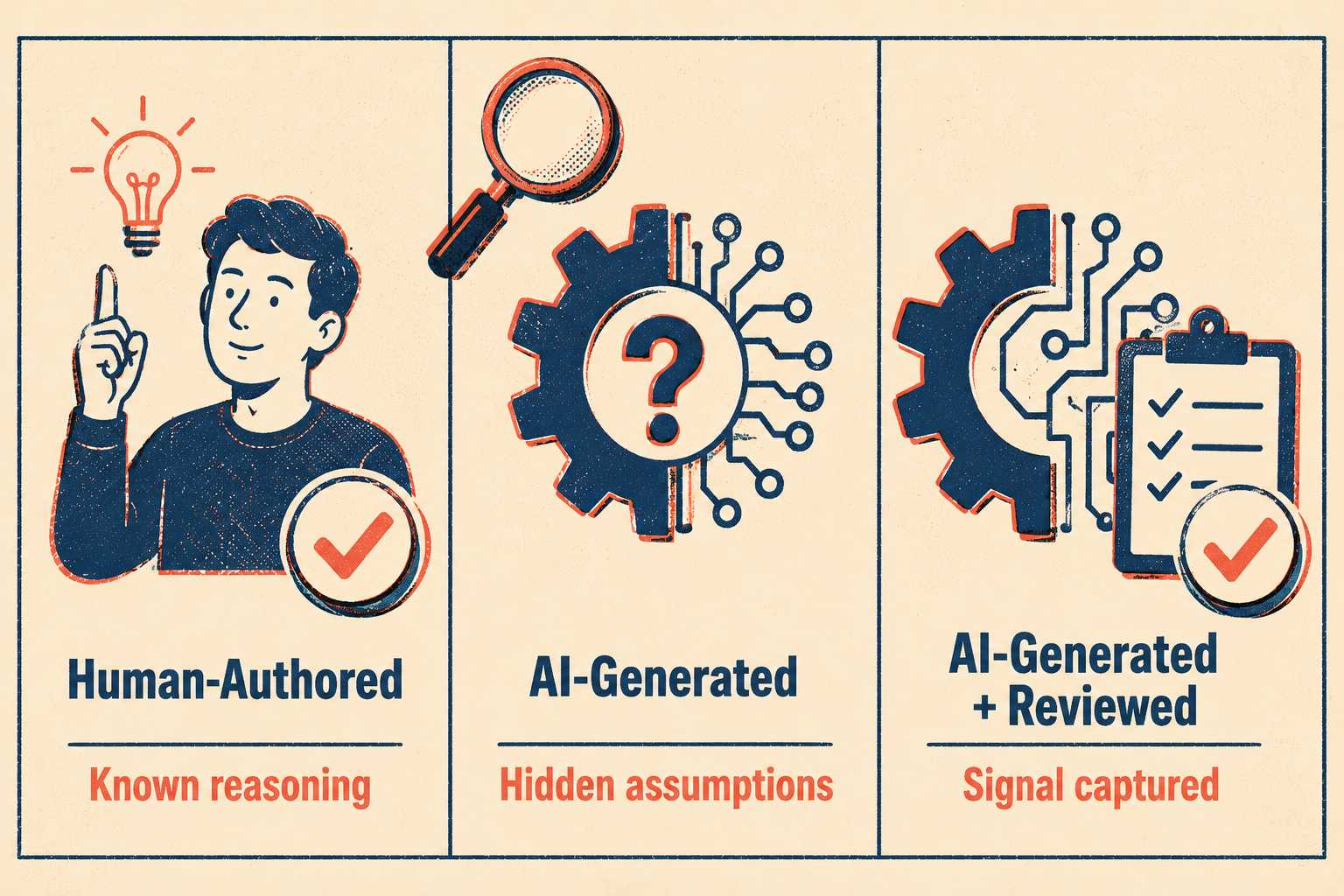
The commit message should reflect the developer's judgment, not just the tool's output. That is the part that cannot be automated.
One developer who has thought carefully about this problem put it plainly: the point of a commit message is to capture intent, not to merely summarize the content of the commit. AI cannot infer intent. It can only describe what changed, not why it changed.
The Limits of Conventional Wisdom
Semantic commit formats still work. They provide a necessary baseline for automation and changelog generation. But they need extension.
A type like feat: or fix: is insufficient on its own. It does not tell you if the code was fully understood before it was merged. It does not tell you if the change was AI-suggested or human-authored. It does not tell you what edge cases were validated.
The good news is that the Conventional Commits specification is designed to be extended. The footer section supports custom trailers using the git trailer format, and the community has started converging on patterns for AI attribution. One approach is a dedicated Coding-Agent: trailer for the tool and a Model: trailer for the specific LLM identifier — far more useful than stuffing a generic noreply email into a Co-Authored-By line, which was designed for human collaborators and was never meant to track machine-generated code.
The distinction matters for practical reasons. The same underlying model can run behind Claude Code, Cursor, Windsurf, or a fully custom agent, each with different system prompts and behaviors. Capturing both the tool and the model gives future maintainers the two dimensions they actually need to understand the context of a change. If a specific version of a model had a known tendency to hallucinate certain patterns, you want to be able to query your commit history for that.
You can also add inline markers to the body of the commit message itself. Tags like [ai-assisted], [ai-suggested], or [human-validated] provide immediate context for reviewers scanning the log. They are lightweight enough to not feel like overhead, but meaningful enough to change how a future maintainer approaches a piece of code.
The Ghostty open source project went further, requiring contributors to disclose all AI tool usage and confirm that the human contributor fully understands every line before submission. That level of rigor may not fit every team's workflow, but it illustrates the direction the industry is moving. The question is not whether AI attribution will become standard practice. It is whether your team will establish the convention proactively or reactively.
How to Actually Capture Intent
The "why" field is the most important part of an AI-aware commit message, and it is the part that AI tools cannot write for you.
A developer who accepts an AI suggestion is making a judgment call. They are deciding that this approach is better than the alternatives, that the code is correct for the specific context, that the edge cases have been considered. That judgment is the thing worth preserving. The commit message is where it lives.
In practice, this means the body of the commit should answer a few specific questions. What problem was this change solving? Why was this particular approach chosen over other options? What constraints shaped the decision? What was validated before the merge? If the code touches a security-sensitive path, an external API, or a performance-critical section, that should be flagged explicitly.
This is not a request for an essay. Two or three sentences of genuine context are worth more than a paragraph of AI-generated summary. The goal is to give a future maintainer enough information to understand the decision without having to reconstruct it from scratch.
A diff tells you what changed, but only the commit message can tell you why. In an AI-assisted workflow, that asymmetry becomes more pronounced, not less. The developer's judgment is the irreplaceable part. The code itself is increasingly interchangeable.
When the Bots Do the Heavy Lifting
Bulk AI-generated changes require different rules. When an AI tool refactors 50 files to update a dependency, enforce a formatting standard, or migrate an API, requiring a detailed rationale for every individual file change will not scale. And it should not have to.
The answer is a separate commit type or tag for automated bulk changes. Define something like chore(ai-refactor): or auto: in your convention, and use it consistently for changes where the AI was operating autonomously rather than assisting a human developer. The body of these commits should document the tool used, the specific prompt or configuration settings, and the scope of the change. The goal is traceability, not commentary.
If a bulk update breaks the build, you need to know exactly which automated process caused it so you can revert it cleanly. If a security audit flags a pattern introduced by an automated refactor, you need to know which model generated it and under what instructions. A well-structured bulk commit makes both of those investigations possible.
There is also a downstream compliance consideration. The EU's regulatory framework for AI brings transparency requirements into effect in August 2026, and organizations will increasingly need to answer questions about where their code came from. A commit log that distinguishes between human-authored, AI-assisted, and fully automated changes is not just a developer convenience. It is the beginning of an audit trail.
Getting the Team on Board
A convention only works if the team follows it, and a convention that feels like bureaucratic overhead will be ignored within a week.
Enforcement requires tooling. Commitlint, pre-commit hooks, and CI checks can enforce structure, but they must be configured to recognize AI-aware metadata. PR templates should prompt developers to disclose AI assistance and explain their validation process. The key is to make compliance the path of least resistance, not an additional task on top of an already full day.
A commit message template configured in Git's global settings is the simplest starting point. When a developer opens their editor to write a commit, the template is already there with the fields they need to fill in. They do not have to remember the convention. The structure is the prompt. You can set this up with a single git config --global commit.template command pointing to a shared template file in your repository.
For teams that want stricter enforcement, Commitlint with a custom configuration can validate AI-aware trailers in the same CI pipeline that runs tests. A commit that is missing the required body or uses an unrecognized trailer format fails the check before it reaches review. This sounds aggressive, but in practice it creates a fast feedback loop that trains the convention into muscle memory far more effectively than a documentation page anyone can ignore.
Roll out the change gradually. Start with a proposal document and gather feedback before writing a single hook. Pilot the new convention on one team for a sprint or two. Iterate based on real usage, paying attention to where the convention creates friction and where it genuinely helps. Then expand it across the organization.
The objections will come. Someone will say it slows them down. Unclear commits slow the team down later, when debugging an AI-generated edge case at 2 AM with no context in the log. Someone will argue that AI tools already document their changes. They summarize syntax. Someone will claim the team doesn't need this yet. They will, the first time they have to audit a security incident and can't tell which commits were AI-generated or what validation was performed.
The convention should feel like it reduces ambiguity. If it feels like paperwork, the framing is wrong. The goal is not compliance. The goal is a commit log that is actually useful when things go wrong.
The Difference Is in the Details
Consider a typical vague commit:
Now consider an AI-aware commit:
The second message captures intent, provenance, and validation. It provides a reliable historical record. A maintainer encountering a related bug six months later has actual context to work with, not just a diff to stare at. The developer's reasoning is preserved. The model's involvement is disclosed. The validation is documented.
That is what a commit message is supposed to do. It just took AI-assisted development to make the gap between what most teams write and what they should write impossible to ignore.
When your commit log is structured this way, it becomes more than a debugging tool. It becomes the foundation for your operational communication. If your engineering workflow captures intent and provenance reliably, Doc Holiday can generate accurate release notes and changelogs directly from it, parsing commit types and body context to produce documentation that reflects the actual reasoning behind a release, not just a list of what files changed. The discipline you apply at commit time compounds downstream, all the way to the documentation your users actually read.
The commit log is the source of truth. It is worth treating it that way.