The Psychology Behind Why Developers Avoid Writing User Guides
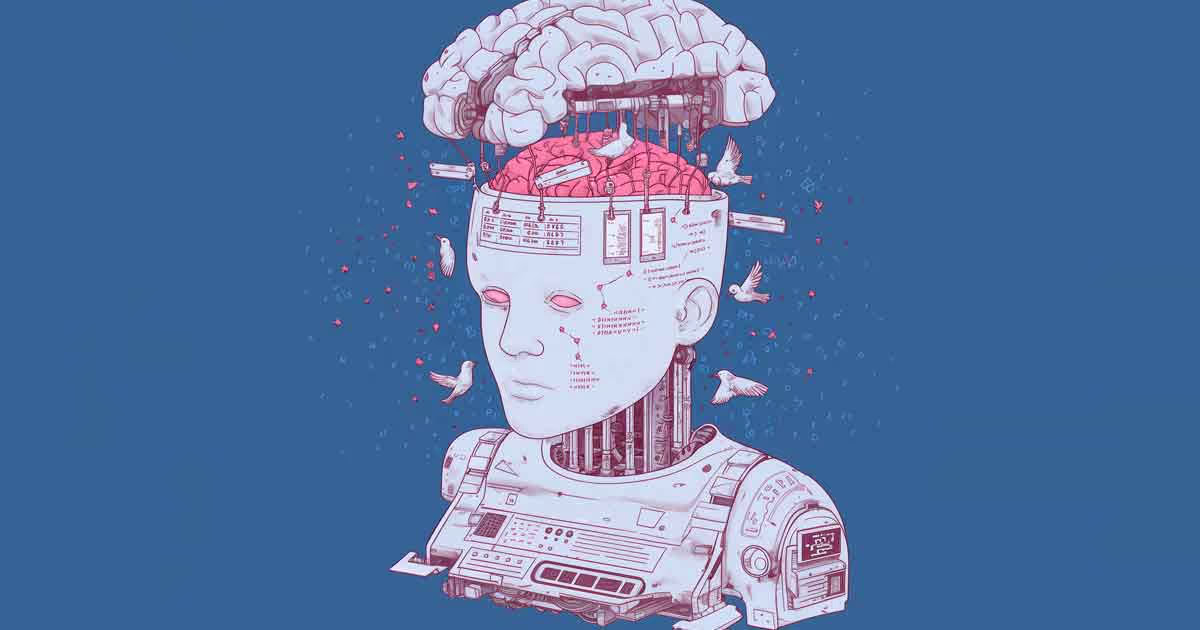

Forget the myth of the “lazy developer.” It’s a cheap, worn-out excuse. You’ve seen the scene play out a thousand times: a programmer, jacked up on coffee and flow, just finished a piece of software that runs like a Swiss watch. The digital gears are turning perfectly. The code is clean, tight, and elegant. Then some manager, oblivious to the high art that just occurred, strolls in and says, “Just bang out the user guide for it.”
A specific kind of cold dread hits the room. The air changes. That request is poison. It kills the momentum stone dead.
People have spent decades calling this laziness, saying they’d simply rather be at the keyboard programming. But it’s not a moral failing. It’s a deep, nasty clash of brain chemistry. We need to stop calling it a chore that’s put off and start looking at the actual cognitive walls that make the task feel like running uphill in cement shoes. We're talking about a multi-billion dollar waste pile built purely on bad documentation. If we want to fix the frustrated users and the overwhelmed support teams, we have to look past simple avoidance and dig into the actual structure of the developer’s mind.
From Logic Puzzle to Poetry
We thought code was just language, right? A specialized dialect, sure, but still part of the language machine in your head. That idea? It was wrong. Dead wrong.
Researchers at MIT, the ones with the brain scanners, watched what happened when programmers read code. They saw the language centers—the parts that light up when you're reading a book or arguing politics—stay dark. Instead, the brain screamed to life in the area responsible for high-level problem-solving, the “multiple demand network” (MIT News, 2022). That's the same circuit you use when you're wrestling with a Sudoku puzzle or trying to figure out how to stack boxes into a too-small truck. Programming is abstract geometry.
Writing, actual human writing, is something else entirely. It demands the language system.
So, when a developer is yanked from the clean, beautiful logic of their code to explain it to a human, they aren't just changing programs. They are forcibly rebooting their entire operating system. It’s like asking a bassoon player to solve a Rubik's Cube with their feet while still on stage. That jarring, immediate shift is the precise point where all the friction lives. The mental gear-grind is enormous. It's not a question of willingness; it's a matter of immense, immediate cognitive pain.
The Twenty-Three Minute Hole in the Day
Every developer knows that delicious, deep immersion—the state where time vanishes and the code flows out of your fingers like water. Flow state. It is precious. It is where all the real value is created.
Asking a developer to write a paragraph of documentation is like throwing a wet towel onto a roaring fire. It’s the end of everything good. It is the interruption. And the cost of that interruption is truly grotesque. Some smart folks at UC Irvine measured this. They found it takes a stunning 23 minutes and 15 seconds to mentally claw your way back to where you were before the interruption hit (University of California, Irvine, 2025).
Twenty-three minutes and change! When a developer pauses to write a user note, they don't lose five minutes; they lose almost half an hour of genuine, high-octane production. It's a tax on the mind, one that everyone sensible wants to cheat. This isn't just about "feeling good." It's about corporate waste. Context switching is the silent assassin of team momentum and the fastest route to developer burnout that money can buy.
The Fog of Expertise and Why They Write for Ghosts
Say the developer sucks it up and pays the cognitive tax. They sit down to write. Now they run straight into the second wall: the Curse of Knowledge. It’s simple: when you know something intimately, you can't remember what it's like to not know it. It’s why the genius physicist sometimes speaks total nonsense to an undergrad. They’ve spent ten thousand hours staring at the guts of the system, and they’ve forgotten that the beginner has only seen the shiny box. They can't un-see the knowledge they possess.
This gets worse with the Expert Blind Spot, which is the brain's habit of automating the steps. The whole process is so automatic to them that they can't even tell you the individual steps anymore. They just do it.
So, what happens to the documentation? It becomes a dumpster fire of insider terms, acronyms, and vague, high-level technical junk. It’s written, unintentionally, for other programmers. It is useless to the actual user, the person coming in cold, who just wants to click three buttons and go home. The developer isn't being cruel or mean-spirited. Their brain is simply incapable of truly seeing the work through the eyes of a total novice. It's an unrewarding, losing battle with their own intelligence.
Where Rewards Don’t Happen
We have to talk about what makes people move. Developers are drawn to building, to the high-stakes satisfaction of solving an impossible problem, to the pure, clean joy of making something work. That's intrinsic motivation.
But organizations are governed by a far coarser system: the reward structure. Who gets the applause? Who gets the raise? The builders. The ones who ship the big features, the ones who squash the worst bugs. The GitHub contribution graph, that visible pile of committed code, is a career machine.
Writing documentation? That's the organizational equivalent of scrubbing the toilets. Necessary. Everyone agrees it should be done. Nobody gets a standing ovation for it. There are no bonuses tied to "exceptionally clear user instructions." The culture whispers that coding is the work and documentation is the tidy-up. Developers are smart people, creatures of rational self-interest. They chase the signal. They gravitate toward the measured, the valued, and the celebrated tasks. When a company’s culture implicitly signals that coding is everything, and writing is just a tedious footnote, it’s no surprise which one gets prioritized. It’s an unrewarding chore that isn't "fun" (Fontanet Losquiño, 2014). The problem is a lack of organizational will, not a lack of individual drive.
Getting Off the Road to Nowhere
So, what do we do? We stop fighting the developer's brain. We get smarter tools. We hire an AI companion to sit next to them.
Think of a tool like Doc Holiday. Instead of demanding a massive, painful context switch, the AI sits right there in the code editor. It watches the code comments. It takes a handful of bullet points and instantly spits out a clean, readable user guide, connecting the expert knowledge to what a user actually needs.
This isn't about replacing the developer. It's about giving them a specific, powerful way to relieve the massive weight of this writing chore. It turns a brain-crushing task into a two-minute review. The pushback against writing documentation is not laziness; it's a siren screaming that we have designed a workflow that is fundamentally broken and hostile to human cognition. The future of software is not forcing your coders to become tired, resentful technical writers. It's building a world where their best work is the only thing they have to worry about.